A blog devoted to exploring wines made from unusual grape varieties and/or grown in unfamiliar regions all over the world. All wines are purchased by me from shops in the Boston metro area or directly from wineries that I have visited. If a reviewed bottle is a free sample, that fact is acknowledged prior to the bottle's review. I do not receive any compensation from any of the wineries, wine shops or companies that I mention on the blog.
Showing posts with label White Wine. Show all posts

Tuesday, May 21, 2013

The Wines of Vino Z Czech - Moravia, Czech Republic

A few months ago, I received an email from a guy named Noah who said he had stumbled across my site and had some wines that he thought I'd be interested to try.  He and his wife had recently started a wine importing company that was focused solely on wines from the Czech Republic and he was wondering if that might be something that would be up my alley. I had never had a wine from the Czech Republic before, so I told him I'd be delighted to give the wines a shot.  A few weeks ago, I wrote about the Welschriesling wines from their portfolio, but today I'd like to tell you a little bit about Vino z Czech and also a little bit about Czech Wine in general.

Noah Ullman worked for years in the eastern European branch of a major US software company.  He spent some time working the Czech Republic and would occasionally go out for a few drinks with his coworkers after a long day.  Most of the people would drink beer on these excursions, but Noah noticed that one of his Czech coworkers, Radim, always ordered wine.  The Czech Republic is generally known as a beer drinking and beer producing country, so Noah was intrigued by Radim's beverage choice.  When he asked him about it, Radim replied "I am from Moravia. We drink wine in Moravia."  Noah visited some Moravian wineries with Radim and fell in love with the wines there.  When he returned to the United States, he found that Czech wines were virtually impossible to find here, so he decided to change that.

Noah and his wife started Vino z Czech a year or so ago as a way to get Czech wines on US shelves.  Their model is a little bit different than most importers.  Radim is their exporter, and they consult with leading Czech sommeliers to try to find the top estate bottled wines in the country.  They work with a handful of producers, but as you will see below, all of the wines are bottled under the blanket Vino z Czech brand, and the specific producer is mentioned on the foil cap and the back label of each wine only.  The front labels pretty much give the name of the grape used (all of their bottlings are varietal wines right now) and have different paintings by Czech artist Alphonse Mucha, who you can read more about here.

I mentioned above that the Czech Republic is primarily associated with beer, but viticulture in the Moravian region can be traced back to the Romans around the second century AD. Recently, a Roman outpost was uncovered near the town of Pasohlávky that contained many viticultural artifacts, and it is thought by some historians that Grüner Veltliner and Welschriesling were probably introduced into the area during the Roman occupation.  Many of the French and German varieties (like Pinot Blanc and Riesling) were probably introduced into the area around the 13th Century as monasteries with monks from those countries settled into the region.  More vineyards were gradually planted over the next few centuries, but then the 30 Years War (1618-1648) wiped many of them out.  They were slowly replanted and the area received a major boost from the creation of a handful of wine academies during the late 19th and early 20th Centuries, but then Phylloxera first struck in the vineyards in 1890 and wreaked havoc on the area over the next 15 years.

During much of this time, the region was actually a part of the Austro-Hungarian Empire, but in 1918, the nation of Czechoslovakia (which contained the modern-day Czech Republic, Slovakia and a bit of land currently in Russia) declared its independence and became a sovereign state.  It was annexed by Germany in 1938 and was part of Nazi Germany until 1945.  Following World War II, Czechoslovakia became a communist state, which is generally not all that beneficial for a country's wine industry (as we saw when we took a look at the Pinela grape).  The Communist government in Czechoslovakia was overthrown in the Velvet Revolution of 1989 and the country peacefully split into the Czech Republic and the Slovak Republic (also known as Slovkia) in 1993. In 1995, the Czech Republic passed Wine Act No. 115/1995 in an attempt to establish wine laws that would bring the country's wine industry into line with the rest of the EU. The Czech Republic formally joined the EU in 2004 and passed Wine Act No. 321/2004, which brought their regulations into line with the rest of Europe.  The Czech Republic's classification system is more closely related to that of Germany and Austria, where ripeness level at harvest is the primary determinant for quality level classification.  There is also a geographical classification ranging from Region, to Sub-Region, to Village to Vineyard (for details on Czech wine law, you can read more here).

Map of Czech Republic with Moravia in red
Moravia is by far the most important wine making region in the Czech Republic, accounting for 96% of the total vineyard area of the country (there are some vines in Bohemia, towards the northwest of the country, but they are scattered and make up a minor part of the industry).  Most of the production is located around the River Dyje in Moravia, and there are four main sub-regions: Mikulovská, Znojemská, Velkopavlovická, and Slovaká (more information about these regions can be found here).  There really is no single dominant variety in the region, and most of the grapes grown have been brought in from other countries.  For white varieties, Müller-Thurgau leads the way with 11.2% of total plantings, followed by Grüner Veltliner with 11%, Welschriesling with 8.5%, Riesling with 7%, Pinot Blanc with 5%, Sauvignon Blanc with 5% and Chardonnay with 4% (among others).  For red vines, St. Laurent is the most widely planted grape with 9% of total plantings, followed by Blaufrankish at 5.6%, Zweigelt at 4.7%, Pinot Noir at 4% and Blauer Portugieser at 3.9%.  

Vino z Czech sent me eight total wines to sample, all of which were white.  I took a look at their two Welschriesling wines a few days ago, and interested readers can check those reviews out here.  The other six wines, made from the Riesling, Grüner Veltliner, Rivaner (Müller-Thurgau), Sauvignon Blanc and Pinot Blanc grapes, are reviewed below.  All of the wines were from the Moravia region of the Czech Republic, but I'm not sure about sub-regions or anything more specific.  These wines are available online here.  Again, these bottles were sent to me as samples for review and I was not compensated in any way for these reviews other than with the bottles themselves.

The first Vino z Czech wine that I tried was the 2011 Riesling from the Michlovsky vineyard.  This wine is available from their online retailer for $19.  In the glass the wine was a fairly light silvery lemon color.  The nose was moderately intense with aromas of peach, pear, lime peel, lemon, white flowers, honey and chalk.  On the palate the wine was on the lighter side of medium with high acidity.  It was dry with racy lemon-lime citrus, white peach, and honeysuckle flower with clean, stony minerals on the finish.  It was a bit tight and austere right out of the bottle, but with a little time and a little increase in temperature, the hard citrus fruits opened up into more stone fruit and honey.  It is drinking well right now, but it is definitely the kind of wine I'd like to be able to revisit in a few years, as I feel like it has the structure to stand up to a few years in the bottle.  Fans of Austrian Riesling will definitely find a lot to like here, though fans of softer, sweeter Rieslings may want to look elsewhere for their fix.

Next up was the 2011 Sauvignon Blanc, which was also from the Michlovsky vineyard.  Retail on this bottle is also $19 online.  In the glass the wine was a medium lemon gold color.  The nose was fairly intense with aromas of white grapefruit, grapefruit peel, cut grass, cat pee and green melon (in other words, it was a classic Sauvignon Blanc nose).  On the palate the wine was medium bodied with medium acidity.  There were flavors of white grapefruit, grapefruit peel, white pear, lemon, tart pineapple, cut grass, green bell pepper, chalk and clean river stones.  The palate was also full of classic Sauvignon Blanc flavors, but it was backed with a really nice minerality that I found in many of these wines.  This wine was much closer stylistically to French Sauvignon Blanc from Sancerre or other parts of the Loire Valley than to the leaner, grassier New Zealand or the big, fleshy California Sauvignon Blancs out there.  I thought it was an excellent wine and would have no problem shelling out $20 for it.

Next on the list was the 2011 Rivaner from Chateau Valtice ($16).  Rivaner is just another name for Müller-Thurgau which hearkens back to the days when it was thought to be the result of a crossing between Riesling and Sylvaner (it isn't, as we learned).  The term Rivaner still hangs around, though Müller-Thurgau is really the most accurate name.  In the glass, the wine was a medium silvery lemon color.  The nose was fairly light and subtle with aromas of pear, golden apple, grapefruit and white peach.  On the palate the wine was medium bodied with fairly high acidity.  It was maybe just a touch off-dry with flavors of white peach, pink grapefruit, pear, golden apple and honeysuckle flower.  It was a mild, delicate, subtle wine that did resemble Riesling to some extent, but with the volume turned down.  My primary concern with this wine is that it is bottled with a synthetic (plastic) cork, so if you decide to try a bottle, get the newest vintage you can and drink it as soon as possible.  I have found that wines under this type of closure go downhill much faster than those under screwcap or traditional cork.

The 2011 Grüner Veltliner from Michlovsky was next out of the box, and it retails for about $16 online.  In the glass the wine was a medium silvery lemon color.  The nose was fairly intense with aromas of lemon, white peach, braised celery, grass and grapefruit.  On the palate the wine was on the lighter side of medium with fairly high acidity.  There were flavors of white pear, lemon peel, grapefruit, braised celery, cracked white pepper and a mild, stony mineral finish.  If you inserted this wine into a blind tasting of Austrian Grüners, I think you'd probably have a tough time singling it out.  Grüner can make a big, powerful wine, but it can also make something a little more delicate, and this wine definitely falls into that latter category.  There were really nice savory notes that would help this wine complement a variety of vegetable dishes, especially those with bell peppers or summer squash.  It's not something that I would try to cellar, though, so drink it early and drink it often.

Vino z Czech offers two wines made from the Pinot Blanc grape from two different producers.  The first one I tried was their 2009 offering from the Vyskocil vineyard ($22).  It can be difficult to tell some of these wines apart just from their front labels, and for the two Pinot Blancs, I had to use the alcohol content on the front to differentiate the two (this one was 13.5% while the other was 13%).  In the glass, the wine was a medium lemon gold color.  The nose was moderately intense with aromas of apricot, coconut, pineapple and green melon with a touch of butter and vanilla (there is some oak going on here).  On the palate the wine was on the fuller side of medium with fairly high acidity.  There were flavors of lime, white peach, toasted coconut, and green melon with a steely mineral backbone.  I am a big fan of Pinot Blanc and think it is one of the more underrated grape varieties out there, and this is a really nice example.  It's very well balanced across the board and was really a pleasure to drink.  A little bottle age probably wouldn't hurt it, but I wouldn't get too crazy with it.

Last but certainly not least is the 2009 Pinot Blanc from the Spielberg vineyard, which is Vino z Czech's top offering and costs about $38 a bottle.  In the glass the wine was a fairly deep lemon gold color.  The nose was fairly intense with aromas of brioche, baked apple, pineapple, butter, cheese, coconut and vanilla.  On the palate the wine was full bodied with fairly high acidity.  There were flavors of creamy golden apple, pear, toasty brioche, pineapple, toasted coconut, butter, lemon curd and vanilla.  This wine also saw some time in oak, but again, I thought it carried it very well and the overall result was a lovely, balanced wine.  As a personal preference, I'm not a big fan of oak in my white wines at all, so I found that I preferred the Vyskocil Pinot Blanc, but those who are more tolerant and/or enthusiastic about oaked white wines would be better served with this wine.  It's not a style I typically enjoy, but I do recognize that it is a very good wine for those who like that kind of thing.

Overall, I was very impressed with the wines of Vino z Czech.  Their offerings retained much of the classic characteristics of the grapes they are working with, but they also have a really lovely minerality that makes them distinctive and gives them a sense of place.  I will confess that I was not optimistic when Noah first contacted me about trying his wines, but all of them were really lovely.  They are just starting to bring some red wines that I hope to be able to try as well, and I will certainly write about them if I get a chance to try them.  In the meantime, check out their site, try some Czech wines and na zdraví (to your health)!

Thursday, May 2, 2013

Welschriesling/Olaszrizling/Graševina - Burgenland, Austria; Moravia, Czech Republic & Villány, Hungary

Welschriesling is a hard grape to get a handle on.  It goes by many different names in many different central European countries and though many of those names might lead you to believe it has certain relationships with other grapes, it actually doesn't.  Today I'd like to try and sift through what we do and don't know about this grape before getting to a few different wines I've recently tried from it.

The first thing one must do when dealing with this particular grape is to sort through the various synonyms it is planted under.  These synonyms fall into three broad categories:

1) The Welschriesling group.  This group consists of the names Welschriesling (as it is known in Austria, Canada, parts of Germany and Switzerland), Wälschriesling (Germany), Laški Rizling (Slovenia, Croatia and parts of Serbia), Rizling Vlašský (Slovakia), or Ryzlink Vlašský (Czech Republic).  In this group, Welsch, Wälsch, Laški and Vlašský all come from the same root word, but it isn't totally clear what that root word might be.  The most likely explanation is that they come from the German word welsch which means "foreigner," and that the name of the grape therefore means something like "foreign Riesling," meaning that it probably came into Germany or Austria from abroad.  Why and how the grape came to be identified with Riesling is unclear since Welschriesling bears no genetic, ampelographic or vinous relationship or similarity to Riesling.  It has also been suggested that the Welsch- prefix means "from Wallachia," which is a wine-making region in Romania.  This would be a possibility except for one thing...

2) In Romania, the grape is known as Italian Riesling, and variations on this name are found in a handful of other countries as well.  In northeastern Italy, it is known as Riesling Italico and the Hungarian name Olaszrizling simply translates as "Italian Riesling."  The grape was introduced into Italy in the 19th Century, but it has been grown elsewhere for longer than that.  Since it is known as Italian Riesling in Romania, it seems reasonable to assume that the grape came into Romania from Italy, which would have had to have happened in the 19th Century or later.  Given that the grape was known as Welschriesling before this time, it seems unlikely that the grape originated in Wallachia in Romania.

3) In Croatia, the grape is known as Graševina, or sometimes Graševina Bijela.  I don't read or speak Croatian, but when I enter the word Graševina into Google translate, it is translated into the word "Riesling," which is really interesting (Bijela just means "white").  If Graševina translates as Riesling, then it would make sense for Germans to refer to it as "foreign Riesling" to differentiate it from their Riesling.  Furthermore, Graševina is the most widely planted grape in Croatia, with over 21,000 acres devoted to the grape as of 2009.  Wine Grapes concludes from all of this that Welschriesling likely originated from Croatia, and the evidence seems fairly convincing to me.

Welschriesling is shockingly widely planted throughout central Europe, but wines made from it are still difficult to find in the US.  As mentioned above, it is Croatia's most widely planted grape, but it is also the most widely planted white grape of Hungary as well, accounting for just over 12,000 acres in 2008.  It is the second most widely planted grape in Austria (behind Grüner Veltliner) with nearly 9,000 acres under vine, which is almost twice the amount of regular Riesling grown in that country.  There are over 17,000 acres planted to the grape in Romania, 7,700 acres in Slovakia, 6,000 acres in Slovenia, 5,000 acres in Italy, and 3,000 acres in the Czech Republic.  Somewhat surprsingly, a grape called Borba in Spain is genetically identical to Welschriesling, but there is only about 20 acres planted there.

Welschriesling is made into a wide range of styles, but the two most common are dry table wines and late harvest/botrytized sweet wines.  I was able to try a variety of wines made from the grape from several different areas and in different styles. The first wine was the 2011 Gere Attila Pincészete Olaszrizling from the Villány region of Hungary (area 15 in red on this map).  I picked this wine up from my friends at Blue Danube Wine for around $13.  In the glass the wine was a fairly pale silvery lemon color.  The nose was fairly intense with aromas of apricot, pink grapefruit, pear and orange peel.  On the palate the wine was medium bodied with medium acidity.  There were flavors of lemon peel, lemon water and pear.  It was mild, delicate and subtle, but finished with a really strong, clean mineral note.  It was light and fresh and just the kind of thing that I would reach for on a screaming hot summer's day.  It's not going to blow your mind, but it does have its subtle charms.


I have recently met the acquaintance the man and wife importing team at Vino z Czech, which is one of the few (and possibly only) importing companies in the US bringing wines from the Czech Republic here.  They sent me all of the white wines in their portfolio (as free samples, in the interest of full disclosure), and I will be writing about those wines, as well as writing more about their company and Czech wine in general, very soon.  Two of the wines they sent me, though, were made from Welschriesling grown in the region of Moravia in the southeastern part of the Czech Republic.  The first wine was the 2011 Spielberg Welschriesling, which can be purchased for around $20 a bottle here.  In the glass, the wine was a medium lemon gold color.  The nose was moderately intense with aromas of white pear, golden apple, chalk and a touch of white flowers.  On the palate the wine was on the lighter side of medium with fairly high acidity.  There were flavors of lemon, green apple, pear and a touch of lees.  It finished with a strong steely, chalky minerality.  Right out of the bottle, the wine was lean, sharp and bright, but as it opens up, the flavor profile shifts from the sharp lemon to more of the soft white fruits.  It stays light and crisp the whole time, though, and is very nice.

The second Vino z Czech Welschriesling was the 2011 Galant, also from Moravia, which retails for around $27 per bottle (about $24 with the case discount through their online retailer). You do have to really read the back labels with these wines since all of them look very similar to one another.  Vino z Czech is a kind of umbrella brand that these guys are using, but all of the wines that they put out are from individual producers.  Spielberg and Galant are two of the producers that they are working with, and the producer information is usually found on the foil cap and the back labels of these wines.  In the glass, this wine was a medium lemon gold color.  The nose was fairly intense with aromas of white pear, orange peel, pineapple, Meyer lemon and cantaloupe.  On the palate the wine was medium bodied with fairly high acidity.  It was dry with flavors of white pear, lemon water, golden apple and river stones.  Like the Hungarian wine above, this wine was subtle and delicate.  My tasting note calls it "a light, lean wine with quiet citrus and white fruit wrapped around a clean, subtle mineral core."  It wasn't as sharp and austere as its fellow countryman, but was still bright and zippy.  It is just a lovely little wine that's shy and a little flirty at the same time.


The final wine that I tried was the 2006 Kracher Beerenauslese from the Burgenland region of Austria.  This wine is made from 70% Welschriesling and 30% Chardonnay grapes that have been botrytized, and it cost about $25 for a half bottle (from my friends at the Spirited Gourmet). In the glasss the wine was a medium bronze gold color.  The nose was intensely aromatic with beautiful aromas of honey, orange marmalade, pineapple, grapefruit, and mango.  On the palate the wine was on the fuller side of medium with fairly high acidity.  It was very sweet with flavors of honey, candied pineapple, grapefruit curd, and orange marmalade.  It had a curious bitter citrus pith kind of finish that was a bit unpleasant and unwelcome.  It's a very good wine, but it really wasn't anything exceptionally exciting, though it is a decent value.  Welschriesling isn't much of a blockbuster grape and I found that I enjoyed its subtle delicacy more in dry table wine form than in this more concentrated style.  It felt a little bit like if the cute librarian you had a crush on showed up one day in a leather mini skirt and a tube top.  She's still a lovely woman, but she doesn't strike your fancy in quite the same way.

Friday, April 26, 2013

Pinela - Vipavska Dolina, Slovenia

Image from Blue Danube Wine's website
It has been a few weeks since my last post and a lot has changed in that time.  Regular readers are probably aware that I live and work in the Boston area, and anyone who has been near a television in the past week or so is surely aware of what happened between the marathon on Monday and the manhunt on Friday of last week.  I was very fortunate to have been only indirectly affected by the bombing and its aftermath, but it was a very disruptive event in the lives of everyone in and around the city of Boston.  Life is getting closer to normal every day, though, and part of that return process is getting back to the things we love to do.  Tasting and writing about unusual wines is probably not all that important on a cosmic scale, but it is important in my own life and I hope it means at least a little to those who read regularly or sporadically.  In that spirit, it's time to get back to the weird grapes by taking a little trip to Slovenia to try the Pinela grape.

Though today's wine is from Slovenia, it is thought that Pinela (under the name Pinella) is originally from Italy.  It is first mentioned all the way back in 1324 in the Catalogo delle varietà delle vitis del Regno Veneto, where it was said to be used in the wines of Udine, Friuli.  It should be mentioned, though, that some sources (here and here) indicate that Pinela is actually indigenous to Slovenia, and, further, that there hasn't been any DNA analysis done to see whether the Pinella of Friuli and the Pinela of Slovenia are actually the same grape.  It seems reasonable to assume that the two are the same, since the region of Friuli borders Slovenia and many of the Slovenian regions where Pinela can be found.  Both Wine Grapes and the VIVC list the two grapes as synonyms, and that's good enough for me right now.  Whatever the case may be, Italy claimed 72 hectares of Pinella in their 2000 agricultural census, while Slovenia claimed 50 hectares of Pinela (or sometimes Pinjela) in their 2009 census.  The grape does not appear to be grown anywhere else in the world.

Slovenian wines are somewhat difficult to find on American shelves, but they've been growing vines and making wines in Slovenia for a very long time.  The Celts and Illyrians were making wine in the area known as modern-day Slovenia long before the Romans began introducing viticulture into the areas where France and Germany are now found.  Slovenia's history is turbulent, as the area has been conquered and occupied by a number of different European powers throughout its history.  It was a part of the Austro-Hungarian Empire until World War I, when the new State of Slovenes, Croats and Serbs broke away and formed their own country.  In 1928, this state merged with Serbia and in 1929, the country was renamed the Kingdom of Yugoslavia.  Yugoslavia was invaded by the Axis powers in 1941 and control was divided between Germany, Italy and Hungary until 1945, when the Axis powers were defeated by the Allies.

After World War II, Yugoslavia became a communist state.  Though not as restrictive as many of the other eastern-bloc communist governments, being a communist state had detrimental effects on the development of the wine industry.  Josip Broz Tito was the leader of communist Yugoslavia until his death in 1980, at which point the political and economic climate of the region began to become less stable.  In 1987, a group of Slovene intellectuals publicly began to call for Slovenia's independence from Yugoslavia and a movement towards democratization began in earnest.  Several democratic amendments were passed in 1989, and in 1990, the Slovenian assembly changed the name of their region to the Republic of Slovenia.  Later that year, 88% of the Slovenian electorate voted for a sovereign and independent Slovenia and the country became independent officially on June 25, 1991.  The Yugoslav People's Army sent troops into the region on June 27 of that year and on July 7, a treaty was signed that ceased hostilities in the region.  A new constitution was adopted in December of 1991 and the EU recognized Slovenia as an independent state in January of 1992, with the United Nations following suit in May of that year.

**UPDATE** An anonymous commenter has informed me that my understanding of post WWII, cold war era politics is a bit mistaken in the paragraph below.  He/she says the following: "Just one note: Yugoslavia (including Slovenia), was not behind the iron-curtain. Yes, it was communist, but not part of the USSR controlled Warsaw-pact... What it meant in practice, was that free travel of people and goods was permitted and as such your statement incorrect that their position was like Romania, Hungary or Georgia. The first two were separate states behind the Iron Curtain, the latter was actually part of the USSR.
Your conclusions, that viticulture was falling behind modern standards remain correct. But the USSR had little to do with that. That was just the result of collective farming in a centrally governed market."  I want to thank that commenter and I offer his/her gloss here in the main text in the hopes that it will help other readers.  I'm not really sure how to fix my erroneous paragraph below, so I'm going to leave it as is so that the commenter's gloss makes sense in context.**

As we've seen with Romania and Georgia, spending time behind the Iron Curtain throughout the latter half of the 20th Century means that you were essentially isolated from the western World.  There was not a lot of movement of ideas or commerce between communist and democratic nations.  The former Soviet bloc countries have had to make up a lot of ground in a very small amount of time in order to carve out a presence in Western markets.  The former Yugoslav republics and countries like Hungary have had a little bit better time of it because they are geographically closer to western Europe, making tourism easier, and because they were never as dependent on the USSR and post-Soviet Russia as countries like Georgia were.  The degree of success that a given country has had following the end of the Cold War is, perhaps unsurprisingly, related to how well the country was functioning throughout the 20th Century, and while all of the former communist dictator states have had to play a bit of catch-up, some, like Slovenia, were better prepared and in a better position than others to do so relatively quickly.

All of which brings us back to Slovenian wine in general.  Slovenia is just south of Austria, just east of Friuli in Italy, just north of Croatia and just west of Hungary.  There are three major wine regions in Slovenia.  Primorje is located in the western part of the country, just over the border from Italy, and this is where most of the wines that we see on US shelves come from.  Brda is perhaps the most well known region within Primorje, but there is also Collio Goriziana (which is partly in Slovenia but which can be bottled as an Italian DOC), Koper and the Vipava Valley, where today's wine hails from.  The other two major wine regions of Slovenia are located on the other side of the country with Podravje in the northeastern corner and Posavje in the southeast.  Podravje (Drava Valley) is the largest of the three major regions of Slovenia and is known primarily for the production of white and sparkling wines.  Posavje (Sava Valley) is the only major region to produce more red than white wine (as a nation, Slovenia's output is about 75% white), but much of the production here is of the bulk variety.

I was able to get my hands on a bottle of the 2008 Batič Pinela (100%) from the Vipavska Dolina region of Slovenia (map here).  I bought the wine from the always excellent Blue Danube Wine Company for around $29.  The first bottle that I ordered was corked, but Blue Danube quickly sent me a replacement.   Pinela is a white grape, but this wine is made in an orange wine style, as the grapes are crushed and left to macerate on the skins for five days without any temperature control.  Natural yeast fermentation is followed by 24 months of aging in old Slovenian oak barrels.  The wine is bottled unfined, unfiltered (usually) and with minimal SO2 additions in the funky vessel seen at right.  In the glass the wine was a medium golden bronze color.  The nose was fairly intense with aromas of dried apple, cider, pear, dried leaves, hay, autumn spice and bergamot.  On the palate the wine was on the fuller side of medium with fairly high acidity.  There were flavors of dried leaves, dried apple, autumn spice, hay, orange peel and toasted nuts.  It clocks in at 14.5% alcohol and does wear it a little clumsily, but overall it was an absolutely wonderful wine.  It's warm and spicy with a great autumn vibe that would be deliciously appropriate at Thanksgiving, but which I'd be happy to enjoy any time.  It is best served no colder than cellar temp and in the company of valued family and friends.

Friday, April 12, 2013

Cayuga White - New Hampshire and Finger Lakes, New York, USA

One of the things that I really love about digging into some of these unusual grapes is learning how many of them are related to one another.  For instance, I knew today's grape, Cayuga White, was a hybrid, but I didn't know anything about its parents or grandparents.  I learned that it is the offspring of a Seyval Blanc x Schuyler crossing, which is kind of cool because I'm a little familiar with Seyval, but I didn't know anything about Schuyler.  It turns out that Schuyler is itself a crossing of Zinfandel and another hybrid grape known as Ontario (which is a crossing of Winchell and Moore's Diamond).  Which means that Cayuga is the offspring of Seyval Blanc, the grandchild of Zinfandel and the great-grandchild of Moore's Diamond, three very different grapes!

As with human beings, one can get into trouble expecting family members to closely resemble one another.  Cayuga bears virtually no resemblance to Zinfandel, and though it can occasionally pick up some foxiness if allowed to over-ripen, it doesn't bear much resemblance to Moore's Diamond either.  Interestingly, the two grapes that Cayuga is most often compared to are Riesling and Muscat, neither of which figure into its family history.  Like Riesling and Muscat, Cayuga is often made into an off-dry or medium sweet wine, though it also makes interesting sparkling wines if harvested early enough.  It is most heavily planted in New York state, where it covers just over 400 acres, but can also be found in the American Midwest and to a more limited extent in the northeastern US and southeastern Canada.

Cayuga was created in 1946 at the New York State Agricultural Experiment Station in Geneva, New York, by John Einset and Willard B. Robinson.  It was selected from other seedlings in 1952 and was finally released in 1972 as "the first of a Finger Lakes series of wine grapes for New York." Cayuga was successful because it buds late and ripens early, which cuts off the extreme ends of the growing season.  It is a heavily productive and vigorous vine that benefits from a discouraging hand in the vineyard.  In fact, in 1964, a "25 variety trial" was undertaken to test the "most commercially promising American and French hybrid varieties and six new Geneva selections."  The 25 selected vines were planted on three different sites in New York and various statistics were gathered about them over a period of several years.  One of the statistics was total yield and Cayuga outperformed all of the other grapes in the trial in that category.  It has decent disease and fungal resistance, but only moderate cold-hardiness, which has prevented it from becoming more popular with growers.

I was able to try two different wines from the Cayuga White grape.  The first was a NV wine from Jewell Towne Vineyards in New Hampshire.  Jewell Towne is the oldest winery in New Hampshire, though they only opened in 1994.  The owner, Peter Oldak, has been growing grapes on the property since 1982, when he planted six vines on a hobbyist lark.  By 1990, he was growing over 60 different varieties and decided to teach himself how to make wine.  He made a few vintages for other wineries but decided to open his own winery in 1994.  His debut vintage was only 40 cases which sold out in three weeks.  Today, Jewell Towne produces over 7000 cases per year and is really the first name in New Hampshire wine today.  I picked this wine up at a state store in Nashua for around $12. In the glass the wine was a very pale silvery lemon color that was almost water-white.  The nose was moderately intense with aromas of peach, grapefruit, pineapple, pear and cheese.  On the palate the wine was light bodied with medium acidity.  It was medium sweet with flavors of mandarin orange, pineapple candy, pear, white peach and golden apple.  It finished short and with a bit of bitterness.  It was a fairly nice wine for the money, but wasn't anything too memorable.

The second wine that I tried was the 2011 Ravines "Keuka Village," which is 80% Cayuga and 20% Vignoles.  Ravines is located on Keuka Lake in the Finger Lakes, but I picked this up locally at the Spirited Gourmet for around $13.  In the glass the wine was a deep gold color.  The nose was moderately intense with aromas of honey, green apple, pear, apricot and orange marmalade.  On the palate, the wine was on the fuller side of medium with high acidity.  It was off-dry with flavors of green apple, lime, honeysuckle flower, orange peel, white grapefruit and pineapple.  It was bright, tart and zippy, which surprised me a little because the nose really smelled sweet and I thought this was going to be a syrupy mess.  It was nice and citrusy, though, and I could definitely see why someone might want to compare this wine to a kabinett level Riesling.  It was nicely aromatic and fairly well balanced, which is a pretty nice combination in a sine under $15.


Friday, April 5, 2013

Know Your Lambrusco - Salamino, Emilia-Romagna, Italy

Last week, I started a new series called Know Your Malvasia where I take a look at different Malvasia-named grapes and explain where they're grown and how they do or do not relate to other Malvasia grapes.  Today I'd like to expand that concept a little and start to talk about the various Lambrusco-named grapes.  There is a lot of bad information out there about Lambrusco grapes and over the next few weeks, I'd like to try to set as much of it right as I can, starting with the Salamino grape today.

The two most common bits of misinformation regarding the Lambrusco grapes are pretty much the same as for the Malvasias.  Some people will tell you about the Lambrusco "family" of grapes, while others will tell you that the various Lambruscos are made from "sub-types" or "sub-varieties" of a single Lambrusco cultivar.  The people that tell you this are wrong.  A study done in 2005 (citation 1 below) analyzed most of the Lambrusco-something cultivars grown throughout Emilia-Romagna and while they found first degree (parent/offspring) relationships between a few of the grapes in the study, pretty much none of the major of Lambrusco cultivars were found to be that closely related to one another.  Which isn't to say that they aren't related at all.  When the team analyzed genetic similarities for all of the grapes in the study, they did find that most of the Lambrusco grapes clustered together, indicating that they probably share a common ancestor at some point along the line, but how distant that relative might be is difficult to say. 

As we learned in my last Know Your Malvasia post, there really is no such thing as "sub-varieties" of grapes.  But one might wonder, if there isn't any direct familial relationship and if they aren't "sub-varieties," then why do they all have the same word in their name?  The word "Lambrusco" means "wild grape" in Italian, and it was long thought that the Lambrusco grapes were domesticated from wild vines around Emilia-Romagna.  A study done in 2009 (citation 2 below) analyzed many wild grape varieties in Piemonte and compared their DNA with several Lambrusco varieties as well as several other cultivated grape varieties of the region.  They found that the Lambrusco grapes had more DNA in common with the wild grapes than the other cultivated varieties, indicating that they were more closely related to the wild vines and may have been domesticated more recently.

It's worth noting that here in the United States, when we think "wild vines" we think of Vitis labrusca or some of the other "foxy," native American varieties.  In Europe, the situation is a little bit different.  Wild vines in Europe are still Vitis vinifera, but there is actually a sub-species of the vinifera species called sylvestris.  Please note, this is a sub-species, not a "sub-type" or "sub-variety."  Vitis vinifera subsp. sylvestris is differentiated from Vitis vinifera subsp. vinifera mainly by the fact that vinifera flowers are hermaphrodites, meaning that they have both male and female organs and so can pollinate themselves, while sylvestris flowers are dioecious, which means that some flowers are male and produce pollen while others are female and need to receive pollen from males in order to produce fruit (unpollenated flowers just fall off a vine and die, while pollinated flowers produce berries). One can easily understand why hermaphroditism was selected for by early farmers, since the ability to self-pollinate produces a more reliable and a larger crop.  Interestingly, there are a handful of Vitis vinifera subsp. vinifera vines that are not self-pollinating, but which are not necessarily dioecious.  Lambrusco Sorbara, for example, only has female flowers, so it must receive its pollen from other vines.  As a result, Sorbara is often inter-planted with Lambrusco Salamino so that the Salamino pollen can pollinate the Sorbara flowers. 

What all this means is that though many of the Lambrusco grapes may be distantly related to one another, they're not exactly a "family."   Furthermore, they are all separate grape varieties and are not "sub-types" of any single Lambrusco grape.  So how do you know which Lambrusco grape you're drinking?  Like Malvasia, it often depends on where you are.  Some of the Lambrusco grapes are easy to spot, since their names are typically printed right on the label.  Lambrusco di Sorbara is made from the Sorbara grape, while Lambrusco Grasparossa di Castelvetto is made from the Grasparossa grape.  Lambrusco Salamino can be found in the Lambrusco Salamino di Santa Croce DOC wines, but can also be found in basic Reggiano DOC wines as well as the wines of Lambrusco Mantovano and the Colli di Scandiano e di Canossa.  You can always check the DOC regulations for the region of wine that you're drinking, but if there are many different varieties authorized for use or if your wine is labeled as IGT, then you may just have to live with the mystery.

Lambrusco Salamino is the most common of the Lambrusco varieties and is planted on over 10,000 acres of land (mostly in Emilia-Romagna, though a little bit is surprisingly found in Sardinia).  The name "Salamino" comes from the fact that the grape bunches are long and cylindrical and thus thought to resemble little sausages, or "little salamis."  There are at least five different clonal variants of Salamino that are recognized by ampleographers: tender, red-leaved, green-leaved, red-stalked, and green-stalked.  Salamino grapes are naturally very high in sugar and so they lend themselves to the production of sweet and off-dry wines, though bone-dry wines made from the grape are also widely available. The berries are deeply colored and can provide quite a bit of tannic grip to the finished wine, and Salamino-based Lambruscos are typically heavier-bodied and more aromatic than those from other Lambrusco grapes.

For those who might object that Lambrusco is far too common for me to write about here, I would counter by saying that the first of the three Salamino-based wines that I'll be reviewing is actually a Lambrusco Bianco, which is made from 100% Salamino grapes that were crushed and rapidly moved off the skins before picking up any coloring, as in a Blanc de Noirs Champagne.  The wine was the NV Lini 910, which I picked up from my friends at Curtis Liquors for around $16.  In the glass the wine was a fairly pale silvery lemon color with nice frothy bubbles.  The nose was fairly intense with aromas of toasty bread, apple, green apple candy, toasted nuts and a touch of raspberry.  On the palate the wine was medium bodied with high acidity.  There were flavors of toasted nuts, toasted bread, ripe apple, pear, fresh cut lemon and lemon peel.  The fruits were a bit subdued, but there was a lot of secondary fermentation aromas and characteristics that were quite nice indeed (which is interesting, since this is a tank-fermented wine).  I found the wine both interesting and delicious and thought that it was a really great value for the money.

I also had the opportunity to taste Lini 910's regular Lambrusco bottling ($17), which their website says is 85% Salamino and 15% Ancelotta, which is a common Lambrusco blending grape that tends to soften the tannic edges of other grapes and round out the flavor profile a bit. In the glass this wine was a fairly deep purple ruby color with lots of fizz.  The nose was fairly intense with aromas of blackberry and black cherry fruit along with grape soda and leather.  On the palate the wine was medium bodied with fairly high acidity.  It was dry with flavors of black cherry, blackberry, cola, grape soda and a touch of smoky charcoal.  It was very fresh and very fruity, but also dry and very refreshing.  This wine is also tank-fermented, and I definitely think it helped to accentuate the fresh fruit flavors.  I had this wine with an Italian cold-cut calzone, and it was absolutely perfect, cutting through the oily meats while also standing up to and complementing the tomato sauce I was dipping into.

A few months ago, I wrote about a wine being imported by my friend Matt, who is a co-owner of the Wine Bottega in the North End of Boston, and his new company Selectio Naturel.  Matt brings in wines from all over Italy (and some from France too), and he has a handful of really killer Lambruscos in his portfolio.  One of them is the 2010 Fondo Bozzole "Giano," which is made from 100% Salamino grapes ($18 at the Bottega).  In the glass this wine was a deep, inky ruby-black color with bright purple fizz.  The nose was moderately intense with aromas of grape soda, black-berried fruits, dark chocolate, cocoa and char.  On the palate the wine was medium bodied with fairly high acidity.  It was dry, but absolutely loaded with blackberry and black cherry fruits and dry grape soda flavors as well.  There was a savory edge to the wine as well and I thoroughly enjoyed it with some ground-turkey lasagna.  It is versatile enough to pair nicely with a variety of foods, but is also delicious enough to just drink on its own. 

CITATIONS

1)  Boccacci, P, Marinoni, DT, Gambino, G, Botta, R, & Schneider, A.  2005.  Genetic characterization of endangered grape cultivars of Reggio Emilia province.  American Journal of Enology and Vititculture, 56(4), ppl. 411-416.

2)  Schneider, A, Marinoni, DT, Raimondi, S, Boccacci, P, Gambino, G.  2009.  Molecular characterization of wild grape populations from north-western Italy and their genetic relationship with cultivated varieties.  Acta Horticulturae, 827, pp. 211-216.

Tuesday, April 2, 2013

Carricante - Mt. Etna, Sicily, Italy

Given that there are several thousand different grape varieties used for commercial wine production, I'm sure that everybody has a few that they are always getting confused.  I know that I personally have a lot of trouble keeping all of the Italian Ver-word grapes straight (Vermentino, Verdicchio, Vernaccia, Verduzzo and probably many more).  I also find myself struggling with Vespaiola and Vespolina, Albarola and Albanello, and today's grape, Carricante, and Catarratto.  Carricante and Catarratto are especially troublesome for me because both are white grapes that are found almost exclusively on the island of Sicily, though Catarratto is much more common than Carricante (Catarratto covers more than 100,000 acres in Sicily while Carricante manages a scant 250 or so).  I'm apparently not the only person with this problem, as Carricante is often erroneously called Catarratto in some parts of Sicily, though the grapes are definitely different cultivars and are not even related.  There's not a lot of things to say about Carricante, but I've summarized what I've found below and also have a review of a wine made mostly from Carricante with a little Catarratto thrown in for good measure.

Catarratto tends to be found on the western end of Sicily, in the heart of traditional Marsala country, while Carricante tends to be found around Mt. Etna in the east.  Carricante is thought to be native to the area of Viagrande, which is just southeast of Mt. Etna, and early written records indicate that Etna vintners used to barrel-age Carricante wines on their lees so that malolactic fermentation would kick in and soften the wines sharp acidic edge.  The name Carricante may be derived from the word carica, which means "load," because the grape is apparently a fairly prolific yielder.  If that is the case, then it seems odd that there isn't more Carricante planted, as wines made from the grape are increasingly recognized for their quality.  A paper published in 2010 (citation 1 below) found that Carricante's parents were two grapes called Montonico Pinto and Scacco, neither of which are familiar to me.  The Etna Bianco DOC requires that wines be made from at least 60% Carricante, though Etna Bianco Superiore requires 80% (and the grapes must come from Milo). Though I've never seen a wine made from Carricante outside of Sicily, the Italian agricultural census of 2000 reported 650 acres of Carricante throughout Italy, though only 250 of them are in Sicily.  I do now know where they are hiding the other 400 acres or so and would be interested in hearing from any readers who have come across this grape on the Italian mainland. 

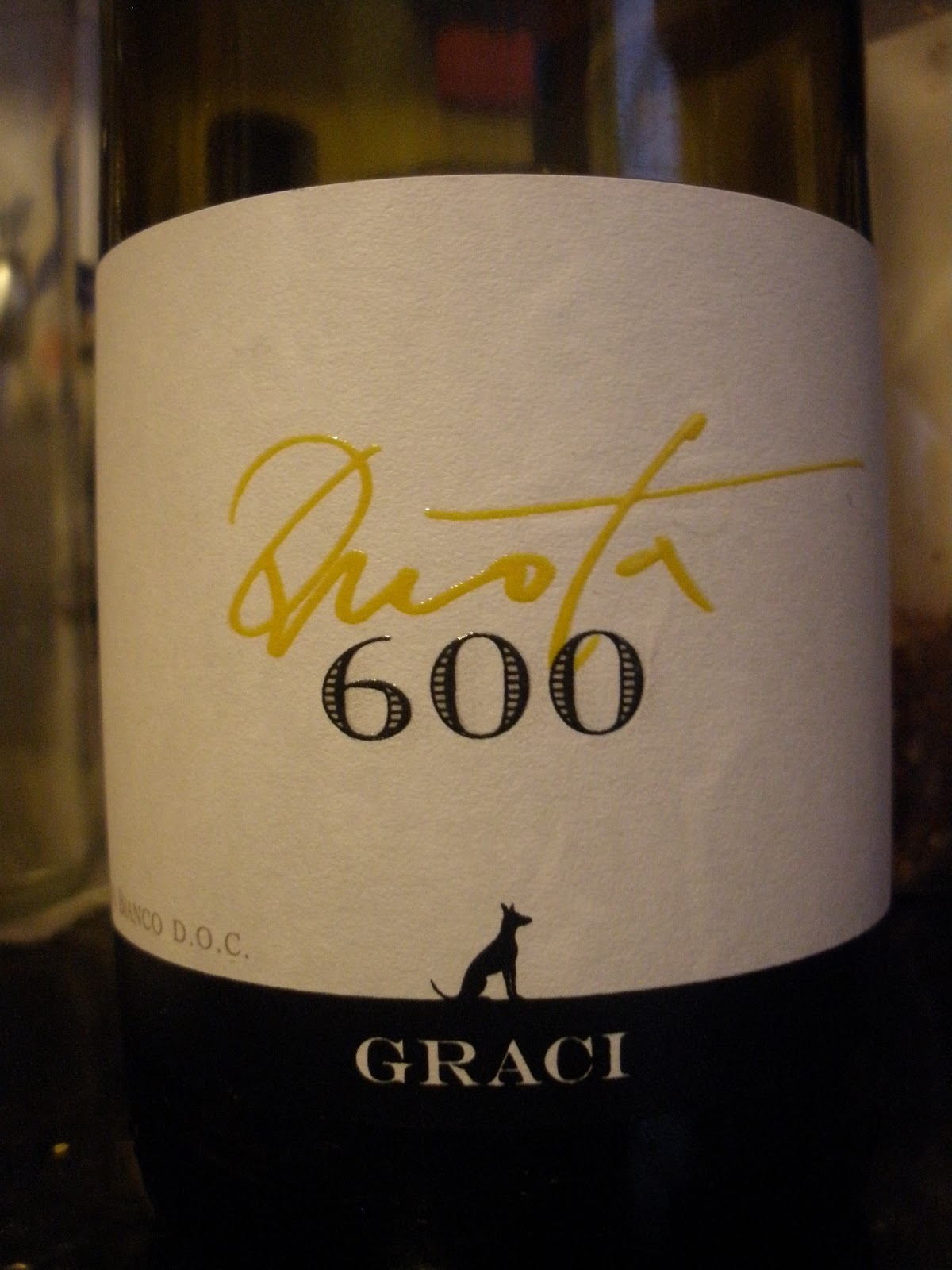
I was able to find a bottle of the 2009 Graci "Quota 600" from Mt. Etna in Sicily, which is a blend of 70% Carricante and 30% Catarratto.  Carricante is typically blended with other Sicilian grapes, though varietal wines can be found as well.  I picked this wine up from my friends at the Wine Bottega for around $35.  In the glass the wine was a fairly light lemon gold color.  The nose was moderately intense with aromas of fresh cut lemon, green apple and river stones.  On the palate the wine was medium bodied with fairly high acidity.  There were tart, racy flavors of lemon and lemon peel, green apple, pear and a really intense stony minerality.  There wasn't a lot of complexity to this wine, but there was a lot of intensity.  It was really heavy on the citrus and stony minerals, and I really enjoyed drinking the wine, but the steep price tag is a little difficult to justify for what you get.  My bottling also had a minor cork failure with some seepage around the cork, but I don't think that it threw the wine off in any way.

Cipriani, G. et al. The SSR-based molecular profile of 1005 grapevine (Vitis vinifera L.) accessions uncovers new synonymy and parentages, and reveals a large admixture amongst varieties of different geographic origin. 2010. Theoretical and Applied Genetics. 121: 1569-1585.

Thursday, March 21, 2013

Vergennes - Finger Lakes, New York, USA

The recently published Wine Grapes, which I reviewed here, advertises itself as "a complete guide to 1,368 vine varieties," which is really an astonishingly high number of grapes.  I've covered just over 200 on this blog and probably have another few hundred in me, but 1,368 represents a staggering amount of work, and even though I definitely have some issues with the book, I really admire and respect Jancis Robinson and her team for all the work that obviously went into the finished product.  That being said, one of the first things that I did when I finally got my hands on my copy of the book was go through it to see whether the were any grapes that I had tried that the authors may have overlooked.  I didn't find very many, but one that I did find was a grape I discovered when I placed an order with Arbor Hill Winery (who also made the dry Moore's Diamond I wrote about recently) in New York State called Vergennes.  I had never heard of Vergennes before seeing it on Arbor Hill's website, so I quickly ordered it and have recently had an opportunity to try it.

Vergennes is thought to have originated as a chance seedling (which just means that a vine was naturally pollinated in the field and one of the resulting seeds was planted) in the garden of a William Green in Vergennes, Vermont in 1874.  According to the VIVC database, one of the parents was a grape called Dracut Amber, but since the vine was naturally pollinated, the other parent is currently unknown.  Arbor Hill's website claims that the grape has vinifera parentage, but most other sources seem to disagree.  In the 1908 work The Grapes of New York (viewable here), U.P. Hedrick considers Vergennes to be a pure Vitis labrusca variety (and the VIVC agrees), and says: "The variety is somewhat remarkable in being probably the best shipper and the best keeper among the pure Labrusca varieties. Nearly all of the grapes which ship and keep well have more or less Vinifera blood, but if Vergennes has any foreign blood it shows it only in its keeping and shipping qualities."  Hedrick describes the vine as a reliable cropper that can be prone to excessive yields, which can affect ripening times if left unchecked (excessive crops can delay ripening by up to two weeks).  He also says that Vergennes wasn't very popular with growers because the vine had a tendency to sprawl, or grow wild and resist training, which made it difficult to work with in the vineyard.  It is fairly cold hardy, but is also somewhat susceptible to diseases like anthracnose.

Hedrick was lukewarm on the quality of the Vergennes grape, saying "the appearance of the fruit is attractive and while the quality is not high, yet it is good; the flavor is agreeable, the flesh is tender and seeds and skin are not objectionable. Considering all of its fruit characters, Vergennes may be said to be more than an ordinary grape - much better than several better known commercial varieties."  An account of Vergennes published in 1900 in the Proceedings of the Fourth Annual Eastern New York Horticultural Society is a bit more positive, stating "although the Vergennes is not a new grape, having been introduced in 1870 (sic), it is mentioned here because it is believed to be worthy of more attention from good vineyardists than it has received."  The most glowing historical account of grape comes from a gentleman named William Noble, who is quoted in a catalog published in 1894 by Bushberg Vineyards and Grape Nurseries in Jefferson, Missouri (view here).  It is interesting to read Noble's effusive praised dampened by the nurserymen in the excerpt below:

"Flavor not rich, but pleasant, free from hard pulp; ripening a little after Concord and possessing superior keeping qualities.  As a winter grape it probably heads the list.  This variety proves generally satisfactory, in some localities very desirable.  General Wm. H. Noble gives the following recommendation to the Vergennes: 'for hardiness, vigor of growth, large bounteous fruitage, a fruit of richest tint of blended pink and purple bloom; for its yield of wine with the most delicate aroma; for its early maturity of wood and fruit; for its long-keeping quality, I think this the equal of any American grape.' While this is excessive praise, which we would not indorse (sic), the Vergennes is no doubt well worthy of attention.  It has so far 'held its own,' and increased in popularity."

If you scan through any of these old catalogs or books on American viticulture from the early 20th Century, you'll come across a lot of entries for grapes that have more or less disappeared from cultivation over the past hundred years.  Vergennes likely would have joined the ranks of many of those vines if not for John Brahm of Arbor Hill Winery.  John graduated from Cornell in 1964 with a degree in Pomology and worked for Widmer Wine Cellars in Naples, New York for over 20 years.  He and his wife founded Arbor Hill in 1987 and they decided to plant some "experimental" grape varieties to see how they fared.  They are credited with being the first winery to produce a wine made from the Traminette grape, and are also credited with "re-introducing" the Vergennes variety as well.

I bought a bottle of the 2010 Arbor Hill Vergennes for $10.50 from the winery.  I spent a little time on Google to see if I could find another Vergennes-based wine and came up blank, so this may very well be the only one in the world right now.  Though the skins of the grape are pink, this is a white wine and in the glass it was a fairly light silvery lemon color.  The nose was moderately intense with aromas of pear, green melon and a subtle but unmistakable note of foxy, musky grapiness.  On the palate the wine was on the lighter side of medium with high acidity and touch of sweetness.  There were flavors of pear and grape musk with something a little steely and minerally on the finish.  If you've ever tasted a slip-skin grape like a Scuppernong and kept the skin in your mouth for awhile after you've eaten the pulp, you'd have a really good idea of what this wine tasted like.  It had all the musk and flavor of a wild grape, but it lacked the sugary kick that you expect to go along with those flavors and aromas.  Much like the  dry Moore's Diamond from this same producer, I found this wine a bit disconcerting, odd and not really all that pleasant to drink.  While I applaud the spirit of experimentation that would lead one to make dry or mostly dry wines from native American grape varieties, I'm beginning to feel like the results are showing why so many producers make sweet wines from these grapes.  Some flavors just need some sugar, and these wild, musky grape flavors certainly fall into that category for me.

Monday, March 11, 2013

Biancu Gentile - Corsica, France

I've covered some pretty rare grapes on this site over the past three years or so, but today's grape is definitely the scarcest one that I've ever written about.   I would guess that prior to today, my post on Amigne probably would have taken the prize for rarest grape, as it is planted on less than 50 hectares of land in the world, and nearly all of them are in a single valley in Switzerland.  It's possible that something like Tempranillo Blanco may be planted on less land, but I haven't been able to find any planting statistics that would say for sure.  Today's grape, though, is grown on a scant 6 hectares of land, which only comes to around 15 acres.  To put it another way, 15 acres is 0.023 square miles (0.060 square km for those of you on the metric system).  When I was growing up in Georgia (the US state, not the country), my family lived just outside of a very small town on about 13 acres of land.  You could stand anywhere in the yard and see every other part of it with little trouble and if you wanted to run a lap around it, it would probably take you about 10 minutes at a good jog.  Six hectares is practically nothing.

But it's not absolutely nothing, and the wine made from the grapes grown on those scant six acres of land does occasionally find its way to our shores.  Before we get to the wine, though, I'd like to take a few moments to take a closer look at the Biancu Gentile grape itself.  References to Biancu Gentile can be traced back to 1822, when the grape was said to be growing in Pila Canale in the southern part of the island of Corsica.  It is thought to be native to Corsica and examples of Biancu Gentile have not been discovered anywhere outside of the island (though UC Davis does have a small experimental plot growing in the San Joaquin Valley in California).  The grape's name means something like "noble white," but the word gentile can also mean something like "grafted," or, "cultivated," as opposed to "wild."  Biancu Gentile is prized for its aromatic profile and can reach very high sugar levels, but the acidity begins to drop precipitously as the sugars rise so growers must be especially vigilant in order to pick grapes that can make balanced rather than heavy, flabby wines.

The grape was thought to be extinct when Yves Leccia, whose varietal Biancu Gentile we'll be taking a look at below, discovered a small block of it growing somewhere on the island of Corsica.  He took some cuttings and began to cultivate it in his own vineyards.  Since Biancu Gentile was supposed to be extinct, it was not permitted in the AOC wines of Corsica and so anyone making a varietal wine from it had to resort to the vin de table classification level for their wines.  As of 2010, Biancu Gentile is allowed in the new IGP classification (which is basically the new EU-wide term for what used to be called vin de pays in France or IGT in Italy), so wines made from it can have the grape name listed on the bottle (this is forbidden at the vin de table level, as is vintage information or specific geographic information).  Biancu Gentile is often blended with the local variety of Vermentino, but a handful of producers such as Yves Lecchia, Antoine Arena and Yves Canarelli of Clos Canarelli make varietal wines from their scant plantings (around 1 ha each) of the grape.

I was able to find a bottle of the 2011 Yves Leccia Biancu Gentile as a special order from my friends at the Wine Bottega for around $40.  All of Yves Leccia's white wines are pressed and cold soaked for 24 hours before allowing fermentation to begin.  Fermentation (2-3 weeks) and maturation (6 months) is done in temperature controlled stainless steel and there is no malolactic fermentation.  In the glass the wine was a medium lemon gold color.  The nose was moderately intense with aromas of ripe pear, lime, grapefruit, honeysuckle flower, lemon peel and chalk.  On the palate the wine was medium bodied with medium to medium + acidity.  There were flavors of lime, grapefruit, pear, and honeysuckle with a bit of chalky minerality on the finish.  The nose was an absolutely delightful citrus fruit cocktail, but the intensity and just general loveliness didn't really follow through that much on the palate.  The price tag on this wine is pretty steep for what you're getting, but then again, with only 6 hectares under cultivation, you may not get many chances to try a Biancu Gentile based wine.

Tuesday, March 5, 2013

Žlahtina - Krk, Croatia

Several years ago, when I first started writing this blog, I came across the website for the Blue Danube Wine company, which is an importer located in California that specializes in eastern European wines.  I looked through their online catalog and found an incredible number of wines made from grapes that I had never heard of before and which I had little chance of finding in my local wine shops.  I live in the state of Massachusetts, though, and it isn't legal for wineries, wine shops, distributors or importers to sell wine directly to me, so for the past couple of years, I've just had to admire Blue Danube's portfolio from afar and hope that I could someday try some of the interesting wines that they were working with.  A few months ago, my dream came true as Blue Danube began to be distributed within Massachusetts by Arborway Imports.  Arborway only carries a handful of Blue Danube's wines, but most importantly, they and Frank Dietrich (owner of Blue Danube) were willing to work with me and allow me to get my hands on several of Blue Danube's offerings in a totally legal fashion.  Over the next few weeks and months, I'll be writing about many of these really cool wines that I've been able to try.

The first wine I'd like to tell you about is made from the Žlahtina grape.  Žlahtina is a Croatian grape that is found on the island of Krk just off the coast of Dalmatia in northwestern Croatia (see this map for more details).  Krk is the largest of the more than 1000 islands in Croatia and most of the vineyards on the island are located inland, away from the coast, in order to avoid the "Bura," the strong wind that blows throughout the region of Dalmatia.  Krk was once well known for the wines it produced and at one time, the island was covered with over 25,000 hectares (nearly 62,000 acres) of vines.  Today, however, there are fewer than 250 hectares left, over 95% of which are devoted to the Žlahtina grape.  The grape's name comes from the the Croatian word "Žlahtno," which means noble and gives some indication as to how highly regarded the grape was in the past.  Most sources agree that Žlahtina is likely native to the island of Krk, as it is found pretty much nowhere else in the country (or outside the country, for that matter).

There are some naming issues with Žlahtina that can cause confusion with other grape varieties.  There is a grape grown in Slovenia called Rdeča Žlahtnina, or "pink Žlahtnina," and according to the crew at Wine Grapes, the genetic profile given for Rdeča Žlahtnina in a recent paper (citation 1) matches that of the Chasselas grape from Switzerland.  I checked the profile for Chasselas in the VIVC database, and it looks like they do match.  The Wine Grapes crew also say that Žlahtina is an accepted synonym for Chasselas in the VIVC database (and therefore that many believe that Žlahtina and Chasselas are actually the same grape), but it looks like they weren't reading carefully enough.  There is a Žlahtina Bigela, a Žlahtnina, and a Žlatina listed as synonyms for Chasselas, but no Žlahtina.  Furthermore, the DNA profile given for Žlahtina in this 1999 paper is definitely distinct from that of Chasselas/Rdeča Žlahtnina, showing that this is definitely a distinct grape variety.

While I did order several wines from Blue Danube, Frank was kind enough to also send me a few samples and the bottle under review here was one of those sample bottles.  It is the 2011 Šipun Estate Žlahtina, which retails for about $17 on the Blue Danube website.  The vineyards and winery are located on the eastern part of the island of Krk, around the city of Vrbnik.  The wine is fermented in stainless steel and then 60% is kept in tank while 40% is aged in a mixture of acacia, oak, mulberry and chestnut woods.  In the glass the wine was a fairly light silvery lemon color.  The nose was moderately intense with aromas of pear, white flowers, green melon, golden apple and chalk.  On the palate the wine was medium bodied with fairly high acidity.  There were flavors of Lemon, pear, white flowers, pineapple and green apple with a strong, stony and chalky kind of minerality on the finish.  It was tart and racy, but also delicate and soft at the same time.  It was dominated by lemon citrus and mineral flavors, but it had a little flesh with some white pear fruit as well.  Ivica Dobincic, a Croatian vigneron, praises the Žlahtina grape for its difficulty in accumulating sugars, even in very hot years, which means that these wines are often modest in alcohol (this one was 12.4%) and delicately flavored.  It's a light, delicious little wine that was really a pleasure to drink.

CITATION

Štajner, N, et al.  2008.  Microsatellite genotyping of old Slovenian grapevine varieties (Vitis vinifera L.) of the Primorje (coastal) winegrowing region.  Vitis, 47(4), pp 201-4.

Friday, March 1, 2013

Odds and Ends - Turina Wines Edition (Marzemino, Friulano, Schioppetino and sparkling Groppello/Marzemino)

Hello everyone and welcome to another edition of Odds and Ends, where I write about interesting wines that I've tried lately which I don't think merit a full post on their own.  All of the wines I'll be writing about today are made from grapes that I've already written extensively about in the past and those relevant links will be included in each write-up.  Additionally, all of the wines I'll be looking at today are imported by my good friend Paul Turina, whose new and improved company website can be perused here.  I profiled Paul and his company about a year ago (read here) and have since tried a handful of wines from various producers that he imports.  All of the wines I'll be writing about below were provided to me as samples by Paul, but all opinions expressed are entirely my own and I have received no compensation for any of the reviews below other than the wines themselves.

About a month after I first met Paul, I was introducing him to some people in the Boston area to try and get his wines distributed here (he is still looking for a Massachusetts distributor, so if anyone is interested, please email him).  One of the wines he poured at a meeting that I accompanied him to was this sparkling pink wine made by some distant relatives of his around Lake Garda in Italy.  I wasn't able to get a note written on the wine (unlike the sparkling Turbiana he also brought which I wrote about here), but I remember enjoying it quite a bit.  I asked him a few weeks ago if he still had any around and he said he had a few bottles from a recent shipment.  He handed the bottle off to me the next time he was in town and I promptly popped the cork on it.  It's a non-vintage, tank-fermented sparkling wine that is made from about 50% Groppello and 50% Marzemino and retail on the bottle (from Paul's website) is about $17.   In the glass the wine was a medium salmon pink color with fine steady bubbles.  The nose was fairly intense with aromas of fresh cut strawberry, red cherry, watermelon and pink bubblegum.  On the palate the wine was on the lighter side of medium with fairly high acidity.  It was dry and tasted like cut watermelon and strawberries with a touch of red cherry.  It finished with a clean, almost quinine-like bitterness.  It's a fun wine, but it's well structured enough to be serious as well.  I drank it around Valentine's Day and it's the perfect wine for that occasion.

His distant Italian relatives not only make wines from Groppello and Turbiana, but also from the Marzemino grape, which I wrote about around a year and a half ago.  Paul recently let me try his family's 2009 Marzemino from the Brescia region of Lombardy on the western shore of Lake Garda.  In the glass the wine was a medium purple ruby color.  The nose was moderately intense with aromas of sour cherry, blackberry, cocoa powder and leather.  On the palate the wine was on the lighter side of medium with high acid and fairly soft tannins.  There were flavors of tart cherry, blackberry, old dusty leather, black plum and cocoa powder.  It was a little lean, but it made up for it with a nice, bright, racy streak of acidity.  As I said in my previous post, Marzemino seems like a grape tailor-made for tomato sauces and pizza.  I had this wine with a big plate of spaghetti and it was a near perfect match.  While I'm not as fond of Marzemino in general as Don Giovanni was, I do like it in the right circumstances and this is a very well made example.

Paul imports wine from a number of different regions in Italy and from a number of different producers.  I've taken a look at some of his producers making wines from Vespaiola, Grechetto and Sagrantino in the past, but today I'd like to take a look at a couple of wines from a producer he works with in Friuli called Petrussa.  Petrussa is located in the Colli Orientali del Friuli region of northeastern Italy and they deal with many of the grapes that are common to that region.  One of them is Friulano, which we took a look at about a year ago.  This particular bottling is from the 2009 vintage.  In the glass the wine was a medium lemon gold color.  The nose was fairly reserved with aromas of white pear, lilac and eucalyptus.  On the palate the wine was on the fuller side of medium with fairly low acidity and a kind of oily mouthfeel.  There were flavors of eucalyptus, pear and lime with a kind of stewed vegetable quality that I find in many of the wines made from the Friulano grape.  This is a well-made wine, but it's a grape that I just can't fall in love with.

The next wine from Petrussa that I tried was made from the Schioppettino grape, which I did like quite a bit when I was able to try it before.  This particular wine was from the 2008 vintage and in the glass it was a medium purple ruby color.  The nose was moderately intense with aromas of black cherry, plum, fresh turned earth, damp leaves and leather.  On the palate the wine was medium bodied with high acidity and soft tannins.  There were flavors of tart cherry, blackberry, old leather and wet leaves.  Right after the cork was pulled, the wine was searingly, almost abrasively sour but it does round out a bit as it settles into the glass.  It's bright and zippy the whole time, though, so fans of high-acid red wines probably need not apply here.  The bright, tart fruits are really well balanced by the damp earthy flavors and the wine reminds me a bit of an electrified Pinot Noir.  It needs food and it needs high acid food so anything with tomato sauce would go quite nicely here.