A blog devoted to exploring wines made from unusual grape varieties and/or grown in unfamiliar regions all over the world. All wines are purchased by me from shops in the Boston metro area or directly from wineries that I have visited. If a reviewed bottle is a free sample, that fact is acknowledged prior to the bottle's review. I do not receive any compensation from any of the wineries, wine shops or companies that I mention on the blog.
Showing posts with label Sicily. Show all posts

Tuesday, April 2, 2013

Carricante - Mt. Etna, Sicily, Italy

Given that there are several thousand different grape varieties used for commercial wine production, I'm sure that everybody has a few that they are always getting confused.  I know that I personally have a lot of trouble keeping all of the Italian Ver-word grapes straight (Vermentino, Verdicchio, Vernaccia, Verduzzo and probably many more).  I also find myself struggling with Vespaiola and Vespolina, Albarola and Albanello, and today's grape, Carricante, and Catarratto.  Carricante and Catarratto are especially troublesome for me because both are white grapes that are found almost exclusively on the island of Sicily, though Catarratto is much more common than Carricante (Catarratto covers more than 100,000 acres in Sicily while Carricante manages a scant 250 or so).  I'm apparently not the only person with this problem, as Carricante is often erroneously called Catarratto in some parts of Sicily, though the grapes are definitely different cultivars and are not even related.  There's not a lot of things to say about Carricante, but I've summarized what I've found below and also have a review of a wine made mostly from Carricante with a little Catarratto thrown in for good measure.

Catarratto tends to be found on the western end of Sicily, in the heart of traditional Marsala country, while Carricante tends to be found around Mt. Etna in the east.  Carricante is thought to be native to the area of Viagrande, which is just southeast of Mt. Etna, and early written records indicate that Etna vintners used to barrel-age Carricante wines on their lees so that malolactic fermentation would kick in and soften the wines sharp acidic edge.  The name Carricante may be derived from the word carica, which means "load," because the grape is apparently a fairly prolific yielder.  If that is the case, then it seems odd that there isn't more Carricante planted, as wines made from the grape are increasingly recognized for their quality.  A paper published in 2010 (citation 1 below) found that Carricante's parents were two grapes called Montonico Pinto and Scacco, neither of which are familiar to me.  The Etna Bianco DOC requires that wines be made from at least 60% Carricante, though Etna Bianco Superiore requires 80% (and the grapes must come from Milo). Though I've never seen a wine made from Carricante outside of Sicily, the Italian agricultural census of 2000 reported 650 acres of Carricante throughout Italy, though only 250 of them are in Sicily.  I do now know where they are hiding the other 400 acres or so and would be interested in hearing from any readers who have come across this grape on the Italian mainland. 

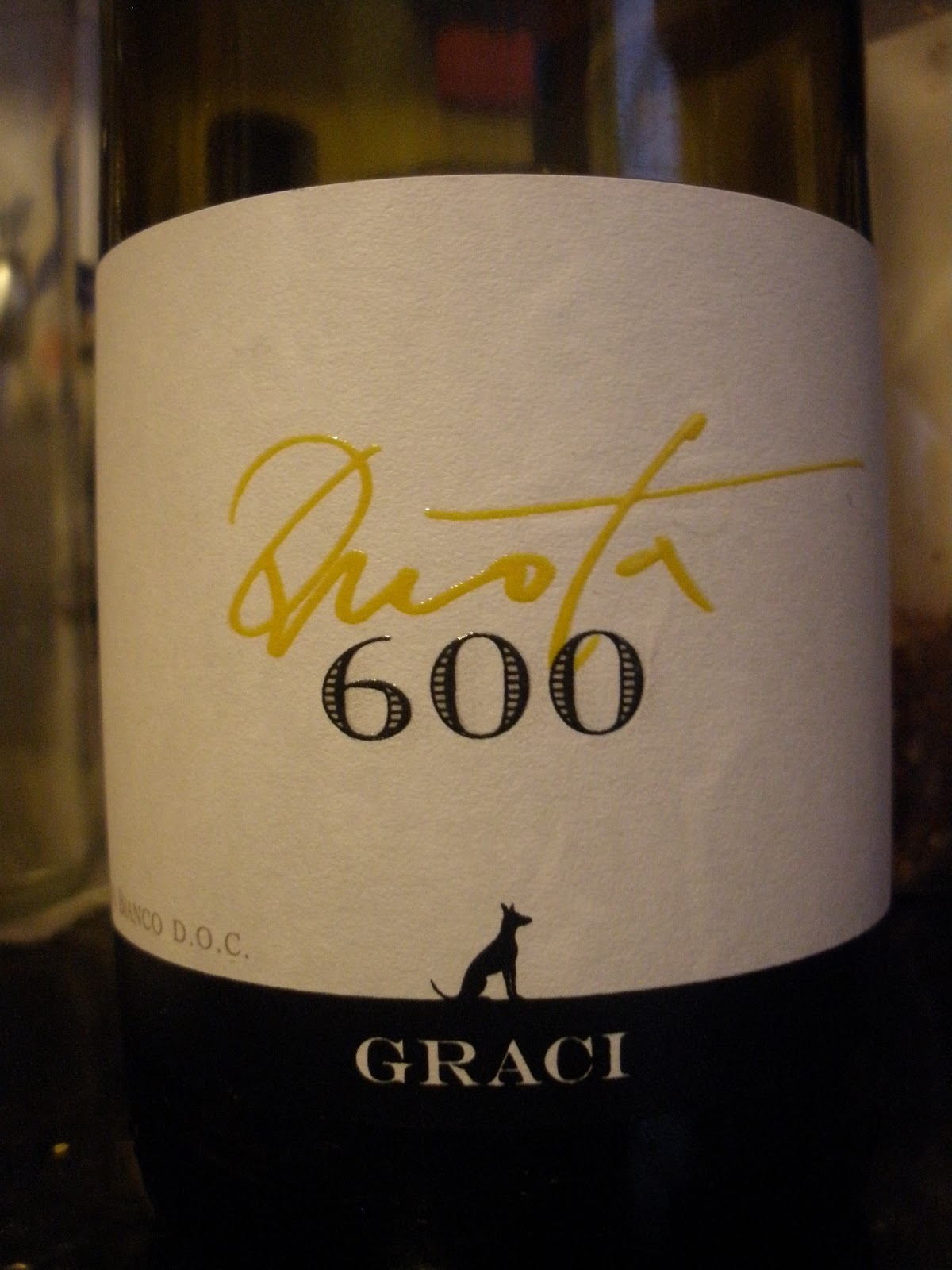
I was able to find a bottle of the 2009 Graci "Quota 600" from Mt. Etna in Sicily, which is a blend of 70% Carricante and 30% Catarratto.  Carricante is typically blended with other Sicilian grapes, though varietal wines can be found as well.  I picked this wine up from my friends at the Wine Bottega for around $35.  In the glass the wine was a fairly light lemon gold color.  The nose was moderately intense with aromas of fresh cut lemon, green apple and river stones.  On the palate the wine was medium bodied with fairly high acidity.  There were tart, racy flavors of lemon and lemon peel, green apple, pear and a really intense stony minerality.  There wasn't a lot of complexity to this wine, but there was a lot of intensity.  It was really heavy on the citrus and stony minerals, and I really enjoyed drinking the wine, but the steep price tag is a little difficult to justify for what you get.  My bottling also had a minor cork failure with some seepage around the cork, but I don't think that it threw the wine off in any way.

Cipriani, G. et al. The SSR-based molecular profile of 1005 grapevine (Vitis vinifera L.) accessions uncovers new synonymy and parentages, and reveals a large admixture amongst varieties of different geographic origin. 2010. Theoretical and Applied Genetics. 121: 1569-1585.

Friday, February 1, 2013

Odds and Ends - Sparkling Turbiana, Picpoul de Pinet, Frappato, Verdejo & Listán Blanco

Hello everyone and welcome once again to my erratic Odds and Ends feature, where I take a look at a few wines I've tried recently that I feel either don't warrant a full post or which feature grapes that I've already written a full post about.  I've got a handful of interesting wines here that I hope you'll enjoy reading about, so without further ado, let's get to them!

I've written several times (as in my posts on Groppello, Vespaiola, Grechetto and Sagrantino) about the wines of Paul Turina, an Italian importer from Maine who is a friend of mine.  Paul has some distant relatives who make wine in the area around Lake Garda in Italy and I've written about some of their offerings in the post on Groppello linked above.  His family also works with the Turbiana grape, which, as we discovered in my post on that grape last year, is actually Verdicchio.  I've tried a sparkling Verdicchio from the Marche, but I've never tried a sparkling Turbiana from Lugana so when Paul gave me the opportunity to taste his family's wine, I graciously took him up on it.  In the glass the wine was a fairly pale lemon gold color with steady bubbles.  The nose was somewhat reserved with aromas of apple and pineapple and little else.  On the palate the wine was on the lighter side of medium with fairly high acidity and a loose bubble structure.  There were flavors of ripe apple, pear, baked white fruits, candied apple and pineapple.  This is a tank fermented wine that has more complexity and depth than your average prosecco.  It's really a lovely little bottle and those interested in trying it are advised to contact Paul via his website.

Next up is a wine made from one of the very first grapes that I wrote about, Picpoul Blanc.  Even though that post was only the tenth one that I had written, I really don't have any new information to add to it.  Picpoul is a pretty straightforward grape without any real controversies or interesting family connections.  I'm still a big fan of it, though, and this bottle, the 2010 vintage from the Saint-Peyre winery in the Coteaux du Languedoc region of France, was given to me as a gift by my wife (retail is around $11).  In the glass the wine was a fairly light silvery lemon color.  The nose was fairly intense with aromas of grapefruit, grapefruit peel, pear and some grassy herbs.  On the palate the wine was medium bodied with fairly high acidity.  There were flavors of pear, grapefruit peel, golden apple, lemon and cut grass.  Picpoul always reminds me a bit of Sauvignon Blanc, and this wine was certainly no exception.  It's bright and zippy with a wonderful wild, grassy vein running through it as well.

I've mentioned one of my favorite shops, The Wine Bottega in the North End of Boston, over and over again because they always have an interesting selection and are always incredibly nice and knowledgeable about their merchandise.  Matt is one of the co-owners of the shop and he has recently started his own importing label on the side called Selectio Naturel.  Like the Bottega, Selectio Naturel is focused on representing small producers making natural wines.  One of those producers is Lamoresca whose vineyards are located deep in the hills of central Sicily at an altitude around 430 meters above sea level.  Their approach in the vineyard and in the winery is minimalistic, and you can read more about it here.  Matt imports their Rosso, which is a blend of Nero d'Avola and Frappato, their Bianco, a blend of Vermentino Corse and Roussanne which I'll have a full review of shortly, and the Nerocapitano, which is 100% Frappato.  Frappato is absolutely one of my favorite grapes and in my prior post on it, I got a little carried away with an example from Occhipinti, so I had high hopes for this bottle, the 2011 vintage, which I picked up at the Bottega for around $30.  In the glass this wine was a fairly light pinkish ruby color.  The nose was intense with aromas of red cherry, wild strawberry, raspberry and rose petals.  On the palate the wine was medium bodied with fairly high acidity.  There were flavors of bright red cherry, raspberry, rose water and wild strawberry.  While it wasn't as intoxicating as the wine from Occhipinti, it was still gorgeous with a beautiful perfume and pure fruit flavors on the palate (and it costs about $20 less per bottle).

Another one of my very early posts was on the Verdejo grape from Spain.  In that post, I wrote that Verdejo was best known in Rueda, Spain, but the bottle that I was able to try was from La Mancha, which is a little further south, a little further inland, and a bit hotter and drier than Rueda.  I enjoyed the bottle that I had picked up, but I was curious to try a more representative sample from an area where the grape was more traditional and more highly regarded.  I found the 2009 Shaya Verdejo ($17) a few months after I wrote my initial post and have had the tasting note kicking around in a notebook for quite some time now.  In the glass the wine was a pale silvery lemon color.  The nose was moderately intense with aromas of pear, white peach and fresh cut lemon.  On the palate the wine was medium bodied with medium acidity.  There were flavors of pear, lemon peel, and lees with a stony, chalky minerality on the finish.  It was an OK wine, but I didn't like it as much as the example from La Mancha, which was actually a little bit cheaper than this bottle.

A few months ago, I was shopping at another one of my favorite local stores, the Spirited Gourmet in Belmont, and came across a bottle of wine made from the Listán Blanco grape (the 2008 Bodegas Carballo, which cost around $24). I had recently picked up a few bottles made from Listán Negro and was excited to find something that I didn't think I had tried before. I bought the bottle without asking anyone about it or bothering to look it up on my phone and so was somewhat disappointed when I looked it up at home and discovered that Listán Blanco is actually just another name for Palomino, which I've already written about.  This wine was from the Canary Islands, though, and was made with some skin contact, so I was curious to see what it was like.  In the glass the wine was a fairly deep lemon gold color just starting to go bronze.  The nose was intense with aromas of red apples, apple cider, fresh cracked pecans, seawater and autumn spice.  On the palate the wine was medium bodied with medium acidity.  There were flavors of baked apple, apple cider, fresh cracked pecans, toasted walnuts, autumn spice and dried leaves.  When I used to jump into raked leaf piles as a kid, I remember there being a particular smell and taste that would result from the leaves being crushed by our bodies.  A fine powder would form and coat the inside of our noses, our mouths and our clothes and that powder had a very distinct kind of taste and smell that I had essentially forgotten about until I drank this wine.  Everything about this bottle screams autumn and I almost felt like the wine had a kind of mulled character to it.  This was miles better than the Palomino I tried previously and it gives a hint as to what Palomino may be capable of in careful hands.

Monday, January 28, 2013

Inzolia/Ansonica - Sicily and Isola del Giglio, Tuscany, Italy

A few days ago, we took a look at a grape known as Garganega in the Veneto in northeastern Italy and as Grecanico Dorato in Sicily way down in southern Italy, but virtually nowhere in between.  While I found that particular geographical situation odd, it is certainly not unique.  Today's grape, for example, is found primarily in Sicily, but is also fairly well represented in Tuscany and has been known in each of those areas for over 300 years, but aside from a few stray vines in Sardinia, Campania and Lazio, it isn't really grown anywhere else.  In Sicily, that grape is known as Inzolia while in Tuscany, it is known as Ansonica and today I'd like to take a closer look at it and its journey.

As mentioned above, Inzolia/Ansonica are first mentioned definitively in the literature around the 16th or 17th centuries.  I say definitively because the ancient Roman writer Pliny the Elder mentions a grape called Irziola in his Naturalis Historia, which some have taken to be the first mention of Inzolia in print, but aside from their similar sounds, there is no evidence that indicates that Pliny was talking about the grape we know as Inzolia today.  In Sicily, Inzolia has historically been found mainly on the western end of the island where it is has been valued as an ingredient, along with Grillo, in high-end Marsala production.  As the production of high-end Marsala has fallen, Inzolia has given way to Catarratto, which is more widely used for low-end Marsala production.  Inzolia is still relatively widely planted, though, as current Sicilian acreage stands at around 19,000 acres.  As table wine production has taken off in Sicily over the past few decades, more and more of the existing Inzolia plantings have been used for that purpose as well.

In Tuscany, the grape is known as Ansonica and is planted mainly along the coast and on some of the nearby islands of the Tuscan archipelago.  The most famous of these seven islands is Elba, where Napoleon was banished in 1814, and while Ansonica is grown there, the island we're most concerned with is called Giglio.  Giglio is a small (about 1.36 square miles), mountainous island made primarily of granite and located about 10 miles from the Tuscan shore.  It has been inhabited since the Stone Age and has been ruled over by the Etruscans, Greeks, Romans and Florentines among others.  At various times throughout history, the island has been completely abandoned as invading forces deported the native population, but it has always been resettled eventually.  Grapes have been grown on this island since at least the 6th Century BC, and today, Ansonica is the mostly widely planted grape there.

Despite their geographical distance, ampelographers have long suspected that Inzolia and Ansonica were the same grape and the Italian authorities have recognized them as the same for many years.  In 1999, the first DNA evidence started coming in which validated this particular hypothesis.  An Italian team used AFLP markers, which are a little bit different from the microsatellite markers primarily used today, to show that the Ansonica from Giglio was most closely related to Ansonica from the Tuscan mainlaind, Inzolia from Sicily, Roditis from Greece, Airén from Spain and Clairette from France.  While these results are interesting, we do have to take them with a grain of salt.  AFLP analysis is looking at DNA sites throughout a sample's genome, which means that it can be more precise than microsatellite analysis, but that precision isn't necessarily a good thing.  If you're looking for a murderer, then you want to be as precise as possible, but when you're dealing with families of plants that are subject to genetic mutation over time, that precision can indicate differences in two plants that you would otherwise consider to be identical.*  Clonal variants can show up in AFLP analysis as different varieties, as can geographically disparate populations that shared a common ancestor hundreds of years ago, but which have been evolving separately from one another ever since.  This is the case with Inzolia and Ansonica, and this AFLP analysis was able to show that there were differences not only between Tuscan Ansonica and Sicilian Inzolia, but also between Ansonica from Giglio and Ansonica from Tuscany.  The two Ansonicas were closer to one another than to Inzolia from Sicily and the Tuscan Ansonica was closer to the Sicilian Inzolia than the Giglio Ansonica was, which would indicate that the grape likely came from Sicily to Tuscany and then to Giglio.

I mentioned above that this study also found similarities between Inzolia/Ansonica and Roditis, Airén and Clairette, and this probably needs a bit of explanation as well.  Many genetic studies compare large groups of grapes from specific geographic regions in order to see how similar they are to one another genetically.  The theory is that grapes from a certain region have likely been together a very long time and are probably distantly related to one another in ways that are too complicated to tease out with pedigree analysis.  When testing a large pool of grapes, the scientists look to see which grapes have the most DNA in common with one another and then hypothesize that these grapes are then more closely related to one another than to the other grapes in the study.  The main problem in interpreting the results is that you are limited by the number and the variety of grapes in a study.  The results are really only telling you that these grapes are more like each other than the other grapes in the study, which can be problematic if you've chosen your samples poorly.  Imagine a study like this done with human beings where you're Italian and your family has lived in a small village for hundreds of years.  The researchers select you and a handful of people from your town and compare them with another group from the mountains of Tibet.  The study should show that you are more closely related to the people from your village than the villagers of Tibet.  Now imagine that the study took you, one person from the village in Tibet, and a pack of chimpanzees.  Suddenly you and the Tibetan villager look a lot more closely related.

The point is that these relatedness studies can be useful, but they can also be misleading.  The group above sampled a very high number of Greek grapes along with a handful of grapes from a whole bunch of different regions all over the world.  They tested very few Sicilian or Tuscan varieties, which one would expect to be more closely related, and so the results may be a little skewed.  They interpreted their results as showing that Inzolia likely came from Greece, due to its relatedness to Roditis, into Sicily before moving to Tuscany and then to Giglio.  In Wine Grapes, Vouillamoz points to a 2010 study (citation 1) where another Italian team analyzed 82 different Sicilian grapes to see how closely they were related as refutation of the study above.  They found that Inzolia was mostly closely related to a few other varieties with Inzolia in the name (but which are separate varieties) such as Inzolia Imperiale and Inzolia Nera (which is not a red-berried mutation of Inzolia at all, but rather a separate variety).  Further, this group also had similarities with Coda di Volpe, Grecanico, Frappato, Carricante and Nerello Mascalese among others.  Vouillamoz claims that the relatedness of Inzolia to these other Sicilian grapes indicates that it is likely from Sicily and not from Greece.  Since this particular study did not include any Greek grape varieties, it seems difficult to compare the results from the different studies and come to that kind of conclusion.  Both studies do seem to indicate that Inzolia came from Sicily to Tuscany, but whether it is native to Sicily or whether its ancestors or Greek seems to still be an open question.

I was able to try two different wines, one from Sicily and one from Giglio, made from the Inzolia/Ansonica grape.  The first was the 2009 Ansonaco from Familia Carfagna, which I picked up for around $50 from my friends at the Wine Bottega (though I have recently seen it available at Curtis Liquors as well).  In the glass the wine was a medium bronze gold color.  The nose was intense with aromas of ripe red apples, toasted nuts, apple cider, poached pear, brown sugar, dried apple and abundant autumn spice.  On the palate the wine was medium bodied with fairly acidity.  There were flavors of dried apricot, red apple, apple cider, toasted almonds, autumn spice and dried leaves.  I would have sworn that this wine saw some skin contact, but this website seems to indicate no maceration.  I thought this was a really gorgeous wine that was an absolute pleasure to drink.  It should be drunk at cellar or room temperature, as the cold really blunts the aromas and flavors.  It is a bit pricey but I thought it was worth every penny.  You probably could pair this with some food, but I really just enjoyed it on its own.

The second wine that I tried was the 2010 Case Ibidni Inzolia from Sicily, which I picked up from my friends at the Wine Bottega for around $12.  In the glass the wine was a medium lemon yellow color.  The nose was moderately intense with aromas of ripe white pear, green melon, ripe apple and something vaguely tropical.  On the palate the wine was on the lighter side of medium with medium acidity.  There were flavors of ripe, round white pear and red apple along with a touch of mild pineapple and banana.  Inzolia does have a tendency to get flabby if not picked early enough, and I think that these grapes maybe hung on the vine a little too long.  It had some of those flat fruit-cocktail kinds of flavors going on and really wasn't my thing.

Reader and frequent commenter WineKnurd was able to try a more recent vintage (2011) of this wine which he picked up from his friends at Wine Authorities in Durham, North Carolina.  His tasting note reads:

"100% Insolia from Sicily, 12.5% abv with a slight spritz in the glass on first pour. Classic Italian white wine nose full of wet stone and minerals backed with notes of fresh cut granny smith apple and some hints of cantaloupe rind. The palate was lighter and less intense than I was expecting based on the nose and the wine in general had lower acidity than what I was expecting for an Italian white. Up front there are flavors of sour apple and melon rind but somewhere along the mid-palate it thins out and finishes weak. My guess is that this needs to be consumed as fresh as possible in Sicily, not a year behind in the USA. At $12.99 it doesn't break the bank but this is money better spent elsewhere."

CITATION

1) Carimi, F, Mercati, F, Abbate, L, & Sunseri, F.  2010.  Microsatellite analyses for evaluation of genetic diversity among Sicilian grapevine cultivars.  Genetic Resources and Crop Evolution.  57(5): pp 703-719.

*It really seems to be taken for granted that Inzolia and Ansonica are genetically identical, but I actually was not able to find any studies that specifically prove the synonymy.  I checked the microsatellite profile data in the VIVC with the data given for Inzolia in Citation 1 and found that the adjusted values matched at all six sites, so that's good enough for me.

Friday, January 18, 2013

Garganega/Grecanico Dorato - Veneto and Sicily, Italy

I wasn't sure whether I was going to write about the Garganega grape or not.  It is the 11th most planted grape in Italy with nearly 30,000 acres devoted to it and is the star grape (making up at least 70% of the blend) in one of the most common white wines from Italy, Soave.  It's a grape right on the fringe of being fringe and I went back and forth about it for a long time.  I ultimately decided to write about it, though, because it turns out that Garganega is a really interesting grape with connections to a surprisingly large number of other Italian grapes.  I was also able to find some interesting wines made from it outside of the Soave region of the Veneto so I thought, what the heck, let's take a look at Garganega.

Garganega is one of the oldest grapes known in Italy.  Its first appearance in the literature dates to a 13th century work by Pietro de Crescenzi which says that it was cultivated around Bologna (in Emilia-Romagna) and Padova (in the Veneto) at that time.  It seemingly hasn't moved very much from this general area in the 800 or so years since de Crescenzi wrote his book since nearly all of the plantings of Garganega and nearly all of the DOC regions where it is approved for use are clustered in the Veneto with just a few in Lombardy, Trentino-Alto Adige and Umbria as well.  There's a little bit of twist to that story, though.  Some ampelographers noticed that Garganega looked an awful lot like a grape called Grecanico Dorato grown in Sicily, but nobody could quite figure out how or why the same grape would show up in such geographically disparate regions and nowhere in between.  Grecanico had been known and grown in Sicily for hundreds of years while Garganega had been known in northeastern Italy for longer than that so while the hypothesis of the two grapes' synonymy was intriguing, it remained just a theory for many years.

In 2003, an Italian research team conducted a study on vines from the Veneto to see if and how any of them were related to one another.  They tested three clones of each of fourteen different Veronese grapes, one of which was Garganega.  The team then took the DNA data they obtained from their Garganega samples and compared them to an exiting profile for Grecanico Dorato from another team's experiments and found that "these cultivars are highly related and most likely represent the same grapevine."  In 2008, another Italian team decided to look at the DNA from Garganega and Sangiovese and compare it to a wide range of grapes from all over Italy in order to see if they could find any interesting relationships.  They tested samples of both Garganega and Grecanico Dorato and found that the two vines were definitely identical.  This result confirmed a study done a year earlier (citation 1) that showed that not only was Garganega the same as Grecanico Dorato, but it was also the same as a grape called Malvasia de Manresa from Spain (which raises a whole bunch of interesting questions that I'm afraid I can't answer).  The vine is no longer cultivated in Spain, but there are still some vines in holding collections in Europe.

The most interesting findings in these last two papers had to do with the other grape varieties that had a close relationship with Garganega.  The team from citation 1 found that Garganega and another grape called Uva Sogra were the parents of Susumaniello, a red grape grown primarily in Puglia today.  They also found that Garganega has a likely parent-offspring relationship with Malvasia di Candia, Trebbiano Toscana and a few other grapes that I've never heard of before.  These results were confirmed in the 2008 study mentioned above and augmented by the discovery that Garganega also appears to have a parent-offspring relationship with Marzemina Bianca, Catarratto, Albana, Greco del Pollino and Empibotte.  The connection with so many different grapes throughout Italy makes Garganega one of the most important cultivars in the history of Italian wine grape evolution.  Though it is a very interesting question, I don't believe than anyone has given a satisfactory answer as to how the grape moved throughout the country of Italy to end up in two places so far apart, leaving only relatives in its wake.  It is thought that since Garganega is more closely related to the vines of the Veneto, it likely came from there originally before making its way south to Sicily, and that's as good an explanation as any, I suppose.

I was able to try a variety of wines made from Garganega/Grecanico from both the Veneto and from Sicily.  The first was the 2008 "Pico" from Angiolino Maule, which I picked up from my friends at the Wine Bottega for around $30.  This wine is 100% Garganega from Maule's vines in the Veneto.  The grapes are crushed and left to ferment in open vats without any temperature control for 2-4 days.  The wine is then moved to old (neutral) 1500 liter barrels for a year prior to bottling without any fining or filtration.  In the glass the wine was a hazy medium gold color.  The nose was fairly intense with aromas of ripe apple, white flowers, pineapple, honeysuckle, pear and grapefruit.  It was deep and wonderful, revealing something new with every sniff. On the palate the wine was medium bodied with fairly high acidity and just a touch of tannic grip.  There were flavors of ripe apple, honey, pineapple, apple cider, Meyer lemon, almonds and grapefruit.  This blows every Soave I've ever had completely out of the water.  It is a complex, fascinating wine that was an absolute delight to drink.  If you've given up on the Garganega grape because you've only had a few bland examples from Soave, let this bottle change your mind.

The second wine that I tried was the 2010 Planeta "La Segreta" ($15 retail) from Sicily.  This is a blended wine made from 50% Grecanico, 30% Chardonnay, 10% Viognier and 10% Fiano.  In the glass the wine was a medium lemon gold color.  The nose was moderately intense with aromas of pear, white peach, lemon peel, chalk and something faintly tropical.  On the palate the wine was medium bodied with medium acidity.  There were flavors of white grapefruit, cut grass, citrus peel, pear and ripe apple with a subtle stony minerality to the finish.  Overall, I found the wine sharp and snappy with a bit of fleshiness to it that helped to balance it out.  It was really citrusy and grassy and reminded me a lot of Sauvignon Blanc, which is one of the few grapes not in the blend at all.  It almost tasted a little under-ripe, which is surprising when you consider how much warmer Sicily is than the Veneto.  I thought it was a decent enough wine, but there wasn't too much in it to get me excited and it really just seemed flat and uninteresting after drinking the Pico.

The final wine that I tried was the Cornelissan Munjebel Bianco 6 from Sicily, which I picked up on clearance at the Spirited Gourmet for around $67.  I've written about Frank Cornelissan before, but his story is worth telling again.  In short, Frank Cornelissan is what happens when you extend the natural wine movement to its most extreme end.  His 8.5 hectares of vines consist of many different native Sicilian vines, inter-planted among one another, that are never sprayed and which are all harvested at the same time.  I don't know precisely what is in the Munjebel Bianco, but I've been told that the bulk of it is likely Grecanico with some Coda di Volpe, Carricante and Catarratto as well.  After harvest, the grapes are crushed and fermented in 400 liter terracotta vessels buried in the ground.  The skins and seeds are left in contact with the fermenting juice for up to a whopping 7-14 months for both red and white wines.  The wines are then pressed and returned to terracotta vessels to be aged "until several full cosmic cycles have passed" before bottling.  The vines are planted on a slope of Mt. Etna and his three different price points for his wines correspond to the altitude at which the grapes used for the wine are planted (the higher the altitude, the higher the price).  Munjebel is the middle tier, and the six refers to the fact that this is the sixth Munjebel white that Frank has produced.  The wines are not vintage dated, but savvy Cornelissan drinkers can tell which vintage a given wine is from the wine's name and its number.  I'm not one of those drinkers, so I have no idea what year this wine is from (though Jamie Goode over at the Wine Anorak says that it's 2009, and I suppose he would know).

Cornelissan's wines are bottled with no sulfur dioxide and with no fining or filtration at any step along the way.  When you look through the bottle at the liquid inside, I'll admit it doesn't look very appetizing as there are frequently both large chunks and fine cloudy particulates that float around inside the bottle at the slightest movement.  The wines can be a bit of a gamble since the lack of preservatives means that if the wine was stored improperly, the chance of microbial spoilage goes up considerably.  This is a sobering prospect for a bottle that costs $67 on clearance, and an even more sobering prospect for the $150 demanded for his highest-end bottling, the Magma.  I was sure to store my bottle carefully and also carefully poured it into my glass, where it was a hazy bronze color that was almost a little tawny.  The nose was moderately intense with aromas of cider, honey, caramel apple, toasted nuts and autumn spice.  On the palate the wine was medium bodied with high acid.  The first descriptor I have in my notes is "crazy."  There was a slight tingle of CO2 followed by flavors of toasted nuts, unfiltered cider, golden apple, pear and pickle juice.  I've tasted only a handful of wines from Cornelissan and only drunk two full bottles of his wines, but their hallmark to me is the excellent balance between oxidation and bright, zippy freshness.  I have always found his wines fascinating and deeply interesting, but I understand that they are an acquired taste in a niche market.  I wouldn't pair this wine with any food at all.  It's the kind of thing that really needs to be experienced on its own.  It really demands the drinker's full attention and should be drunk slowly, over the course of several hours, so one can really see the wine evolve and devolve.  These aren't wines that I would want to drink every day, but when I do find myself with a Cornelissan wine open in front of me, it's always a memorable experience.

Thursday, September 20, 2012

Perricone - Sicily, Italy

When you think about red wines from Sicily, at least one grape probably springs immediately to mind.  Nero d'Avola has become the signature grape of the island, and it is difficult to walk into a wine store anywhere and not be able to find at least one on the shelves.  Sicily has a host of other interesting red grapes, though, and we've covered a few of them here recently.  Nerello Mascalese is starting to show up more and more in many wine shops, as is Frappato, which is undoubtedly one of my favorite grapes.  Today I'd like to take a look at an even lesser known Sicilian grape called Perricone (which is sometimes called Pignatello, though it is not related to Pugnitello, Pignoletto, or Pignolo as far as I know).

When I started to research the Perricone grape, it initially looked like perhaps it wouldn't be suitable for inclusion on this site after all.  Searching for Perricone on Wikipedia initially directed me to a page for a Dr. Nicholas Perricone, but below the header for that article it says "for the wine grape that is also known as Perricone, see Barbera," which, to me at least, is certainly not Fringe Wine grape.  I was surprised, but went to the article on Barbera where I read "in Sicily, the grape [Barbera] is used in various blends under the names Perricone or Pignatello."  The source for this bit of information was the Oxford Companion to Wine, and in its entry for Barbera, the OCW says "in Sicilia some argue that the local Perricone, or Pignatello, is Barbera."  The OCW also has an entry on Perricone, though, which reads in full: "Sicilian red grape variety planted on hardly more than 1,000 ha/2,500 acres of the island.  Soft varietal wines are sometimes called by its synonym Pignatello."  No mention is made of a possible relationship to Barbera, so I decided to expand the search and see if there was anything more substantial that could prove or disprove a connection between the two grapes.

The VIVC cultivar name database has separate listings for Barbera and Perricone, which means that they are considered separate cultivars by the database.  The VIVC microsatellite database had an entry for Barbera, but not for Perricone, so I set out to try to find a DNA profile of Perricone to compare to the VIVC profile for Barbera.  The first paper that I found (citation 1 below) evaluated 82 different Sicilian grapes and published the microsatellite profile for each.  When I checked this against the Barbera entry in the VIVC, it was clear that they didn't match.  This was encouraging, but I felt like I needed a little more before I could feel confident that the two grapes were not identical and, furthermore, not related.

The VIVC's entry on Perricone indicates that one of its parents is Sangiovese.  The bibliographic entry for this bit of information led me to a second paper (citation 2 below), which I had actually read before while I was doing research for my post on Ciliegiolo.  In this paper, the authors provide microsatellite data that was consistent with what was in the first paper, and which also didn't match Barbera.  Further, the authors were able to show that Perricone is likely an offspring of Sangiovese, though the other parent is unknown.  Barbera is definitely not an offspring of Sangiovese, and if you don't want to take my word for it, you can plug each grape into the VIVC microsatellite database and see in the results (the fact that they don't match at either site on VVMD7 & VrZAG62 proves there is no parent/offspring relationship).  All of this information together means that Perricone and Barbera are definitely two different cultivars.

Now that we know what Perricone isn't, let's see if we can learn a little bit about what it is.  The phrase "blending grape" pops up a lot in descriptions of Perricone as its deep color, full body and tannic structure make it suitable for blending with lighter Sicilian grapes.  Nicolas Belfrage, in his Brunello to Zibibbo says that it was more widely spread throughout Sicily as recently as 100 years ago, but plantings have fallen over the past century as plantings of Nero d'Avola have risen since the grapes share many of the same oenological qualities, but Nero d'Avola is considered superior to Perricone in the quality of the wines it makes.  There are a couple of DOCs (namely Eloro and Contea di Sclafani) that permit the inclusion of Perricone and which also allow for varietal wines to be made from it, but the two wines that I was able to find were both IGT.

The first wine that I tried was the 2010 Feudo Montoni "Colle del Mandorlo," which I picked up for about $11 from my friends at the Spirited Gourmet.  In the glass the wine was a fairly deep purple-ruby color.  The nose was fairly intense with smoky black cherry and black raspberry fruit along with some savory charcoal and meat aromas.  On the palate the wine was medium bodied with medium acidity and medium tannins.  There were flavors of black cherry, blackberry and raspberry fruit as well as some smoky leather and charred meat.  There was something a little bit like burnt rubber on the finish, but it wasn't prominent enough to throw the wine off.  Overall I thought this wine was juicy, fruity and savory and actually reminded me quite a bit of Nero d'Avola or Syrah.  I thought it was a very nice value at only $11 and imagine that it would be a great match for pretty much any grilled red meat, though it is definitely soft and friendly enough to drink on its own.

The second wine that I tried was the 2007 Caruso Minini "Sachia" Perricone, which I picked up from Winestone for around $25.  In the glass this wine was also a fairly deep purple-ruby color.  The nose was moderately intense with smoke, black cherry, black plum, charred wood and dried fruit aromas.  On the palate the wine was on the fuller side of medium with fairly high acidity and fairly low tannins. There were big, gushing fruit flavors of black cherry, blackberry and dried blueberry fruit backed by smoke and char.  This was a much bigger and denser wine than the Montoni, loaded with rich, dark black fruits.  Again I was reminded of Nero d'Avola while drinking this wine, but the similarity to Syrah was much stronger here than in the Montoni.  Fans of rich, generous, hot weather Syrah-based wines will find a lot to like in this particular bottling.  Is it worth the extra money?  Well, it probably depends on what the occasion is and what you like to drink.  $25 seems like a fair price to me for what you get with this wine, but bargain hunters may be more comfortable with the $11 wine.  It would be difficult to go wrong with either choice, though, as both are very good.

Citations

1)  Carini, F., Mercati, F., Abbate, L., & Sunseri, F.  2010.  Microsatellite analyses for evaluation of genetic diversity among Sicilian grapevine cultivars.  Genetic Resources and Crop Evolution, 57, pp. 703-719.

2)  Di Vecchi Staraz, M., Bandinelli, R., Boselli, M., This, P., Boursiquot, J.M., Laucou, V., Lacombe, T., & Vares, D.  2007.  Genetic structuring and parentage analysis for evolutionary studies in grapevine: kin group and origin of the cultivar Sangiovese revealed.  Journal of the American Society of Horticultural Science, 132(4), pp. 514-524.

Thursday, January 26, 2012

Nerello Mascalese - Sicily, Italy

If Nerello Mascalese was a person, it would have a serious little-brother complex.    It's never been considered the greatest grape in Sicily and has been greatly overshadowed for many many years by the Nero d'Avola grape.  Nero d'Avola was itself little known outside of Sicily until not that long ago, but now it is hands down the most well-known and well-regarded Sicilian grape, especially among the red  varieties.

It's difficult to talk about Nerello's recent presence in our lives and on our shelves without talking a little about the Nero d'Avola effect.  For a long, long time, Sicily was not regarded as a place for fine wine production by most of the world.  They grow a ton of grapes all over Sicily, but the overwhelming majority of the juice from those grapes ends up in bulk wine production or at the distillery.  Of course there were people on the island who were interested in making fine wines and who, for the most part, were succeeding in that task, but they were small voices in a loud crowd, so to speak, and the reputation of Siclian wines overall was still not that great in spite of their successes.  They could have tried to do what a number of different regions have done and decide to try their hand with the International grape varieties, which do grow well and flourish in the Sicilian climate, but if they had gone that route and tried to compete with the great wine regions of the world, I suspect they probably wouldn't have succeeded.  Cabernet from a region known for cheap wines is still just cheap Cabernet and that identification with mass-produced, cheap wines is a difficult barrier to pass.

What they really needed was something that would separate and differentiate them from the other wine regions of the world.  They found that something in the Nero d'Avola grape.  The story is similar to the phenomenon of Australian Shiraz or Argentine Malbec.  The Aussies didn't have an original product, but they had a different name for it that made it stand out from the other bottles on the shelf.  Argentina wasn't the only place making wines from the Malbec grape, but they were the only ones doing it in quantities that would make the wines easily accessible to nearly every consumer.  The trick was finding a little niche in the market that wasn't adequately filled by some other region and making the case that what you were filling that niche with was not only exciting and interesting, but was really only available from you, which is of course not true with Syrah or Malbec, but the marketing machines convinced a lot of people that it was.  The great thing about Nero d'Avola for the Sicilians was that they didn't even really have to spin it.  Nero d'Avola is only grown in Sicily and is only available from Sicilian winemakers.  They had a real, original wine to offer.

These wines were new and interesting, but they were also well made and tasty.  Consumers flocked to these wines because they were something different, but they stuck around because the wines were actually pretty good.  Even though the overwhelming majority of wine made in Sicily is still bulk (only 5% ultimately ends up in bottle and only 2% of that is DOC classified), those winemakers who were interested in reaching a different demographic had finally found their in-road with the Nero d'Avola grapes.  Consumers were now willing to buy and drink not only wines made from Nero d'Avola, but also wines from Sicily in general.  The tide rose and raised a lot of ships, which, finally, brings us to our featured grape, Nerello Mascalese.  Nerello and many of the other interesting Sicilian grapes are traveling the path blazed by the success of the Nero d'Avola grape.

There are actually two different Nerellos.  Mascalese is the more common of the two and is named for the plain of Mascali at the base of Mt. Etna, the Sicilian volcano that has really been the epicenter for quality wine production within Sicily.  The other Nerello is called Cappuccio, though I'm not sure why.  The two are almost always blended together since they tend to have complimentary characteristics.  One is lighter in color but higher in tannins while the other has deep color but low tannins.  I'm not sure which contributes which, and there is no real consensus about which of the two grapes is considered superior.  The important thing to remember is that they usually travel together and when they do, you're much more likely to see a higher proportion of Mascalese in the blend than Cappuccio.

The grape has been grown around Mt. Etna for at least 200 years.  It does well on the volcanic soils and can be especially nice when grown on higher altitude sites on the volcano.  Despite the fairly long established history and the lack of similar grapes in any other region, Nerello is probably not native to Sicily.  A study done in 2008 (source) found that Nerello Mascalese is almost certainly the offspring of the Sangiovese grape and some other unidentified parent, meaning that it probably came over from the Italian mainland at some point.  This puts Nerello in some interesting company, as the same study also found that Frappato and Gaglioppo, among others, had the same kind of relationship to Sangiovese, meaning that all of those grapes are at least half brothers with one another.

I was able to find a handful of different bottles of Nerello representing several different styles and philosophies. The first wine that I tried was a NV Casa Fondata Valdo that I picked up at Bauer Wine and Spirits for about $13.  This is actually made in the Prosecco region of Italy from Prosecco grapes (also known as Glera) and Nerello grapes or juice that they bring up from Sicily.  There's minimal skin contact with the Nerello grapes, so there's very little color, and the wine made in the Charmat method, as is most Prosecco, so it's much fruitier than your typical Champagne method sparkler.  In the glass the wine was a pale salmon pink color that was nice and fizzy.  The nose was fairly aromatic with bright, fruity strawberry and green apple aromas.  On the palate, the wine was on the lighter side of medium with medium acidity and nice bubbles. There were flavors of strawberry and raspberry candy with snappy green apple backing it up.  This is all fruit and is as simple as it can be, but it's nice and tasty and is something that's definitely a little bit different.  I'm sure Prosecco has some great food matches, but I always just like to drink it on its own and have a little fun with it.  For $13, it's really hard to go wrong.

The next wine that I picked up was the 2008 Nicosia Nerello Mascalese that I grabbed from my friends at Bin Ends for about $10.  It's more representative of the kind of everyday table wine you may find at your local wine shop.  In the glass, the wine was a fairly light ruby color.  The nose was nicely aromatic with red cherry and smoke aromas along with some stewed red berries.  On the palate, the wine was medium bodied with fairly high acid and low tannins.  There were flavors of sour cherry and redcurrant fruit along with some dried herbs and chocolate on the finish.  As the wine opens up, the fruit flavors move away from the red end of the spectrum towards the black with more black cherry, black plum, smoke, chocolate and baking spice showing up.  It's a good, solid, Italian food wine that would be great with anything with a tomato sauce or with some braised red meats.  At $10 a bottle, it's a good, solid value wine that isn't going to blow you away, but is going to be well-made, well-structured and well-suited to a variety of different kinds of food.

The final wine that I'll be talking about is probably the most interesting and the most divisive.  A few weeks ago, my friends over at the Wine Bottega put on a tasting of the wines from Frank Cornelissan, the Madman of Etna.  The Cornelissan estate is really serious about the concept minimal intervention in the vineyard and in the winery and they take it about as far as it can go.  The wines made by Frank Cornelissan come as close as wine can come to that line that separates wine as a beverage from vinegar as a condiment.  They go into their philosophy in some detail on the website linked above and I encourage you to read what they have to say.

The estate makes three different red wines ranging in price from about $27 to about $150.  Each wine at each price point is made from grapes harvested at a certain altitude on the slopes of Mt. Etna with the most expensive wines made from grapes grown at the highest elevations.  The guys at the Bottega were nice enough to let us sample all of the different cuvees and even opened a few bottles from previous vintages that they had been squirelling away. I ended up buying a bottle of the Contadino 8, which is the bottom of the line cuvee, for about $27.  There is no vintage on the wine and the number is an indication of how many times he's made that particular cuvee before.  This is the 8th incarnation of the Contadino blend, which is mostly Nerello Mascalese, but it would be something of a fool's errand to try and figure out exactly which grapes are in this bottle.  The wine is unsulfured and unfiltered so I had to store it in the fridge upright until I was ready to drink it, at which point I took it out and let it come to room temperature over 24 hours.  I then very carefully decanted the wine twice to leave as much sediment behind as possible (when I did get some sediment, it was fairly bitter, so avoid it if you can).  In the glass, the wine is a light ruby red color that is more serious than a rosé but less dark than you'd expect from a red wine.  The nose was nicely aromatic with bright red cherry and candied cherry fruits and damp, forest floor kind of aroma.  In the glass, the wine was on the fuller side of medium with fairly high acidity.  There were flavors of red cherry, wild raspberry, wild strawberry, black tea and damp leaves.  The wine develops with incredible speed as it sits in the decanter in the glass and the bright red flavors get darker and duskier.  It reminded me a lot of some of the Trousseau from the Jura that I had or even of really funky Burgundy.  It's a wild, savage wine that is really unlike anything I've ever had before.  It's hard to recommend it unequivocally to people, as it is certainly not going to be everyone's kind of thing, but if you're looking for a weird, wild, different kind of wine adventure, give something in the Cornelissan line a shot.

Friday, January 6, 2012

Catarratto - Sicily, Italy

Pop quiz time again:  what is the second most planted grape in all of Italy?  As you might expect, Sangiovese is number one but I would have guessed that Trebbiano was right behind it and I definitely would have guessed that Trebbiano was the most widely planted white grape in Italy.  It is true that if you count all of the various sub-types of Trebbiano under a single heading (which would be a mistake, since they are, for the most part, separate grape varieties and not really "sub-types" at all), then Trebbiano becomes the most widely planted grape in Italy, but as of 2000, the Istituto Statistica Mercati Agro-Alimentari in Italy regards them separately, so I'll follow suit.  Trebbiano Toscana comes in third right behind today's grape, Catarratto (specifically Catarratto Bianco Comune, but we'll get to that in a minute).

The really amazing thing about Catarratto's high placement on that list is that all of the plantings of the grape are on Sicily, and nearly all of them are concentrated in the western part of the island.  In fact, Catarratto accounts for over 60% of the vineyard area on the island of Sicily, which is no mean feat as Sicily has more acreage devoted to the vine than any other region of Italy with over 330,000 acres planted (how the grape got to Sicily is a bit of a mystery as recent DNA testing [source] has shown that it is an offspring of the Garganega grape, which is primarily cultivated on the northern end of the Italian mainland in the Veneto region).  Catarratto Bianco Comune covered about 109,000 acres in 2000, which was actually down from nearly 150,000 acres in 1990.  None of those figures account for plantings of Catarratto Bianco Lucido which stood at about 20,000 acres in 2000.  So what's the big deal?  Why is so much land devoted to this grape?  The reason is pretty simple.  Catarratto is low-maintenance in the vineyard and yields like crazy, which is the perfect storm for growers whose main concern is selling their juice off for bulk wine production.  Catarratto is also important in the production of Marsala, but, as mentioned in the Grillo post a few days back, Marsala production has also become an industrialized, bulk production kind of affair and Catarratto's high yields, fairly neutral character and tendency to oxidize easily are all perfect for those kinds of operations.

I noted above that the planting figures were different for Catarratto Bianco Comune and Catarratto Bianco Lucido.  The Italian authorities recognize these as two distinct grape varieties, but recent DNA testing (source) has confirmed that they are actually clonal variants of the same grape (there are actually more than just these two, all genetically identical, but these are the most important in terms of acreage and volume).  They are distinguished from one another by the relative presence or absence of a whitish bloom on the skins of the grapes as they mature.  Comune has the most whitish color present while Lucido has less, creating a clearer, glossier looking grape skin.  Another sub-variety known as Extra-Lucido was discovered and isolated in 1971 from some Lucido vines and, as you might expect, it has virtually no bloom on the skins.  Comune is the more prolific producer, which is why its plantings tower over plantings for the other sub-varieties (all are rather voluminous yielders, though).  The Oxford Companion to Wine asserts that Lucido is the finer of the two in terms of quality production, but Bastianich and Lynch in their Vino Italiano hold that the differences between the two sub-varieties is subtle at most.  The tiebreaker goes to Nicolas Belfrage who, in his Brunello to Zibibbo maintains that Lucido is indeed the finer of the sub-varieties.

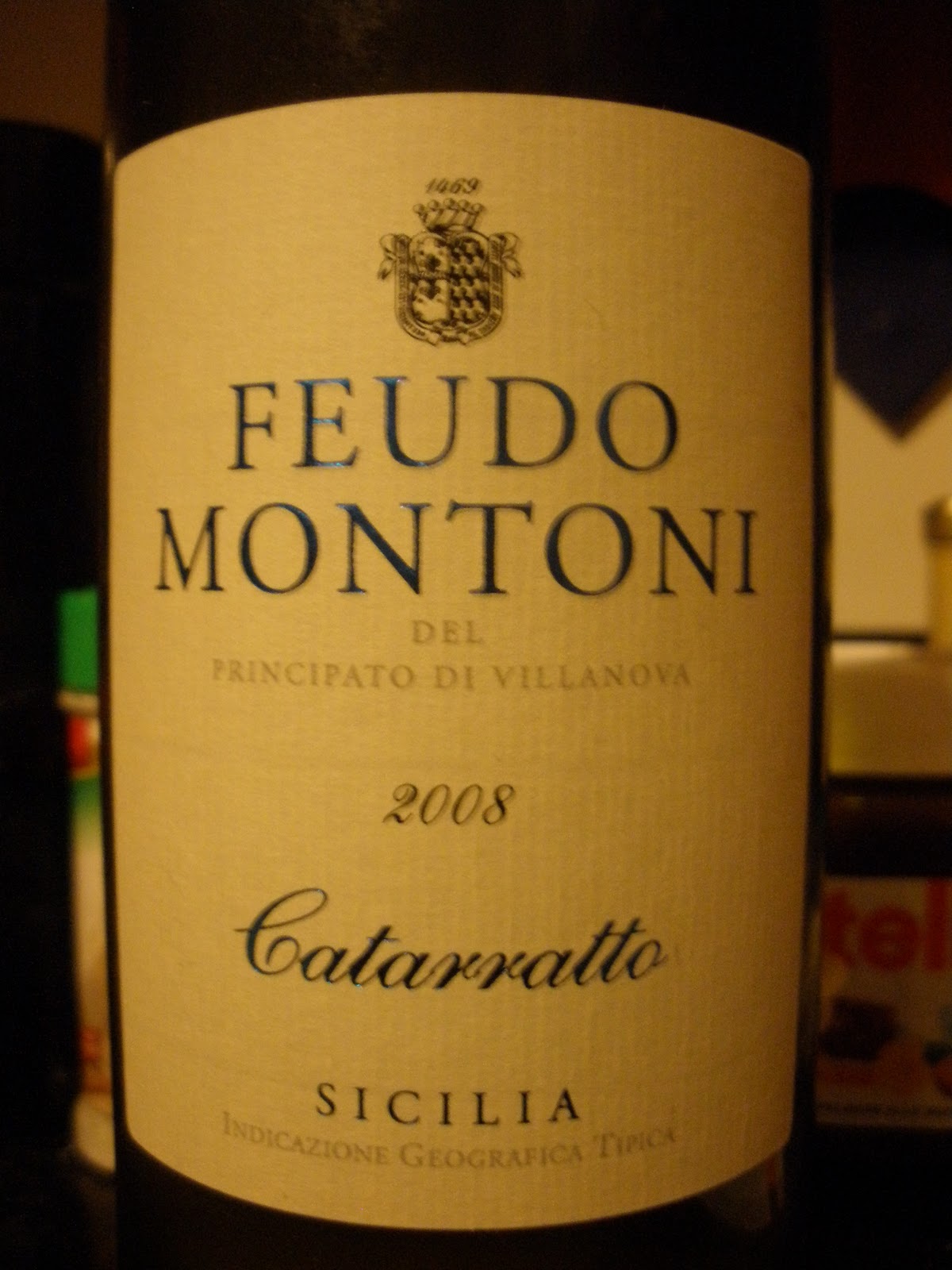
I don't know which one was in the bottle of Catarratto that I was able to find, but the odds suggest that it's probably Catarratto Bianco Comune.  I picked up a bottle of the 2008 Feudo Montoni Catarratto locally for about $20.  In the glass the wine was a fairly deep lemon-gold color.  The nose was nicely aromatic with green apple and apple pie filling aromas with some pineapple tropical fruit notes.  On the palate the wine was medium bodied with medium acidity.  There were flavors of baked apples and apple cider with a touch of lemony citrus.  The finish was bitter with a powdery, chalky kind of edge to it.  The cidery notes kept getting stronger as the wine stayed open, making it harder and harder to drink.  Overall, I didn't care for this at all.  Even taking into account that it is probably just a little past its prime, the flavors here were too one dimensional and the chalky texture was so unpleasant that it became a struggle to get through this bottle.  I'm always wary of writing a grape off due to one bad bottle, so I'll keep my eyes open for something a little fresher and will post a review if I come across anything.

Wednesday, January 4, 2012

Grillo - Sicily, Italy

When researching grapes for this blog, I occasionally stumble over interesting stuff completely by accident.  In the case of today's grape, Grillo, I was simply looking online for a picture of some grapes that I could use to decorate the post with.  It's usually sufficient to enter the name of the grape into a Google image search to get what I'm looking for, but occasionally there are some surprises.  When I entered Grillo into the search today, I got back pages and pages of pictures of all kinds of crickets because, apparently, grillo is the Italian word for cricket.  So, for those of you like me who do not speak any Italian, there's your word for the day.  As for why the grape is known as Grillo, I have no idea.  Nobody who writes about the grape seems all that interested in the fact that the grape's name also means cricket, so my guess is that it's probably just a coincidence.  Nothing about the grapes or the vines look like a cricket to me and, as far as I know, crickets don't eat grapes, so I'm out of ideas as to the source of the name.

It turns out that exactly where the grape comes from is a bit of a mystery as well.  The most popular explanation online is that the grape came to Sicily via Puglia.  Nicolas Belfrage, in his Brunello to Zibibbo is doubtful about this since there doesn't appear to be anything like Grillo at all in Puglia.  Further, those who champion this explanation believe that the grape came to Sicily only after phylloxera struck the Italian vineyards, which would mean that it has only been grown on Sicily for about 150 years at the most.  I'm skeptical about this since another factoid given out about Grillo is that it was the basis for the famous Roman wine called Mamertino, which was a favorite of Julius Caesar.  One assumes that the ancient Mamertino wine was made around the area of Mamertino, which is itself on the island of Sicily, so if it is true that Grillo is the base of the Mamertino wine of old, then we have to posit that Grillo has been on the island of Sicily for several thousand years.  It is, of course, unbelievably difficult to match modern grapes to historical wines, so that's not exactly a smoking gun, but Belfrage's observation about the lack of similar grapes in Puglia seems pretty damning to me.  His theory is that the grape came to Sicily with the Phoenicians thousands of years ago, but given that Grillo's parents are listed on the VIVC as Muscat of Alexandria and Catarratto, which is thought to be native to Sicily, it seems more likely to me that Grillo was born on Sicily at some point in the distant past.

Grillo is particularly well suited to the Sicilian climate as it is very tolerant of high temperatures and dry conditions, which Sicily has in abundance.  Further, the grape is capable of reaching fairly high sugar levels when ripe, which was a major boon when it was the primary grape used in the production of Marsala.  Marsala, as some of you may know, is a fortified wine produced on the island of Sicily that is made in a way that is similar to Sherry.  The Sicilian name for what the Spanish call the solera system is in perpetuum.  In the late 18th and early 19th Centuries, Marsala was a big deal on the international wine scene, but demand for it has fallen even more precipitously than for the fortified wines of other areas such as Madeira, Port and Sherry.  For the most part, the Marsala of today is industrially produced and is good for little more than use as a cooking wine.  There are some artisan producers still making quality Marsala, but it is very difficult to find.

Grillo was once fairly widely planted, but as you might expect, once demand for the principal wine produced from it began to fall, acreage devoted to the vine began to decline as well.  It's also not exactly a prolific yielder, so as the process for Marsala production began to shift over to a bulk, industrial process, Grillo was uprooted in favor of the Catarratto grape, which yields more productively and reliably.  The low point for Grillo came in the early 1990's when acreage devoted to the grape fell below 5,000 acres.  Plantings have rebounded lately as the popularity of dry white table wines has increased over the past twenty years or so, and growers and consumers have found that Grillo can make interesting, characterful table wines.

I was able to find two wines made from the Grillo grape.  The first was the 2008 Corvo "Terrae Dei" which I was able to find for about $12.  In the glass, the wine had a medium lemon-gold color. The nose was shy with a little bit of lemon and pear, but not much. It picks up a little funky leesy, cheesy kind of aroma as it approaches room temperature, but it never really gets that strong.  On the palate the wine was on the fuller side of medium with medium acidity.  The sensation was of light, delicate fruits like lemon, lime, green apple and creamy pear.  The leesy kind of flavor persisted a bit onto the palate as well, providing an interesting, slightly cheesy and funky kind of flavor that picks up as the wine approaches room temperature, but never gets out of control.  I was a little concerned when I bought this bottle that it might be in the midst of its decline, and I think I was probably right.  It's drinking OK right now, but the fruit flavors are definitely in full retreat here.

Luckily I was able to find a bottle of the 2009 Ca' di Ponti Grillo from my friends at the Gypsy Kitchen for about $10.  In the glass, the wine was a fairly pale silvery lemon color.  The nose was very aromatic with melon, green apple, pineapple and grapefruit aromas.  It was like a fruit cocktail leaping out of the glass.  On the palate the wine was on the fuller side of medium with medium acidity.  There were flavors of creamy pear and melon with some banana and lemony citrus.  The fruits were much more muted on the palate than on the nose, which surprised me a little bit.  I have in my notes that the overall flavor profile was "broad," which, to me, means that the acid is fairly muted and the wine has almost a kind of creamy mouthfeel.  A broad wine has more acidity than a "flabby" wine, but it's still on the lower side of balanced.  I'm a sucker for a high-acid white wine, so this didn't really do it for me, though it is a very nicely made wine and at only $10 a bottle represents a very good value.  Those looking for a substitute for Chardonnay will find a lot to like here, but I just need more zip in my whites than this wine can provide.

Bonus factoid for those of you who read all the way to the end: Grillo is unusual in that it only has one known synonym.  The grape is also known as Riddu in some places, though the Palomino Fino grape has Grillo as one of its accepted synonyms.  Most grapes pick up dozens of synonyms as they move through different regions (see Chasselas and its 200+ different names), but Grillo only has the one.

Friday, September 30, 2011

Frappato di Vittoria - Sicily, Italy

It's kind of hard for me to believe, but today's post marks Fringe Wine's first foray into Sicily.  It's certainly not for lack of material.  Sicily has a substantial number of indigenous grapes and a wealth of interesting topics to write about, but for some  reason, I just haven't gotten around to it.  That will change in the near future as I have several handfuls of wines made from native Sicilian grapes that I'll be posting about in short order.

Sicily is Italy's largest region and, for many centuries, has been a major source of bulk agricultural products.  This bulk product mentality wasn't (and to some extent still isn't) limited just to food products, but it extends into wine production as well.  The overwhelming majority of wine production in Sicily is devoted to bulk wine production and production of anonymous blending wine components that are trucked all over Italy (and likely elsewhere) for use in a wide variety of applications.  By area, Sicily is Italy's largest region both in total land volume and in acres devoted to the vine.  By volume, Sicily is Italy's third largest producer with over 7 million hectoliters of wine produced.  Out of all that production, though, only about 5 percent actually ends up in bottles and only 2 percent of that amount is DOC quality wine.

As in so many bulk wine regions, a handful of producers and co-ops have decided to buck the trends of history and set out to make quality wine, and, as mentioned above, they have ample natural resources at their disposal.  Not only is there a wealth of local grapes to choose from, but the Sicilian climate lends itself quite well to viticulture.  While most of the grapes grown on Sicily are white (most are used in bulk Marsala production), the red wines are really where the cool, interesting stuff is happening.  Nero d'Avola has recently burst onto the world stage and Nerello Mascalese might not be too far behind (we'll consider Nerello in a future post).

Today's post, though, is concerned with Frappato.  Frappato's origins are not entirely clear, as some people maintain that the grape is native to the area around Vittoria in southeastern Sicily, while others believe it may have brought over from Spain during one of the periods of Spanish occupation of the island.  The genetic evidence points in a different direction, however.  In a study published in 2008, the authors found that Frappato (as well as a handful of other Italian grapes) shares some genetic similarities with Sangiovese, indicating that Frappato is actually an offspring of Sangiovese and an undetermined other variety.  This certainly muddies the issue as it makes both origin hypotheses difficult to explain.  It seems likely that the grape was brought over from the Italian mainland, along with Nerello Mascalese, at some point prior to the 17th Century, as the grape has been known around Vittoria for at least that long.

I was able to get my hands on two different Frappato bottlings.  The first was the 2009 bottling from the Valle Dell'Acate co-op which I picked up from Gordon's for about $17.  In the glass, the wine had a pale ruby color.  The grape is known for the light colored wines it produces, but if you associate lightly colored wines with lightly scented and flavored wines, Frappato has a surprise for you.  The nose on this wine was very aromatic with distinctive red cherry and rose aromas.  The perfume was intoxicating and it was difficult to pull my nose out of the glass in order to take a sip.  On the palate, the wine was medium bodied with fairly high acidity and medium tannins.  There were delicate red cherry and strawberry fruit flavors with a flowery, rosy kind of flavor to it.  It's a delicate wine that's seemingly held together with gossamer.  The fruit is subdued and hung ever so lightly over the acid and tannin bones of this wine.  The perfume is the thing about this wine that you'll remember and trust me, you'll remember it for a long time.

The second wine I tried was the more upscale 2008 offering from Occhipinti which I picked up at Central Bottle for about $41, though I've also seen it on the shelves of my friends at the Wine Bottega.  In the glass, the wine had a medium purple-ruby color.  Beyond the color, words start to fail with this wine.  I'm going to try a tangent and see if I can get closer to what I want to say.

When I was in college, I went to a concert at one of the local venues (I attended UGA in Athens, Georgia, so there were plenty around) and a band I'd never heard of took the stage.  Standing behind the keyboard was an absolute vision that I couldn't take my eyes off of.  When the band kicked into the first song, I stood like I was nailed to the floor and felt every note ring through my body.  For some reason that night, every ion in my body was lined up in such a way that the combination of sight of and sound had me completely mesmerized and I stood there, nailed to a spot on the floor, and let it all wash over me, waiting through every moment for my heart to explode.  Life is not full enough of transcendent moments like those where every second that ticks by is both sacred in its own bliss and profane in its temporality and finitude.

This wine is one of those experiences.  The nose here is explosively aromatic with roses, violets and crushed red berry fruit.  That's the objective story of what it smells like.  The subjective story is that I fell completely in love with this wine in the way that you can fall in love with objects and unobtainable things that are marked by their temporary appearance in the timeline of your life.  It's about falling in love with something whose end is not only inevitable and near, but whose end you are in fact bringing about much more rapidly through your enjoyment.  On the palate, the wine was on the fuller side of medium with fairly high acidity and medium tannins.  There were ripe, rich flavors of wild blueberries and tart cherries with wild strawberry jam and a flowery kind of character.  Again, this captures only the objective experience here.  This is a breathtaking wine that was an exquisite agony to drink.  I've been moved by wines in the past, but this touched something deep and has been a haunting experience that I can't get out of my head.  I hesitate to offer this review as any kind of a call for people to run out and try this because it was a very personal reaction that I had to this wine and those rarely translate well between people.  Objectively, it is a very fine wine that is well worth the money, but subjectively, it was much more than that and I get concerned here that people will feel I've led them astray if their experience lacks the profundity that I experienced.  I don't know how to answer that.  It's worth the chance, I guess is all I can say.

Please see this more recent post for a tasting note on another 100% Frappato wine from the Lamoresca winery in the hills of central Sicily.