When I sat down to start researching the Bellone grape, I wasn't really expecting to find very much information. I've only ever come across one wine made from it and had never heard of it prior to coming across that wine, so I assumed that it was pretty obscure and that there wouldn't be too much to say about it. I was surprised to find that Bellone apparently isn't all that unusual in its home region of Lazio, where the Oxford Companion to Wine tells us there was about 7500 acres planted in the 1990's. Once you get past that little factoid, though, the information available about Bellone gets hazy pretty quickly.
Let's start with Wikipedia, which claims that Bellone is primarily a red grape which also happens to have a white-skinned clonal mutation. The OCW refers to Bellone as a white-skinned grape, as the does the VIVC. Literally every other source that I checked indicated that Bellone is a white-skinned grape, but the source of the mistake is actually a misprint in the only source that Wikipedia references. Jancis Robinson's Guide to Wine Grapes says Bellone is a "very juicy ancient grape grown near Rome," but the icon next to the entry indicates that Bellone is a red grape. This has been corrected in the current edition of the Oxford Companion to Wine to read "very juicy ancient white grape..." Wikipedia is occasionally wrong, and I know that people will tell you all the time that it's not a valid resource, but I don't necessarily think that's fair or true. Most of the information in Wikipedia is correct and trustworthy, but as with any resource that you're using for research, you really need to check the citations and try to find supporting evidence from at least one other, non-affiliated source in order to verify that the information is correct. In this particular case, the citation was from an outdated source and it just so happened that this particular entry in the original source was incorrect. Always remember: it's not a fact if only one person says it. Facts need to be corroborated across sources.
Next, let's consider the claim, presented in this article on the grape, that Bellone can be traced back to Ancient Rome, where it was called "uva fantastica" ("fantastic grape") by Pliny the Elder in his Naturalis Historia. It seems like an interesting little bit of information, and it looks like this site might provide some corroboration, but I've seen this sort of thing before. Pliny's book is perhaps our best source of knowledge about ancient Roman wines, but it is incredibly difficult to link grapes that he mentioned thousands of years ago to grapes being cultivated today (see also my post on Falanghina). There are, fortunately enough, online texts of Pliny's Natural History available in both English and in the original Latin. I decided to have a look to see what the context was for this assertion and to see whether linking Bellone to the "uva fantastico" was really warranted. I was surprised to discover that the phrase "uva fantastica" doesn't even occur in Pliny's text. In fact, the word "fantastica" doesn't occur anywhere in the text in any of its forms. There is simply no evidence that Pliny ever referred to any grape as "uva fantastica," much less Bellone (which doesn't appear in the Natural History either).
I'm not saying that everything that I've published on this blog has been meticulously fact-checked and thoroughly cited. I've done my best with the time and the materials that I've had, but mistakes get through. I'm not necessarily taking the writers of the Wikipedia and Alta Cucina articles to task, but am rather calling for readers to be careful about the kinds of information that you're willing to admit into your knowledge bank as facts. Information is more freely available now than at any other time in history, and the volume of that information increases every day. I don't know how much of it is true, but I know that at least some of it isn't which is enough to make me feel the need to verify what I read and hear in my own way before believing any of it. As Sir Arthur Conan Doyle said so well, "healthy scepticism is the basis of all accurate observation."
All of which brings us back around to the Bellone grape. Bellone is grown almost exclusively in the Lazio region of Italy, near the city of Rome. It is known for being both hardy and prolific, meaning that it is resistant to wide variety of diseases and yields fairly generously. It is permitted in a handful of DOC areas, but is most often used as a blending grape, rather than as the star of the show, and even the locals refer to its taste as "simple."
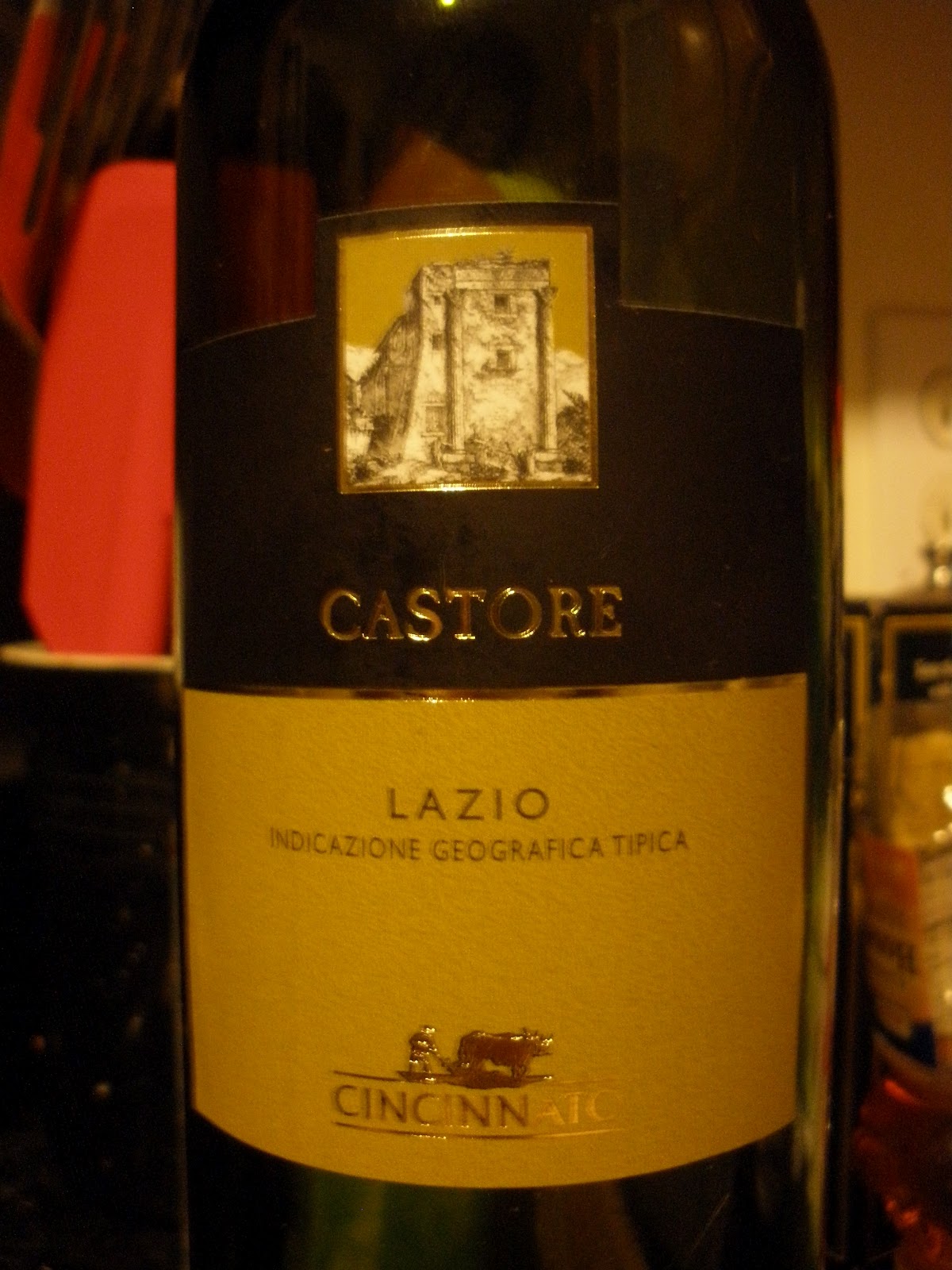
The wine that I was able to try was the 2009 Cantina Cincinnato "Castore" bottling, which retails for around $10 (from my friends at Curtis Liquors). This wine is 100% Bellone. The name "Castore" comes from Castor and Pollux, the "Gemini" twins born from Leda after she was raped by Zeus in the guise of a swan. It is the companion bottling to the Nero Buono based "Pollùce" we took a look at a few months back. In the glass this wine was a fairly light silvery lemon color. The nose was delicate and mild with pear, ripe apple and just a hint of lemon. On the palate the wine was on the fuller side of medium with fairly high acidity. There were flavors of green apple and pear with a very bitter lemon peel kind of flavor. This does eventually blow off a bit, but there is a bitter undercurrent to the wine that never really goes away. It's not a particularly complex wine, as the pear aromas and flavors really dominate throughout, but it's still pretty tasty and is a nice bargain at around $10 a bottle.
A blog devoted to exploring wines made from unusual grape varieties and/or grown in unfamiliar regions all over the world. All wines are purchased by me from shops in the Boston metro area or directly from wineries that I have visited. If a reviewed bottle is a free sample, that fact is acknowledged prior to the bottle's review. I do not receive any compensation from any of the wineries, wine shops or companies that I mention on the blog.
Showing posts with label Lazio. Show all posts
Thursday, August 2, 2012
Tuesday, September 20, 2011
Nero Buono - Lazio, Italy
I always know that I'm in for a fun post when The Oxford Companion to Wine doesn't have an entry on the grape that I'm trying to write about. It doesn't happen often, but it does happen and I end up scrambling, trying to piece together various internet sources to come up with some interesting to say.
Today's grape is Nero Buono which, as hinted at above, is completely left out of the OCW. Bastianich and Lynch's Vino Italiano has a very brief mention of the grape in their glossary at the end of the book, but the entire entry reads: "Used as a blending variety in DOCs such as Castelli Romani and Cori," which doesn't really give me a lot to work with. To compound matters, most of the sources online that have any information about the grape at all are in Italian, a language that I have no talent in. Thankfully, we live in a modern age and Google Translate is able to at least make some of the text coherent, so here we go.
Nero Buono's exact origins are unknown, but it is thought that the grape is native to the Lazio region of Italy. The grape has something to do with a fifth Century Roman politician named Cincinnatus whose home was around the city of Cori, where most of the plantings of this grape can be found today. It looks like there's a possibility that Cincinnatus is the one who may be responsible for bringing the grape to this region and cultivating it in this area, but it sounds like this may just be a legend with no historical record to back it up. Whatever the truth actually is, a local co-op from the region called Cantina Cincinnato thought enough of the legend to use the politican's name in naming their group, and they are one of the largest wineries dedicated to this particular grape in the world.
The grape itself is known mostly for having good color and for adding structure to blends but until recently, it's suitability for creating varietal wines was questionable. The only DOC that allows more than 50% Nero Buono in the blend is the Castelli Romani DOC just south of Rome where Nero Buono is permitted up to 100%. Most bottlings you are likely to find, though, are going to be labeled as IGT wines since the town of Cori where most Nero Buono is grown falls outside of the Castelli Romani DOC zone. In Cori, where the grape does best in the hills outside of the town at altitudes between 200 and 500 meters, the DOC regulations only permit 40% Nero Buono.
A few producers are finding that the grape has very good potential in making varietal wines so long as the grape is treated properly in the vineyard and in the winery. The grape is somewhat surprisingly susceptible to rot and downy mildew given the thickness of its skins, so care must be taken in rainy vintages. As is the case with so many grapes, keeping yields low is crucial to bringing out the best that Nero Buono has to offer. Experiments with oak-aging are proving very successful as the flavors of the wine seem to have a natural affinity for the flavors of oak. Since the wine isn't well known enough to command the kind of premium that 100% new-oak barrique aging would impose, many producers are making do with second-pass barrels that still have some oak flavoring to give.
Cantina Cincinnato has two bottlings of Nero Buono. They have a wine simply called "Nero Buono" which is their higher end offering that seems to go for around $20 retail in markets where it is available. The only bottling I was able to find was their 2008 "Pollùce" which I was able to pick up for about $11. The wine is named for the divinely fathered Pollux of the Gemini twins who has a temple near the town of Cori. In the glass, the wine had a medium purple-ruby color with aromas of stewed raspberry, red cherry and tart plums. As the wine opens up, the aromas get a little cleaner and pick up a kind of waxy fruit character. On the palate, the wine is on the fuller side of medium with fairly high acidity and low tannins. Right out of the bottle, the flavors were predominantly of stewed red berries with a little plumminess and leathery earth. As with the nose, as the wine opened up the flavor shifted to waxy black cherry fruit. This is a wine that needs a little air to show its best so don't give up on it right away. It's not a profoundly complex wine, but it's well made and the price is right on it at $11 a bottle. It's one of those grapes where if you don't grab it when you see it, you may never see it again so give Nero Buono a shot if you get the chance.
Today's grape is Nero Buono which, as hinted at above, is completely left out of the OCW. Bastianich and Lynch's Vino Italiano has a very brief mention of the grape in their glossary at the end of the book, but the entire entry reads: "Used as a blending variety in DOCs such as Castelli Romani and Cori," which doesn't really give me a lot to work with. To compound matters, most of the sources online that have any information about the grape at all are in Italian, a language that I have no talent in. Thankfully, we live in a modern age and Google Translate is able to at least make some of the text coherent, so here we go.
Nero Buono's exact origins are unknown, but it is thought that the grape is native to the Lazio region of Italy. The grape has something to do with a fifth Century Roman politician named Cincinnatus whose home was around the city of Cori, where most of the plantings of this grape can be found today. It looks like there's a possibility that Cincinnatus is the one who may be responsible for bringing the grape to this region and cultivating it in this area, but it sounds like this may just be a legend with no historical record to back it up. Whatever the truth actually is, a local co-op from the region called Cantina Cincinnato thought enough of the legend to use the politican's name in naming their group, and they are one of the largest wineries dedicated to this particular grape in the world.
The grape itself is known mostly for having good color and for adding structure to blends but until recently, it's suitability for creating varietal wines was questionable. The only DOC that allows more than 50% Nero Buono in the blend is the Castelli Romani DOC just south of Rome where Nero Buono is permitted up to 100%. Most bottlings you are likely to find, though, are going to be labeled as IGT wines since the town of Cori where most Nero Buono is grown falls outside of the Castelli Romani DOC zone. In Cori, where the grape does best in the hills outside of the town at altitudes between 200 and 500 meters, the DOC regulations only permit 40% Nero Buono.
A few producers are finding that the grape has very good potential in making varietal wines so long as the grape is treated properly in the vineyard and in the winery. The grape is somewhat surprisingly susceptible to rot and downy mildew given the thickness of its skins, so care must be taken in rainy vintages. As is the case with so many grapes, keeping yields low is crucial to bringing out the best that Nero Buono has to offer. Experiments with oak-aging are proving very successful as the flavors of the wine seem to have a natural affinity for the flavors of oak. Since the wine isn't well known enough to command the kind of premium that 100% new-oak barrique aging would impose, many producers are making do with second-pass barrels that still have some oak flavoring to give.
Cantina Cincinnato has two bottlings of Nero Buono. They have a wine simply called "Nero Buono" which is their higher end offering that seems to go for around $20 retail in markets where it is available. The only bottling I was able to find was their 2008 "Pollùce" which I was able to pick up for about $11. The wine is named for the divinely fathered Pollux of the Gemini twins who has a temple near the town of Cori. In the glass, the wine had a medium purple-ruby color with aromas of stewed raspberry, red cherry and tart plums. As the wine opens up, the aromas get a little cleaner and pick up a kind of waxy fruit character. On the palate, the wine is on the fuller side of medium with fairly high acidity and low tannins. Right out of the bottle, the flavors were predominantly of stewed red berries with a little plumminess and leathery earth. As with the nose, as the wine opened up the flavor shifted to waxy black cherry fruit. This is a wine that needs a little air to show its best so don't give up on it right away. It's not a profoundly complex wine, but it's well made and the price is right on it at $11 a bottle. It's one of those grapes where if you don't grab it when you see it, you may never see it again so give Nero Buono a shot if you get the chance.
Tuesday, July 5, 2011
Cesanese del Piglio - Lazio, Italy
Sorry for the lack of posting over the past week or so, but I've been on vacation in the Finger Lakes region of New York state and didn't have internet access while I was away. I picked up some very interesting bottles there which will eventually find their way here, but for now, we're taking yet another trip into Italy to discuss the Cesanese grape.
There are two distinct clones of Cesanese. Cesanese Comune is the most common and is distinguished by its larger berry size and its relative hardiness compared to Cesanese d'Affile which is the more prized of the two. Cesanese d'Affile is used in the production of DOC wines from Olevano and Affile as well as the DOCG wines from Piglio. Piglio was granted DOCG status in 2008 and it was, somewhat surprisingly, the first DOCG region in Lazio, which is essentially the grape's exclusive home, though a few plantings have managed to sneak northward into southern Tuscany.
The grape is thought to be native to Lazio and may have roots here as far back as ancient Roman times. As far as I can tell, the grape was not mentioned specifically by the name "Cesanese" by the Romans, but it may have been mentioned in a roundabout way by Pliny in one of his works. Its more recent history is decidedly racier as Cesanese was chosen by porn star Savanna Samson to be the lead grape in her winemaking venture Sogno Ono (which, fortunately, means "Dream One" and is not some kind of lewd Italian phrase). Cesanese accounts for 70% of the blend of her wine, and none other than Robert Parker gave the debut effort (the 2004 bottling) from the winery 91 points, though it should be noted that he did not taste the wine blind (he had it in a Parisian bistro according to the New York Times). In case you don't feel like perusing the article, the hands-down winner for best quote is: "Ms. Oliveros said that her chief talent is her passion for her work. She said she genuinely enjoys having sex with strangers...'for those few minutes that I'm working with someone, I love that person,' she said. 'For that reason it makes me good at what I do.'"
Ahem. So, back to Cesanese, shall we? The wine is question today is a Cesanese del Piglio from 2005, which pre-dates the new DOCG law. The Piglio region is just south of center of Lazio (itself located immediately south of Tuscany) and is almost right on the border with Abruzzo. The area is somewhat hilly and is difficult to farm as a result of the terrain. Cesanese is grown on fewer than 1000 hectares (2500 acres) across all of Italy, though I wasn't able to find a specific figure for the commune of Piglio. Dry wines made from Cesanese are a relatively recent phenomenon as, traditionally, the grapes were made into sweet still or frizzante wines. The first taste I ever had of Cesanese was in a 70/30 blend of Cabernet Sauvignon and Cesanese from Cantina Gabriele that was called "Dolcemente." The wine was enjoyable, but since Cesanese made up such a small proportion of the blend and since most of what I tasted was almost certainly from the Cabernet, I never did anything with my notes on the wine (for those deeply interested, my final thought was: "pleasant, but not sure how versatile it would be...not enough sugar for dessert and not enough structure for meats and cheeses").
The first varietally bottled Cesanese I ever saw I let get away from me and it took me almost six months of searching to find another in the Boston area. I was finally able to track down the 2005 Hyperius Cesanese del Piglio at Federal Wine and Spirits for around $18. In the glass, the wine had a medium ruby color and a moderately open nose with aromas of spicy black plum, black cherries and cloves. The wine was medium bodied with high acid and no tannin. There were a lot of baking spice notes (cloves and allspice in particular) to go with the dark, plummy, black cherry fruit. The fruit was dark but the acidity gave it a bright, juicy taste. As it opened up it started to pick up some raisin and prune flavors, which were not at all unwelcome. Six years is a lot of age for a Cesanese, but the wine was very enjoyable and easy to drink. Conventional wisdom says that these should be enjoyed as young as possible, so I would definitely like to get my hands on a younger one, but I'm not exactly holding my breath. If you like lighter red wines, you should definitely give Cesanese a shot and if you like lighter red wines and porn, well, you may have just hit the jackpot.
There are two distinct clones of Cesanese. Cesanese Comune is the most common and is distinguished by its larger berry size and its relative hardiness compared to Cesanese d'Affile which is the more prized of the two. Cesanese d'Affile is used in the production of DOC wines from Olevano and Affile as well as the DOCG wines from Piglio. Piglio was granted DOCG status in 2008 and it was, somewhat surprisingly, the first DOCG region in Lazio, which is essentially the grape's exclusive home, though a few plantings have managed to sneak northward into southern Tuscany.
The grape is thought to be native to Lazio and may have roots here as far back as ancient Roman times. As far as I can tell, the grape was not mentioned specifically by the name "Cesanese" by the Romans, but it may have been mentioned in a roundabout way by Pliny in one of his works. Its more recent history is decidedly racier as Cesanese was chosen by porn star Savanna Samson to be the lead grape in her winemaking venture Sogno Ono (which, fortunately, means "Dream One" and is not some kind of lewd Italian phrase). Cesanese accounts for 70% of the blend of her wine, and none other than Robert Parker gave the debut effort (the 2004 bottling) from the winery 91 points, though it should be noted that he did not taste the wine blind (he had it in a Parisian bistro according to the New York Times). In case you don't feel like perusing the article, the hands-down winner for best quote is: "Ms. Oliveros said that her chief talent is her passion for her work. She said she genuinely enjoys having sex with strangers...'for those few minutes that I'm working with someone, I love that person,' she said. 'For that reason it makes me good at what I do.'"
Ahem. So, back to Cesanese, shall we? The wine is question today is a Cesanese del Piglio from 2005, which pre-dates the new DOCG law. The Piglio region is just south of center of Lazio (itself located immediately south of Tuscany) and is almost right on the border with Abruzzo. The area is somewhat hilly and is difficult to farm as a result of the terrain. Cesanese is grown on fewer than 1000 hectares (2500 acres) across all of Italy, though I wasn't able to find a specific figure for the commune of Piglio. Dry wines made from Cesanese are a relatively recent phenomenon as, traditionally, the grapes were made into sweet still or frizzante wines. The first taste I ever had of Cesanese was in a 70/30 blend of Cabernet Sauvignon and Cesanese from Cantina Gabriele that was called "Dolcemente." The wine was enjoyable, but since Cesanese made up such a small proportion of the blend and since most of what I tasted was almost certainly from the Cabernet, I never did anything with my notes on the wine (for those deeply interested, my final thought was: "pleasant, but not sure how versatile it would be...not enough sugar for dessert and not enough structure for meats and cheeses").
The first varietally bottled Cesanese I ever saw I let get away from me and it took me almost six months of searching to find another in the Boston area. I was finally able to track down the 2005 Hyperius Cesanese del Piglio at Federal Wine and Spirits for around $18. In the glass, the wine had a medium ruby color and a moderately open nose with aromas of spicy black plum, black cherries and cloves. The wine was medium bodied with high acid and no tannin. There were a lot of baking spice notes (cloves and allspice in particular) to go with the dark, plummy, black cherry fruit. The fruit was dark but the acidity gave it a bright, juicy taste. As it opened up it started to pick up some raisin and prune flavors, which were not at all unwelcome. Six years is a lot of age for a Cesanese, but the wine was very enjoyable and easy to drink. Conventional wisdom says that these should be enjoyed as young as possible, so I would definitely like to get my hands on a younger one, but I'm not exactly holding my breath. If you like lighter red wines, you should definitely give Cesanese a shot and if you like lighter red wines and porn, well, you may have just hit the jackpot.
Friday, April 29, 2011
Roscetto - "Falesco Ferentano," Lazio, Italy
Roscetto is one of those rare Italian grapes that is grown in a single place and made by a single producer and is not produced anywhere else in the world. If you've found this page, you've probably gone through quite a few pages that have written about the grape and every single one of them mentions a single producer and winemaker: Riccardo Cotarella of Falesco Winery. Wikipedia comes up empty, Jancis Robinson's Oxford Companion of Wine makes no mention, and even the VIVC (Vitis International Variety Catalog) has no results for Roscetto. The only information that is available is coming from the winery, either in articles written about the winery or winemaker or from the winery's website itself. Normally, I like to use a variety of sources so I can check them against one another, but in this case, not only is all the wine on earth made from this grape coming from a single estate, but seemingly all the information on earth about the same grape is coming from there as well.
So what do we know? Falesco winery has a bottling called Ferentano that is the only 100% varietally bottled Roscetto on earth (some of their Roscetto crop goes into their Est! Est!! Est!!! bottling). According to Falesco, the grape is an ancient variety indigenous to the Lazio region (and more specifically, Montefiascone, a town in northeastern Lazio about 100 km from Rome). It is a white grape that turns a little pinkish as it ripens. It has thick skins and after the grapes are crushed, the skins and juice are held together at a very low temperature for awhile (a process called cryomaceration) in order to extract the phenolic compounds from the skins. The wine was first bottled by the Falesco winery in the 1998 vintage. And that's about all I can find. There's plenty of information out there about the winery itself, which is perhaps best known for their Merlot bottling called Montiano, though they have a pretty wide variety of offerings. Wine.com informs me that "in 2006, our customers purchased more bottles of wine from Falesco than from any other winery in the world." I don't know how many cases of the Ferentano are produced, but I have found this wine in two different wine shops in the Boston area so I don't think production is down in the cult numbers.
The bottle I was able to pick up was from the 2006 vintage (oddly, both local stores where I've found this wine were from the 2006 vintage). It cost me $12 at Bin Ends, but I picked it up from a sale rack marked 50% off. I believe this usually retails for around $20.
The wine had a rich, gold color in the glass. When I first pulled the cork, the wine had a heady, appley perfume that faded pretty quickly into something fairly neutral with some buttery toast notes. It was rich and full-bodied on the palate with good acidity and a creamy texture. There were ripe apple, buttery toast, lime peel and toasted nut flavors with some vanilla. It was pretty clear that this had seen some oak, and the winery web site confirms that the wine spends four months in oak barriques. I was very pleasantly surprised at how lively this was at five years old. This probably has the stuffing for a few more years in bottle. It's very similar to white Burgundy or some of the more restrained California Chardonnays. I don't know what kind of oak is used here, but it's almost certainly not American, and if you made me choose, I'd guess its mostly new French oak. This is not really the style of white wine I go for, but this was really an exceptional bottle. If you can track this bottle down, definitely give it a shot as it's a very unique grape (even if it is made in an international style).
So what do we know? Falesco winery has a bottling called Ferentano that is the only 100% varietally bottled Roscetto on earth (some of their Roscetto crop goes into their Est! Est!! Est!!! bottling). According to Falesco, the grape is an ancient variety indigenous to the Lazio region (and more specifically, Montefiascone, a town in northeastern Lazio about 100 km from Rome). It is a white grape that turns a little pinkish as it ripens. It has thick skins and after the grapes are crushed, the skins and juice are held together at a very low temperature for awhile (a process called cryomaceration) in order to extract the phenolic compounds from the skins. The wine was first bottled by the Falesco winery in the 1998 vintage. And that's about all I can find. There's plenty of information out there about the winery itself, which is perhaps best known for their Merlot bottling called Montiano, though they have a pretty wide variety of offerings. Wine.com informs me that "in 2006, our customers purchased more bottles of wine from Falesco than from any other winery in the world." I don't know how many cases of the Ferentano are produced, but I have found this wine in two different wine shops in the Boston area so I don't think production is down in the cult numbers.
The bottle I was able to pick up was from the 2006 vintage (oddly, both local stores where I've found this wine were from the 2006 vintage). It cost me $12 at Bin Ends, but I picked it up from a sale rack marked 50% off. I believe this usually retails for around $20.
The wine had a rich, gold color in the glass. When I first pulled the cork, the wine had a heady, appley perfume that faded pretty quickly into something fairly neutral with some buttery toast notes. It was rich and full-bodied on the palate with good acidity and a creamy texture. There were ripe apple, buttery toast, lime peel and toasted nut flavors with some vanilla. It was pretty clear that this had seen some oak, and the winery web site confirms that the wine spends four months in oak barriques. I was very pleasantly surprised at how lively this was at five years old. This probably has the stuffing for a few more years in bottle. It's very similar to white Burgundy or some of the more restrained California Chardonnays. I don't know what kind of oak is used here, but it's almost certainly not American, and if you made me choose, I'd guess its mostly new French oak. This is not really the style of white wine I go for, but this was really an exceptional bottle. If you can track this bottle down, definitely give it a shot as it's a very unique grape (even if it is made in an international style).
Subscribe to:
Posts (Atom)


