While starting to research this wine, I found myself wondering just what might be going on in a grape that would cause a berry color mutation. I knew that these mutations were more common in some grapes than in others, and I also knew that the DNA analyses being done for cultivar identification and pedigree reconstruction were unable to differentiate these mutations from their mother vines. There was clearly something genetic going on, though, and I wondered if scientists had been able to figure out anything about the genetics of berry color. I found the results of my research very interesting, and have tried to summarize what I learned in the paragraphs that follow.
While there are a large number of white and red/black berried Vitis vinifera grapes, it turns out that most wild grape types are almost always black. Of the 30 Vitis species native to North America, only 3 have been reported to have any white-berried cultivars, and those 3 only have 1 white-berried vine each. Before the advent of modern DNA analysis, scientists were studying genetics by observing traits in various plants and animals and seeing how those traits were passed along to offspring. As early as 1915, UP Hedrick and RD Anthony were able to show that the white berry color was a recessive trait. For those not up on their high school biology, remember that grapevines (and people) have two sets of DNA encoded on two sets of chromosomes (one from each parent). For a dominant trait, only one set of chromosomes needs to have the gene for that particular trait in order for it to be expressed. For a recessive trait, both sets of chromosomes must have the gene for that trait in order to be expressed. If a vine has one gene for red or black berries and the other gene is for white berries, then the berries on that vine will be red or black. Only if a vine has two genes for white berries will white berries result. Crossing two white berried vines will always create a new white berried vine, but crossing two red berried vines may still produce a white berried vine 25% of the time if both original vines carried the recessive gene for white berries.
It would be wonderful if it turned out that there was a single gene responsible for berry color, but as with many issues in genetics, the real story is a little more complicated than that. It turns out that color in grapevines comes from compounds known as anthocyanins which are blue or purple pigments that color nearly all blue or purple plants from eggplants to violets. There are many different genes that regulate anthocyanin production, but it turns out that one (or possibly two) of them is much more important than the others. In 2005, a Japanese research team (citation 1) discovered a retrotransposon, which they named Gret1, which seemed to contribute to white berried mutations of grapes. A retrotransposon is a special class of transposon, which is just a segment of DNA that is able to move around within a genome, meaning basically that they are able to kind of cut themselves out of a particular segment of DNA and insert themselves somewhere else. Retrotransposons encode onto RNA which then moves around and is reverse-transcribed into another part of the genome.
Retrotransposons are fairly common in the genomes of most living things, but for the most part, they move around in areas of "junk DNA" and don't cause any trouble. When one lands in or near a gene, though, it can disrupt that gene's function and lead to a mutant. What the Japanese team found was that when Gret1 jumped in front of a particular gene (with the catchy name VvmybA1) responsible for anthocyanin regulation on both sets of chromosomes, the result was a white-berried vine. What scientists think is happening is that VvmybA1 is part of a sequence of genes that together regulate anthocyanin production in grapes. When this first gene is disrupted, the whole sequence is shut down and anthocyanins aren't produced. There is some evidence that disruptions to the next gene in the sequence, VvmybA2, also lead to white berry production (see note at bottom*). The entire sequence is not fully understood at this time, but it looks like disruptions to these two genes may be responsible for approximately 95% of all white berried vines on earth.
The Japanese team looked at only a small number of grapes for their studies, but in 2007, a much larger study (citation 2) was done on a larger range of grapes (over 200) to see whether Gret1's involvement in berry fruit color could be determined. They looked at 84 white berried vines and 117 pigmented berried vines and found that the Gret1 sequence was in both chromosome sets in 81 of the 84 white vines, while all 117 of the pigmented berries had at least one complete copy of the VvmybA1 gene without the Gret1 mutation. The results clearly indicate that there's a very high degree of correlation between the presence of Gret1 in the VvmybA1 gene, but the presence of white-berried vines that do not show this particular mutation indicate that there are likely other mechanisms for the creation of white-berried vines as well.
The research team also performed a DNA sequence analysis on all of the vines present, and what they found was that there was actually very little diversity between all of the white berried vines in the study. Furthermore, even the sequences of the red-berried vines that had one copy of the mutated gene tended to be very similar to one another and to the white-berried vines. The team has hypothesized that a single jump of the Gret1 retrotransposon into the VvmybA1 gene happened a very long time ago and created a white berried vine. Since the Gret1 mutation is found in essentially the same location for all white-berried vines, this mutation probably happened on a single chromosome in a red-berried vine. This vine was probably self-fertilized at some point, and when the seeds were planted, about 1/4 of them turned into vines with white berries. One or several of these vines are probably the distant ancestor(s) of many of the white grape vines that we enjoy today.
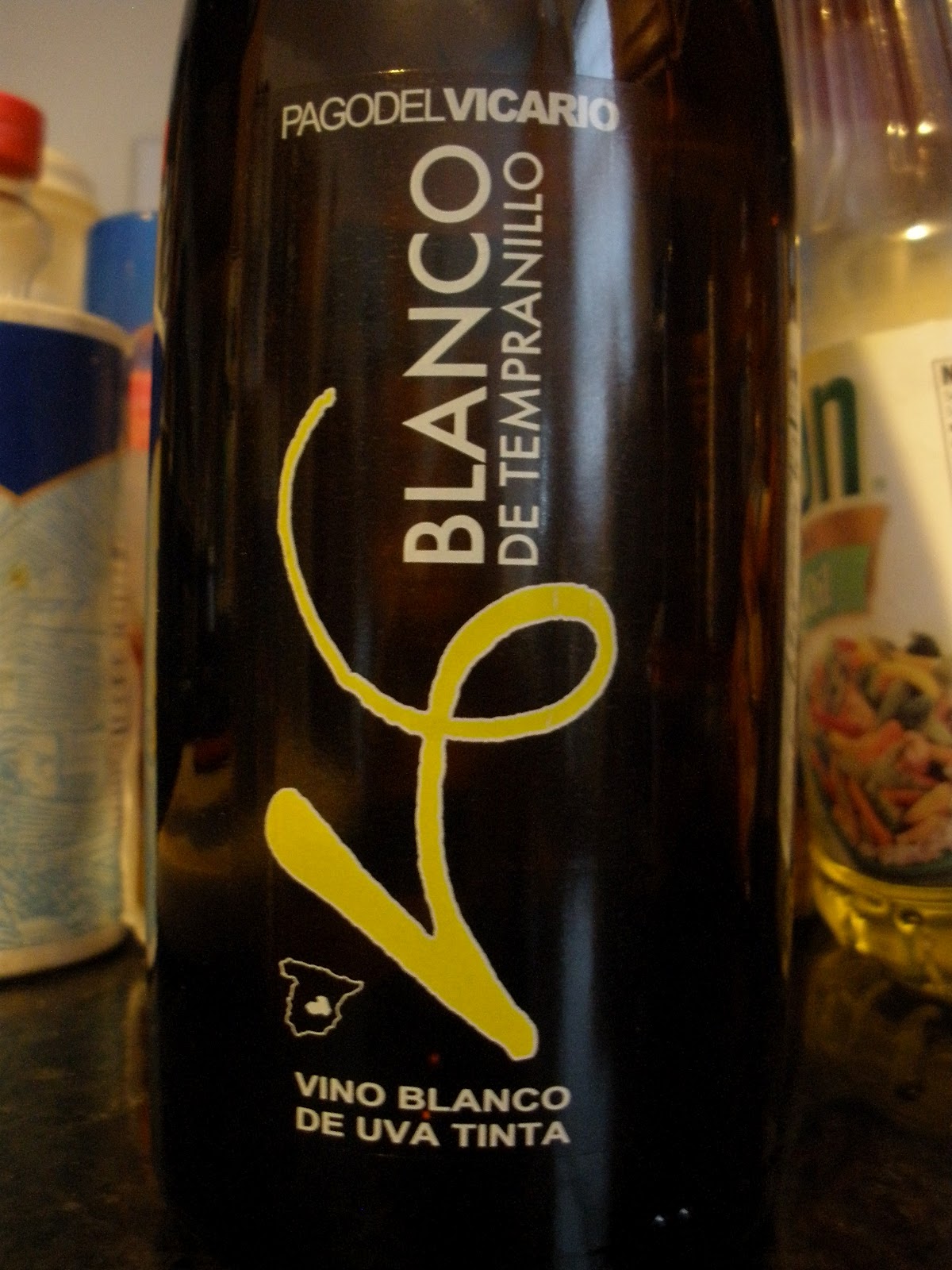
All of which brings us to Tempranillo Blanco. Remember from our investigation into the Albillo grape that Tempranillo's parents were Albillo Mayor and Benedicto. Albillo Mayor is a white-berried grape, and it is likely that it carries this particular mutation. When crossed with Benedicto, a red-berried grape, the offspring would also be red-berried, but it would carry one copy of the recessive white allele. It is possible that at some point, the non-mutated allele (the red-berried one) itself either went through the mutation above or had some other kind of mutation to the VvmybA1 gene that caused it to be non-functional. The result would be a white-berried vine. It has been demonstrated in Pinot Noir and Cabernet Sauvignon that white berried-mutations are the result of a complete deletion of the previously functional VvmybA1 gene, which means that the mutated tissue now has one copy of the mutation and nothing on its other chromosome, which results in white berries (citation 3 and 4). It is unclear whether this is the mechanism that occurs for all white-berried sport mutations, though.
As far as I know, no one has analyzed Tempranillo Blanco's genome in order to see exactly what kind of mutation occurred (**UPDATE** I'm kind of wrong here...I have found a paper that shows that Tempranillo Blanco has at least one copy of the mutant VvmybA1 gene [with the Gret1 insertion], which isn't surprising since Tempranillo does as well, but the paper doesn't offer an explanation as to what might have happened to the functional VvmybA1 gene to cause the color mutation). I've seen references to a DNA test that was done in order to verify that it was in fact Tempranillo, but I can't find the source for that info. What we do know is that in 1988, a grower in Rioja noticed that one of his Tempranillo vines was suddenly producing green berries (green = white in viticultural terms). The local authorities took some cuttings and propagated them to see if the vine was suitable for planting in the area. The early results were encouraging, and a few wineries were allowed to cultivate the grape on an experimental basis. In 2007, Tempranillo Blanco was officially permitted in DOC wines from Rioja.

REFERENCES
1) Kobayashi, S, Goto-Yamamoto, N, Hirochika, H. (2004) Retrotransposon-induced mutations in grape skin color. Science. 304, pp 982.
2) This, P, Lacome, T, Cadle-Davidson, M, Owens, CL. (2007) Wine grape (Vitis vinifera L.) color associates with allelic variation in the domestication gene VvmybA1. Theoretical and Applied Genetics. 114, pp 723-730.
3) Yakushiji, H, Kobayashi, S, Goto-Yamamoto, N, Jeong, ST, Sueta, T, Mitani, N, Azuma, A. 2006. A skin color mutation of grapevine, from black-skinned Pinot Noir to white-skinned Pinot Blanc is caused by the deletion of the functional VvmybA1 allele. Bioscience, Biotechnology and Biochemistry. 70(6), pp 1506-1508.
4) Walker, AR, Lee, E, Robinson, SP. Two new grape cultivars, bud sports of Cabernet Sauvignon bearing pale-coloured berries, are the result of deletion of two regulatory genes of the berry colour locus. Plant Molecular Biology. 62(4-5), 623-645.
also consulted:
Cadle-Davidson, M, Owens, CL. (2008) Genomic amplification of the Gret1 retroelement in white-fruited accessions of wild Vitis and interspecific hybrids. Thoretical and Applied Genetics. 116, pp 1079-1094.
**I've recently come across a more recent paper that shows that locates a specific mutation in VvmybA2 that is present in all white cultivars that also have the Gret1 transposon mutation in front of VvmybA1. The VvmybA2 mutation occurs in two places within the gene. The first mutation alters the production of an amino acid (the gene produces leucine here in the non-mutated version and arginine in the mutated one), while the second mutation is a deletion of a dinucleotide, which causes the gene to terminate early. It looks like these mutations on VvmybA1 and VvmybA2 are typically found together in most of the white-berried grape cultivars studied.
Walker, AR, Lee, E, Bogs, J, McDavid, DAJ, Thomas, MR, & Robinson, SP. 2007. White grapes arose through the mutation of two similar and adjacent regulatory genes. The Plant Journal. 49, pp 772-785.