A blog devoted to exploring wines made from unusual grape varieties and/or grown in unfamiliar regions all over the world. All wines are purchased by me from shops in the Boston metro area or directly from wineries that I have visited. If a reviewed bottle is a free sample, that fact is acknowledged prior to the bottle's review. I do not receive any compensation from any of the wineries, wine shops or companies that I mention on the blog.
Showing posts with label Spain. Show all posts

Tuesday, February 5, 2013

Tinta Negra (Negramoll) - Canary Islands, Spain

Over the past few months I've been slowly making my way through the noble grapes of Madeira and have thus far covered Sercial, Bual (Malvasia Fina) and Verdelho.  I also have plans to cover Malmsey (aka Malvasia Branca de São Jorge) and the rare Terrantez in the near future, but today I'd like to take a look at the workhorse grape of the island of Madeira, Tinta Negra.  This grape used to be known as Tinta Negra Mole in Portugal, but the name was recently changed to avoid confusion with another grape grown in Algarve on the Portuguese mainland which is also (and now officially) called Tinta Negra Mole.  Tinta Negra is also known as Negramoll in the Canary Islands of Spain (which is where both wines we'll be looking at today are from) and as Mollar in parts of the Spanish mainland (especially in southern Spain).  Though I won't be writing about any wines from Madeira in today's post, I'd still like to start off by talking a little bit about the grape's importance on that island before moving to the Spanish examples I was recently able to try.

Tinta Negra is planted on about 680 acres on Madeira but is responsible for making about 80% of the wines there.  If you've ever bought a wine for around $10 - $20 that was just labeled "Madeira," chances are that it was made from Tinta Negra grapes.  The fortified wines made from Tinta Negra are generally thought to be much inferior to those made from the noble varieties mentioned above, so one may wonder why so much more wine is made from it than from those other grapes.  The reason can be traced back to the twin catastrophes that visited the vineyards of Madeira in the mid 19th century.  In 1851, powdery mildew arrived on Madeira and since many of the noble grape varieties of the island are particularly susceptible to fungal infections like powdery mildew, the vineyards all over the island were completely decimated.  It was soon discovered that applying sulfur to the vines could combat this fungus and many growers began to replant, but in the 1870's phylloxera arrived and wiped out the vineyards all over again.  Rather than replant those vines which had proven so susceptible to these diseases, many growers elected to plant hybrid and native American vines (called direct producers because they did not need to be grafted onto resistant rootstock) or vines like Tinta Negra which has very good fungal resistance and which yields generously and reliably.  When the EU banned the use of hybrid and native American vines for quality wine produced in the EU, Tinta Negra's plantings rose even more.  Though there are some producers who are making high quality fortified wines from the grape, most of the wines made from Tinta Negra on Madeira are generic and uninteresting.

The grape is actually much more widely planted throughout the Canary Islands of Spain, where there are just over 3,000 acres under vine.  It is known as Negramoll in the Canary Islands and is used primarily to make red table wines rather than fortified wines.  It had long been thought that Negramoll was either native to the Canary Islands or to the island of Madeira, but a study published in 2006 (citation 1) found that the variety known as Negramoll was identical to a vine grown in Andalusia on the Spanish mainland called Mollar Cano.  The name Mollar comes from the Latin word mollis, which means soft (apparently because the berries are soft to the touch), and so Negramoll basically means something like "soft black."  References for Mollar can be traced back a few hundred years and many of those references are to vines grown throughout South America (where there are still vines called Mollar, some of which have been recently shown to be genetically identical to Negramoll [citation 2]), which means that this particular vine, like the Mission grape, was widely disseminated throughout the new Spanish world by missionaries who were planting vines to make sacramental wine. As we saw in my post on Listán Negro, the Canary Islands were often the last stop for ships on their way to the new Spanish colonies in the Americas and many of the vines that were destined for those new lands ended up in the Canaries as well.  It is now thought that Negramoll is likely from Andalusia and was brought to the Canary Islands and to Madeira on ships that were ultimately bound for the New World.

Since Tinta Negra is rarely mentioned by name on bottles from Madeira and since generic bottles of Madeira are available at every corner liquor store on Earth, I decided it probably wasn't necessary to write a review of one of them.  Instead, I recently was able to try two different table wines from the Canary Islands. The first was the 2009 Tinto Negramoll from Bodegas Carballo, which I picked up for around $22 from my friends at Curtis Liquors.  In the glass the wine was a fairly light brickish garnet color with some orange-brown tints to it.  The nose was fairly intense with aromas of red cherry, wild strawberry, stewed tomato, licorice, damp leafy earth and spice.  On the palate the wine was medium bodied with fairly high acidity and low tannins.  There were flavors of wild strawberry, tart cherry, damp leaves, canned tomatoes and green bell pepper.  The nose was quite lovely but I found the palate bitter, metallic and a little harsh.  I was a little disappointed in this wine because I enjoyed the Listán Blanco from this winery quite a bit, but I really had a hard time drinking this particular bottle.

I also picked up a bottle of the 2009 Bodegas Juan Matias Torres Perez "Vid Sur" Negramoll from my friends at the Wine Bottega for around $20.  This wine was from the island of La Palma, which is the most northwesterly of the Canary Islands and is the fifth largest in that chain.  In the glass the wine was a fairly light brickish ruby color with a bit of brown to it.  The nose was moderately intense with aromas of dusky wild strawberry, red cherry, canned stewed tomatoes, damp leaves and earth.  On the palate the wine was medium bodied with fairly high acidity and low tannins.  There were flavors of wild strawberry, tart cherry, cranberry, wet leaves, stewed tomato and cola.  I picked up the same harsh metallic notes in this wine as in the other and while it wasn't quite as unpleasant to drink, it wasn't exactly a pleasure either.  If they packaged cheap Pinot Noir in tin cans, I bet the result would taste a lot like these two wines.  I really didn't expect to end up preferring those simple Madeira wines made from this grape to these two table wine examples, but that's pretty much what happened.  There may be producers out there doing amazing things with this grape, but I just don't think that it's for me.

CITATIONS

1)  Martin, JP, Santiago, JL, Pinto-Carnide, O, Leal, F, Martinez MC, & Ortiz, JM.  2006.  Determination of Relationships among Autochthonous Grapevine Varieties (Vitis vinifera L.) in the Northwest of the Iberian Peninsula by using microsatellite markers.  Genetic Resources and Crop Evolution, 53(6), pp 1255-61.

2) Martinez, LE, Cavagnaro, P, Masuelli, RW & Zuniga, M.  2006.  SSR-based Assessment of Genetic Diversity in South American Vitis Vinifera varieties.  Plant Science, 170(6), pp 1036-44.

Friday, February 1, 2013

Odds and Ends - Sparkling Turbiana, Picpoul de Pinet, Frappato, Verdejo & Listán Blanco

Hello everyone and welcome once again to my erratic Odds and Ends feature, where I take a look at a few wines I've tried recently that I feel either don't warrant a full post or which feature grapes that I've already written a full post about.  I've got a handful of interesting wines here that I hope you'll enjoy reading about, so without further ado, let's get to them!

I've written several times (as in my posts on Groppello, Vespaiola, Grechetto and Sagrantino) about the wines of Paul Turina, an Italian importer from Maine who is a friend of mine.  Paul has some distant relatives who make wine in the area around Lake Garda in Italy and I've written about some of their offerings in the post on Groppello linked above.  His family also works with the Turbiana grape, which, as we discovered in my post on that grape last year, is actually Verdicchio.  I've tried a sparkling Verdicchio from the Marche, but I've never tried a sparkling Turbiana from Lugana so when Paul gave me the opportunity to taste his family's wine, I graciously took him up on it.  In the glass the wine was a fairly pale lemon gold color with steady bubbles.  The nose was somewhat reserved with aromas of apple and pineapple and little else.  On the palate the wine was on the lighter side of medium with fairly high acidity and a loose bubble structure.  There were flavors of ripe apple, pear, baked white fruits, candied apple and pineapple.  This is a tank fermented wine that has more complexity and depth than your average prosecco.  It's really a lovely little bottle and those interested in trying it are advised to contact Paul via his website.

Next up is a wine made from one of the very first grapes that I wrote about, Picpoul Blanc.  Even though that post was only the tenth one that I had written, I really don't have any new information to add to it.  Picpoul is a pretty straightforward grape without any real controversies or interesting family connections.  I'm still a big fan of it, though, and this bottle, the 2010 vintage from the Saint-Peyre winery in the Coteaux du Languedoc region of France, was given to me as a gift by my wife (retail is around $11).  In the glass the wine was a fairly light silvery lemon color.  The nose was fairly intense with aromas of grapefruit, grapefruit peel, pear and some grassy herbs.  On the palate the wine was medium bodied with fairly high acidity.  There were flavors of pear, grapefruit peel, golden apple, lemon and cut grass.  Picpoul always reminds me a bit of Sauvignon Blanc, and this wine was certainly no exception.  It's bright and zippy with a wonderful wild, grassy vein running through it as well.

I've mentioned one of my favorite shops, The Wine Bottega in the North End of Boston, over and over again because they always have an interesting selection and are always incredibly nice and knowledgeable about their merchandise.  Matt is one of the co-owners of the shop and he has recently started his own importing label on the side called Selectio Naturel.  Like the Bottega, Selectio Naturel is focused on representing small producers making natural wines.  One of those producers is Lamoresca whose vineyards are located deep in the hills of central Sicily at an altitude around 430 meters above sea level.  Their approach in the vineyard and in the winery is minimalistic, and you can read more about it here.  Matt imports their Rosso, which is a blend of Nero d'Avola and Frappato, their Bianco, a blend of Vermentino Corse and Roussanne which I'll have a full review of shortly, and the Nerocapitano, which is 100% Frappato.  Frappato is absolutely one of my favorite grapes and in my prior post on it, I got a little carried away with an example from Occhipinti, so I had high hopes for this bottle, the 2011 vintage, which I picked up at the Bottega for around $30.  In the glass this wine was a fairly light pinkish ruby color.  The nose was intense with aromas of red cherry, wild strawberry, raspberry and rose petals.  On the palate the wine was medium bodied with fairly high acidity.  There were flavors of bright red cherry, raspberry, rose water and wild strawberry.  While it wasn't as intoxicating as the wine from Occhipinti, it was still gorgeous with a beautiful perfume and pure fruit flavors on the palate (and it costs about $20 less per bottle).

Another one of my very early posts was on the Verdejo grape from Spain.  In that post, I wrote that Verdejo was best known in Rueda, Spain, but the bottle that I was able to try was from La Mancha, which is a little further south, a little further inland, and a bit hotter and drier than Rueda.  I enjoyed the bottle that I had picked up, but I was curious to try a more representative sample from an area where the grape was more traditional and more highly regarded.  I found the 2009 Shaya Verdejo ($17) a few months after I wrote my initial post and have had the tasting note kicking around in a notebook for quite some time now.  In the glass the wine was a pale silvery lemon color.  The nose was moderately intense with aromas of pear, white peach and fresh cut lemon.  On the palate the wine was medium bodied with medium acidity.  There were flavors of pear, lemon peel, and lees with a stony, chalky minerality on the finish.  It was an OK wine, but I didn't like it as much as the example from La Mancha, which was actually a little bit cheaper than this bottle.

A few months ago, I was shopping at another one of my favorite local stores, the Spirited Gourmet in Belmont, and came across a bottle of wine made from the Listán Blanco grape (the 2008 Bodegas Carballo, which cost around $24). I had recently picked up a few bottles made from Listán Negro and was excited to find something that I didn't think I had tried before. I bought the bottle without asking anyone about it or bothering to look it up on my phone and so was somewhat disappointed when I looked it up at home and discovered that Listán Blanco is actually just another name for Palomino, which I've already written about.  This wine was from the Canary Islands, though, and was made with some skin contact, so I was curious to see what it was like.  In the glass the wine was a fairly deep lemon gold color just starting to go bronze.  The nose was intense with aromas of red apples, apple cider, fresh cracked pecans, seawater and autumn spice.  On the palate the wine was medium bodied with medium acidity.  There were flavors of baked apple, apple cider, fresh cracked pecans, toasted walnuts, autumn spice and dried leaves.  When I used to jump into raked leaf piles as a kid, I remember there being a particular smell and taste that would result from the leaves being crushed by our bodies.  A fine powder would form and coat the inside of our noses, our mouths and our clothes and that powder had a very distinct kind of taste and smell that I had essentially forgotten about until I drank this wine.  Everything about this bottle screams autumn and I almost felt like the wine had a kind of mulled character to it.  This was miles better than the Palomino I tried previously and it gives a hint as to what Palomino may be capable of in careful hands.

Monday, January 14, 2013

Malvar - Vinos de Madrid, Spain

Image from the excellent Vinos Ambiz blog
Today's post was supposed to be a breeze.  I had a nice little bottle of wine made from a grape called Malvar that looked like it was going to be fairly easy to find a little information on and write about.  I checked the Oxford Companion to Wine online version first and the first sentence there is "also known as Lairén."  I next went to check out what Wine Grapes had to say about the grape, and the entry in that book also referred me to the post on Lairén.  I went to check out the entry for Lairén and I saw that the authors have Malvar listed as an accepted synonym along with the little symbol that they use to show that this particular synonymy has been verified by DNA analysis.  As I read through the "Origins and Parentage" section, I started to notice that most of the text is devoted to showing that Lairén and Airén are two different grapes and there is no mention made of Malvar at all.  As I read through the entire entry, I realized that no citation is given for the synonymy between Lairén and Malvar at all.  I started to have a familiar feeling.

I checked out some of the citations given for the differentiation between Lairén and Airén and also some of the other papers concerning Spanish wines that I have on hand and noticed something interesting.  Not only do none of these papers indicate that Malvar and Lairén are synonyms, but several of them (citation 1 and 2 below) have huge charts showing the genetic profiles of all the grapes that were analyzed in each particular study.  These charts had entries for Airén, Lairén and Malvar and all three profiles were different.  For those new to these studies (some background here), if all three grapes have distinct DNA profiles (as these three do), then they're all separate grape varieties.  Furthermore, one of these studies (citation 1) was specifically cited by Vouillamoz in Wine Grapes as providing evidence that Lairén and Airén were two different grapes (the other study he cites also shows that those two grapes are different, but it doesn't mention Malvar at all, so it doesn't concern us here).

Despite the claim put forward in the OCW and in Wine Grapes, I cannot find any evidence that indicates that Malvar and Lairén are the same grape.  A few sources indicate that Malvar and Airén have historically been confused with one another, and one paper even has a sample labeled Malvar that was actually Airén, but they clarify this finding by saying "'Malvar' is sometimes confused with 'Airén' (IBAÑEZ et al. 2003), but is clearly separable by microsatellite analysis; hence, accession 3 is considered to be a misnamed genotype and not a homonym of 'Malvar' (43)."  As you might expect, Lairén and Airén have historically been confused for one another as well, but as we've already indicated, several DNA analyses have shown that these are two different grapes.  No study that I've been able to find has given any indication that Malvar is the same grape as Lairén, and in fact, all the genetic evidence that I've seen seems to clearly indicate that they are separate grapes.

Now that we know what Malvar probably isn't, let's try to find out a little bit more about what it is.  Malvar is a white wine grape that is grown to a very limited extent in central Spain, and in 2008 its planting figures stood at around 650 acres.  It is most often found in the Vinos de Madrid DO, which is located just south of the city of Madrid and just north of the region of La Mancha.  It is also permitted in Mondéjar and Ribera del Guadiana, but it is really most important in Madrid.  Compared to Airén, Malvar is a less generous yielder and more of an early ripener.  It also has higher acidity and some producers produce a late harvest wine from its berries because of its ability to maintain balance late into its ripening process.  When made into a table wine, Malvar is often blended with Airén, but several producers do make varietal versions as well.

I was able to find a bottle of the 2011 Zestos Malvar from my friends at Curtis Liquors for around $10.  In the glass the wine was a medium silvery lemon color.  The nose was intense with aromas of peach, grapefruit, honey, lime and honeysuckle flower. On the palate the wine was medium bodied with fairly high acidity.  There were flavors of peach, lime, grapefruit, and honeysuckle with a lovely stony minerality to the finish.  The wine was very citrusy right out of the bottle, but as it opened up it started to pick up more tropical banana and melon flavors.  The nose was just gorgeous and it was a real pleasure just to sit and enjoy it for a little while before having a sip.  This bottle over-delivers for the money in a really big way.  Fans of aromatic white wines will really find a lot to like here, as will fans of high-acid, food friendly wines that aren't wallet-busters.  Malvar is definitely a more assertive grape than Airén but since I've never had a wine made from Lairén, I can't offer any insight as to how similar or dissimilar they may be.

CITATIONS

1)  Ibanez, J., de Andrea, M.T., Molino, A., & Borrego, J. "Genetic Study of Key Spanish Grapevine Varieties Using Microsatellite Analysis." American Journal of Enology and Viticulture (54:1). 2003. 22-30.

2)  Martin, J.P., Borrego, J., Cabello, F., & Ortiz, J.M. "Characterization of Spanish Grapevine Cultivar Diversity Using Sequence-Tagged Microsatellite Site Markers." Genome (46). 2003. 10-18.

Friday, January 11, 2013

Odds and Ends - Sparkling Malbec, Botrytized Rkatsiteli, White Pinot Noir, Rufete Rosado and Pignoletto Redux

Today I'd like to introduce a new erratic feature where I provide a few tasting notes for some unusual wines that I've come across lately that I either don't want to write a whole post about or which feature grapes that I've already written a full post about and just don't want to fully revisit.  The former group mostly features wines made from common grapes but made in unusual styles and while I enjoy drinking these wines, I find that I don't have much to say about them, so when I go to write a new post, I tend to skip over those entries in my tasting notebook for those featuring novel grapes.  I'm starting to accumulate quite a few notes like that, though, so I decided to unload some of them here.  I also have a tendency to buy bottles made from unusual grapes I've already covered here so that I can compare them to the wines I've previously written about.  I used to just updat those prior posts with these new tasting notes, but since new posts get more readers than old ones, I thought that those notes may be missed by many readers, so I decided to include them in this little feature as well.

The first wine I'd like to write about is the NV Domaine Augis "La Rosée" sparkling Malbec from the Valency region of the Loire Valley in France.  Though Malbec is currently the superstar grape of Argentina, its original home is France and in many French areas, including this one, the grape is known as Côt.  This is a traditional method rosé sparkler that I picked up for around $17 from my friends at the Wine Bottega.  In the glass the wine was a fairly deep violet pink color with vigorous bubbles.  The nose was somewhat reserved with aromas of fresh cut strawberries and crushed raspberries.  On the palate the wine was light bodied with fairly high acidity and smooth, creamy bubbles.  There were flavors of bitter cherry, fresh strawberry, red currant and crushed red berries.  I found the wine very clean and refreshing and enjoyed it with a pan seared swordfish steak.  I think it's a tremendous value for a traditional method sparkler at less than $20 a bottle and would recommend it unreservedly.

The next wine I'd like to talk about is the 2006 Satrapezo "Gviani," which is a dessert wine made from botrytized Rkatsiteli grapes (retail around $30 for 375 mL).  I've written about Rkatsiteli many times (here and here and here), but this is the first dessert wine made from the grape that I've been able to try.  The grapes for this wine were grown on the banks of the Alazanis river in Georgia where mists and morning dew from the river combined with warm afternoon sun provide the ideal conditions for the development of botrytis cinerea, which is perhaps better known as noble rot.  This fungus infects the berries by piercing the grape's skin, causing much of the water in the berry to evaporate, leaving a dense, sticky, sugary liquid behind.  This liquid is fermented as much as possible and, in this case, aged for a short time in oak barrels prior to bottling.  In the glass the wine was a fairly deep lemon gold color.  The nose was fairly reserved with aromas of apricot, mint, orange marmalade, vanilla and pineapple.  On the palate the wine was full bodied with fairly high acidity.  It was very sweet with flavors of apricot, orange marmalade, honey, red grapefruit and peach cobbler with a clean, minty finish.  I found this wine pretty shut down at fridge temp, but much more generous and open at cellar temp.  I enjoyed this wine and thought it was a reasonable value, but it really lacked the complexity of fine Sauternes or BA/TBA wines from Germany.  Fans of botrytized wines should probably check this out, but connoisseurs may want to skip it.

Next up is the 2008 Trenz Spätburgunder Blanc de Noir from the Rheingau region of Germany, which I picked up from my friends at Curtis Liquors for around $18.  Spätburgunder is the German word for Pinot Noir and while German Pinot Noir certainly isn't that unusual, white wines made from the grape are.  I took a look at a Cabernet Franc wine (and a Nebbiolo wine) made using this method a few months back so readers looking for technical information on how the wine is made are referred to the Cab Franc post.  In the glass the wine was a medium lemon gold color.  The nose was fairly intense with funky, leesy aromas of candied strawberry, watermelon and candied apple.  It smelled more like a rosé than a white wine, which is what I also found in that Blanc de Franc.  On the palate the wine was medium bodied with fairly high acidity.  It was off-dry with honey, peach, candied strawberry, candied green apple and lemon curd flavors.  It was bright and zippy and walked that line between sweet and tart that the Germans are so fond of exploring.  I've had a few other Blanc de Noir style Pinot Noir table wines before, but this is definitely the best that I've ever had.

Next up is the 2008 Vina Salamanca Rufete rosado, which I also picked up from Curtis Liquors for around $13.  I wrote about the Rufete grape a few years back, but at the time, the only wine I could find containing the grape was 50% Rufete and 50% Tempranillo.  This wine is from the same producer, but is made from 100% Rufete grapes.  In the glass the wine was a light salmon pink color.  The nose was moderately intense with funky, leesy aromas of strawberry and not much else.  On the palate this wine was on the lighter side of medium with fairly high acidity.  There were flavors of red cherry, fresh cut strawberry, raspberry and a touch of leesy funk.  This wine was definitely in decline a bit as it was a few years old by the time I got my hands on it, but it was still crisp, fruity and refreshing, which is all I really ask of my pink wines.  I know that there are red wines made from the Rufete grape out there, but I have been unable to track any of them down thus far.  When I finally do, you can bet that tasting note will be up on the site somewhere.

The final wine that I'd like to write about was the 2008 Branchini Pignoletto from the Emilia-Romagna region of Italy (which I picked up at Panzano Proviste for around $18).  I wrote about the Pignoletto grape a few months back and took a look at two wines from Alberto Tedeschi which were very good but were hardly what you might consider traditional.  When I came across this example from Branchini, I decided to try it out to see what a regular table wine made from the grape might be like.  In the glass the wine was a fairly deep lemon gold color.  The nose was somewhat reserved with ripe apple, lemon and mint aromas along with something vaguely floral.  On the palate the wine was on the fuller side of medium with medium acidity.  There were flavors of white peach, mint and Meyer lemon with a bit of nuttiness on the finish.  The citrusy lemon notes were dominant at fridge temp, but the peachy flavors woke up and became a bit more generous as the wine warmed up.  This wine was probably a little over the hill, but it still provided an interesting counter point to the more avant garde efforts from Tedeschi.  Overall, I thought it was OK, but probably not worth the price tag.  The Tedeschi wines were much more interesting and characterful and only a few dollars more than this example, thought they're also probably more of an acquired taste.

Wednesday, November 14, 2012

Boal/Bual/Gual/Malvasia Fina - Madeira, Portugal and Canary Islands, Spain

When I decided to try and write about each of the major Madeira grapes, I really wasn't anticipating any problems or confusion.  Everything I had read said that there were four major grapes that produced four different styles of Madeira.  Easy peasy.  I got through two of the four major grapes, Sercial and Verdelho, with little problem, but then I came up against Boal, and things started to get a little dicey.  It turns out that there are a handful of grapes that are called Boal or Bual and unless you are familiar with some of the recent legislation regarding grape names in Portugal, you may be misled in your search for information about the Boal of Madeira.  You might be inclined, as I was at first, to think that Boal Branco is the grape you're after...after all, it does list Boal de Madere as one of its synonyms.  It turns out that Boal Branco, which is sometimes used a synonym for Sémillon in the Douro Valley, is actually a very obscure grape that is hardly cultivated any more (at least according to Wine Grapes, the massive new grape book from Jancis Robinson & Co. that I hope to review very shortly).

If you're looking for Boal, you actually need to start looking in that tangled web of grapes that is the Malvasia "family."  I have "family" in scare quotes, because it turns out that many of the grapes called Malvasia Something are actually not related to one another at all.  The story goes that these grapes are ultimately named for the port of Monemvasia in Greece, which was at one time (many hundreds of years ago) a major hub for wine commerce.  There were many different sweet wines coming out of the port of Monemvasia, and it is thought that the place name became a kind of substitute for the grape name and many of the wines being shipped out of there just came to be called vinum de Malvasias or some variant of that.  Before the heyday of ampelography (and, more recently, DNA analysis), it was probably the case that any grape making wines similar in style to these wine were called Malvasia, regardless of whether they were related to any of the grapes making the wines coming out of Monemvasia or not.  Wines with "Malvasia" somewhere in their name are genetically and geographically diverse, which would seem to lend credence to a stylistic basis for the common root rather than a genetic one.  Malvasia grapes are especially common in Italy, Spain and Portugal and there have been numerous studies done to try and see how they are (or are not) related to one another.  Many of the Malvasias do have some kind of genetic connection, but there are others that are obvious outliers, so if we speak of Malvasia as a family, we really are only doing so in a linguistic sense.

All of which is wonderful, but what does any of this have to do with Boal, you may be asking.  Well, in the year 2000, the Portuguese authorities officially renamed the Boal/Bual grape Malvasia Fina (Boal is the Portuguese name while Bual is the Anglicization of it...remember that Madeira was a British dominated market for a very long time and the British apparently had a tough time with the "oa" diphthong  so they changed it to "ua"...go figure).  This wasn't done on a whim, but rather based on genetic and ampelographic information that showed that these two grapes were actually one and the same (and also showed that Malvasia Fina had a parent/offspring relationship with another grape known as Boal Ratinho).  Malvasia Fina is one of the Portuguese specialties of Malvasia and it is grown on about 2,200 hectares throughout that country.  It is mostly found in the Douro, where it is thought to have originated, and the Dão in the northern part of the country, but it is really grown throughout Portugal, as evidenced by its appearance on Madeira and the Azores islands.

Those familiar with the wines of Madeira may be starting to wonder about something right about now.  The four styles of quality Madeira are Sercial, Verdelho, Bual and Malmsey, and Malmsey is supposed to be made from Malvasia grapes.  Is the Malvasia used for Malmsey the same or different from the Malvasia Fina used for Bual?  This question was much more difficult to answer than I had thought as nearly all sources that I consulted simply say that Malmsey is made from Malvasia grapes with no further elaboration.  I actually put off even writing this post until my copy of Wine Grapes arrived, as I was hopeful that they could shed some light on it.  According to them, the grape used for Malmsey production on Madeira is a variety known as Malvasia Branca de São Jorge, which doesn't appear to be grown anywhere else or used for any other wines.  We'll get into more detail about it when I take a look at a Malmsey Madeira, but for now, suffice it to say that it is a distinct variety of Malvasia from Malvasia Fina, and wines labeled Bual and Malmsey are made from different grape varieties.

Having sorted all of that out, I still wasn't quite out of the woods.  I also had picked up a wine from the Canary Islands of Spain which was labeled as Gual and which I was told (and had no reason to disbelieve)  was made from the Bual grape of Madeira.  When I tried to search for Gual in the VIVC database, though, the only result that came back showed that Gual was a synonym of Albillo Mayor, the recently proven parent of Tempranillo that I'm not sure whether I tried or not.  After a bit of digging, I found this paper (in Spanish) which seems to confirm that the Gual of the Canary Islands is in fact the same as the Bual/Boal/Malvasia Fina of Madeira.

On the ascending sweetness scale for Madeira wines, Bual sits in third position, generally a little sweeter than Verdelho, but not as sweet as Malmsey.  I was able to try the NV Boston Bual from Vinhos Barbeito, which I picked up locally for around $40. In the glass the wine was a medium tawny brown with a kind of greenish-yellow tint at the rim.  The nose was intense with very nutty aromas of raisin and burnt sugar.  On the palate, the wine was on the fuller side of medium with fairly high acidity.  It was medium-sweet with flavors of burnt sugar, dark caramel, tart apple, crème brûlée, toasted nuts, maple syrup and raisins.  It was very well balanced wine, as many of these Historic Series Madeiras are, with a really lovely mix of acid and sugar that made it very easy to drink.  It was not as searingly acidic as the Sercial and was a bit richer than the Verdelho, and would be an easy slam dunk with nut or caramel based desserts.  I plan on serving the Malmsey from this same line with a pecan pie this coming Thanksgiving, and will report the results when I write about that grape and wine.

The second wine that I tried was the 2008 Vinatigo Gual from the Ycoden Daute Isadora region of Tenerife in the Spanish Canary Islands.  I picked this wine up from my friends at the Spirited Gourmet for around $32.  In the glass the wine was a medium lemon gold color.  The nose was fairly intense with aromas of apricot, cantaloupe, honey and red grapefruit.  On the palate the wine was on the fuller side of medium with fairly high acidity.  There were flavors of leesy dried apricot and cantaloupe fruit along with a bit of honeysuckle flower as well.  It was difficult to find a good temperature to drink this at, as it was a bit too alcoholic at room temperature, but was also too austere and bitter at fridge temp.  Cellar temperature or a little bit cooler seemed to really be the sweet spot for the wine.  It's a nice, interesting wine, but is difficult to justify at the price point.  I'd much rather pay the little bit extra for the Madeira and enjoy Bual in its traditional incarnation.  Those interested in finding out what the wine might taste like before it finishes its journey to becoming Madeira may be better served tracking down a Malvasia Fina from mainland Portugal if price is a concern, but those interested in an island wine showing a different side of the grape should definitely give this a shot.

Wednesday, October 31, 2012

Cayetana Blanca (Pardina) - Ribera del Guadiana, Spain

When I'm looking for something to write about here, I often skip over tasting notes in my notebook for wines that I've tried but which I'm not looking forward to researching.  For the most part, these are grapes that I've done a bit of preliminary research on and have found very little information, so I usually put them off for awhile and eventually get around to them when I feel bad about having neglected them for so long.  I try to include new and interesting information about the grapes and wines that I write about, and it can be a real struggle to dig long enough to find it for some of them.  I thought that today's grape was going to be this kind of struggle, but I quickly realized how wrong I was.

A few months back, I was browsing around Ralph's Derby Street Wine & Spirits in Hingham, MA, and I came across a Spanish white wine made from a grape called Pardina.  I'd not heard of it before, but I know that there's a lot of overlap between Spanish and Portuguese grapes, and also that many of these grapes have numerous synonyms.  I quickly looked it up on my phone and saw that it wasn't anything that I'd tried before, so I took the bottle home and opened it a few weeks later.  I put off writing about it because my initial research (basically just Wikipedia on my iPhone) said that Pardina was sometimes also known as Pardillo, and that was pretty much it.  That's definitely not enough information to warrant an entire blog post, and I didn't have any real reason to suspect that I'd find much more than that, so I procrastinated doing the deep research on the grape until today.

It turns out that Pardina is kind of a big deal.  Neither Pardina nor Pardillo is actually this grape's official name.  It is listed in the VIVC database under Cayetana Blanca, where it has a whopping 82 synonyms, including both Pardina and Pardillo*.  More notable, though, is the synonym Jaén Blanco, which is the name it is perhaps best known under throughout Spain.  References to Jaén can be traced all the way back to the 16th Century, and in 1807, a Spanish writer, commenting on the confusion of the times resulting from the widespread use of the name Jaén for a multitude of unrelated white grapes, wrote "the first person to clarify exactly all cultivars that are called Jaén in Spain will make their country a royal service."  Modern DNA science has certainly helped to provide some clarification, and it is thought today that Jaén Blanco/Cayetana Blanca/Pardina/etc is planted on over 30,000 acres of land, making it approximately the sixth most planted cultivar in Spain.  Much of the juice from these grapes is ultimately distilled into brandy with very little making its way into table wine production (though this is starting to change in some areas).

Despite its lack of viticultural importance, it turns out that Cayetana is very important for genetic reasons.  A study in the past year (citation 1) sought to find possible familial relationships between Cayetana Blanca and other Spanish and Portuguese grapes.  The study started out by analyzing 838 different plants and eventually whittled the number down to just a handful.  Among the discoveries the group made was a fairly broad family, very much like the Pinot x Gouais Blanc family discussed in my Romorantin post, with Cayetana Blanca and Alfrocheiro, a red Portuguese grape, as the two parents.  They found five different grapes with this exact parentage: Malvasia Preta, Mouraton, Cornifesto, Camarate and Castelão.  They were also able to disprove a prior study that had indicated that Cayetana Blanca's parents were Antão Vaz and Rabo de Ovelha, but still showed that either of those grapes (just not both) could be a parent or offspring of Cayetana Blanca.  They further showed a possible parent/offspring relationship between Cayetana Blanca and several other Portuguese and Spanish grapes, though they were not able to prove the specific relationship.

One of the most interesting things that the study found was that Cayetana Blanca and Listán Prieto (better known as Listán Negro or Mission) were the parents of a grape called Jaén Tinto.  While Jaén Tinto is one of the more common synonyms for the Mencía grape of Bierzo, we're not talking about Mencía here.  This Jaén Tinto has been described in Spain since the 18th Century, though there is very little of it left today.  This parentage link is important because it seems to definitely point to a Spanish origin for the Mission grape.  Some sources have indicated that Mission was actually developed in the US from a seedling from a Spanish vine, but this seems highly unlikely given Mission's role in the parentage of Jaén.  The reasoning is that Jaén Tinto is mentioned in the Spanish literature as early as 1765, which is before the phylloxera epidemic.  Phylloxera essentially eradicated Mission from the Spanish mainland, though it did survive in the new world and in some of the Spanish islands.  It is very unlikely that Jaén Tinto was born in one of these places and taken back to Spain without being more widely cultivated in the place of its birth (and it is not cultivated in the new world or on the islands), so it must have been born on the Spanish mainland before the phylloxera epidemic, meaning that its parents must also have been present on the Spanish mainland at that time.

All of which is very interesting (I hope), but we're here to taste wine as well as find out interesting trivia about the grapes it is made from.  As mentioned above, I was able to pick up a bottle of the 2008 Bodegas Ortiz Señorío de Orán Pardina from Ralph's for about $12.  In the glass this wine was a medium lemon gold color.  The nose was fairly reserved with pear aromas and something vaguely cheesy and funky to it, but little else.  On the palate the wine was medium bodied with fairly low acidity.  There were flavors of white pear, ripe apple, and green melon with a twist of lemony citrus. There was also a touch of stony minerality on the finish, but overall this was pretty bland and subdued.  It's almost certainly a wine that should be enjoyed much younger than this but when Richard over at the Passionate Foodie tried this same wine in 2010, he didn't seem to find much more in it than I did.  There's nothing particularly wrong with it, but there isn't really much particularly right about it either.  It is at least relatively inexpensive, so adventurous tasters can sample it for themselves and make their own judgments.

CITATIONS

1) Zinelabidine, LH, Haddioui, A, Rodriguez, V, Cabello, F, Eiras-Dias, JE, Martinez Zapater, JM, & Ibanez, J.  2012.  Identification by SNP analysis of a major role for Cayetana Blanca in the genetic network of Iberian peninsula grapevine varieties.  American Journal of Enology and Viticulture.  63(1), pp 121-126.

The source for the identification of Pardina with Cayetana Blanco seems to be:

2) Asensio, ML, Valdez, E, & Cabello, F.  2002.  Characterisation of some Spanish white grapevine cultivars by morphology and amino acid analysis.  Scientia Horticulturae.  93, pp 289-299.

This study doesn't use DNA analysis, but rather uses ampelography and amino acid content of the various varieties to conclude that the two grapes are identical.  I don't know enough about this methodology to know how sound their conclusions are, but this was the only paper I could find that linked those two grapes together.  The OCW says in their entry on Cayetana that the research was done in the early 2000s, but the entry on Pardina says it was done in 2005.  Without a specific citation, it's very difficult to follow the line of their research, but I've done the best I could.

*There is actually a Spanish grape called Pardillo, but Pardina is not one of its synonyms.  There is also a grape known solely as Pardina, but it's an Italian grape that looks like it may be a table grape and is unrelated to what we're talking about here.  The bit of information about Pardillo sometimes being known as Pardina ultimately comes from Jancis Robinson's Guide to Wine Grapes entry on Pardillo (which was published in 1996).  I think its pretty clear that this Pardillo/Pardina is the same as Cayetana and is not meant to refer to this other Spanish Pardillo, but if you want to make a case for it, be my guest in the comments.

Tuesday, October 16, 2012

Tempranillo Blanco, or why are some grapes white? - Rioja, Spain

A few months ago, I wrote about a white wine that I tried made from red Tempranillo grapes.  I indicated in that post that I was hoping that the wine would be from a rare grape I had read about which was actually a white-berried mutation of red Tempranillo grapes, but alas, it was not.  A few weeks back, reader Tony tipped me off to an internet only special that the Pennsylvania state stores were running on a bottle that was actually made from 100% white Tempranillo grapes.  I was able to track the bottle down and try it recently, and that note is below.

While starting to research this wine, I found myself wondering just what might be going on in a grape that would cause a berry color mutation.  I knew that these mutations were more common in some grapes than in others, and I also knew that the DNA analyses being done for cultivar identification and pedigree reconstruction were unable to differentiate these mutations from their mother vines.  There was clearly something genetic going on, though, and I wondered if scientists had been able to figure out anything about the genetics of berry color.  I found the results of my research very interesting, and have tried to summarize what I learned in the paragraphs that follow.

While there are a large number of white and red/black berried Vitis vinifera grapes, it turns out that most wild grape types are almost always black.  Of the 30 Vitis species native to North America, only 3 have been reported to have any white-berried cultivars, and those 3 only have 1 white-berried vine each.  Before the advent of modern DNA analysis, scientists were studying genetics by observing traits in various plants and animals and seeing how those traits were passed along to offspring.  As early as 1915, UP Hedrick and RD Anthony were able to show that the white berry color was a recessive trait.  For those not up on their high school biology, remember that grapevines (and people) have two sets of DNA encoded on two sets of chromosomes (one from each parent).  For a dominant trait, only one set of chromosomes needs to have the gene for that particular trait in order for it to be expressed.  For a recessive trait, both sets of chromosomes must have the gene for that trait in order to be expressed.  If a vine has one gene for red or black berries and the other gene is for white berries, then the berries on that vine will be red or black.  Only if a vine has two genes for white berries will white berries result.  Crossing two white berried vines will always create a new white berried vine, but crossing two red berried vines may still produce a white berried vine 25% of the time if both original vines carried the recessive gene for white berries.

It would be wonderful if it turned out that there was a single gene responsible for berry color, but as with many issues in genetics, the real story is a little more complicated than that.  It turns out that color in grapevines comes from compounds known as anthocyanins which are blue or purple pigments that color nearly all blue or purple plants from eggplants to violets.  There are many different genes that regulate anthocyanin production, but it turns out that one (or possibly two) of them is much more important than the others.  In 2005, a Japanese research team (citation 1) discovered a retrotransposon, which they named Gret1, which seemed to contribute to white berried mutations of grapes.  A retrotransposon is a special class of transposon, which is just a segment of DNA that is able to move around within a genome, meaning basically that they are able to kind of cut themselves out of a particular segment of DNA and insert themselves somewhere else.  Retrotransposons encode onto RNA which then moves around and is reverse-transcribed into another part of the genome.

Retrotransposons are fairly common in the genomes of most living things, but for the most part, they move around in areas of "junk DNA" and don't cause any trouble.  When one lands in or near a gene, though, it can disrupt that gene's function and lead to a mutant.  What the Japanese team found was that when Gret1 jumped in front of a particular gene (with the catchy name VvmybA1) responsible for anthocyanin regulation on both sets of chromosomes, the result was a white-berried vine.  What scientists think is happening is that VvmybA1 is part of a sequence of genes that together regulate anthocyanin production in grapes.  When this first gene is disrupted, the whole sequence is shut down and anthocyanins aren't produced.  There is some evidence that disruptions to the next gene in the sequence, VvmybA2, also lead to white berry production (see note at bottom*).  The entire sequence is not fully understood at this time, but it looks like disruptions to these two genes may be responsible for approximately 95% of all white berried vines on earth.

The Japanese team looked at only a small number of grapes for their studies, but in 2007, a much larger study (citation 2) was done on a larger range of grapes (over 200) to see whether Gret1's involvement in berry fruit color could be determined.  They looked at 84 white berried vines and 117 pigmented berried vines and found that the Gret1 sequence was in both chromosome sets in 81 of the 84 white vines, while all 117 of the pigmented berries had at least one complete copy of the VvmybA1 gene without the Gret1 mutation.  The results clearly indicate that there's a very high degree of correlation between the presence of Gret1 in the VvmybA1 gene, but the presence of white-berried vines that do not show this particular mutation indicate that there are likely other mechanisms for the creation of white-berried vines as well.

The research team also performed a DNA sequence analysis on all of the vines present, and what they found was that there was actually very little diversity between all of the white berried vines in the study.  Furthermore, even the sequences of the red-berried vines that had one copy of the mutated gene tended to be very similar to one another and to the white-berried vines.  The team has hypothesized that a single jump of the Gret1 retrotransposon into the VvmybA1 gene happened a very long time ago and created a white berried vine.  Since the Gret1 mutation is found in essentially the same location for all white-berried vines, this mutation probably happened on a single chromosome in a red-berried vine.  This vine was probably self-fertilized at some point, and when the seeds were planted, about 1/4 of them turned into vines with white berries.  One or several of these vines are probably the distant ancestor(s) of many of the white grape vines that we enjoy today.

All of which brings us to Tempranillo Blanco.  Remember from our investigation into the Albillo grape that Tempranillo's parents were Albillo Mayor and Benedicto.  Albillo Mayor is a white-berried grape, and it is likely that it carries this particular mutation.  When crossed with Benedicto, a red-berried grape, the offspring would also be red-berried, but it would carry one copy of the recessive white allele.  It is possible that at some point, the non-mutated allele (the red-berried one) itself either went through the mutation above or had some other kind of mutation to the VvmybA1 gene that caused it to be non-functional.  The result would be a white-berried vine.  It has been demonstrated in Pinot Noir and Cabernet Sauvignon that white berried-mutations are the result of a complete deletion of the previously functional VvmybA1 gene, which means that the mutated tissue now has one copy of the mutation and nothing on its other chromosome, which results in white berries (citation 3 and 4).  It is unclear whether this is the mechanism that occurs for all white-berried sport mutations, though.

As far as I know, no one has analyzed Tempranillo Blanco's genome in order to see exactly what kind of mutation occurred (**UPDATE** I'm kind of wrong here...I have found a paper that shows that Tempranillo Blanco has at least one copy of the mutant VvmybA1 gene [with the Gret1 insertion], which isn't surprising since Tempranillo does as well, but the paper doesn't offer an explanation as to what might have happened to the functional VvmybA1 gene to cause the color mutation).  I've seen references to a DNA test that was done in order to verify that it was in fact Tempranillo, but I can't find the source for that info.  What we do know is that in 1988, a grower in Rioja noticed that one of his Tempranillo vines was suddenly producing green berries (green = white in viticultural terms).  The local authorities took some cuttings and propagated them to see if the vine was suitable for planting in the area.  The early results were encouraging, and a few wineries were allowed to cultivate the grape on an experimental basis.  In 2007, Tempranillo Blanco was officially permitted in DOC wines from Rioja.
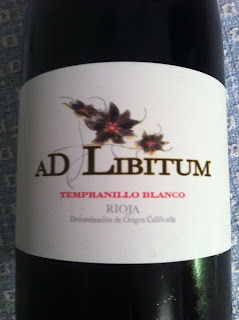
I special ordered the 2009 Ad Libitum 100% Tempranillo Blanco from the Pennsylvania state store website.  Retail on the bottle was $15 and shipping was around $7 (they do not ship out of state, but my in-laws live around Pittsburgh and were able to pick the bottle up for me).  In the glass the wine was a medium silvery lemon color with greenish tints.  The nose was fairly intense with pear, beeswax, mint and asparagus aromas.  On the palate the wine was on the fuller side of medium with medium acidity.  There were flavors of pear, cooked asparagus, Meyer lemon, eucalyptus and beeswax.  It had a very vegetal kind of flavor profile overall that was really odd.  It picks up a bit of tartness as it approaches room temperature, but never really shakes off the stewed vegetable character.  I don't see this grape taking over the vineyards of Rioja any time soon, especially since the Consejo Regulador of the Rioja region has specified that vineyards must pull up a previously growing vine in order to plant Tempranillo Blanco in their vineyards.  I'd like to get my hands on a fresher example to see if perhaps age played a part in my disliking this wine, but as you might imagine, Tempranillo Blanco based wines are pretty difficult to find. 

REFERENCES

1) Kobayashi, S, Goto-Yamamoto, N, Hirochika, H.  (2004)  Retrotransposon-induced mutations in grape skin color.  Science.  304, pp 982.

2)  This, P, Lacome, T, Cadle-Davidson, M, Owens, CL.  (2007)  Wine grape (Vitis vinifera L.) color associates with allelic variation in the domestication gene VvmybA1.  Theoretical and Applied Genetics.  114, pp 723-730.

3) Yakushiji, H, Kobayashi, S, Goto-Yamamoto, N, Jeong, ST, Sueta, T, Mitani, N, Azuma, A.  2006.  A skin color mutation of grapevine, from black-skinned Pinot Noir to white-skinned Pinot Blanc is caused by the deletion of the functional VvmybA1 allele.  Bioscience, Biotechnology and Biochemistry.  70(6), pp 1506-1508.

4) Walker, AR, Lee, E, Robinson, SP.  Two new grape cultivars, bud sports of Cabernet Sauvignon bearing pale-coloured berries, are the result of deletion of two regulatory genes of the berry colour locus.  Plant Molecular Biology.  62(4-5), 623-645.

also consulted:

Cadle-Davidson, M, Owens, CL.  (2008)  Genomic amplification of the Gret1 retroelement in white-fruited accessions of wild Vitis and interspecific hybrids.  Thoretical and Applied Genetics.  116, pp 1079-1094.

**I've recently come across a more recent paper that shows that locates a specific mutation in VvmybA2 that is present in all white cultivars that also have the Gret1 transposon mutation in front of VvmybA1.  The VvmybA2 mutation occurs in two places within the gene.  The first mutation alters the production of an amino acid (the gene produces leucine here in the non-mutated version and arginine in the mutated one), while the second mutation is a deletion of a dinucleotide, which causes the gene to terminate early.  It looks like these mutations on VvmybA1 and VvmybA2 are typically found together in most of the white-berried grape cultivars studied.

Walker, AR, Lee, E, Bogs, J, McDavid, DAJ, Thomas, MR, & Robinson, SP.  2007.  White grapes arose through the mutation of two similar and adjacent regulatory genes.  The Plant Journal.  49, pp 772-785.

Monday, September 24, 2012

Verdelho - Madeira, Portugal; Canary Islands, Spain & California, USA

Several months ago, I wrote a post about the Sercial grape, in which I indicated that  I was planning a series of posts that would deal with the major grapes used in the production of Madeira.  That project is taking longer than I would have liked, but today I'd like to continue it with a look at another of the "classic" Madeira grapes, Verdelho.  In my Sercial post, I briefly outlined the history of Madeira wine, and readers interested in that topic are advised to read through that post, as today I'm more interested in taking a look at what makes Madeira different from other wines, and to do that we need to take a closer look at how it is made.

Before it was the name of a wine, Madeira was the name of a place, namely an island group about 600 miles west of Portugal.  It was one of the last stops for European ships on their way to the Americas, and many of them stocked up on the wines of the islands before setting off on their journeys.  In the early days, the wines made on the Madeira Islands were ordinary table wines, but it was found that they spoiled very quickly on board the ships, as they were stored in large barrels and exposed to the elements, particularly the sun, which deteriorated them rapidly.  Eventually it was found that adding brandy to the wines helped them last longer while on board traveling ships, but even these fortified wines eventually cooked in the merciless sun in the middle of the ocean.  While the resulting product was very different from everyday wine, it was found that it picked up some new and interesting flavors not found in any other wines, and many people began to develop a taste for it.  In particular, the US Colonies were very fond of these wines from Madeira and became a large export market for them.

Up until the early 20th Century, some Madeira houses still put barrels of wine on ships in order to properly age them, but virtually no one does that anymore.  Today, there are basically two different methods used to properly age Madeira: estafugem and canteiro.  Estafugem is the quick and dirty method where the wine is placed in large stainless steel vats that are heated either via a hot water jacket on the outside of the tank or by immersing a heating coil in the wine itself.  The vats are sealed, but not filled to capacity and are usually agitated in some way to aid oxidation as well.  The heat is applied for about three months before being bottled.  This method is fast and cheap and is used for the production of low-quality Madeiras, as the secondary flavor characteristics prized by Madeira enthusiasts are at best only hinted at using this method.

The canteiro method is the one preferred for the production of higher quality Madeiras, especially for vintage or varietal Madeiras.  Here, the wines are placed in wooden casks that can vary from 300 to 2500 litres, and the casks are placed in a warm place.  Many lodges place them in lofts or in areas as high as possible (since heat rises, after all), though others just place them outside in the sun.  The casks are typically left alone for at least two years, and the wines made in the canteiro style cannot be sold until at least three years from the January 1st following the harvest.  The casks are not topped up, and most barrels lose about 5% of their liquid each year due to evaporation.  Basic Madeiras sold with the name of one of the four "noble" Madeira grapes, Sercial, Bual, Verdelho or Malmsey, usually go through this process, while vintage Madeiras are typically aged for much, much longer.

As mentioned above, Verdelho is one of the four noble Madeira grapes.  Each of the four noble grapes maps roughly on to a particular style of Madeira with Sercial being the driest, Verdelho the next driest, Bual a little sweeter and Malmsey the sweetest.  The Verdelho of Madeira is not the same as the Verdelho of mainland Portugal, which is now known as Gouveio (or Godello, in Spain).  The Madeira Verdelho is also widely grown in the Azores, and it is thought that vines from the Azores were brought to Australia in the 19th Century.  Verdelho is still relatively widely planted throughout Australia, to the extent that the Australian Alternative Varieties Wine Show does not consider Verdelho to be an alternative variety and will not consider entries made from it.  I must admit that I came across more examples of wine made from the Verdelho grape than I had anticipated, but in the end decided it was still unusual enough to merit inclusion here.

The first wine that I tried was the 2005 Twisted Oak Verdelho made from grapes grown in the Silvaspoons Vineyard in Lodi, California, which I picked up from my friends over at the Gypsy Kitchen for about $16.  As mentioned in my recent post on Torrontés, the Silvaspoons Vineyard is owned and maintained by Ron Silva, who primarily grows Portuguese grape varieties there.  In the glass, this wine was a light silvery lemon color with greenish tints. The nose was fairly reserved with some green apple and lemon-lime citrus fruits along with some slighly oaky and buttery aromas as well.  On the palate the wine was on the fuller side of medium with fairly low acidity.  There were flavors of vanilla, ripe pear, buttery pie dough, ripe apple, coconut and pineapple candy.  I had half expected that the wine would be shot as it was 7 years old when I tried it, but it was drinking very well.  It's not really my style of wine, though, as the low acid and prominent oak are a deadly combination for my taste buds.  Fans of moderately oaked California Chardonnay will find a lot to like here, though, especially for the money.

The next wine that I tried was the 2007 Bodegas Viñátigo Verdello from the Ycoden Daute Isadora region on the western tip of the Tenerife island in the Canary Island chain.  I picked this wine up for around $32 from my friends at the Spirited Gourmet.  In the glass the wine was a fairly deep bronze-gold color.  The nose was fairly intense with leesy aromas of red apple, pear and honey with a little nuttiness and a little cheesy funk as well.  On the palate the wine was medium bodied with fairly high acidity.  There were flavors of toasted almonds and sawdust along with some honey, red apple, dried apple, dried apricot and baking spice.  This is a wine that really needs to be served as close to room temperature as you can manage, as it is harsh and spare when chilled too much.  As it warms up, though, the spice and dried fruits really become more apparent and the wine becomes much more generous and appealing.  It's not a cheap wine, but it is both good and interesting, which are the two major requirements I have for wines in this price range.

The final wine that I tried was the NV Vinhos Barbeito "Savannah Verdelho" from their Historic Series, which set me back about $40.  As a proud Georgia native, I was gratified to learn about the strong history of Madeira in the city of Savannah.  In addition to being a major port city for the import of Madeira wine in the early days of America, the city was (and I believe still is) the home to the Madeira Club of Savannah, a group of Madeira enthusiasts who gather monthly to drink fine old Madeiras, dine together and discuss issues of the day.  While this wine probably wouldn't be served at one of their functions, I found it plenty enjoyable.  In the glass the wine was a dark, deep tawny-brown color.  The nose was very intense with powerful roasted nut and burnt sugar aromas.  On the palate the wine was on the fuller side of medium with high acid and medium sweetness.  There were zippy flavors of green apple, tasted walnuts and pecans, burnt sugar and smoke along with a slight salinity as well.  This wine was exceptionally balanced with an electric vein of acidity that really supported the sugar and nutty fruits.  This would be amazing with nutty desserts like pecan pie or baklava, but would also be nice with salty, funky cheeses as well.

Much of the discussion about the methods of producing Madeira wine is adapted from Trevor Elliott's The Wines of Madeira, which interested readers can order here.

Friday, September 14, 2012

Albarín Blanco - Tierra de Leon, Spain

A few months ago, reader Tony sent me an email asking if I'd ever had a wine made from the Albarín Blanco grape, and, furthermore, whether I knew if Albarín Blanco was the same grape as the much more well known Albariño.  His cursory research into the matter was inconclusive as some sources indicate that the grapes are identical to one another while others assert that they are separate varieties.  I'm always up for a challenge, so I decided to look into the matter a little bit to see what I could find.  I had always heard that the two grapes were identical, but I had never really investigated the matter in depth.

My first two lines of research are always Wikipedia and the Oxford Companion to Wine.  The latter source has no entry on Albarín Blanco while the former redirects you to the entry on Albariño.  This was interesting, but hardly conclusive, so next I checked out the VIVC database where I was surprised to find that there were separate entries for Albariño and Albarín Blanco, which is usually a solid indication that the grapes are indeed distinct from one another.  Given the conflict between the sources I had consulted to that point, I decided to check a few abstract databases to see if there were any studies published that looked at both Albarín Blanco and Albariño.

To my surprise, I was able to find quite a few different papers with DNA profiles for both grapes.  The first paper that I read (citation 1 below) was actually an ampelographical study which looked at the physical characteristics of a number of different vines in northwest Spain and concluded that the two vines looked different enough to be considered separate varieties.  The authors also examined the claim that Albarín Blanco was the same as the Albillo grape and were able to determine that they were separate grapes as well.  Ampelographical evidence is nice to have, but it's not really considered definitive in today's world of DNA analysis, so I moved on to the next paper (citation 2 below), which analyzed the DNA of a number of different grapes in northwestern Spain at 10 different microsatellite sites.  The results clearly showed that the two grapes were separate cultivars with distinct DNA profiles.  Somewhat tantalizingly, though, the profiles matched at one allele on 9 of the 10 sites analyzed, which may suggest some kind of relationship between the two grapes, though not a parent/offspring relationship.

Satisfied, I sent my findings back to Tony, who was excited by the answers that I found.  Tony had already tried a wine made from the grape and had found a lot of Sauvignon Blanc characteristics in it, so he decided to check the VIVC microsatellite database to see whether those two grapes might be related.  While there were a number of similarities, the data at the VIVC definitely indicated that there was no parent/offspring relationship between Sauvignon Blanc and Albarín Blanco.  Tony also decided to check Albarín Blanco against Savagnin, though, and, surprisingly, the two grapes matched one another at one allele on all six sites that the VIVC tracks.  This is suggestive of a parent/offspring relationship, but as we've mentioned here before, you need way more than six sites to determine those kinds of relationships, so I fired up the old search engines again and tried to find studies that might be able to link Savagnin with Albarín Blanco.

My search led me to a paper (citation 3 below) written by a Spanish research team who happened to notice that two sample vines (accessions) in the collection of the Mision Biologica de Galicia, which were both labeled as Albarín Blanco, actually looked very different from one another.  They suspected that these were two distinct vines, so they analyzed each of them.  They also analyzed a handful of other accessions that looked very similar to one of the Albarín Blanco vines (Albarín Blanc I) to see whether they were related as well.  What they found was that not only was the Albarín Blanco I vine distinct from the Albarín Blanco II vine, but the Albarín Blanco II vine was actually Savagnin!

The authors believe that Savagnin may have been brought into Spain in the late 19th Century by French wine technicians from Bordeaux.  These technicians came to show the locals how to graft vines onto native American rootstocks in order to thwart the phylloxera louse that had recently ravaged the vineyards of Europe.  They brought several different French vines with them, and it is thought that Savagnin could have been one of those vines.  Both Albarín Blanco and Savagnin share some physiological characteristics and both ripen early, so it is possible that growers confused the two vines and have just been calling both by the same name for years.  Coincidentally, it also turns out that much of what was grown in Australia as Albariño was later found to be Savagnin as well.  I can't find any evidence that the cases of mistaken identity have a common root cause, but the mind certainly swims with possibilities.

There was also a study published in 2003 (citation 4 below) that found that Albarín Blanco and Savagnin were identical.  The samples for this particular study both came from the El Encín in Madrid.  Readers with good memories may recall that an accession at the Encín was the result of all of the confusion surrounding Hondarrabi Zuri, as a sample mislabeled as Hondarrabi Zuri was actually an American hybrid grape called Noah.  The authors of the paper on Albarín Blanco and Savagnin say that while many of the vines at the Encín were collected by grapevine experts, towards the second half of the 20th Century, the institute began requesting vines from the Agricultural Authority of each province, rather than sending an expert into the fields to collect them.  In many cases, then, the person who was collecting the requested vine was not an expert, and it is thought that this led to many errors in naming in this collection.

All of which is interesting, but the original question that I had was whether Savagnin could possibly be a parent to Albarín Blanco.  I emailed the corresponding author on paper #3, but have not received any response.  I've also been unable to find anything definitive in the literature.  The closest thing I've found was a paper (citation 5 below) that analyzed 56 different grape varieties grown in the northwestern area of the Iberian peninsula, including both Albarín Blanco and Savagnin.  The study wasn't designed to check for parent/offspring relationships, but the authors do mention a few possible relationships between some of the grapes that they analyzed given the data that they acquired, but a possible relationship between Albarín Blanco and Savagnin is not mentioned.  This is merely suggestive evidence, but it makes me think that the two grapes probably aren't related.

I was able to pick up a bottle of the 2011 Villacezan "Elverite" Albarín Blanco from a store in the Pittsburgh, PA, area for about $9.  The wine is from the Tierra de Leon DO in northwestern Spain (map).  In the glass the wine was a pale silvery lemon color with greenish tints.  The nose was fairly intense with grapefruit, grapefruit peel, apricot and honeydew melon fruits along with a kind of grassy herbaceousness.  On the palate the wine was medium bodied with medium acidity.  There were flavors of white grapefruit, honeydew melon and grassy herbs along with a touch of salinity and a strong mineral finish.  Like Tony, I found a lot of similarities between this wine and a Sauvignon Blanc-based wine. The salinity and minerality really put this over the top for me and give it a kind of complexity that is very difficult to find at this price point.  It would be a slam-dunk with fresh oysters and lots of other seafood as well.  Sauvignon Blanc fans will find a lot to like here, as will fans of bright, fresh white wines.

CITATIONS

1) Martinez, MC, & Perez, JE.  2000.  The forgotten vineyard of the Asturias Princedom (north of Spain) and ampelographic description of its grapevine cultivars (Vitis vinifera L.).  American Journal of Enology & Viticulture, 51(4), pp 370-378.

2) Gago, P, Santiago, JL, Boso, S, Alonso-Villaverde, V, Stella Grando, M, & Carmen Martinez, M.  2009.  Biodiversity and characterization of twenty-two Vitis vinifera L. cultivars in the northwestern Iberian peninsula.  American Journal of Enology & Viticulture, 60(3), pp 293-301.

3) Santiago, JL, Boso, S, Vilanova, M, & Carmen Martinez, M. 2005.  Characterisation of cv. Albarín Blanco (Vitis vinifera L.).  Synonyms, homonyms and errors of identification associated with this cultivar.  Journal International des Sciences de la Vigne et du Vin, 39(2), pp 57-65.

4) Martin, JP, Borrego, J, Cabello, F, & Ortiz, JM.  2003.  Characterization of the Spanish diversity of grapevine cultivars using sequence-tagged microsatellite site markers.  Genome, 46, pp 10-18.

5) Martin, JP, Santiago, JL, Pinto-Carnide, O, Leal, F, Carmen Martinez, M, & Ortiz, JM.  2006.  Determination of relationships among autochthonus grapevine varieties (Vitis vinifera L.) in the northwest of the Iberian peninsula by using microsatellite markers.  Genetic Resources and Crop Evolution, 53, pp 1255-1261.