A blog devoted to exploring wines made from unusual grape varieties and/or grown in unfamiliar regions all over the world. All wines are purchased by me from shops in the Boston metro area or directly from wineries that I have visited. If a reviewed bottle is a free sample, that fact is acknowledged prior to the bottle's review. I do not receive any compensation from any of the wineries, wine shops or companies that I mention on the blog.
Showing posts with label Hybrid Grapes. Show all posts

Friday, April 12, 2013

Cayuga White - New Hampshire and Finger Lakes, New York, USA

One of the things that I really love about digging into some of these unusual grapes is learning how many of them are related to one another.  For instance, I knew today's grape, Cayuga White, was a hybrid, but I didn't know anything about its parents or grandparents.  I learned that it is the offspring of a Seyval Blanc x Schuyler crossing, which is kind of cool because I'm a little familiar with Seyval, but I didn't know anything about Schuyler.  It turns out that Schuyler is itself a crossing of Zinfandel and another hybrid grape known as Ontario (which is a crossing of Winchell and Moore's Diamond).  Which means that Cayuga is the offspring of Seyval Blanc, the grandchild of Zinfandel and the great-grandchild of Moore's Diamond, three very different grapes!

As with human beings, one can get into trouble expecting family members to closely resemble one another.  Cayuga bears virtually no resemblance to Zinfandel, and though it can occasionally pick up some foxiness if allowed to over-ripen, it doesn't bear much resemblance to Moore's Diamond either.  Interestingly, the two grapes that Cayuga is most often compared to are Riesling and Muscat, neither of which figure into its family history.  Like Riesling and Muscat, Cayuga is often made into an off-dry or medium sweet wine, though it also makes interesting sparkling wines if harvested early enough.  It is most heavily planted in New York state, where it covers just over 400 acres, but can also be found in the American Midwest and to a more limited extent in the northeastern US and southeastern Canada.

Cayuga was created in 1946 at the New York State Agricultural Experiment Station in Geneva, New York, by John Einset and Willard B. Robinson.  It was selected from other seedlings in 1952 and was finally released in 1972 as "the first of a Finger Lakes series of wine grapes for New York." Cayuga was successful because it buds late and ripens early, which cuts off the extreme ends of the growing season.  It is a heavily productive and vigorous vine that benefits from a discouraging hand in the vineyard.  In fact, in 1964, a "25 variety trial" was undertaken to test the "most commercially promising American and French hybrid varieties and six new Geneva selections."  The 25 selected vines were planted on three different sites in New York and various statistics were gathered about them over a period of several years.  One of the statistics was total yield and Cayuga outperformed all of the other grapes in the trial in that category.  It has decent disease and fungal resistance, but only moderate cold-hardiness, which has prevented it from becoming more popular with growers.

I was able to try two different wines from the Cayuga White grape.  The first was a NV wine from Jewell Towne Vineyards in New Hampshire.  Jewell Towne is the oldest winery in New Hampshire, though they only opened in 1994.  The owner, Peter Oldak, has been growing grapes on the property since 1982, when he planted six vines on a hobbyist lark.  By 1990, he was growing over 60 different varieties and decided to teach himself how to make wine.  He made a few vintages for other wineries but decided to open his own winery in 1994.  His debut vintage was only 40 cases which sold out in three weeks.  Today, Jewell Towne produces over 7000 cases per year and is really the first name in New Hampshire wine today.  I picked this wine up at a state store in Nashua for around $12. In the glass the wine was a very pale silvery lemon color that was almost water-white.  The nose was moderately intense with aromas of peach, grapefruit, pineapple, pear and cheese.  On the palate the wine was light bodied with medium acidity.  It was medium sweet with flavors of mandarin orange, pineapple candy, pear, white peach and golden apple.  It finished short and with a bit of bitterness.  It was a fairly nice wine for the money, but wasn't anything too memorable.

The second wine that I tried was the 2011 Ravines "Keuka Village," which is 80% Cayuga and 20% Vignoles.  Ravines is located on Keuka Lake in the Finger Lakes, but I picked this up locally at the Spirited Gourmet for around $13.  In the glass the wine was a deep gold color.  The nose was moderately intense with aromas of honey, green apple, pear, apricot and orange marmalade.  On the palate, the wine was on the fuller side of medium with high acidity.  It was off-dry with flavors of green apple, lime, honeysuckle flower, orange peel, white grapefruit and pineapple.  It was bright, tart and zippy, which surprised me a little because the nose really smelled sweet and I thought this was going to be a syrupy mess.  It was nice and citrusy, though, and I could definitely see why someone might want to compare this wine to a kabinett level Riesling.  It was nicely aromatic and fairly well balanced, which is a pretty nice combination in a sine under $15.


Thursday, February 7, 2013

Moore's Diamond - Cape Cod, Massachusetts and Finger Lakes, New York, USA

When I was first learning about wine, I had a lot of trouble trying to understand what the term "foxy" meant when it was applied to native American grape varieties.  At that time, I had only ever had wine that was made from Vitis vinifera grapes so the use of the word "foxy" to describe wines made from non-vinifera varieties was mystifying to me.  The Oxford Companion to Wine's entry on "foxy" says that foxiness is "the peculiar flavour of many wines, particularly red wines, made from American vines and American hybrids," which isn't really all that helpful.  The entry goes on to state that the Concord grape is the most well known foxy-tasting grape, "reeking of something closer to animal fur than fruit, flowers, or any other aroma associated with fine wine."  This seems to suggest that the term comes from the fact that the grapes and wines taste kind of like fox fur, but that may not necessarily be the case.  Writing in 1908, UP Hedrick, in his Grapes of New York (which you can peruse electronically here), has the following to say about the origin of the term foxy:

"Bailey gives the following interpretation of the word "fox" and its derivatives as applied to grapes: 'The term fox-grape was evidently applied to various kinds of native grapes in the early days, although it is now restricted to the vitis labrusca of the Atlantic slope. Several explanations have been given of the origin of the name fox-grape, some supposing that it came from a belief that foxes eat the grapes, others that the odor of the grape suggests that of the fox - an opinion to which Beverly subscribed nearly two centuries ago - and still others thinking that it was suggested by some resemblance of the leaves to a fox's track. William Bartram, writing at the beginning of this century, in the Medical Repository, is pronounced in his convictions: 'The strong, rancid smell of its ripe fruit, very like the effluvia arising from the body of the fox, gave rise to the specific name of this vine, and not, as many have imagined, from its being the favourite food of the animal: for the fox (at least the American species) seldom eats grapes or other fruit if he can get animal food.' I am inclined to suggest, however, that the name may have originated from the lively foxing or intoxicating qualities of the poor wine which was made from the wild grapes. At the present day we speak of 'foxiness' when we wish to recall the musk-like flavor of the wild Vitis labrusca; but this use of the term is of later origin, and was suggested by the name of the grape."' Bailey, L. H . Evolution of our Native Fruits: 5 1898."  Peter May (whose book on Pinotage I reviewed here) passed along this link which has a thorough and interesting discussion on "foxiness" as well.

All of which is interesting, but unless you know what the "effluvia arising from the body of a fox" smells like, probably isn't really all that helpful.  Judging by the number of threads devoted to the topic of foxiness on many wine message boards, I wasn't alone in my confusion.  Many try to describe it as a musky flavor, which is a little more helpful but is still maddeningly vague enough to not be satisfactory.  Still others describe it as a kind of grapey flavor, like Welch's grape juice or grape jelly, which I've found a little bit more helpful, but not totally accurate. The scientific explanation is that there are two chemicals, methyl anthranilate and O-aminoacetophenone, that are responsible for the taste and flavor perceptions that we regard as foxy. Methyl anthranilate (C8H9NO2) is found in Concord grapes and many other fruits, but is also secreted by dog and fox musk glands and is responsible for the "sickly sweet" smell of rotting corpses.  At full concentrations, its aroma is described as "grapey" and it is often used to flavor grape candies and drinks.  O-aminoacetophenome is apparently another chemical with a particularly grapey aroma that is found in many native American grape varieties, but can also be found in the anal sac of the Japanese weasel (really).

Knowing all of the information above can get you part of the way to understanding what "foxiness" is, but the only real way to get a handle on what that term means is to try a foxy wine.  Several years ago, still not knowing just what "foxy" meant, I found myself at Truro Vineyards in Truro, Massachusetts.  My wife and I were going through a tasting of some of their wines, most of which are made from traditional Vitis vinifera varieties, when they poured me a wine from a blue bottle shaped like a lighthouse which they said was made from a grape called Moore's Diamond.  When I stuck my nose in the glass, I knew immediately what "foxiness" was.  I grew up in rural Georgia and my grandparents had a grape arbor in their back yard that was planted with Scuppernong grapes.  Scuppernongs belong to the Vitis rotundifolia species which is also known as "muscadine" because they're very musky and have a very distinctive kind of taste which, it turns out, is what people mean when they talk about foxiness.  It was a moment of great revelation as so many things suddenly became clear to me.  I wasn't doing this blog at the time, but I recently came across another bottling of Truro's Diamond and decided to write a little bit about the grape.

Moore's Diamond was bred by Jacob Moore around 1870 by fertilizing a Concord vine with pollen from an Iona vine.  Iona is itself a hybrid of Diana (or possibly Catawba) and an unknown Vitis vinifera vine, which makes Diamond a Vitis vinifera x labrusca hybrid.  It was once very highly regarded and in 1908, UP Hedrick writes: "Diamond is surpassed in quality and beauty by few other grapes. When to its desirable fruit characters are added its earliness, hardiness, productiveness and vigor it is surpassed by no other green grape."  He goes on to say: "We usually accord Niagara first place among green grapes but Diamond rivals it for the honor. The former attained high rank not only through merit but by much advertisement while Diamond has made its way by merit alone.  If we consider the wants of the amateur and of the wine-maker as well as those of the commercial vineyardist, unquestionably Diamond must be accorded a high place
among the best all-around grapes."  Hedrick was a fan of Diamond because he likes "the refreshing sprightliness of our native fox grapes," and feels that the introduction of some vinifera into the lineage gave Diamond a "touch of the exotic."  The vine is also relatively cold hardy and carries many of the same resistances to disease as the other native American vines, but it is thin skinned and thus susceptible to many fungal diseases.  Its popularity was never as high as Hedrick might have hoped, and today it is planted on less than 100 acres in New York state and in minuscule quantities across the northeastern and Midwestern United States.

Truro Vineyards way out towards the tip of Cape Cod makes a wine that they call Diamond White from the Moore's Diamond grape.  This wine is non-vintage and comes in a blue tinted bottle shaped like a lighthouse.  It cost me around $18 at a local wine event I recently attended.  In the glass, the wine was a fairly light lemon gold color.  The nose was very intense and smelled like the Platonic ideal of foxiness (meaning it was very musky and grapey).  On the palate the wine was medium bodied with medium acidity and was medium sweet.  There were flavors of fresh picked grapes with a little bit of white pear, sweet peach and green apple flavors.  As with most wines that I try from native American grapes or hybrid grapes with predominately native American parentage, this wine tasted mostly like grape juice and very little else.  It's not that most of these wines are bad, but rather that they're not very complex and many wine drinkers avoid them because they're simple and you almost always know what you're going to get.  If you like sweet wines that taste like grape juice, then you're going to love this wine, but the price tag on it is pretty steep for what you're getting.

If you drink a lot of wines made from labrusca varieties or from foxy grapes, chances are that nearly all of them are sweet.  I don't drink wines from these grapes habitually, but I can say that every wine that I've ever had from a foxy grape was sweet except for one.  Arbor Hill in the Finger Lakes region of New York not only makes a dry wine from Moore's Diamond grapes, they age the wine in oak barrels for awhile before bottling too.  They release the wine as a NV and it costs about $10.50 directly from the winery.  In the glass this wine was a very pale silvery lemon color.  The nose was explosively perfumed and was 100% musky grapes.  On the palate the wine was medium bodied with fairly high acidity and was bone dry.  There wasn't a lot of fruit to the wine, but what was there was a little musky and grapey with a little bit of vague citrus as well.  It was a really weird wine with a kind of salty, tangy nuttiness to it as well.  The dominant flavor was still foxy grapes, but I think that because I have such a strong association of sweetness with that foxy grape flavor, this wine just ended up coming off as weird to me.  Of all the wines I've tasted for this site, this was definitely one of the most bizarre and while I'm glad that I got to try it, I don't think it's something that I'll be seeking out again anytime soon.

Wednesday, January 16, 2013

Seyval Blanc - Haverhill, Massachusetts, USA

Hello friends and neighbors and welcome to Fringe Wine's 250th post!  We've covered hundreds of grapes over the course of the previous 249 posts, but there are still literally thousands of others out there.  My ambition is not to try all of them, but merely to try as many as I can and write what I learn about them and what I think about the wines they produce.  Today I'd like to take a look at a hybrid grape that's relatively common around where I live (the northeastern United States) and in a few other (cold climate) places, but which isn't very well known outside of these limited areas.  The grape I'm talking about is called Seyval Blanc, or more cumbersomely Seyve-Villard 5276.  It was created by the French father and son-in-law team of Victor Villard and Bertille Seyve who were themselves disciples of the great French hybridizer Albert Seibel, creator of thousands of grapes like Chancellor and Verdelet.  Bertille Seyve was also the father of Joannes Seyve, who created the Chambourcin grape, and Bertille Seyve, Jr., who also tried his hand at breeding grapes, but was not as successful as his brother and father.

Seyval Blanc was created in Saint-Vallier, France (the name Seyval is a contraction of Seyve and Vallier), by crossing Seibel 5656 with Rayon d'Or.  Both of these grapes are complex hybrids, which just means that they have more than two different grape species in their lineage.  A simple hybrid would be the result of a crossing between two grapes that were of different species and which had no other species in its its parentage.  A pure Vitis vinifera crossed with a pure Vitis labrusca would produce a simple hybrid.  If we crossed this simple hybrid with a pure Vitis aesitvalis, the resulting offspring would have three different species of grapes in its lineage and it would be a complex hybrid.  This pedigree chart (from the publisher of Wine Grapes) shows just how complex Seyval Blanc's lineage is (it is erroneously listed as Seibel 5276 on the chart and is on the third row from the bottom towards the left of page 2).  While Seyval Blanc isn't quite as complex as Traminette, there are still many different grape species in its pedigree as well as several vinifera vines as well.

Seyval Blanc is also important as a parent variety and was used to breed Cayuga White, Chardonel, La Crosse and Melody, among others.  It is prized by growers and breeders alike for its high yields, disease resistance and its cold hardiness as well as its lack of foxy aromas and flavors.  It can generally be found in cool climate areas where other varieties, especially vinifera varieties, are unable to get fully ripe.  It was at one time the most widely planted grape in the UK, but its plantings have fallen to less than 100 hectares as of 2009 (which is still 6.5% of the total vineyard area of the country, though).  It is also popular in Canada and the mid-western and northeastern United States, where it was once the most widely planted grape in that region (and still may be, but I haven't seen any recent statistics).

Inside the barn/tasting room
A few months back, I was in northern Massachusetts and paid a visit to Willow Spring Vineyards in Haverhill.  I met with Jim Parker, owner of the winery, and he gave me a tour of his vineyards and of the grand centerpiece of the whole endeavor, the 18th Century barn located on the property.  When Jim and Cindy bought the property, the barn was in a state of dilapidation and disrepair, as was the land surrounding it.  Very shortly after finalizing the purchase, the pair received a letter from the city building inspector informing them that the barn was a condemned building and must be either torn down immediately or repaired.  Jim promised the barn's former owner that he would fix up the property, and so that's exactly what he set out to do.  Jim's a handy guy and so he decided to do the renovation himself.  He bought the property in 2001 and has been working on it for more than 10 years at this point, but the finished (or near finished) product is remarkable.  When I arrived for my scheduled visit, Jim was out front with some of his friends and a backhoe putting the finishing touches on the front entrace.  That entrance leads into the tasting room which still has much of the original lumber used to build the barn.  It's a wide open area that also doubles as an event center.  There's a large wraparound porch that Jim has added that looks out onto his vines.  The winery itself is located underneath the main floor of the barn (see the white door beneath the deck in the picture below).

Exterior of barn.  The wraparound deck is now covered.
Jim knew when he bought the property that he wanted to grow something on the land, but wasn't sure exactly what.  After visiting a micro brewery with some friends on a ski trip, Jim's friends suggested that he grow hops, but for some reason, Jim said he saw vines growing on the property.  He had never tried to grow grapes before, but that didn't stop him from jumping in with both feet.  Jim read widely and voraciously on viticulture and enology, met other local winemakers and went to conferences to learn as much as he could.  He started out planting Vignoles, Seyval Blanc, Marechal Foch and Leon Millot and has since added a few vines of Chardonnay as well.  The vineyards are on a south facing slope so they get maximum exposure to the sun and the cold air flows down the hill to protect the vines from frost, which is very important this far north.  Jim and his friends tend to the vines themselves and Jim's daughter Brandi has recently joined the team as head winemaker after an apprenticeship at another local winery.  When I visited, Willow Spring was available to visit by appointment only, though they plan to open to the public soon.  Those interested in visiting can email Jim directly at jim.willowspring@yahoo.com, and I highly recommend that you do as the barn is beautiful and Jim is an engaging and gracious host whose enthusiasm for his project is infectious.

When I was there, I picked up a bottle of his Leon Millot, which I'll be writing about a bit later, as well as the last bottle of his 2011 Seyval Blanc (his wines are not labeled with a vintage, though they are vintage wines, and he told me this was the 2011).  This bottle cost about $14 in the tasting room.  In the glass the wine was a very pale silvery lemon color.  The nose was somewhat reserved with aromas of green melon, pear, golden apple and banana.  On the palate the wine was light bodied with high acidity.  It was maybe just a touch off-dry with flavors of lime, green apple, tart pineapple and green melon.  It clocks in at only 11.5% abv and is lean, racy and sharp.  I love high acid white wines and this particular bottle was right up my alley.  It's difficult to believe that these guys have only been making wine for a few vintages as this was a very polished effort that definitely shows a lot of promise.  Willow Spring is a winery to keep an eye on and is a place I will certainly be visiting again before too long.

Those interested in learning more about Willow Spring should check out this video feature on YouTube and this article.  

Thursday, January 3, 2013

Traminette - Finger Lakes, New York, USA

Hello and welcome to Fringe Wine's first post of 2013.  I hope everyone had a wonderful holiday season and is having a happy young new year!  I figured I'd ease back into the blogging game by taking a look at a grape I came across during my trip to the Finger Lakes region of New York a few years back.  That trip turned out to be a fertile one, as this is the 15th post I've written about some wine I picked up while I was out there.  It is, unfortunately, also the last for awhile.  I still have many wines from that trip in my cellar, but for the most part, they're probably a bit too mainstream for this site.  I do hope to re-visit the region in the not-too-distant future, and hopefully I can find a few more unusual and interesting things then.  In the meantime, I still have many interesting grapes and wines to share with you in the coming year, so let's go ahead and get started!

Traminette is a hybrid grape with a lot of different grape species in its pedigree.  Its parents are  Gewürztraminer, which isn't too complicated, and Joannes Seyve 23.416, which is where things get crazy on a couple of different fronts.  Let's start with the grape itself: Joannes Seyve 23.416 is a cross of Bertille Seyve 4825 and Chancellor.  Bertille Seyve 4825 is not itself important as a commercial grape, but it has been somewhat important for grape breeders, and you can get a sense for how complicated its pedigree is from this chart, which is from Robinson, Harding & Vouillamoz's Wine Grapes (and which is freely available on their website due to printing issues with the book).  As you can see, Bertille Seyve 4825 (left side of the page, about half way down) has a lot of grapes in its family tree, and those grapes are from several different Vitis species, such as riparia, labrusca, aestivalis, lincecumii, rupestris, cinerea and vinifera which means that not only is Bertille Seyve 4825 itself a very complex hybrid, its offspring and its offspring's offspring are as well.

You may have also noted that we've been using two different human names for some of these crosses and these two names have a surname in common.  Joannes Seyve (1900-1966) was a French biochemist who also apparently bred grapes, as did many other members of his family.  Joannes's best known creation is Chambourcin, which we looked at not too long ago.  His father and brother were both named Bertille Seyve and both also bred grapes, though the father was more accomplished than the son.  Bertille Seyve Sr. worked closely with his own father-in-law Victor Villard, who was also a noted and successful grape breeder.  Seyve and Villard were essentially carrying on the work of Albert Seibel (who created Verdelet and Chancellor among many others) and all of the Seyve family members used Seibel crossings liberally in their own works.  The most successful Seyve-Villard crossing is Seyval Blanc, which you can read more about here.

Traminette, though, is not a Seibel or a Seyve crossing and only belongs to that group known as the French hybrids by virtue of its parentage.  You see, Traminette was created at the University of Illinois by Herb Barrett in 1965 in an effort to create large clustered table grapes with the characteristic spicy tang of Gewürztraminer.  Barrett sent the seeds from his crossing to Cornell's grape breeding program in 1968.  The seed was planted and fruit was first observed in 1971.  The vine was selected and propagated starting in 1974 under the lovely name NY65.533.13.  The vine's roots are phylloxera resistant, so grafting is unnecessary.  It is moderately winter hardy, but much more hardy than Gewürztraminer, and when it does suffer damage from cold conditions, it is typically the trunk rather than the buds which are harmed (which is not really a good thing since severe enough trunk damage can kill the entire vine).

The vine typically ripens in the first half of October in New York state.  Traminette's acidity level stays relatively high for a short while during the ripening process, and its acidity is generally higher than its parent Gewürztraminer.  It lacks the unwelcome foxy aromas and flavors of many hybrid grapes while also maintaining some of the characteristic floral and spice notes of Gewürztraminer, though the grape purportedly does not have the bitterness that turns so many people off to its parent.  These flavor characteristics can be enhanced with prolonged skin contact (12 to 48 hours) at fairly low temperatures (40 -50 degrees Fahrenheit)  prior to fermentation.  The berries and leaves are moderately resistant to a variety of mildews, though the leaves are susceptible to downy mildew.  In 1996, the New York State Agricultural Experiment Station officially named the grape Traminette, making it the fifth grape named by that group.*

I was able to try two different wines made from the Traminette grape.  The first was the 2009 Fulkerson Traminette from the Finger Lakes region of New York, which I picked up at the winery for around $12.  In the glass, the wine was a medium lemon gold color.  The nose was moderately intense with grapefruit, lychee and peach aromas along with something vaguely floral as well.  On the palate the wine was on the fuller side of medium with low acidity.  It was sweet with flavors of peach, mandarin orange, lychee, rose water and pink grapefruit.  The low acid was a problem for me, as the sugar in the wine tasted clumsy and off-balance without it.  It was also a little bitter and soapy as well, which I really don't have an explanation for.  I'm generally a fan of Gewürztraminer, and this wine had a lot of Gewürz character to it, but it really picked up a lot of the bad things Gewürz brings to the table without enough of the good.  It was probably the best of the four Fulkerson wines that I picked up (Vincent, Dornfelder and Lakemont/Himrod) and it is a decent wine for the money, but it's not something that I would find myself consistently reaching for.

The second wine that I tried was the 2009 McGregor Vineyards Traminette from the Finger Lakes, which I picked up in their tasting room for around $16.  In the glass the wine was a fairly light silvery lemon color.  The nose was moderately intense with grapefruit, baking spice, lychee, and pear aromas with something vaguely floral as well.  On the palate the wine was medium bodied with fairly high acidity.  It was maybe a little sweeter than off-dry with flavors of lime, pink grapefruit, lychee, green apple and honeysuckle flower.  This wine was almost searingly tart and had acid to burn.  I generally prefer my wines to be more like this, but I found myself wishing that I had something in between these two examples, as that's where I thought the real balance probably was.  Overall, I thought they both kind of tasted like more restrained versions of Gewürztraminer, so if the powerful floral and spice characteristics of that grape are too much for you, then Traminette may be worth a shot.  I personally love the rich heady perfume of Gewürztraminer and don't think that these wines are really a fair substitute for wines made from that grape, but they're interesting and characterful in their own right and are priced much lower than their European counterparts.

*I have heavily leaned on their press release for much of the information in this post.  The release can be read in full here.

Friday, December 7, 2012

Vidal Blanc - Massachusetts and Finger Lakes, New York, USA

Vidal Blanc is either a grape you've never heard of or a grape that you can't get away from, depending on where you live and, to some extent, how you shop.  Here in the cold northeastern United States, Vidal is seemingly everywhere, but only if you go to the local wineries to sample their wares.  It is still difficult to find on store shelves in the Boston area, and if you do run across one in your local shop, chances are it's a Canadian ice wine.  I've made many visits to most of the wineries in Massachusetts and to many others throughout New England, though, and I came across so many Vidal Blanc based wines that, for awhile, I thought that perhaps Vidal Blanc wasn't really a fringe grape.  I was surprised, though, when I saw some of the planting statistics for the grape.  Canada certainly leads the way in Vidal plantings at nearly 2,000 acres, much of which is ultimately used to make ice wine, but I was shocked to learn that Virginia actually leads the way in US plantings of Vidal at 150 acres,* followed closely by Michigan  (145 acres) and Missouri (118 acres) before dropping off precipitously to 35 acres in Indiana and 32 in Illinois.  Clearly the vine isn't quite as ubiquitous as it seemed to me, so I decided to write about the Vidal Blanc grape itself and a few local wines that I've come across recently.

Vidal Blanc was created in 1930 by Jean-Louis Vidal, a French grape breeder who was trying to create new grapes for Cognac production.  Jean-Louis created Vidal Blanc by crossing Ugni Blanc (aka Trebbiano Toscano, one the grapes still most commonly used to make Cognac) with Rayon d'Or, which is itself a hybrid created by our old friend Albert Seibel by crossing two other Seibel hybrid grapes together (Seibel 405 & 2007, for those filling out your pedigree charts at home).  Jean-Louis Vidal created several thousand different grapes throughout his career, but Vidal Blanc has definitely been the most successful and is easily the most widely cultivated grape bred by him.  Even though the grape was created in France by a French breeder, it is virtually non-existent there today.

Vidal Blanc came to the New World, or at least to Canada, in 1945, when a man named Adhémar de Chaunac imported 35 French hybrids (one of which was Vidal Blanc) and four vinifera varieties into Canada.  De Chaunac was the technical director at TG Bright winery in Niagara Falls, and he was looking for new grapes to grow at his winery other than the foxy native American varieties that had been widely used to that point in Canadian wine history.  Most plantings with vinifera varieties had not gone well, as they were generally unable to tolerate the harsh Canadian winters, so De Chaunac was hoping to find some cold hardy varieties in this group that could withstand the difficult climate and still make European-style wines.  Test plots were planted and wine making trials began and by the 1960's, the hybrid grapes that showed the most potential were gaining ground in the Canadian planting statistics.  Maréchal Foch, Seyval Blanc, Verdelet, De Chaunac and Vidal Blanc were the most popular, and many of those grapes are still somewhat widely planted throughout Canada.

Vidal Blanc is perhaps best known for the ice wines created from it in many parts of Canada and the northeastern United States.  As mentioned in my post on an ice wine made from Cabernet Sauvignon in Canada, true ice wines are made from grapes that are left on the vine well after the regular harvest and allowed to freeze there.  The frozen grapes are harvested in the dead of night (to prevent their thawing) and are pressed while still frozen.  What happens when a grape freezes is that much of the water in the grape turns to ice, but most of the sugar doesn't freeze, so when you press the frozen grapes, the solid ice stays behind, but a concentrated, sugary syrup comes out.  This syrup is then partially fermented, since it is impossible to convert all of that sugar into alcohol, and the result is a rich, lusciously sweet wine.

It may seem like a simple thing to just leave some grapes on the vine and harvest the frozen juice, but not all grapes are suited to making good ice wine.  First of all, the grapes need to stay on the vine a very long time, and as grapes hang on the vine and ripen, they tend to lose their acidity.  Acidity is key in sweet wines, though, since without it, wines just taste syrupy and cloyingly sweet.  Secondly, the longer grapes hang on the vine, the greater the chance that they can be damaged either by diseases such as molds or mildews, by insects or birds, or just from the wind and weather.  Thick grape skins help protect grapes while they are waiting for the first freeze to arrive, so while thin-skinned varieties like Semillon are valued for the production of botrytised sweet wines (since their thin skins allow the botrytis to more easily infect the grapes), thick skinned varieties are preferred for the production of ice wines.  Vidal Blanc happens to have thick skins and relatively high acidity, which makes it an ideal grape for ice wine production.

When I visited the Finger Lakes region of New York a year or so ago, I picked up a bottle of the 2009 Vidal Ice from Standing Stone Vineyards for about $25 for a half bottle.  This is not a true ice wine, since the grapes were picked and then later frozen before ultimately being pressed.  In the glass it was a light tawny gold color.  The nose was fairly intense with aromas of honey, dried apricot, quince, baked apple and pineapple.  On the palate the wine was on the fuller side of medium with fairly high acidity.  It was lusciously sweet with flavors of honey, apricot, baked pineapple, and orange creme with a bright, zippy vein of tart green apple running through it.  It was dense and rich, but it was also lively and snappy thanks to the fresh acidity.  I found it really well balanced and enjoyed it an awful lot.  I've bought Vidal Blanc based ice wines from Canada before and have paid almost $100 for half bottles of some of them, so at only $25 per half bottle, this is a tremendous value.

In his Wines of Canada (which I've used extensively throughout this post), John Schreiner gives the following quote about Vidal Blanc from the CEO of the Canadian wine powerhouse Vincor, Donald Triggs: "Vidal is in that magical area of not making a really great table wine but a phenomenal Icewine."  While Canada tends to focus on making ice wine from their Vidal grapes, most American producers make dry table wines from theirs, and I was able to pick up a few local examples recently and test whether Triggs' assessment of its potential as a table wine grape was accurate or not.

The first bottle that I tried was the 2010 Vidal Blanc from Running Brook Vineyards in North Darthmouth, Massachusetts, which set me back about $13.   Running Brook was founded by Pedro Teixeira and Manuel Morais, both of whom spent much of their separate childhoods in the Azores islands of Portugal.  Manuel started his first vineyard in 1975 and was one of the first people to grow grapes commercially in New England.  Pedro was actually his dentist and the two quickly realized that they both shared a passion for the vine and wine and decided to go into business together.  They opened Running Brook Vineyards in 1998, according to their website, though their labels say "Est. 2000."

In the glass, this wine was a medium lemon gold color.  The nose was moderately intense with pear, banana, grapefruit and honeysuckle flower aromas.  On the palate the wine was on the fuller side of medium with medium acidity.  It was medium sweet with flavors of honeyed pink grapefruit, poached pear, candied pineapple and coconut.  The image that sprang to mind while drinking this wine was a Dole fruit cup, meaning it was fruity and sweet with a variety of flavors going on, but was still kind of flat and ultimately not that exciting.  Fans of simple, sweet white wines will find a lot to like here, especially for the price, but it's not really my thing.

The second wine that I tried was the 2009 Travessia Vidal Blanc, which I picked up for about $10 (not at the winery, but rather at the Bin Ends discount store in Braintree...the 2011 Vidal Blanc seems to cost about $15 at the winery itself).  Travessia is an "urban winery" located in downtown New Bedford, Massachusetts, which is owned by Marco Montez, who also makes all the wine.  Marco doesn't own any vineyards, but rather he buys most of his grapes from Running Brook and from Westport Rivers in Massachusetts.  He does make wine from California and from Washington St. grapes, but he insists that his wines labeled as being from Massachusetts are made with 100% Massachusetts fruit.

In the glass, this wine was a medium lemon gold color.  The nose was reserved with reserved aromas of honey, pineapple and peach.  On the palate, the wine was medium bodied with high acidity.  It tasted off-dry with flavors of green apple, under-ripe pineapple and lime with just a touch of peachiness.  It was somewhat tart with sharp acidity, but I found that I preferred this to the flatter Running Brook wine.  Both were somewhat Riesling-like, but the Running Brook was definitely broader and more generous, while the Travessia was leaner, sharper and more austere.  To some extent, this could be a vintage issue, since 2010 was very hot in Massachusetts, and many wineries found themselves with very ripe grapes.  2009 was a more typical, cooler year, so the grapes probably weren't quite as ripe as in 2010, and as a result, the acidity is a bit higher and the fruits aren't quite as generous.  Whatever the reason, this wine is a great value at only $10, and would still be a good value at $15 as well.

*These statistics are taken from Wine Grapes, which indicates that New York has substantial plantings, but gives no acreage for them.  I haven't been able to find any specific numbers for New York myself, since most sources online only list the top 5 or so hybrid grapes grown in New York, and Vidal apparently doesn't crack that list.  Further, New York seems to measure things in terms of tons of grapes processed rather than acres under vine, so even if I could find a number for Vidal, I'm not sure how enlightening it would actually be.
Tuesday, July 31, 2012

Chancellor - Rhode Island, USA

I actually set out to write about the Chancellor grape a few weeks ago, but in the course of researching that post, I found out that a wine that I had that I thought was made from Chancellor grapes actually turned out to be made from the Kanzler grape (among others).  Luckily that wasn't the only wine made from the Chancellor grape that I had in my cellar, so today we're still able to take a look at the grape and to take a look at a stylistically unusual wine made from it.

Chancellor is a hybrid grape that was created by our old friend Albert Seibel, who, among his 16,000 grape creations, also created the Verdelet grape we took a look at a few months back.  Those interested in Seibel's life and work are advised to click on the Verdelet link, as I went into some detail about him there and don't plan to repeat most of it here.  Seibel created Chancellor around the 1860's and named it Seibel 7053.  S 7053 was the offspring of two other Seibel crossings, Seibel 5163 and Seibel 880.

I've written a few times about how hybrid grapes are named, but Chancellor offers a unique opportunity to really see the process.  As I've mentioned before, nearly all of the hybridizers who were working in France in the mid to late 19th Century only named their grape creations with their own last name and a number.  These grapes typically retain these names until they start to gain some acceptance as viable commercial crops, and then someone, usually a body in the area where the grape is gaining prominence, names the grape in order to make it appealing and memorable to consumers.  Seibel 7053 is not only an unenticing name, but also would get very confusing if there were 10 different Seibel grapes available with only a three, four or even five digit number differentiating their names  Do I want Seibel 7053 or Seibel 7063?

As mentioned above, Chancellor was created in the 1860's in France and was, at one time, the most widely planted hybrid in France, but it was never really used to produce commercial wines, and so was never given a proper name.  It was introduced into the US in the 1940's and into Canada in 1946.  It became an important grape in some of the cooler regions of the US and Canada, such as the Finger Lakes region of New York.  In 1970, the Finger Lakes Wine Growers Association decided to rename Seibel 7053 Chancellor, and that name has stuck ever since.  The letter proclaiming Chancellor's new name can be viewed here, and it is interesting to see that this is also the same letter that gave Vignoles its current name.  It is also interesting to note that the names given in these circumstances don't always take.  Seibel 9549 is given the name Cameo by the Growers Association, but that grape is currently better known as DeChaunac.

Chancellor is considered to be one of the finest French hybrid vines for wine production.  It is considered cold-hardy, but does have an early bud break that can be a problem in areas with late spring frosts.  The vine is also susceptible to a handful of vine disesases, but it is thought that its susceptibility to both downy and powdery mildew has limited its plantings, especially in damp, humid areas like the eastern United States.  Chancellor is the grandparent to Noiret, a grape we took a look at a few months back that is generating some excitement as a promising new hybrid grape.

I had expected to be able to find a table wine made from the Chancellor grape during my trip to the Finger Lakes last summer, but ultimately was unable to do so.  The wine that I do have is from a winery in Rhode Island called Sakonnet, which is located about 45 minutes south of my home and just a few minutes outside of Newport, RI.  It is interesting in that it is a sweet fortified wine made in a Port style, rather than a table wine style, which is not something that very many people are trying to do with the grape.  I picked up this half-bottle of the 2007 Chancellor port for $25 at the winery. In the glass the wine was an inky, opaque purple-black color with a narrow crimson rim.  The nose was fairly intense with aromas of raisins, dried blueberries and dried figs.  On the palate the wine was on the fuller side of medium with medium acidity and high alcohol.  It was medium sweet with velvety dried blueberry, blackberry jam, prune, raisin and fig flavors.  I've tried this wine on a few different occasions and have found nearly every time that the alcohol is excessively prominent and the wine burns as you drink it.  Most fortified wines taste a little hot, but the high alcohol is generally carried pretty well and balanced by the ripe, sweet fruits, but the alcohol in this wine is really out of balance.  The wine is pretty tasty overall and is definitely interesting, but it is a bit pricey and has some obvious flaws as well.

Wednesday, June 27, 2012

Vignoles - Finger Lakes, New York, USA

Generally speaking, establishing the pedigree of man-made crossings and hybrids is a pretty simple task.  The people who create these new grapes are typically working in a research laboratory environment and they tend to keep detailed notes and logs about their efforts.  Even those grape breeders who are working outside the confines of a university (like our old friend Elmer Swenson) tend to keep written records of their experiments and to meticulously track the pedigree of each grape that they create.  Pedigree reconstruction for these grapes is supposed to be an easy thing because we don't have to try and reconstruct a process of nature.  A person was not only there for the birth of a new grape, but was directly responsible for putting both of its parents together.

Despite this, it does occasionally happen that the parentage of a man-made grape comes into dispute.  A few months back we took a look at the Emerald Riesling grape, which was created by the legendary Dr. Harold Olmo at UC Davis in 1948.  Olmo's own paper announcing the release of the grape lists the grape's parentage as Muscadelle of California and White Riesling, but the Oxford Companion to Wine online edition lists the parentage as Muscadelle and Grenache.  As mentioned in my post on Emerald Riesling, the OCW declined to provide any additional details about their claim, other than to assert that the parentage given by Olmo was incorrect.  They promise that their new book on wine grapes, which will be published later this year, will provide more details and we'll just have to wait and shell out the $125 to read all about it then.

Part of the pitch for this new book from the OCW publishing crew is that they brought a grape geneticist on board who not only reviewed and incorporated some of the most up-to-date literature on grape DNA analysis, but also conducted a number of analyses himself explicitly for inclusion in this particular book.  My guess is that whatever new parentage they've uncovered for Emerald Riesling is the result of this private research.  I'm very interested to read their take in this new book and hope that these results turn out to be more viable than their assertion that Hondarrabi Zuri and Noah are the same grape.

I personally find it unlikely that Harold Olmo would be mistaken about the parentage of a grape that he created, but if he was (**UPDATE** he was), it turns out that this wouldn't be the first time that something like this has happened.  The subject of today's post, the Vignoles grape, was created in France by a private breeder named J.F. Ravat around 1930.  The grape was known as Ravat 51 until 1970 when the Finger Lakes Wine Growers Aassociation renamed it Vignoles.  The parentage of Vignoles was reported as Seibel 6905 (also sometimes known as Subereux) and Pinot de Corton.  This parentage is given in a number of different sources (Iowa St., Wikipedia, the OCW, the VIVC and the National Grape Registry, among others) with a few minor variations.  First, it turns out that there isn't any grape known as Pinot de Corton, so some assume that Pinot de Corton refers to a clone of Pinot Noir from the Corton region of Burgundy and thus report Pinot Noir as a parent rather than Pinot de Corton.  Additionally, Wikipedia reports the other parent as Seibel 8665 rather than Seibel 6905 (which is almost certainly a mistake), while the OCW simply says that the other parent is Seibel (which, as far as I know, is not a name given to any individual grape, but is rather used generally to refer to the thousands of various grapes that Albert Seibel created during his career).

The problem, it turns out, is that neither Seibel 6905 nor Pinot Noir are actually the parents of Vignoles.  In a study published in 2008 (see citation 1 below), a research team from UC Davis and Cornell University examined a number of hybrid grapes that are commonly used by the Cornell breeding program to see whether their purported parentages were accurate.  Of the 24 grapes that they examined, the given parentage was confirmed for 20.  Two of the others were the result of a vague description and one other had Gamay reported as a parent but was actually the offspring of Pinot Noir.  Vignoles was the 24th grape, and the team was able to conclusively rule out both Pinot Noir and Seibel 6905 as parents.  Unfortunately they were not able to identify the actual parents of Vignoles, so that bit of its history remains a mystery.  The research group tested two other samples of Vignoles to be sure that they didn't have an anomalous grape and both of those samples came back identical to the first sample.  They offer as a possible explanation that perhaps what is known in the US isn't actually Ravat 51, but it's hard to know how at this point how that might be tested.

Vignoles was introduced into the US in 1949 and was given the catchy moniker P17857 (or sometimes 181481).  As mentioned above, it was renamed in 1970 by the Finger Lakes Wine Growers Aassociation, though I'm not sure what led them to choose the name Vignoles.  The grape buds late, which helps it avoid early spring frosts, and has small berries with thick skins.  Despite that, the berries are not only prone to cracking, but are also very susceptible to botrytis cinerea infection in both its good and its bad forms.  It is naturally high in sugar and acid and as a result many wines made from it are either made in an off-dry style or as a late-harvest style dessert wine.  It is moderately cold hardy which has made it popular in cooler climates like the Finger Lakes region of New York.


During my vacation to that area last year, I picked up three different wines made from Vignoles, all from the same producer but each in a different style.  The first wine was the standard table wine offering from Anthony Road on Seneca Lake.  I picked this up for about $13 from the winery and tasted it at our beautiful cabin on the lake (seen in the background of the picture at right).  In the glass this wine was a medium gold color.  The nose was moderately intense with white peach, grapefruit peel and pear fruit along with a touch of something vaguely floral.  On the palate the wine was medium bodied with fairly high acidity and was off-dry. There were flavors of honey, white peaches, grapefruit peel, and pineapple.  There was a touch of something bitter on the finish that was a little disconcerting, but overall this was a very nice wine, especially for the money.  It is somewhat Riesling-like in its balance of sweetness and acidity, but isn't quite as graceful as some of the best Rieslings.

The second wine that I tried was Anthony Road's "Sweet Dream," which is a late-harvest dessert style wine made from Vignoles grapes.  This wine was from the 2007 vintage and set me back about $16 for a half-bottle.  In the glass the wine was a fairly light amber-gold color.  The nose was pretty intense and pungent with pineapple, ripe peach, baked apple and orange marmalade fruits along with something that I couldn't quite identify but which smelled kind of like kerosene or like an old camping lantern.  On the palate the wine was full bodied with fairly high acidity.  It was very sweet (16.2% residual sugar) and had flavors of pineapple, honey, orange marmalade and orange peel.  This wine finished with the same kind of bitterness that the table wine had, but it was more pronounced here.  Overall the wine was OK, but that assessment may have something to do with the fact that I drank it the day after the next wine that I'll be writing about, which is a wine that it had no hopes of being able to compete with.

The final wine that I tried was the 2008 "Martini-Reinhardt Selection" Vignoles Trockenbeeren, which I picked up from the winery for $75 for a half bottle.  If that price sounds extravagant, well, it kind of is.  This wine is made from grapes infected with noble rot, botrytis cinerea, which, as mentioned above, Vignoles is particularly susceptible to.  It is extraordinarily rare for grapes to be infected with noble rot in the Finger Lakes region, but in 2008, the conditions lined up just right for some of the Vignoles and Riesling vines at Anthony Road to fall victim to the fungus.  The winemaker at Anthony Road recognized what was going on and decided to make a sweet wine in the style of the great Trockenbeerenauslese wines of Germany or the Sauternes wines of France.  These wines are typically very expensive because you get very little juice from the desiccated grapes (in Sauternes it is said that an entire vine yields a single glass of wine) and because the grapes have to be monitored daily and hand picked cluster by cluster and sometimes berry by berry in order to ensure that the best grapes are being used.  It's a labor-intensive process that requires an experienced eye and a lot of extra time.

In the glass this wine was a medium amber gold color.  The nose was fairly intense with aromas of marmalade, honey and stone fruit along with the same very pungent, almost kerosene like smell.  It was much stronger in this wine than in the other and may have been a by-product of the botrytis fungus itself (some of the berries for the prior wine may have picked up a little botrytis on the vine but not enough to make a wine in this particular style).  On the palate the wine was full bodied with high acidity.  It was lusciously sweet, clocking in at a whopping 26.5% residual sugar.  There were flavors of ripe peaches, orange marmalade, honey, green apple and lime curd.  In a word, this wine was extraordinary.  It was impeccably balanced with an amazing tension between the electric acidity and the rich, dense, explosively sweet fruit flavors.  It is well worth every penny of its steep price tag and if there's a better wine on earth made from Vignoles grapes, I'd be extremely surprised.

WORKS CITED

1. Bautista, J., Dangl, G.S., Yang, J., Reisch, B., & Stover, E.  2008. "Use of Genetic Markers to Assess Pedigrees of Grape Cultivars and Breeding Program Selections."  American Journal of Enology and Viticulture.  59(3).  pp 248-254.

Wednesday, June 13, 2012

Baco Noir - Ontario, Canada

Today marks Fringe Wine's first foray into the Great White North, better known to most as the nation of Canada.  While Canada's wine making history can be traced back to the early 19th century, finding wines from Canada that aren't ice wines can be a difficult task, even here in Massachusetts which is only a few hours from the Canadian border.  Canadian wines are apparently somewhat tough to find even in Canada, as they hold less than a 50% market share of all wines sold within Canada (meaning that over half of all wines in Canada are from somewhere else in the world, which is a rare feat among wine-producing nations).  I was able to find today's wine, made from Baco Noir grapes, in a shop in the Boston area, but before telling you about that wine and the Baco Noir grape, I'd like to talk a little bit about the history of the Canadian wine industry.

Much of the vineyard land in Canada is located in the southern part of the country, typically around large bodies of water that help to moderate drastic temperature shifts and which can also soften the edges of a harsh winter.  Somewhat surprisingly, most Canadian vineyards are located at a latitude similar to that of Languedoc in southern France or Chianti in Italy.  Furthermore, in some of Canada's wine growing regions, the summer temperatures are higher on the average than those in Bordeaux or Burgundy.  While these facts may seem to add up to a warm growing region, the fact of the matter is that because the summers are so much shorter and because the winters are so much harsher, Canada's vineyards cannot support the same warm weather grapes as their latitudinal counterparts across the pond.

The first cultivated vineyard in Canada was a 20 acre plot devoted to local labrusca vines.  From about 1811 through 1916, most of the vineyards in Canada were planted either to various native vine species or to cold-hardy hybrids.  1916 could have sounded a catastrophic death-knell to Canada's young and scattered wine industry as the Canadian government enacted their own form of prohibition, four years before the United States would do the same.  Curiously, grape growers in Canada were able to lobby that wine be excluded from the general prohibition on alcohol, so rather than suffer the profound setbacks that the United States wine industry endured as a result of this legislation, the Canadian wine industry was able to flourish and expand.  Canadian prohibition was repealed in 1927 (six years before the 21st amendment repealing prohibition was passed in the US), and in the eleven year span of its existence, nearly 60 winery licenses were granted just in the province of Ontario.

The ending of prohibition in Canada was damnation in disguise, though, as at around the same time prohibition was repealed, the Canadian government enacted legislation that created large government controlled monopolies within each province which were responsible for the sale and distribution of all alcoholic beverages.  A freeze was also put on granting winery licenses, and no licenses were given for new wineries from 1927 until 1974, when the Inniskillin winery was given its commercial license.  During this 50 year span, though, the wine industry was essentially handcuffed, as expansion and experimentation were very difficult, if not impossible, within the confines of this system.  Most of the wines produced were sweet and foxy and quite a few of them were fortified to boot, while most of the vineyards were still planted to native grape varieties and hybrids.

A series of events around 1988 led to the establishment of what might be called the modern Canadian winemaking industry.  The first was the enactment of a free trade agreement with the United States in 1987 which removed many trade restrictions between these two nations and allowed for greater movement of consumer goods between them.  The second was the creation of the Vintners Quality Alliance (VQA), which established the framework for an appellation system in Canada as well as minimum quality standards for wines that would carry the VQA seal (this exists only in Ontario and British Columbia with subtle differences in each locale).  The final act was the initiation of a vine-pull program that had the Canadian government partially subsidizing and incentivizing growers to pull up their native vine species and hybrids and replace them with higher quality vines.  While this has certainly led to an increase in the plantings of European vinifera vines, there are still a lot of native and hybrid species, especially in some of the more climactically extreme regions of the country (though labrusca species are specifically banned from inclusion in any VQA wines, no such ban exists on hybrids or on wines produced outside the purview of the VQA).

One of the more popular and well regarded of the hybrid vines in Canada is Baco Noir.  Baco Noir was created by a Frenchman named François Baco either in the 1890's or early 1900's.  Baco was one of the great French hybridizers (like Albert Seidel, Johannes Seyve or Pierre Landot) who was active around the turn of the 20th Century.  Baco's crowning achievement was actually a grape called Baco Blanc, which was used primarily as the base for Armagnac until the 1970's.  Folle Blanche had been the primary Armagnac grape until phylloxera came along and decimated the plantings in this area.  Folle Blanche didn't take well to the phylloxera cure of grafting onto American rootstocks, and so Baco Blanc, a crossing of Folle Blanche and a native American grape called Noah, became the preferred variety in the area.  It has since been supplanted by Ugni Blanc, but there are still over 5,000 acres planted to it in the area, though that number is decreasing rapidly.

Baco Noir is also an offspring of Folle Blanche, but its other parent is an unknown Vitis riparia vine.  It was itself once widely planted in some areas of France, but is hardly found there anymore.  It was introduced into the United States in 1951 and in Canada a few years later in 1955.  It is relatively widespread throughout the midwestern, northeastern and mid-Atlantic regions of the US as well as in eastern Canada.  It is fairly cold hardy, though it does have a relatively early bud-break which can be a problem in areas that are prone to late spring frosts.  It does have a problem with vigor and needs to be aggressively pruned on light, fertile soils, but is typically fine on heavier, poorer soils.  It is a fairly low yielder that is susceptible to a few different fungal diseases and is apparently very attractive to birds.

I was able to find a bottle of the 2005 Henry of Pelham Baco Noir from Ontario for about $18 from my friends at Curtis Liquors.  In the glass the wine was a fairly deep brickish garnet color with a brick red rim.  The nose was intense with spicy black plum and black cherry fruit along with some baking spice, bitter chocolate and cocoa powder.  On the palate the wine was full bodied with fairly high acidity and medium tannins.  There were flavors of cocoa, black plum, black cherry, dried cherry, baking spice and black pepper, with a hint of tart cherry popping up on the finish.  This wine was much deeper and richer than some of the other red hybrids I've reviewed (like Chambourcin, St Croix, Vincent, Marechal Foch and Landot Noir), but it did still have that tart red berry fruit at its core.  It is a tasty wine and represents a pretty good value at less than $20 a bottle.  I would definitely recommend grabbing a bottle if you run across it and serving it with a richly marbled grilled steak.

Friday, March 30, 2012

Verdelet - Finger Lakes, New York, USA

Entering words blindly into Google image search isn't always a wise idea.  There isn't usually a lot of overlap between grape names and tawdry photos, but I do occasionally get some racy results.  Other times, I find out that there's a weird kind of synonymy between the grape I happen to be researching and some random thing in the world.  Today, for example, I found out that there is apparently a character named Verdelet in a video game called Drakengard who "is a pious man who is always careful of his words and of doing the right thing, but places himself first should the situation becomes dire."  Sure, I could eliminate these kinds of results by always including the word "grape" in my searches, but sometimes those wrong results can shed some interesting light on how a grape may have gotten its name, like with the Trousseau grape.  Most of the time, though, those wrong turns just end up at dead ends like the pious, self-interested Verdelet of Drakengard who, I think we can safely assume, has nothing to do with today's grape.

Today's grape is Verdelet and it is a hybrid grape that was created by the great French hybridist (hybridizer? hybridder?) Albert Seibel, who we've mentioned in passing in a few posts around here but who we've never really taken a good, detailed look at.  Seibel lived from 1844 - 1936 and was a physician by trade.  Those of you who are up on your vinous history will note that Seibel was a young man through the heart of the Phylloxera epidemic, which really started to become a noticeable problem in France around the 1860's.  Once it became known that native American vines were the source of the louse and, further, that the native American vines seemed to be immune to it, one of the proposed solutions to the scourge was to create hybrid grapes by crossing native European vines and native American vines.  This solution was successful, but was not ultimately the answer to the problem since the resulting hybrid vines were unable to produce wines that were qualitatively similar to the native European vines.  But just because it wasn't the ultimate solution doesn't mean that it wasn't a viable (and profitable) solution in the short term, and Seibel ended up creating a company that was focused on developing new hybrid grape varieties.

Seibel and his group ultimately created over 16,000 different hybrid grapes and had as many as 500 of those available for commercial cultivation at one point.  While nowhere near that many are still cultivated today, it is shocking how many are still planted and made into wine.  One might wonder why anybody would bother with these vines since the Phylloxera louse has been rendered virtually obsolete by the technique of grafting European vines onto native American rootstocks.  The answer is that many of the hybrids created are also tolerant of more extreme climactic conditions, especially cold conditions, such as those found in the northeastern or mid-western United States or in the UK.  Further, they tend to be quite disease resistant and also tend to yield generously.  For climactic regions that are too harsh for the cultivation of vinifera species, the French hybrids that Seibel and others like him created are a good second choice.  Even though the wines made from them aren't as interesting or complex as wines made from vinifera grapes, they are much better than the foxy, ultra-sweet wines made from native American grapes.

When I visited the Finger Lakes region of New York recently, I came across a wide variety of hybrid grapes, many of which were created by Seibel.  Verdelet, also known as Seibel 9110, is certainly one of them, but Chancellor, Chelois, De Chaunac and Vignoles were also well represented.  Grapes like Aurore, Rougeon, and Rosette are also relatively well represented in other parts of the US, Canada and the UK, while the Plantet grape still covers quite a bit of ground in the Loire Valley in France.  Verdelet is one of the less common Seibel grapes, and as a result, specific information about it is limited.  As you can see from the picture above, the grapes are nearly clear when ripe with little green pigmentation their skins.  Most nurseries that offer the vine for sale indicate that it is mostly used as a table grape, and a very productive one at that.  In a book on wines from British Columbia in Canada, the author gives an anecdote about a producer who obtained 120 tons of fruit from only 6 acres of land planted to Verdelet.  Acreage devoted to the grape is declining pretty much everywhere, though it is apparently still fairly popular in Texas.

While in the Finger Lakes, I only came across a single wine made from the Verdelet grape.  It was made by Bully Hill Vineyards, who we've had some dealings with before around here, and it was a NV wine that I picked up for about $8 in their tasting room.  In the glass, this wine was a medium lemon gold color.  The nose was moderately intense with aromas of pear, ripe apple, grapefruit and a bit of peachy stone-fruit.  On the palate the wine was on the lighter side of medium with high acidity.  The label says the wine is dry but I found it to be just off-dry.  There were flavors of lime citrus, peach and grapefruit that were tart and zippy.  It wasn't a particularly complex wine, but the flavors were bright with a nice intensity.  It reminded me a little bit of Riesling, though without the depth and concentration that good Rieslings can have.  Overall, I was very pleased with this wine, especially at only $8, and would be eager to try it again the next time I find myself in the area.  It was definitely the best thing that I tried from Bully Hill, though that isn't exactly saying a lot.  Bully Hill makes a ton of different wines (I mean a ton) and I tried only a few while I was there (for the reasons why, see this post on the St. Croix grape).   For the most part, the quality of wines made here isn't that great, but this wine and the Chardonel I wrote about last week were were pleasantly surprising.  The Verdelet isn't listed on their webpage, for some reason, so I don't know what kind of availability they usually have, but if you happen across it, it's definitely worth a try.

Friday, March 23, 2012

Chardonel - Finger Lakes, New York

Researching hybrid grapes can be brutally and mind-numbingly boring sometimes.  There are the occasional interesting cases of older grapes like Delaware, but the closer you get to the present day, the less interesting the back-stories for these grapes tend to be.  Generally speaking, these hybrids have been created in a laboratory setting in order to meet a specific need, such as cold-hardiness or disease resistance, and their status as engineered products puts off a lot of people who are seduced by the romance of nature in grapes and wine.  Most of the information that is published about these grapes reflects this utilitarian functionality and is aimed more for growers and for researchers than for consumers.  It tends to be loaded with descriptions about the vine's temperature preferences, disease resistance and susceptibilities, yields, and more physical description of each part of the plant than you would ever want to know.  There are few places to try and get a good narrative foothold since there's rarely any kind of mysterious back story or human angle in the grape's creation.  Sure, the grapes are ultimately made by people (scientists are people after all), but the creation stories for these grapes almost never focus on them, opting for information about their pedigree and behavior in the field instead, which ultimately ends up coming across as sterile and dull.  They're basically plant catalogs whose function is to convey a certain kind of information as simply and efficiently as possible.

This certainly isn't the case for all hybrids and crossings.  Some of the older hybrids and crossings are interesting because there is a distinct human element present in their story.  Grapes like St. Croix, for instance, which was created by an amateur in Wisconsin in his own back yard.  Or grapes that were created by people like Harold Olmo or Albert Seibel who were prolific in their efforts and were extraordinarily successful in creating a large number of grapes that are still somewhat widely cultivated today.  I like to think of these guys as mad scientists in flickering rooms cluttered with arcane equipment who are hell bent on unleashing their huge armies of Frankengrapes upon the world.  People like that are out of date now, though, as most grapes are created by teams of scientists at breeding institutions who are fortunate if any of their creations are ever made available for public use.  In the case of the Chardonel grape, the published paper announcing the grape's release has eleven authors on it, which should give you some sense of the collaborative effort required for its creation.  One man who creates a dozen grapes is interesting but a dozen people who create one grape is a different story altogether.

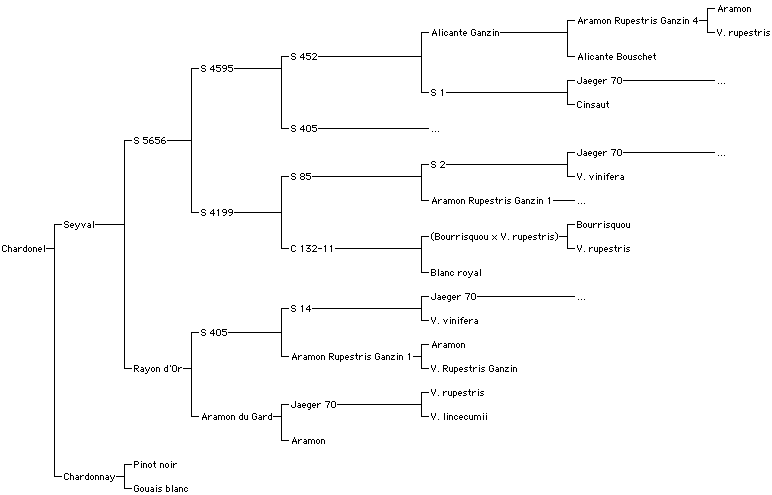
But Chardonel was created and it is available for commercial propagation.  Since I was able to track down a bottle of it, I'm going to tell you the most interesting things that I've been able to find out about it.  Chardonel was created at Cornell's New York State Agricultural Experiment Station in Geneva, NY, in 1953 from a crossing of Seyval Blanc and Chardonnay.  Seyval Blanc is itself a hybrid which is grown mainly in cooler climate regions like the Finger Lakes in New York and, surprisingly, in England.  The full pedigree for Chardonel can be seen here and it's an interesting view of just how grueling it can be to create a viable hybrid.    If you just stopped the family tree at Chardonel's parents, it would look like a fairly simple project, but as you go deeper and look at the family tree for Seyval Blanc, it gets dizzying in a hurry.  All of those fields that are simply letters and numbers are other hybrid grapes created by other hybridizers which were never deemed good enough for commercial release and thus never named.  The letters represent the hybridizers last names (S = Seibel, for example) and the numbers correspond to whatever numbering convention each hybridizer used to catalog his own creations.

Though the Seyval x Chardonnay crossing responsible for Chardonel happened in 1953, the fruit was not observed until 1958 and the vine wasn't chosen for experimental propagation until 1960.  The grape wasn't released to the public until 1990, though, for reasons we'll get to momentarily.  I mentioned above that the paper announcing Chardonel's release had 11 authors and implied that they were all involved in the grape's creation, but the fact of the matter is that the very long time between the grape's creation and its release makes it difficult to say for sure who was involved and in what capacity.  The VIVC and this page at Iowa State University lists the grape's creators as Reisch, Pool and Einset.  Reisch and Pool are the lead authors of the announcement paper, but Einset is only mentioned in the acknowledgements.  I'm not sure who the other 9 people given an author credit in the paper are or what their role actually was.

Like most grapes created at the New York State Agricultural Experiment Station, Chardonel was bred specifically to be able to handle cold conditions.  Seyval Blanc is noted for its winter hardiness and the hybridizers were hoping that they could create something as hardy as Seyval with the flavor characteristics of Chardonnay.  And to some extent, they were successful.  Chardonel has much better winter hardiness than Chardonnay and is rated as hardier than Seyval in Michigan but as slightly less hardy in most other places.  It does ripen late, though, which is a problem for cooler areas with short growing seasons like New York.  Wines made from the Chardonel grape are generally regarded as preferable to those made from Seyval, and wines made from grapes grown in warmer areas like Missouri and Arkansas are considered superior to those of New York.  The reason that the grape wasn't released for 30 years is that the fields tests being done in New York weren't promising enough to warrant release.  Some vines were planted experimentally in Michigan and Arkansas, though, and the results from those vines were so encouraging that the grape was finally named (it had been known as New York 45010 at first and then as GW9 prior to 1990) and released.

I was able to find a bottle of Chardonel at Bully Hill Vineyards on my trip to the Finger Lakes region of New York a few months back.  I've previously written about my experience at the winery and interested readers can find that information here.  Bully Hill is weird about their vintages and this wine isn't labeled with one.  It cost me about $8 in their tasting room.  In the glass the wine was a medium lemon gold color.  The nose was very reserved with a whiff of pear if I used my imagination, but overall it was a total blank.  On the palate the wine was medium bodied with fairly high acidity.  It is one of the few dry offerings that Bully Hill has.  There were zippy lemon and lime citrus flavors with some green apple and citrus peel with a touch of green melon on the finish.  The wine was bright, lively and interesting, which was much more than I was really expecting.  The label on this wine honestly put me off of it for a long time and I kept looking at it in my cellar and dreading the thought of opening and drinking it, but I found it very nice.  I would gladly pay $8 for this again and am now very curious about these superior wines being made from Chardonel elsewhere in the US.