A blog devoted to exploring wines made from unusual grape varieties and/or grown in unfamiliar regions all over the world. All wines are purchased by me from shops in the Boston metro area or directly from wineries that I have visited. If a reviewed bottle is a free sample, that fact is acknowledged prior to the bottle's review. I do not receive any compensation from any of the wineries, wine shops or companies that I mention on the blog.
Showing posts with label Colombard. Show all posts

Friday, March 16, 2012

Free Wine Friday - Domaine du Tariquet, Côtes de Gascogne, France

It doesn't happen all that often, but it does occasionally happen that some very nice people affiliated with a winery or a distributor will send me some free wine.  The US representative for the Domaine du Tariquet in France recently reached out to me and offered to send me three wines from their portfolio.  I let them know that of the three, really only one would fit with my Fringe Wine theme, but they sent me all three anyway.  I figured since they were nice enough to send them all to me, I could bend my rules just a bit and start a new feature called Free Wine Friday where I'll profile whatever wines I've received for sample purposes, even if the wines don't fit all that neatly into my Fringe Wine paradigm.  I don't expect that this will turn into a regular feature, but we'll see what happens.  I do want to be sure to say that the only compensation that I have been given was a sample of the wines themselves and that my opinions expressed below are my honest impressions of the wines I tasted.  This post has not been written or reviewed by anyone other than myself and I have no affiliation or commercial interest in Domaine du Tariquet or any of their business associates.

Domaine du Tariquet is located in the Gascony region of southwest France.  The Gascony region is more or less the area between the Atlantic Ocean to the west and the Garonne River to the east, stretching south from Bordeaux to the Spanish border.  The Domaine itself is located in the foothills of the Pyrenees mountains in a town called Éauze, which looks like the middle of nowhere on Google maps.  Éauze is situated within the Armagnac region, which is, of course, best known for the production of the brandy which carries the region's name.  This area does not fall into any established AOC region, so table wines made here carry the Côtes de Gascogne vin de pays designation instead.  The Côtes de Gascogne is responsible for producing more than 100 million bottles of wine per year and nearly all of it is for the export market.  About 90% of that production is white wine, which is somewhat unusual if you look at all the red wines produced in the neighboring regions, but which makes more sense when you remember that the grapes used as the base for Armagnac production are all white grapes.  As the demand for table wines has increased, many of the growers in the Armagnac region have opted to make table wines from their grapes rather than brandy, so since they have acres and acres of white grapes at hand, it certainly makes sense that they would ultimately make white wines.

Tamed Bears.  Seriously.  Bears.
Domaine du Tariquet follows that pattern as well, but before we get there, it's worth taking a look at the history of the estate and the family that has owned it for the past 100 years.  Like so many great stories, this one starts out with a bear tamer and a dream.  Artaud (whose first name I can't seem to find) was a bear tamer from the village of Ercé in the foothills of the Pyrenees where apparently bear taming was just something that you do.  He had two (!) tamed bears that he took with him around the world in what I'm guessing was some sort of traveling act before he ultimately ended up in the US where he stayed for several years.  Eventually homesickness got the better of him and he returned to France in 1912.  He came across the Tariquet estate and fell in love with it, so with the financial assistance of his son Jean-Pierre, a bartender in New York, and Jean-Pierre's wife Pauline, he bought the estate whose lands had been thoroughly gutted by the Phylloxera epidemic which had left only seven hectares of land under vine and those vines in terrible shape.  Artaud lived on the Tariquet estate while Jean-Pierre and his family remained in New York.

When World War I broke out in 1914, Jean-Pierre returned to France and enlisted in the army.  He was injured by a bayonet wound during the war and the massive blood loss he suffered caused him to suffer from amnesia.  He was hospitalized in France until 1922 when he was sent back to New York to his wife who had waited for him for over eight years.  Jean-Pierre was much changed from his experiences, but Pauline stuck it out with him.  The two of them soon returned to France and had a child they named Hélène.

Fast forward to the 1930's when a man named Pierre Grassa was working as a hairdresser in the town of Bordeaux after his tour of duty in the Joinville Battalion of the French army was finished.  When WWII broke out in 1939, Pierre rejoined his old battalion, which was soon captured, making Pierre a German prisoner of war.  Apparently Pierre wasn't much of a fan of being held prisoner so he escaped and fled to southwestern France where he joined the local resistance movement in the town of Éauze, which, it just so happens, is where Domaine du Tariquet is located.  Pierre meets Hélène, they fall in love, and are soon married.  They are still married to this day and their children, Maïté and Yves, are carrying on the family business, which has grown from the meager 7 hectares under vine in 1912 to more than 900 today, which makes them the largest family owned estate in France.

In 1972, the family decided to start their own company to produce brandy rather than just selling the grapes off to other brandy houses.  In 1982, they decided to make table wines as well.  Yves, who took over winemaking responsibilities 25 years ago, was the first grower in the region to plant Chardonnay, Sauvignon Blanc and Chenin Blanc grapes alongside the Armagnac stand-byes of Ugni Blanc (the Trebbiano Toscana of Italy) and Colombard.  It seems hard to believe that planting these grapes was ever a controversial thing to do, but at that time, it definitely was.  Yves was rewarded for his risk in 1987 when one of his wines was selected as Wine of the Year in England.  Today the third generation of the Grassa family, Remy and Armin, are in charge of the estate which is celebrating its 100th year under family ownership this year.

Domaine du Tariquet currently makes 10 different wines, 9 white and 1 rosé, and they sent me three of their offerings to try.  The first was their 2010 "Classic" bottling which is 70% Ugni Blanc and 30% Colombard.  It looks like the blend for this wine may vary by vintage, as they winery currently has the 2011 info available on their website with a much different composition.  MSRP on the 2010 is $8.99.  In the glass the wine is fairly pale silvery lemon color with some greenish tints to it.  The nose was somewhat reserved with lemony citrus and peachy fruits with a touch of herbaceousness and a bit of leesy funk (which blows off pretty quickly after opening).  On the palate the wine was on the lighter side of medium with fairly high acidity.  There were zippy lemon, lime and grapefruit citrus fruits along with some ripe peach.  The overall character was a bit tart, but the wine more than made it up for it with an incredible intensity that was very surprising.  This wine overdelivers for the price in a big way and is a really great value.  I have a lot of trouble finding wines I enjoy drinking in the under $10 range, but I would drink this absolutely any time.

The second wine I tried was the 2010 Chenin/Chardonnay which is 75% Chenin Blanc and 25% Chardonnay.  MSRP for this bottle is $10.99.  In the glass the wine was a very pale silvery lemon color.  The nose was moderately aromatic with a lot of ripe pear fruit an a touch of lemony citrus and white flowers.  On the palate the wine was medium bodied with fairly high acidity.  It tasted just off-dry to me, but Tariquet doesn't put any residual sugar information on their website for their wines.  All of them are pretty low alcohol (around 11% each), so it wouldn't surprise me if there was a bit of sugar kicking around here.  There were flavors of lemony citrus and green apple with a touch of lime, tart pineapple and ripe peaches.  It was lean, sharp and zippy, so if there was any residual sugar in it, it was being balanced nicely by the racy acidity.  I enjoyed this wine, but not nearly as much as the Classic.  At $11 a bottle, it does represent a very good value, though, especially for fans of South African Chenin Blanc or fans of unoaked Chardonnay.  The email they sent me advises drinkers to "enjoy with pad thai, samosas, asian dumplings, and roast pork," which sounds about right to me.

The last wine that I tried was the 2010 Côté, which is a blend of 50% Chardonnay and 50% Sauvignon Blanc.  MSRP for this wine is $14.99.  In the glass the wine was medium lemon gold color.  The nose was very reserved with some grapefruit and green apple aromas, but it was mostly a total blank.  It does open up a little bit with some air, but not much.  On the palate the wine was medium bodied with fairly high acidity and, again, I thought it was probably just off-dry.  There were flavors of pink grapefruit, ripe apple and peaches with a touch of honey and that Sauvignon trademark grassy herbaceousness.  The wine had much more Sauvignon Blanc character than Chardonnay, which probably shouldn't be all that surprising.  It had the nice balance between the lean, sharp acidity and the round, ripe, honeyed peach flavors that the Classic wine had, but again, I preferred the Classic bottling to this one.  The email from the Tariquet representative suggests pairing this with "fish & chips, quail, or roast chicken."

Overall, I found these wines fairly enjoyable.  They're all fairly affordable and represent good values for their respective prices.  They seem like they would be versatile food wines with enough acid to stand up to a variety of foods and just enough residual sugar to be good for spicier Asian or Indian inspired dishes.  The estate offers a late harvest Gros Manseng and another late harvest Petit Manseng that I'd be very excited to try if I ever come across them.

Wednesday, December 14, 2011

Southwest France Round-Up - Virtual Tasting of 12/7/11

Last Wednesday night I was invited to a virtual tasting of eight wines from all over Southwest France.  The tasting was led by Master Sommelier and spokesperson for the South West Wines of France Council Fred Dexheimer, who led a group of bloggers through the eight wines that were provided to us free of charge.  Today I'd like to give my impressions of the eight wines we tasted, some of which we've covered here before and some of which we'll get to shortly.

The total vineyard area for Southwest France is about 50,000 hectares, half of which are in the hands of private producers and half of which is used by members of local co-ops.  The region produces about 450 million bottles of wine annually, split pretty evenly between white wines on one hand and red and rosé wines on the other.  There's also a small percentage of sparkling wine here made in the very old (older than the Champagne method) methode ancestrale which we took a brief look at when we looked at a wine made from the Mauzac grape.  I've written fairly extensively about the local wine histories of the subregions of Gaillac, Marcillac, Jurançon and Fronton elsewhere on the site, so I won't go over all that again.  Instead, I'm just going to jump right in and go through the wines in the order they were presented to us.

The first wine was the 2010 Producteurs Plaimont "Colombelle" Blanc from the Côtes de Gascogne, which is just south of Bordeaux in the Armagnac region of France.  The blend here is 80% Colombard and 20% Sauvignon Blanc and Ugni Blanc and the SRP is $10.  In the glass, the wine was a pale silvery lemon color.  The nose was very aromatic with white grapefruit and grapefruit peel with a bit of pear fruit as well.  There was also a very prominent kind of grassy herbaceousness that reminded me a lot of Sauvignon Blanc.  On the palate, the wine was light bodied with high acidity.  There were flavors of tart lemon, white grapefruit and sour pineapple.  The grassy herbaceous character extended through the palate as well.  The wine was clean and very refreshing with a stony minerality to the finish.  This wine would be a great stand-in for those looking for a substitute for Sauvignon Blanc or anyone looking for a tart, high acid aperitif.  Surprisingly, this wine held up very well the next day, and even tasted a little better as the acid had calmed down a bit.  For $10, this is an outstanding wine that would be great with shellfish or light chicken dishes.

The second wine we tried was from the same vintage and producer, but was a red wine (called Colombelle Rouge) that was about 60% Tannat, 20% Merlot and 20% Cabernet Sauvignon with an SRP of $10.  Tannat is usually a very fierce grape in its youth, so to soften it, the winemakers used a technique known as micro-oxygenation, which is essentially like sticking an aquarium bubbler into the wine as it is fermenting to introduce a lot of oxygen very quickly which reduces the tannic bite of a wine and makes it more approachable in its youth.  The technique is not without controversy, but you can go watch Mondovino or read any number of other writers if you're interested.  In the glass, this wine was a medium purple ruby color which wasn't all that deep, but which was very intense.  The nose was nicely aromatic with black cherry and dark plummy fruit with a noticeable bell pepper edge to it.  On the palate, the wine was medium bodied with fairly high acidity and low tannins.  There was juicy cherryish fruit with some bell pepper herbaceousness and some dark, earthy undertones to balance it out.  Overall, it was a little thin and hollow for my tastes, but it represents a pretty decent value for the money.  It had completely fallen apart by day two and, overall, it was my least favorite wine of the tasting.

For the third wine, we went back to the whites and had a 2008 Château Montus Blanc that was from the Pacherenc du Vic-Bilh, which is the name for white wines made in the Madiran region.  The wine is made up of 90% Petit Courbu and 10% Petit Manseng with an SRP of $27.  The wine is aged on the lees in very large (600 gallon) new French Oak barrels for between 6-8 months before bottling.  In the glass, the wine had a deep golden straw color.  The nose was nicely aromatic with vanilla, butterscotch and baked apple aromas with some pear, pineapple and pastry crust.  On the palate, the wine was just on the fuller side of medium with fairly high acidity.  There were flavors of lemony citrus, ripe apple and tropical pineapple flavors with side notes of pastry dough, butter and vanilla.  I am usually not a fan of oak in white wines, but the oak is integrated beautifully here and the wine is exceptionally balanced.  It's very similar to a fine white Burgundy and would pair with essentially the same kinds of dishes.  This wine suffered a bit on day two, but it was one of only two of the bottles that I completely finished and it was the second best wine of the tasting in my opinion.  $27 is a little high, but the quality is exceptional here and I wouldn't hesitate to pay full retail for this wine should I run across it again.

The fourth wine was one that I've had before and one I've written about here.  The wine was the 2010 Domaine du Cros "Lo Sang del Pais" made from the Fer Servadou grape (100%) in the Marcillac region.  The SRP for this bottle is around $12.  In the glass, the wine was a deep, nearly opaque purple-ruby color.  The nose was nicely aromatic with waxy black cherry and brambly blackberry fruit with some vegetal, smoky bell pepper aromas.  On the palate, the wine was medium bodied with fairly high acidity and medium tannins.  There were flavors of dark black fruits like blackberry and black cherry with a lot of smoke and savory meat flavors as well.  The tasting note provided to us says that the wine "displays the iron mineral character that is characteristic of the terroir," and I can kind of see that, I guess.  There was a bitter, metallic tang to the finish of the wine that reminded me of the unfortunate occasions in my life when I've had a bit of rusty metal in my mouth.  Iron oxide does have a particular tang to it, and I could certainly see it here, though I'm not totally sure if it was a good thing or not.  I wasn't a bit fan of this wine the first time I had it, and I'm still not totally sold on it, but for $12, it's definitely worth a shot for those curious about Fer Servadou.  The wine held up pretty well by day two, but there were other wines that I was more interested in within this tasting.

The fifth wine we tasted was the 2008 Domaine des Terrisses Gaillac Rouge which was 50% Fer Servadou, 30% Duras and 20% Syrah.  The SRP for this wine is $13.  In the glass, the wine was a very deep, purple ruby color that was inky black in the center all the way out to a very narrow violet rim.  The nose was a bit reserved with some smoky black fruit and a little bit of bell pepper herbaceousness.  On the palate, the wine was on the fuller side of medium with medium acidity and fairly high tannins.  There were flavors of dark black cherry and blackberry fruit with an intense smokiness and bitter iron tang on the finish.  There was also a touch of black pepper that lingered on the finish.  The wine was dark, brooding and a bit backward, needing a bit of time to really open up, which was a little surprising to me since our notes say that the wine is matured in stainless steel instead of wood.  Perhaps the lack of oxidative aging kept it tightly wound, but I'm not sure.  It was one of the few wines that was much better the second day.  I certainly enjoyed it, but I was much more fond of the Domaine Philémon Gaillac Rouge I wrote about in my Fer post, which is available at the same price point.  This wine will probably improve with some extra time in the bottle so if you run across it, maybe give it a little time before cracking it open.

The sixth wine that we tried was the 2008 Chateau Bellevue La Forêt "Ce Vin," made from the Négrette grape in the Fronton region of France.  I wrote about Négrette yesterday and also wrote about this wine, so those interested in reading more about the grape can do so here, and I'll just cut and paste my tasting note from yesterday's post.  In the glass, the wine was a deep, inky purple-ruby color.  The nose was very aromatic with strawberry and red berry fruit with a floral, rosy kind of character to it.  The nose was intoxicating and reminded me a bit of the Frappato that I wrote about a few months ago.  On the palate the wine was medium bodied with medium acidity and low tannins.  Like the other Fronton above, the palate was a bit of letdown from the nose, as this wine had some raspberry and blackberry fruit with a touch of bitter smoke and spice.  Overall, it was a little hollow and thin and the bitterness was a little too pronounced for me.  I tasted all of the wines for the tasting the next day and this one had suffered the most, completely falling apart by day two.

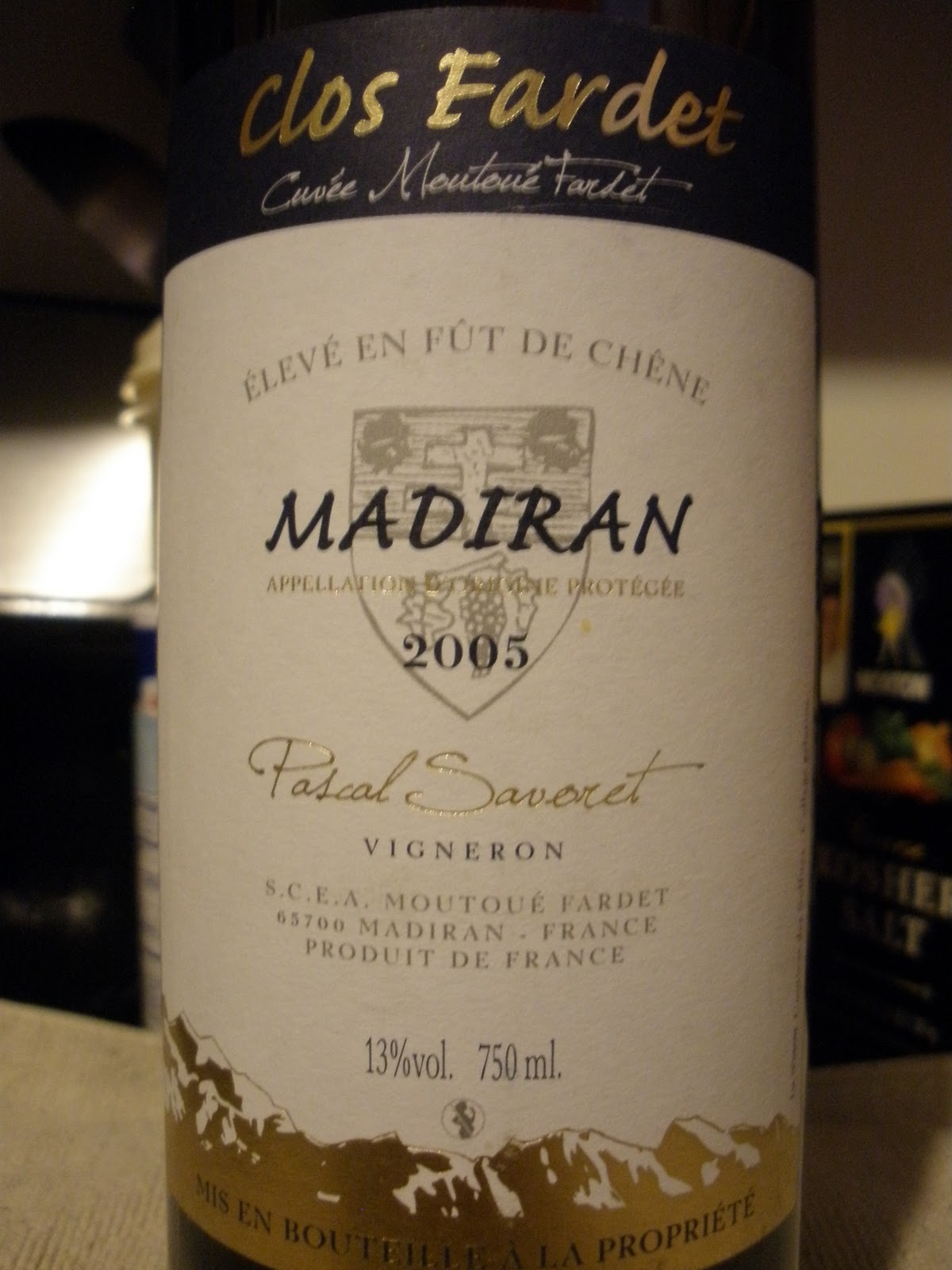
The seventh wine we had was the 2005 Clos Fardet Cuvée Moutoue Fardet which was made from 98% Tannat and 2% Cabernet Franc.  The wine is from the Madiran region and has an SRP of about $27.   The wine is made with natural yeast and minimal sulfur contact and is aged in 400 liter barrels for five years before being bottled.  In the glass, the wine had a deep, inky purple-black color that was opaque out to a narrow crimson rim.  The nose was very aromatic with tobacco, spice box, leather, cocoa, rich black cherry, blackberry and black plum fruit and just a hint of mint.  The nose was deep, complex and compelling and it was a struggle to get past the sniffing phase of the tasting.  On the palate, the wine was full bodied with fairly high acidity and fairly high tannins.  The flavor profile was deep, dense and ripe with boysenberry, blackberry and black cherry fruit with deep earthy chocolate, baking spice and cigar tobacco flavors as well.  It was incredibly powerful and layered but also exceptionally balanced.  It was the hands down superstar of the tasting for me and was drinking well three days after I opened it.  At $27, this wine is a steal and I wouldn't hesitate to pay double that retail if I had to.  The big problem is that they only make about 350 cases total, about half of which makes it to US shores.  It is a phenomenal wine that is now on my personal "buy on sight" list.

The final wine that we tried was the 2008 Domaine Brana "Ohtiza" Rouge from the very hilly Irouléguy region of France, right on the Spanish border.  The wine is made up of 80% Tannat and 20% Cabernet Franc and retails for about $26.  In the glass the wine was a deep purple-ruby color that was nearly opaque out to a narrow violet rim.  The nose was nicely aromatic with blackberry and black cherry fruit with a touch of smoke.  It turns out that I'm very sensitive to bell pepper aromas, and I picked up quite a bit on this wine.  On the palate the wine was on the fuller side of medium with fairly high acid and medium tannins.  There were flavors of tart cherry and under-ripe blackberry fruits with something a little cranberryish about it.  The wine was very lean and angular with sour berry fruits and vegetal flavors.  Where the Madiran was all soft curves and plush fruits, this wine was sharp and sour and wasn't as much to my taste.  It held up fairly well by day two, but never really got any softer.  Perhaps more so than any other wine in the tasting, this wine really needed some food and I wasn't really able to accommodate it properly.  This would be really good with sausage stuffed peppers or really any rich red meat dish with a heavy vegetable presence.

Overall, the tasting was exceptionally well done and I had a great time participating.  There was a wonderful range of wines represented from a wide variety of regions within Southwest France.  I came away from this tasting even more convinced that Southwest France is one of the great world wine regions for very good wines made from unusual grapes at great prices.

Just to reiterate, all wines reviewed above were provided to me free of charge and I have done my best to review them as objectively as I could.  I received no compensation for participating in this event other than the wines. 

Friday, April 22, 2011

Colombard - Bas-Armagnac, France

In the United States, there was a time where it would have been laughable to consider Colombard a fringe grape.  Until 1991, it was the most planted white grape in California (where it was known as French Colombard), accounting for over 70,000 acres of plantings at its peak.  It formed the base for many jug wines and was allegedly prized for its aromatic profile and its ability to retain acidity in very hot climates (like the Central Valley), but I suspect growers loved it mostly for its massive yields (over 12 tons per acre or over 200 hl/ha).  The Chardonnay revolution in California has displaced most Colombard plantings and what is left is nearly all used in jug wine production. The US also has some plantings in Texas and Alabama, of all places, and it is grown successfully in South Africa and Australia as well due to its ability to tolerate very hot conditions.

Colombard's home, though, is France.  Everyone's best guess seems to be that Colombard is the result of a crossing of Gouais Blanc and Chenin Blanc.  It is thought that it originated in the Charente region of France where it was vinified primarily in order to provide a base for Cognac. That role is being played mostly by Ugni Blanc (Trebbiano) these days, and plantings of Colombard in France have fallen as a result.  It is still permitted in Bordeaux and is planted in some of the less prestigious regions there where it is used primarily as a blending grape.  It is most widely grown in the Gascony region of Southwestern France where there are some varietal Colombard bottlings available.

Today's wine is from Bas-Armagnac in southwestern France (spanning the Landes and Gers départements in Gascony, for those with an intimate knowledge of French political geography), which is one of the three areas where grapes can be cultivated for Armagnac production.  I was able to pick up a bottle of the 2009 Claire de Montesquiou "Espérance" bottling for around $9 from my friends over at Bin Ends.  The wine was a pale lemon color in the glass.  Even with a heavy chill on it, the nose was generous with grapefruit, green apple, lime and some vegetal asparagus aromas and overall was pretty similar to a Sauvignon Blanc.  As the wine warmed up, it opened into more stone fruit and flower aromas, like a nice Viognier.  The palate showed the same kind of thing: more green apple and citrus when very cold with more round peach flavors as it warmed up a bit.  I personally preferred it with just a slight chill on it, but if you want it to taste a little leaner and sharper, throw it in the fridge overnight and keep it ice cold when serving.  There was a nice lingering minerality on the finish which was very refreshing. I imagine this with seafood or other light meat dishes, though it's charming and interesting enough where I wouldn't mind just drinking it on its own.  It's a great warm weather wine that I would love to crack open after mowing the lawn.  I was very surprised at the quality and relative complexity of this wine given its low price.  It seems to be very widely distributed so if you happen to run across it, do yourself a favor and give it a shot.