Last Wednesday night I was invited to a virtual tasting of eight wines from all over Southwest France. The tasting was led by Master Sommelier and spokesperson for the South West Wines of France Council
Fred Dexheimer, who led a group of bloggers through the eight wines that were provided to us free of charge. Today I'd like to give my impressions of the eight wines we tasted, some of which we've covered here before and some of which we'll get to shortly.
The total vineyard area for Southwest France is about 50,000 hectares, half of which are in the hands of private producers and half of which is used by members of local co-ops. The region produces about 450 million bottles of wine annually, split pretty evenly between white wines on one hand and red and rosé wines on the other. There's also a small percentage of sparkling wine here made in the very old (older than the Champagne method)
methode ancestrale which we took a brief look at when we looked at a wine made from the
Mauzac grape. I've written fairly extensively about the local wine histories of the subregions of
Gaillac, Marcillac,
Jurançon and
Fronton elsewhere on the site, so I won't go over all that again. Instead, I'm just going to jump right in and go through the wines in the order they were presented to us.
The first wine was the 2010 Producteurs Plaimont "Colombelle" Blanc from the Côtes de Gascogne, which is just south of Bordeaux in the Armagnac region of France. The blend here is 80%
Colombard and 20% Sauvignon Blanc and Ugni Blanc and the SRP is $10. In the glass, the wine was a pale silvery lemon color. The nose was very aromatic with white grapefruit and grapefruit peel with a bit of pear fruit as well. There was also a very prominent kind of grassy herbaceousness that reminded me a lot of Sauvignon Blanc. On the palate, the wine was light bodied with high acidity. There were flavors of tart lemon, white grapefruit and sour pineapple. The grassy herbaceous character extended through the palate as well. The wine was clean and very refreshing with a stony minerality to the finish. This wine would be a great stand-in for those looking for a substitute for Sauvignon Blanc or anyone looking for a tart, high acid aperitif. Surprisingly, this wine held up very well the next day, and even tasted a little better as the acid had calmed down a bit. For $10, this is an outstanding wine that would be great with shellfish or light chicken dishes.

The second wine we tried was from the same vintage and producer, but was a red wine (called Colombelle Rouge) that was about 60% Tannat, 20% Merlot and 20% Cabernet Sauvignon with an SRP of $10. Tannat is usually a very fierce grape in its youth, so to soften it, the winemakers used a technique known as micro-oxygenation, which is essentially like sticking an aquarium bubbler into the wine as it is fermenting to introduce a lot of oxygen very quickly which reduces the tannic bite of a wine and makes it more approachable in its youth. The technique is not without controversy, but you can go watch
Mondovino or read any number of other writers if you're interested. In the glass, this wine was a medium purple ruby color which wasn't all that deep, but which was very intense. The nose was nicely aromatic with black cherry and dark plummy fruit with a noticeable bell pepper edge to it. On the palate, the wine was medium bodied with fairly high acidity and low tannins. There was juicy cherryish fruit with some bell pepper herbaceousness and some dark, earthy undertones to balance it out. Overall, it was a little thin and hollow for my tastes, but it represents a pretty decent value for the money. It had completely fallen apart by day two and, overall, it was my least favorite wine of the tasting.
For the third wine, we went back to the whites and had a 2008 Château Montus Blanc that was from the Pacherenc du Vic-Bilh, which is the name for white wines made in the Madiran region. The wine is made up of 90%
Petit Courbu and 10% Petit Manseng with an SRP of $27. The wine is aged on the lees in very large (600 gallon) new French Oak barrels for between 6-8 months before bottling. In the glass, the wine had a deep golden straw color. The nose was nicely aromatic with vanilla, butterscotch and baked apple aromas with some pear, pineapple and pastry crust. On the palate, the wine was just on the fuller side of medium with fairly high acidity. There were flavors of lemony citrus, ripe apple and tropical pineapple flavors with side notes of pastry dough, butter and vanilla. I am usually not a fan of oak in white wines, but the oak is integrated beautifully here and the wine is exceptionally balanced. It's very similar to a fine white Burgundy and would pair with essentially the same kinds of dishes. This wine suffered a bit on day two, but it was one of only two of the bottles that I completely finished and it was the second best wine of the tasting in my opinion. $27 is a little high, but the quality is exceptional here and I wouldn't hesitate to pay full retail for this wine should I run across it again.

The fourth wine was one that I've had before and one I've written about
here. The wine was the 2010 Domaine du Cros "Lo Sang del Pais" made from the Fer Servadou grape (100%) in the Marcillac region. The SRP for this bottle is around $12. In the glass, the wine was a deep, nearly opaque purple-ruby color. The nose was nicely aromatic with waxy black cherry and brambly blackberry fruit with some vegetal, smoky bell pepper aromas. On the palate, the wine was medium bodied with fairly high acidity and medium tannins. There were flavors of dark black fruits like blackberry and black cherry with a lot of smoke and savory meat flavors as well. The tasting note provided to us says that the wine "displays the iron mineral character that is characteristic of the terroir," and I can kind of see that, I guess. There was a bitter, metallic tang to the finish of the wine that reminded me of the unfortunate occasions in my life when I've had a bit of rusty metal in my mouth. Iron oxide does have a particular tang to it, and I could certainly see it here, though I'm not totally sure if it was a good thing or not. I wasn't a bit fan of this wine the first time I had it, and I'm still not totally sold on it, but for $12, it's definitely worth a shot for those curious about Fer Servadou. The wine held up pretty well by day two, but there were other wines that I was more interested in within this tasting.

The fifth wine we tasted was the 2008 Domaine des Terrisses Gaillac Rouge which was 50%
Fer Servadou, 30%
Duras and 20% Syrah. The SRP for this wine is $13. In the glass, the wine was a very deep, purple ruby color that was inky black in the center all the way out to a very narrow violet rim. The nose was a bit reserved with some smoky black fruit and a little bit of bell pepper herbaceousness. On the palate, the wine was on the fuller side of medium with medium acidity and fairly high tannins. There were flavors of dark black cherry and blackberry fruit with an intense smokiness and bitter iron tang on the finish. There was also a touch of black pepper that lingered on the finish. The wine was dark, brooding and a bit backward, needing a bit of time to really open up, which was a little surprising to me since our notes say that the wine is matured in stainless steel instead of wood. Perhaps the lack of oxidative aging kept it tightly wound, but I'm not sure. It was one of the few wines that was much better the second day. I certainly enjoyed it, but I was much more fond of the Domaine Philémon Gaillac Rouge I wrote about in my
Fer post, which is available at the same price point. This wine will probably improve with some extra time in the bottle so if you run across it, maybe give it a little time before cracking it open.
The sixth wine that we tried was the 2008 Chateau Bellevue La Forêt "Ce Vin," made from the Négrette grape in the Fronton region of France. I wrote about Négrette yesterday and also wrote about this wine, so those interested in reading more about the grape can do so
here, and I'll just cut and paste my tasting note from yesterday's post. In the glass, the wine was a deep, inky purple-ruby color. The nose was very aromatic with strawberry and red berry fruit with a floral, rosy kind of character to it. The nose was intoxicating and reminded me a bit of the
Frappato that I wrote about a few months ago. On the palate the wine was medium bodied with medium acidity and low tannins. Like the other Fronton above, the palate was a bit of letdown from the nose, as this wine had some raspberry and blackberry fruit with a touch of bitter smoke and spice. Overall, it was a little hollow and thin and the bitterness was a little too pronounced for me. I tasted all of the wines for the tasting the next day and this one had suffered the most, completely falling apart by day two.

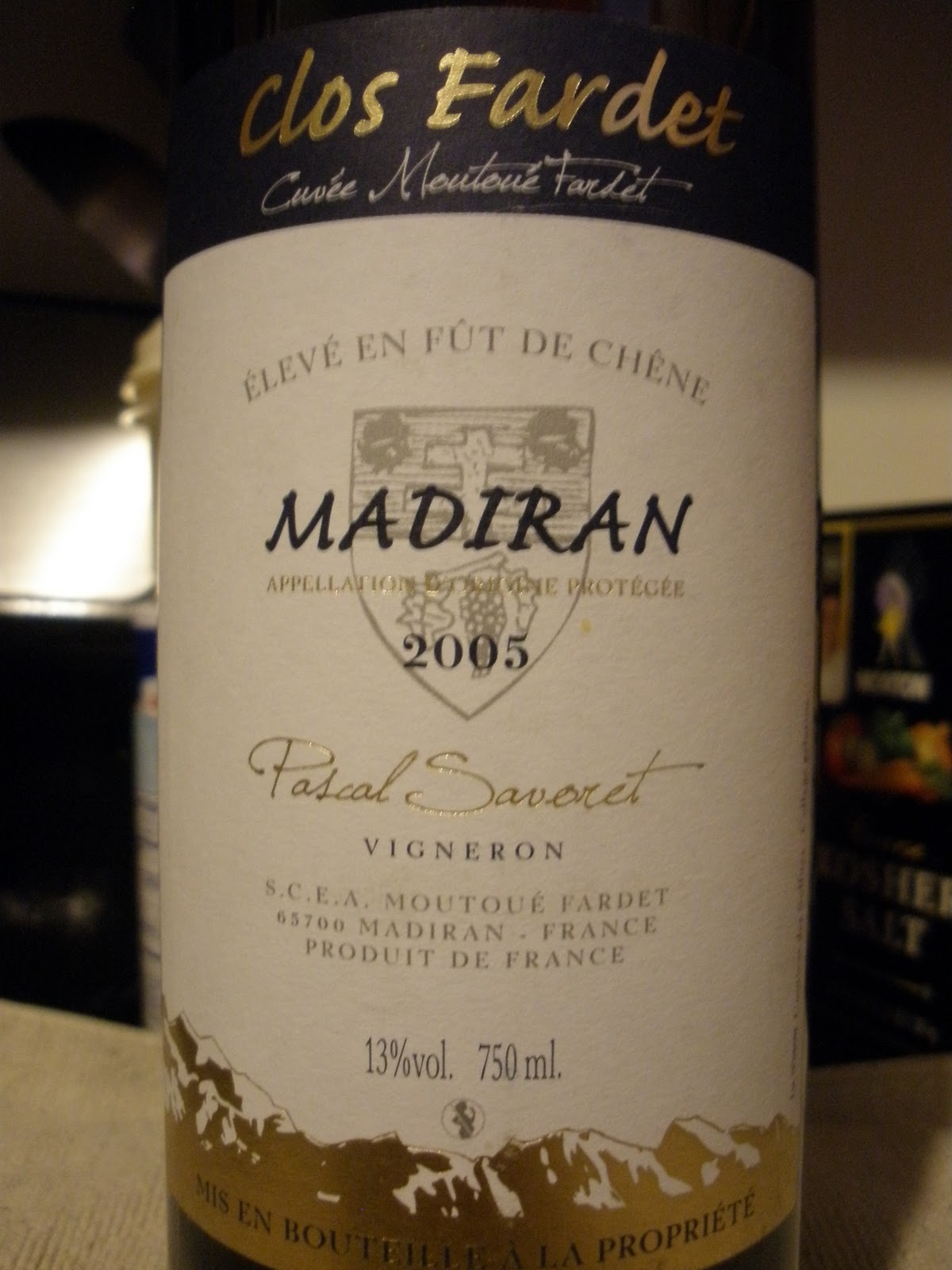
The seventh wine we had was the 2005 Clos Fardet Cuvée Moutoue Fardet which was made from 98% Tannat and 2% Cabernet Franc. The wine is from the Madiran region and has an SRP of about $27. The wine is made with natural yeast and minimal sulfur contact and is aged in 400 liter barrels for five years before being bottled. In the glass, the wine had a deep, inky purple-black color that was opaque out to a narrow crimson rim. The nose was very aromatic with tobacco, spice box, leather, cocoa, rich black cherry, blackberry and black plum fruit and just a hint of mint. The nose was deep, complex and compelling and it was a struggle to get past the sniffing phase of the tasting. On the palate, the wine was full bodied with fairly high acidity and fairly high tannins. The flavor profile was deep, dense and ripe with boysenberry, blackberry and black cherry fruit with deep earthy chocolate, baking spice and cigar tobacco flavors as well. It was incredibly powerful and layered but also exceptionally balanced. It was the hands down superstar of the tasting for me and was drinking well three days after I opened it. At $27, this wine is a steal and I wouldn't hesitate to pay double that retail if I had to. The big problem is that they only make about 350 cases total, about half of which makes it to US shores. It is a phenomenal wine that is now on my personal "buy on sight" list.

The final wine that we tried was the 2008 Domaine Brana "Ohtiza" Rouge from the very hilly Irouléguy region of France, right on the Spanish border. The wine is made up of 80% Tannat and 20% Cabernet Franc and retails for about $26. In the glass the wine was a deep purple-ruby color that was nearly opaque out to a narrow violet rim. The nose was nicely aromatic with blackberry and black cherry fruit with a touch of smoke. It turns out that I'm very sensitive to bell pepper aromas, and I picked up quite a bit on this wine. On the palate the wine was on the fuller side of medium with fairly high acid and medium tannins. There were flavors of tart cherry and under-ripe blackberry fruits with something a little cranberryish about it. The wine was very lean and angular with sour berry fruits and vegetal flavors. Where the Madiran was all soft curves and plush fruits, this wine was sharp and sour and wasn't as much to my taste. It held up fairly well by day two, but never really got any softer. Perhaps more so than any other wine in the tasting, this wine really needed some food and I wasn't really able to accommodate it properly. This would be really good with sausage stuffed peppers or really any rich red meat dish with a heavy vegetable presence.
Overall, the tasting was exceptionally well done and I had a great time participating. There was a wonderful range of wines represented from a wide variety of regions within Southwest France. I came away from this tasting even more convinced that Southwest France is one of the great world wine regions for very good wines made from unusual grapes at great prices.
Just to reiterate, all wines reviewed above were provided to me free of charge and I have done my best to review them as objectively as I could. I received no compensation for participating in this event other than the wines.