Though most of the wines I write about on this site are things that I've come across on my own, I do occasionally receive tips from readers about interesting grapes and wines they've come across that I might also be interested in. One of my more prolific tipsters is Tony from Pennsylvania who, in addition to providing a tasting note for my post on Nuragus, also has a sharp eye for unusual wines. He has previously pointed me to Albarín Blanco and Tempranillo Blanco, but the grape he directed me to for today's post is definitely more obscure than either of those.
A few months ago, Tony asked if I had ever heard of a grape called Çimixà from Liguria. Çimixà was definitely a new one on me, and a cursory glance on the internet revealed virtually no information the grape. I saw that Bisson, whose wines I had featured in some prior posts, and whose portfolio seems to be pretty well represented in the Boston area, made a varietal Çimixà, so I set about trying to track a bottle down. I asked around locally to see if anybody could get their hands on some, and came up empty. Not only that, but none of the guys I asked about ordering the wine had ever even heard of it, and these guys are pretty tough to stump. I was now getting more and more anxious to get my hands on a bottle. Tony pointed me in the direction of MCF Rare Wine in New York City, who had about half a dozen bottles in stock and who was willing to sell a bottle to me (all legally, of course).
Though I pulled the cork on my bottle a month or so ago, I've been quietly dreading having to write this post because, as I mentioned above, I wasn't able to find any information at all about Çimixà when I had previously searched online, and a new Google search didn't really get me very much new information either. I went to look the grape up in Wine Grapes, and began to get despondent when I didn't see an entry under Çimixà, so I checked the index and found that it was listed under the name Scimiscià. I know I was a little harsh on Wine Grapes in my review of that book, and I still stand by my criticisms, but it is really an excellent reference work and is very helpful for situations just like this one. Their entry on the grape indicates that it is one of those grapes (like Pugnitello or Nascetta or Pecorino, etc) that was on the brink of extinction, but was rescued by a gentleman named Marco Baciagalupo, a pastry chef from Genoa, Liguria. In the 1970's, Marco gathered together about 500 vines that were purported to be Çimixà and planted them all together in a single plot. A local cooperative took over the job of caring for these vines in the 1990's, and by 2003, the grape was included in the national register of varieties in Italy.
Eagle-eyed readers may note that the picture I've included with this post is for a grape called Genovese, and not Çimixà or Scimiscià. The reason for that is that a study done in 2009 found that the Scimiscià of Liguria was not only the same as the grape known as Frate Pelato in the Cinque Terre, but was also the same as the Genovese of Corsica. It had been suspected that the Corsican Genovese was actually either a local curiosity or was identical to the Bianchetta Genovese/Albarola or the Bosco of Liguria, but this team was able to show that none of these hypotheses were true. Though the three grapes share some morphological similarities, it doesn't look like any of them have any first degree relationships with one another, though Bosco and Albarola appear to be more closely related to one another than either is to Scimiscià.
The last published agricultural census for Italy was carried out before Scimiscià was added to the national register of varieties, so there currently is no figure on total plantings of the grape in Italy (though one imagines that the total is probably pretty minuscule). According to this site, the Çimixà and Scimiscià names are dialectical variants of one another, and both refer to bedbugs because the vine apparently has these spots on it that look like bedbug bites, which is not very appetizing at all. Under the name Genovese, Scimiscià can be found in some Corsican wines, but is pretty much used as a blending grape there. As Frate Pelato, the grape is occasionally used in the blends of the Cinque Terre. There are a handful of Ligurian producers making varietal wines from the grape, and nearly all of them use either the Çimixà or the Scimiscià name for their products.
Bisson chooses to use the Çimixà name on their label, though the wine itself is called "L'Antico." I paid about $30 for my bottle from MCF Rare Wine in New York. I am not sure whether any Italian DOC allows for a 100% Çimixà wine, but this was bottled as an IGT, so it's not really a problem. In the glass the wine was a medium lemon gold color. The nose was moderately intense with lovely, delicate aromas of peach, pear, lime, white flowers and chalk. On the palate the wine was on the lighter side of medium with medium acidity. There were flavors of apricot, lime peel, ripe pear, and golden apple with some chalky minerality on the finish. The wine was subtle, delicate and elegant and was really just lovely to drink. It's not a wine to lay down, though, and it had completely unraveled by the next day, but while it held together, it was very pretty. It is a bit on the expensive side, as many wines from Liguria tend to be, but it's a really unique drinking experience and I don't feel slighted by the price at all.
A blog devoted to exploring wines made from unusual grape varieties and/or grown in unfamiliar regions all over the world. All wines are purchased by me from shops in the Boston metro area or directly from wineries that I have visited. If a reviewed bottle is a free sample, that fact is acknowledged prior to the bottle's review. I do not receive any compensation from any of the wineries, wine shops or companies that I mention on the blog.
Showing posts with label Liguria. Show all posts
Wednesday, December 12, 2012
Wednesday, September 12, 2012
Weird Blend Wednesday - Bosco, Vermentino & Albarola, Cinque Terre, Liguria, Italy
![]() |
| Bosco Grapes |
Wines from the Cinque Terre DOC must be made up of at least 40% Bosco and can contain a maximum of 40% Vermentino and/or Albarola and a maximum of 20% of "other authorized white grapes." As mentioned above, we just recently took a look at the Albarola grape, and we've taken a few indirect looks at the Vermentino grape (in the context of the Favorita and the Pigato grapes, which are genetically identical to Vermentino), which just leaves us the Bosco grape, about which there is apparently very little to say. The Oxford Companion to Wine's entry reads in full: "ordinary white grape of Liguria." Jancis Robinson's Guide to Wine Grapes adds little more, as that entry reads "very ordinary Ligurian that forms the basis of Cinqueterre and oxidizes easily." Nicolas Belfrage, in his Barolo to Valpolicella calls the grape "strange, but not so wonderful." Besides Cinque Terre, Bosco is permitted in only one other DOC region, the Val Polcevara just west of Genoa in central Liguria, where it is allowed to make up no more than 40% of the blend.
I was able to try the 2009 Bisson "Marea," which is 60% Bosco and 40% Vermentina/Albarola (the winery doesn't give a more precise breakdown). I picked this bottle up for about $29 locally. In the glass the wine was a fairly deep lemon gold color. The nose was moderately intense with aromas of golden apples, fresh pears, honeysuckle flower, pineapple and lemon. On the palate the wine was medium bodied with medium acidity. There were flavors of ripe red apples, lemon, almonds and pecan. It was bitter and kind of metallic tasting as well. I noted above that Bosco oxidizes pretty easily, and it's possible that this wine was starting to go through that process. This bottle is only about three years old and I wouldn't expect it to be shot this soon, especially at this price point, but it's hard to say whether I just got a bad bottle or whether this is a wine meant to be drunk as early as possible. I don't exactly relish the idea of dropping another $30 to try to find out, so please leave a comment below if you've had some experience with this wine and want to share it.
Monday, September 10, 2012
Bianchetta Genovese (Albarola) - Golfo del Tigullio, Liguria, Italy
I'm somewhat shocked to discover that today marks only the third time that I've written about a wine from Liguria. We first visited this tiny region of northwestern Italy back in January when we took a look at the Pigato grape, which it turns out is genetically identical to Vermentino and Favorita. We stopped by again back in April to take a look at an interesting little rosato made from the Ciliegiolo grape, which it turns out is an offspring of Sangiovese and a little known grape called Muscat Rouge de Madere. Both of those posts dealt with some really interesting scientific questions and controversies, and today's grape looks to follow that trend, so join me in taking a look at the Bianchetta Genovese grape, more commonly known as Albarola.
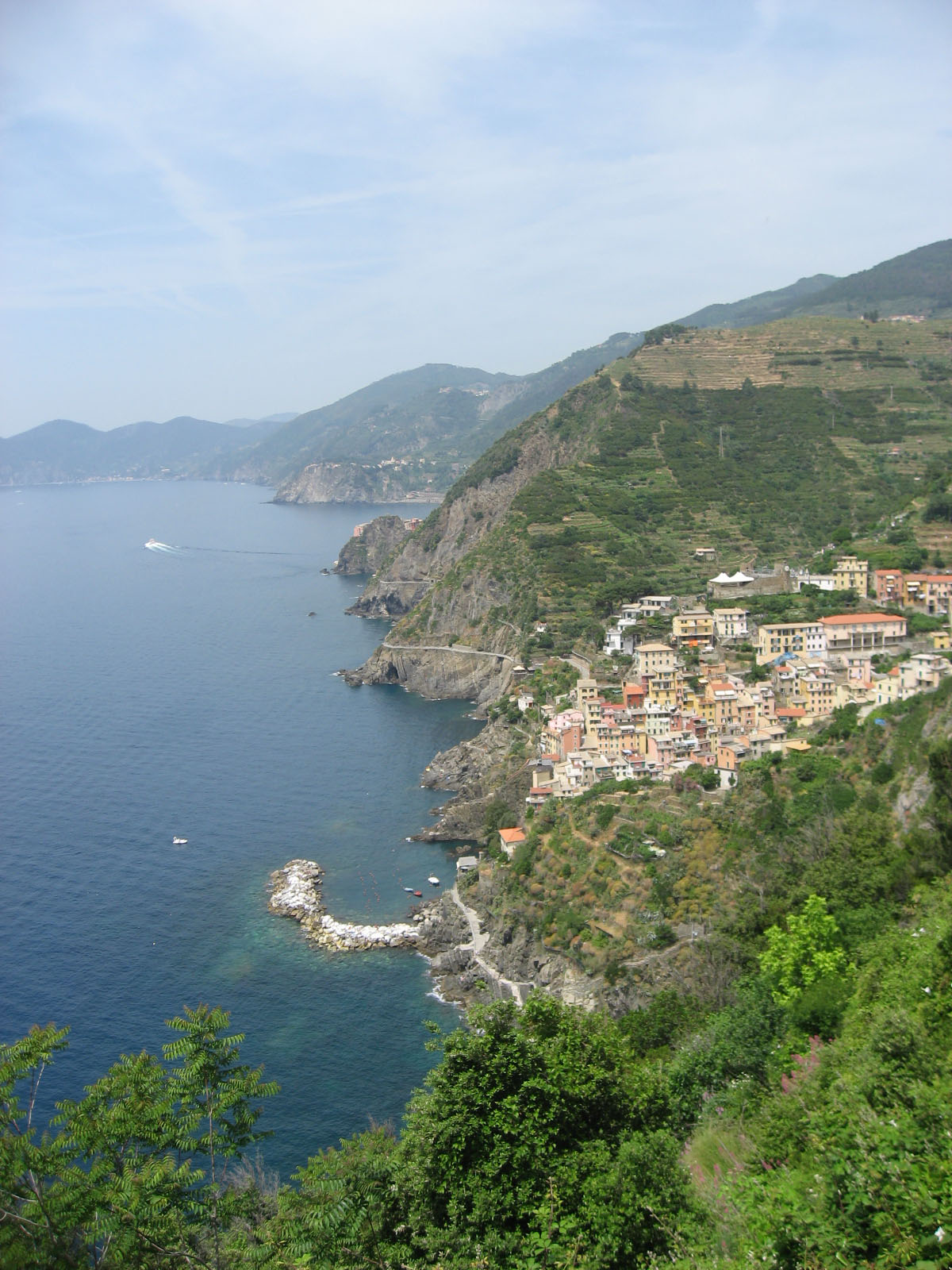
For the most part, when you're talking about the Albarola grape, you're talking about the Cinque Terre region of Liguria. Most wine drinkers who have had a white wine from Liguria have probably had one from Cinque Terre. It's an interesting region that makes some really nice wines, and we'll take a closer look at it later this week, but we're not really interested in that region today because while Albarola is allowed in the wines of Cinque Terre, it cannot make up more than 40% of the blend there. No, today we're interested in the Golfo del Tigullio region, which is a little farther north and west along the bend of the Ligurian coastline. The growing area is based around the Gulf of Tigullio, particularly around the towns of Portofino, Santa Margherita and Rapallo. Here, Albarola is known as Bianchetta Genovese, and DOC wines which indicate Bianchetta Genovese on the label must be made up of at least 85% Bianchetta.
But let's stop for a moment and ask whether Albarola and Bianchetta Genovese are really the same grape. When you search for Bianchetta Genovese on Wikipedia, you are automatically redirected to the page for Albarola where you are told that one of the accepted synonyms for Albarola is Bianchetta Genovese. This is true, but it's not the whole truth. Bianchetta Genovese is also an accepted synonym for a grape called simply "Genovese," according to the VIVC. Further, Nicolas Belfrage, in his Barolo to Valpolicella, distinguishes between Albarola and Bianchetta Genovese and writes about them as if they're two separate grapes. This source, seems to suggest that the grape can be found as a blending component in the wines of Cinque Terre, which would support the argument that it is in fact the same as Albarola. This source, however, seems to indicate that Bianchetta Genovese is a rare grape rescued from extinction by Pierluigi Lugano, the founder of Enoteca Bisson, who made the wine we'll be looking at below. This story matches the one told on the Bisson website, which says that Lugano was "led to 'revive' native Ligurian wines that were practically disappeared, such as the 'Bianchetta Genovese.'" None of the literature on Albarola mentions any kind of revival or rescue from extinction, so either Bianchetta Genovese is separate from Albarola and Lugano saved it for the world, or it's really the same grape and all this talk of rescue is based on a mistake.
Which is true? Once again, DNA research comes to the rescue. A study done in 2009 (paper can be found here) analyzed several different grapes from Liguria as well as grapes from nearby regions of Italy. The research team found that Albarola and Bianchetta Genovese were genetically identical, meaning that they are one and the same grape. There was another vine called Albarola which didn't match the other samples in the study, but this was found to be an obscure local curiosity from Lavagna that isn't used for commercial wine production. Interestingly, this study also found that the Tibouren grape grown in Provence, France, is the same as the Rossese grape grown around Dolceacqua in Liguria.
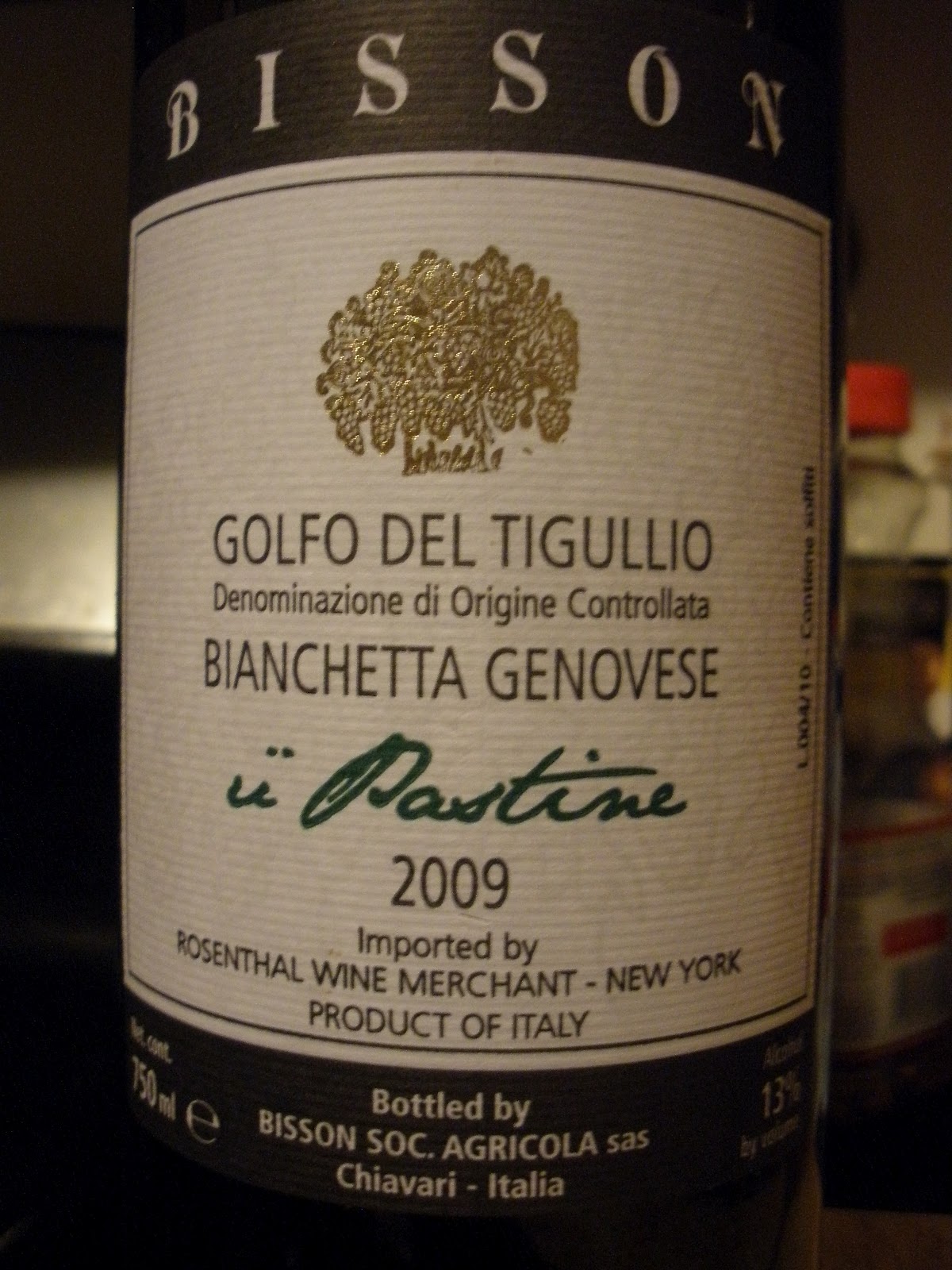
The wine I was able to try was the 2009 Bisson "u Pastine," which means something like "very special gift" in the local Ligurian dialect. I picked this bottle up for about $25 locally. In the glass this wine was a fairly deep lemon gold color. The nose was moderately intense with subtle white pear, lemon, citrus peel and white flower aromas. On the palate the wine was medium bodied with medium acidity. There were flavors of pear and lemon fruit along with some bitter lemon peel. The wine had a strong chalky minerality to it, which is something I'm never a particularly big fan of. This grape is mostly found in blends and is rarely bottled on its own, and this wine is a compelling piece of evidence for why that might be the case. Bisson usually makes very good and interesting wines, but this particular bottle just didn't have enough character to keep me engaged. It could have been a little over the hill, and I'd be interested in trying a younger bottle if I happen to run across one on sale, but this is a difficult wine to recommend given my experience with this particular bottle.
For the most part, when you're talking about the Albarola grape, you're talking about the Cinque Terre region of Liguria. Most wine drinkers who have had a white wine from Liguria have probably had one from Cinque Terre. It's an interesting region that makes some really nice wines, and we'll take a closer look at it later this week, but we're not really interested in that region today because while Albarola is allowed in the wines of Cinque Terre, it cannot make up more than 40% of the blend there. No, today we're interested in the Golfo del Tigullio region, which is a little farther north and west along the bend of the Ligurian coastline. The growing area is based around the Gulf of Tigullio, particularly around the towns of Portofino, Santa Margherita and Rapallo. Here, Albarola is known as Bianchetta Genovese, and DOC wines which indicate Bianchetta Genovese on the label must be made up of at least 85% Bianchetta.
But let's stop for a moment and ask whether Albarola and Bianchetta Genovese are really the same grape. When you search for Bianchetta Genovese on Wikipedia, you are automatically redirected to the page for Albarola where you are told that one of the accepted synonyms for Albarola is Bianchetta Genovese. This is true, but it's not the whole truth. Bianchetta Genovese is also an accepted synonym for a grape called simply "Genovese," according to the VIVC. Further, Nicolas Belfrage, in his Barolo to Valpolicella, distinguishes between Albarola and Bianchetta Genovese and writes about them as if they're two separate grapes. This source, seems to suggest that the grape can be found as a blending component in the wines of Cinque Terre, which would support the argument that it is in fact the same as Albarola. This source, however, seems to indicate that Bianchetta Genovese is a rare grape rescued from extinction by Pierluigi Lugano, the founder of Enoteca Bisson, who made the wine we'll be looking at below. This story matches the one told on the Bisson website, which says that Lugano was "led to 'revive' native Ligurian wines that were practically disappeared, such as the 'Bianchetta Genovese.'" None of the literature on Albarola mentions any kind of revival or rescue from extinction, so either Bianchetta Genovese is separate from Albarola and Lugano saved it for the world, or it's really the same grape and all this talk of rescue is based on a mistake.
Which is true? Once again, DNA research comes to the rescue. A study done in 2009 (paper can be found here) analyzed several different grapes from Liguria as well as grapes from nearby regions of Italy. The research team found that Albarola and Bianchetta Genovese were genetically identical, meaning that they are one and the same grape. There was another vine called Albarola which didn't match the other samples in the study, but this was found to be an obscure local curiosity from Lavagna that isn't used for commercial wine production. Interestingly, this study also found that the Tibouren grape grown in Provence, France, is the same as the Rossese grape grown around Dolceacqua in Liguria.
The wine I was able to try was the 2009 Bisson "u Pastine," which means something like "very special gift" in the local Ligurian dialect. I picked this bottle up for about $25 locally. In the glass this wine was a fairly deep lemon gold color. The nose was moderately intense with subtle white pear, lemon, citrus peel and white flower aromas. On the palate the wine was medium bodied with medium acidity. There were flavors of pear and lemon fruit along with some bitter lemon peel. The wine had a strong chalky minerality to it, which is something I'm never a particularly big fan of. This grape is mostly found in blends and is rarely bottled on its own, and this wine is a compelling piece of evidence for why that might be the case. Bisson usually makes very good and interesting wines, but this particular bottle just didn't have enough character to keep me engaged. It could have been a little over the hill, and I'd be interested in trying a younger bottle if I happen to run across one on sale, but this is a difficult wine to recommend given my experience with this particular bottle.
Monday, April 16, 2012
Ciliegiolo - Golfo di Tigullio, Liguria & Maremma, Tuscany, Italy
There are a lot of things at stake when paternity tests are given to humans, but it is virtually never the case that a genetic test is required to see which of a pair of individuals is the parent and which is the offspring. The directional arrow of parent-offspring relationships are pretty easy to determine for animals because the age of one or both of the parties involved is usually pretty easy to determine. The same is not necessarily true for plants, though, and it is especially not true for grape varieties. You might object that the situations aren't exactly the same, but I would contend that they're closer than you might think.
Let's take a moment to consider what an individual grape variety actually is. Take Chardonnay, for example. We happen to know that Chardonnay is the offspring of two other grapes called Pinot Noir and Gouais Blanc. What that means is that pollen from a Pinot Noir plant was used to fertilize the flowers of a Gouais Blanc plant and when one of the resulting seeds was planted, a Chardonnay plant was the result. But here's what we also know: when the same two parents got together on other occasions, the plants that grew were not Chardonnay, but were rather Aligoté, Auxerrois, Gamay Noir, Romorantin, and Melon, among many others. All of these grapes are full siblings of one another, and if you think about the consequences of that fully you should see that what that really means is that each variety of grape is essentially like an individual person. We can't get more Chardonnay plants by having its parents mate over and over again, so if we want to grow more Chardonnay vines, we have to clone the ones we have by planting cuttings. By the same token, if we needed another one of you, we couldn't ask your parents to have another child but would rather have to clone you.
Now let's imagine a world where human cloning has been perfected and is not only allowed, but is the preferred method of creating new human beings. Over time, there have been certain individuals who have particular qualities in certain combinations that makes them ideal human beings and these individuals are now our archetypes for the human race. They are still capable of sexual reproduction, but this kind of reproduction is seen as a kind of genetic gamble that people are rarely willing to take so nearly all new human beings are clones of a series of archetypal individuals who were born as products of sexual reproduction several generations ago. Let us further imagine that we are face to face with two of these clones who are ultimately descended from different individuals, one of whom was the father of the other, but we don't know which is the father and which is the son. Neither of the individuals in front of us actively fathered the other, but one of the genetic lines is the ancestor of the other. How could we tell which was the father and which was the offspring?
Obviously we can't just look at the two to see which is older since we're dealing with clonal lines and not direct lines of parentage and progeny. You might be thinking that DNA analysis should be able to clear this up rather quickly, but it's a little trickier than that. Offspring, both grape and human, get 1/2 of their DNA from their father and 1/2 from their mother. If we were to analyze the DNA from each of the two individuals in front of us, we would be able to see that they share 1/2 of their DNA, but we wouldn't be able to tell which of them had passed that DNA to the other. In order to determine which is the father and which is the son, we would need the genetic information from the mother as well. Whichever of the two people in front of us also contained DNA from the mother would be the son and thus the descendant of the other.
All of which does, finally, bring us to today's grape, Ciliegiolo. We know that Ciliegiolo has a parent-offspring relationship with Sangiovese, but the direction of that relationship is in some dispute. Our story begins in 2007, when a paper was published which claimed to have uncovered the parentage of the Sangiovese grape. José Vouillamoz (who some of you may remember from the Hondarrabi Zuri saga) and his team used a private database of microsatellite markers and 180 plant samples from various university germplasm collections in an attempt to discover Sangiovese's parent grapes. To do this, they first checked to find grapes in their databases and samples that shared a lot of DNA with Sangiovese. These grapes were hypothesized to be Sangiovese relatives, though the exact relationship at this point wasn't clear. In order to establish parentage relationships, they essentially had to go by trial and error and try out a lot of different combinations of grapes as putative parents to see what worked. In the course of their analyses, they found that Ciliegiolo and an obscure grape they plucked out of the countryside near Naples that they call Calabrese di Montenuovo were the parents of the Sangiovese grape.
Game over, right? Well, not exactly. Shortly thereafter, another research group led by Manuel Di Vecchi Staraz (citation below) analyzed the DNA of several thousand different grapes to try and determine how and where Sangiovese might fit in with any of their family trees. This team was unable to find any parent-pair for Sangiovese among their samples and while they found a parent-offspring relationship between Ciliegiolo and Sangiovese, their research led them to conclude that Sangiovese was actually the parent to Ciliegiolo (along with a grape called Muscat rouge de Madére). Further, their analysis enabled them to discover the parents of Muscat Rouge de Madére, which enabled them to do some analyses based on these sets of grandparents which, they feel, cemented their claim (I don't understand enough of the science to know how justified they are in this claim). They also point to the fact that Sangiovese appears in the literature earlier than Ciliegiolo as proof that it is an older variety and thus parent to Ciliegiolo by necessity, but I don't find this argument convincing as names for grapes change frequently and the presence of a grape in the written record only accounts for its discovery not for its existence.
So we have a controversy here, and as far as I can tell, it is still unresolved. A paper published the next year seems to side with Vouillamoz et. al., though you can really only tell that by looking at Figure 2 in their paper (the text is maddeningly vague). The VIVC, though, seems to accept Di Vecchi Staraz's theory, and they list Ciliegiolo as an offspring of Sangiovese. Wikipedia acknowledges the controversy and remains agnostic, if poorly cited, about it. The Oxford Companion to Wine (online version) unequivocally states that Ciliegiolo is one of the parents of Sangiovese, which shouldn't be that surprising if you remember that José Vouillamoz, the lead author of the paper cited above which also makes this claim, is the OCW's resident grape pedigree expert. In fact, José Vouillamoz is credited (obliquely, I should add...his initials are provided at the end of the entry and you have to click on the J.V. to get his name) as one of the authors of the entry (the other author is one of the cadre of MW's that the OCW has on staff who is an expert on Italian wines but not on genetics). This means that the entry in the OCW wasn't written by a dispassionate outside observer, it was written by one of the scientists who is directly involved in the debate itself and it bothers me a bit that this not only was this fact not openly disclosed, but the other voices in the debate are completely disregarded in the entry itself. If you only read the OCW's entry on Ciliegiolo, you wouldn't know that there was any controversy at all, and that doesn't sit right with me. I haven't contacted anyone at the OCW regarding this because I'm not really in the mood to be told that I have to wait and buy their $125 book to read the full story again.
There are a few lessons to be learned here. The first is that scientific discovery is a process which sometimes arrives at the truth quickly, but sometimes arrives there by a more complicated route. The information that is currently available is conflicting, and it seems like a reference material such as The Oxford Companion to Wine should acknowledge that conflict to some extent. The second lesson is that you should always try to be aware of who the author of what you're reading actually is. The OCW, as an encyclopedic resource, is a collaborative effort, but there are certain articles that are written by specific contributors and those contributors are occasionally highlighted and credited, but not always. It is important to know that what you're reading has been written by someone who is in a position to know what they're talking about (an expert), but it's also important to know whether the author has any other kind of stake in the issue at hand. This particular entry is written by an expert, but he is a biased expert in this case and the responsible thing to do is to acknowledge both the bias itself and also the wider controversy so that interested readers can seek out the original materials if they are so inclined.
**UPDATE**
I've recently come across another paper published in 2010 that sides with Di Vecchi Starazin saying that Ciliegiolo is the offspring of Sangiovese and Moscato Violetto, which is a synonym for Muscat Rouge de Madere. Their research seems convincing and I'm inclined to believe their results at this point. The citation is: Cipriani, G. et al. The SSR-based molecular profile of 1005 grapevine (Vitis vinifera L.) accessions uncovers new synonymy and parentages, and reveals a large admixture amongst varieties of different geographic origin. 2010. Theoretical and Applied Genetics. 121: 1569-1585.
********
So, enough about all that then. Let's take a look at a couple of wines made from the Ciliegiolo grape, whatever its relationship to Sangiovese turns out to be.
I was actually able to find two different wines made from the Ciliegiolo grape in two very different styles. The first was the 2010 Bisson Ciliegiolo from the Golfo del Tigullio in Liguria in northwestern Italy. This wine was made in a rosé style and I picked it up from my friends at the Wine Bottega for about $23. In the glass this wine was a coral red color like the color of the juice in a bottle of maraschino cherries. The nose was very intense with nearly every kind of cherry that you can imagine (maraschino, candied, dried, tart, red) along with a touch of strawberry. The grape is supposedly named for the Italian word for cherry (ciliegia) due to its propensity to smell and taste like, well, cherries. On the palate the wine was medium bodied with fairly high acidity. There were flavors of sour cherry, wild strawberry, candied red cherry, cranberry and sour red fruits. There may have been a hint of residual CO2, but I wasn't entirely sure. The wine was fresh and juicy but completely dry. This is a knockout summer wine that I would drink with just about anything. The fruits were pure and ripe and the wine was an absolute delight to drink.
The second wine that I tried was the 2007 Sassotondo Ciliegiolo from the Maremma region of Tuscancy. I had to special order this wine and my friend Joe at Curtis Liquors brought it in for me for about $18. In the glass this was a deep, opaque purple ruby color with a narrow violet rim. The nose was moderately intense with very meaty, savory flavor notes that reminded me of the smell of dry-aged beef steaks. There were also dried black fruits (fig and prune) along with some flat cola, baking spice and chocolate. On the palate the wine was on the fuller side of medium with medium acidity and fairly substantial tannins. There were flavors of dried black fruits, black cherry and fig, along with a distinctive meaty, beefy kind of flavor and something like flat cola and imitation chocolate. The wine tasted a little sweet, but it could have been the 15% alcohol giving that illusion. The meatiness did eventually blow off but in its place that fake chocolate taste came on stronger and stronger. I just flat out did not like this wine and was unable to finish the bottle. The sweet taste and the fake chocolate were just too much for me and I only made it through one glass before I discarded the rest.
Citation:
DI VECCHI STARAZ, M.; BANDINELLI, R.; BOSELLI, M.; THIS, P.; BOURSIQUOT,
J. M.; LAUCOU, V.; LACOMBE, T.; VARÈS, D.; 2007: Genetic structuring
and parentage analysis for evolutionary studies in grapevine: kin
group and origin of the cultivar Sangiovese revealed. J. Am. Soc.
Hort. Sci. 132, 514-524.
Let's take a moment to consider what an individual grape variety actually is. Take Chardonnay, for example. We happen to know that Chardonnay is the offspring of two other grapes called Pinot Noir and Gouais Blanc. What that means is that pollen from a Pinot Noir plant was used to fertilize the flowers of a Gouais Blanc plant and when one of the resulting seeds was planted, a Chardonnay plant was the result. But here's what we also know: when the same two parents got together on other occasions, the plants that grew were not Chardonnay, but were rather Aligoté, Auxerrois, Gamay Noir, Romorantin, and Melon, among many others. All of these grapes are full siblings of one another, and if you think about the consequences of that fully you should see that what that really means is that each variety of grape is essentially like an individual person. We can't get more Chardonnay plants by having its parents mate over and over again, so if we want to grow more Chardonnay vines, we have to clone the ones we have by planting cuttings. By the same token, if we needed another one of you, we couldn't ask your parents to have another child but would rather have to clone you.
Now let's imagine a world where human cloning has been perfected and is not only allowed, but is the preferred method of creating new human beings. Over time, there have been certain individuals who have particular qualities in certain combinations that makes them ideal human beings and these individuals are now our archetypes for the human race. They are still capable of sexual reproduction, but this kind of reproduction is seen as a kind of genetic gamble that people are rarely willing to take so nearly all new human beings are clones of a series of archetypal individuals who were born as products of sexual reproduction several generations ago. Let us further imagine that we are face to face with two of these clones who are ultimately descended from different individuals, one of whom was the father of the other, but we don't know which is the father and which is the son. Neither of the individuals in front of us actively fathered the other, but one of the genetic lines is the ancestor of the other. How could we tell which was the father and which was the offspring?
Obviously we can't just look at the two to see which is older since we're dealing with clonal lines and not direct lines of parentage and progeny. You might be thinking that DNA analysis should be able to clear this up rather quickly, but it's a little trickier than that. Offspring, both grape and human, get 1/2 of their DNA from their father and 1/2 from their mother. If we were to analyze the DNA from each of the two individuals in front of us, we would be able to see that they share 1/2 of their DNA, but we wouldn't be able to tell which of them had passed that DNA to the other. In order to determine which is the father and which is the son, we would need the genetic information from the mother as well. Whichever of the two people in front of us also contained DNA from the mother would be the son and thus the descendant of the other.
All of which does, finally, bring us to today's grape, Ciliegiolo. We know that Ciliegiolo has a parent-offspring relationship with Sangiovese, but the direction of that relationship is in some dispute. Our story begins in 2007, when a paper was published which claimed to have uncovered the parentage of the Sangiovese grape. José Vouillamoz (who some of you may remember from the Hondarrabi Zuri saga) and his team used a private database of microsatellite markers and 180 plant samples from various university germplasm collections in an attempt to discover Sangiovese's parent grapes. To do this, they first checked to find grapes in their databases and samples that shared a lot of DNA with Sangiovese. These grapes were hypothesized to be Sangiovese relatives, though the exact relationship at this point wasn't clear. In order to establish parentage relationships, they essentially had to go by trial and error and try out a lot of different combinations of grapes as putative parents to see what worked. In the course of their analyses, they found that Ciliegiolo and an obscure grape they plucked out of the countryside near Naples that they call Calabrese di Montenuovo were the parents of the Sangiovese grape.
Game over, right? Well, not exactly. Shortly thereafter, another research group led by Manuel Di Vecchi Staraz (citation below) analyzed the DNA of several thousand different grapes to try and determine how and where Sangiovese might fit in with any of their family trees. This team was unable to find any parent-pair for Sangiovese among their samples and while they found a parent-offspring relationship between Ciliegiolo and Sangiovese, their research led them to conclude that Sangiovese was actually the parent to Ciliegiolo (along with a grape called Muscat rouge de Madére). Further, their analysis enabled them to discover the parents of Muscat Rouge de Madére, which enabled them to do some analyses based on these sets of grandparents which, they feel, cemented their claim (I don't understand enough of the science to know how justified they are in this claim). They also point to the fact that Sangiovese appears in the literature earlier than Ciliegiolo as proof that it is an older variety and thus parent to Ciliegiolo by necessity, but I don't find this argument convincing as names for grapes change frequently and the presence of a grape in the written record only accounts for its discovery not for its existence.
So we have a controversy here, and as far as I can tell, it is still unresolved. A paper published the next year seems to side with Vouillamoz et. al., though you can really only tell that by looking at Figure 2 in their paper (the text is maddeningly vague). The VIVC, though, seems to accept Di Vecchi Staraz's theory, and they list Ciliegiolo as an offspring of Sangiovese. Wikipedia acknowledges the controversy and remains agnostic, if poorly cited, about it. The Oxford Companion to Wine (online version) unequivocally states that Ciliegiolo is one of the parents of Sangiovese, which shouldn't be that surprising if you remember that José Vouillamoz, the lead author of the paper cited above which also makes this claim, is the OCW's resident grape pedigree expert. In fact, José Vouillamoz is credited (obliquely, I should add...his initials are provided at the end of the entry and you have to click on the J.V. to get his name) as one of the authors of the entry (the other author is one of the cadre of MW's that the OCW has on staff who is an expert on Italian wines but not on genetics). This means that the entry in the OCW wasn't written by a dispassionate outside observer, it was written by one of the scientists who is directly involved in the debate itself and it bothers me a bit that this not only was this fact not openly disclosed, but the other voices in the debate are completely disregarded in the entry itself. If you only read the OCW's entry on Ciliegiolo, you wouldn't know that there was any controversy at all, and that doesn't sit right with me. I haven't contacted anyone at the OCW regarding this because I'm not really in the mood to be told that I have to wait and buy their $125 book to read the full story again.
There are a few lessons to be learned here. The first is that scientific discovery is a process which sometimes arrives at the truth quickly, but sometimes arrives there by a more complicated route. The information that is currently available is conflicting, and it seems like a reference material such as The Oxford Companion to Wine should acknowledge that conflict to some extent. The second lesson is that you should always try to be aware of who the author of what you're reading actually is. The OCW, as an encyclopedic resource, is a collaborative effort, but there are certain articles that are written by specific contributors and those contributors are occasionally highlighted and credited, but not always. It is important to know that what you're reading has been written by someone who is in a position to know what they're talking about (an expert), but it's also important to know whether the author has any other kind of stake in the issue at hand. This particular entry is written by an expert, but he is a biased expert in this case and the responsible thing to do is to acknowledge both the bias itself and also the wider controversy so that interested readers can seek out the original materials if they are so inclined.
**UPDATE**
I've recently come across another paper published in 2010 that sides with Di Vecchi Starazin saying that Ciliegiolo is the offspring of Sangiovese and Moscato Violetto, which is a synonym for Muscat Rouge de Madere. Their research seems convincing and I'm inclined to believe their results at this point. The citation is: Cipriani, G. et al. The SSR-based molecular profile of 1005 grapevine (Vitis vinifera L.) accessions uncovers new synonymy and parentages, and reveals a large admixture amongst varieties of different geographic origin. 2010. Theoretical and Applied Genetics. 121: 1569-1585.
********
So, enough about all that then. Let's take a look at a couple of wines made from the Ciliegiolo grape, whatever its relationship to Sangiovese turns out to be.
I was actually able to find two different wines made from the Ciliegiolo grape in two very different styles. The first was the 2010 Bisson Ciliegiolo from the Golfo del Tigullio in Liguria in northwestern Italy. This wine was made in a rosé style and I picked it up from my friends at the Wine Bottega for about $23. In the glass this wine was a coral red color like the color of the juice in a bottle of maraschino cherries. The nose was very intense with nearly every kind of cherry that you can imagine (maraschino, candied, dried, tart, red) along with a touch of strawberry. The grape is supposedly named for the Italian word for cherry (ciliegia) due to its propensity to smell and taste like, well, cherries. On the palate the wine was medium bodied with fairly high acidity. There were flavors of sour cherry, wild strawberry, candied red cherry, cranberry and sour red fruits. There may have been a hint of residual CO2, but I wasn't entirely sure. The wine was fresh and juicy but completely dry. This is a knockout summer wine that I would drink with just about anything. The fruits were pure and ripe and the wine was an absolute delight to drink.
The second wine that I tried was the 2007 Sassotondo Ciliegiolo from the Maremma region of Tuscancy. I had to special order this wine and my friend Joe at Curtis Liquors brought it in for me for about $18. In the glass this was a deep, opaque purple ruby color with a narrow violet rim. The nose was moderately intense with very meaty, savory flavor notes that reminded me of the smell of dry-aged beef steaks. There were also dried black fruits (fig and prune) along with some flat cola, baking spice and chocolate. On the palate the wine was on the fuller side of medium with medium acidity and fairly substantial tannins. There were flavors of dried black fruits, black cherry and fig, along with a distinctive meaty, beefy kind of flavor and something like flat cola and imitation chocolate. The wine tasted a little sweet, but it could have been the 15% alcohol giving that illusion. The meatiness did eventually blow off but in its place that fake chocolate taste came on stronger and stronger. I just flat out did not like this wine and was unable to finish the bottle. The sweet taste and the fake chocolate were just too much for me and I only made it through one glass before I discarded the rest.
Citation:
DI VECCHI STARAZ, M.; BANDINELLI, R.; BOSELLI, M.; THIS, P.; BOURSIQUOT,
J. M.; LAUCOU, V.; LACOMBE, T.; VARÈS, D.; 2007: Genetic structuring
and parentage analysis for evolutionary studies in grapevine: kin
group and origin of the cultivar Sangiovese revealed. J. Am. Soc.
Hort. Sci. 132, 514-524.
Labels:
Ciliegiolo,
Golfo di Tigullio,
Italy,
Liguria,
Maremma,
Red Wine,
SCIENCE,
Tuscany
Tuesday, January 17, 2012
Pigato - Riviera Ligure di Ponente, Ligura, Italy
Today marks Fringe Wine's first foray into the tiny region of Liguria in Italy. In fact, if I'm not mistaken, with today's post, Fringe Wine will have covered a wine from each of the individual regions within Italy. Liguria is the last to be covered not because they lack interesting wines, but because they make so little of them and export even fewer. Liguria is next-to-last in vineyard area and total volume of production within Italy, ahead only of the Valle d'Aosta. When you look at a map of Italy, it's pretty easy to see why. Liguria is a tiny region in northwestern Italy, right below Piemonte, that forms a narrow band that just wraps above the Ligurian Sea. The landscapes here are dramatic, as there are steep hillsides and mountains that begin sometimes right at the shoreline and stretch back into Piemonte. So what you have is an area that isn't that big to begin with that has very difficult ground to work, which results in a relatively small amount of wine being made. Further, Liguria is a tourist haven, given their long shoreline and dramatic vistas, so much of the wine that is made locally is also consumed locally either by tourists or by the Ligurian natives.
I've been reading a lot about Italian wine over the past year or so, and have been eagerly seeking out some wines made from the unique grapes that are found in Liguria. I've managed to pick up a few that we'll get around to in the near future, but for today, I want to talk about a grape called Pigato. Pigato was probably the first Ligurian grape that I was able to try, though the first bottle that I bought was well past its prime. It took me a few months, but I was able to find a replacement and I've been eagerly anticipating writing about this grape for a little while now. I started flipping through some of my books to start my research off and noticed that there seems to be some controversy about just where Pigato may have come from, which started to get me even more excited since I just love those kinds of controversies. And then I went to the Oxford Companion to Wine, who says that "DNA profiling showed that pigato and vermentino, both long-established in Liguria, and Favorita, cultivated in Piemonte, are all identical."
My heart sank. There were all these great stories about how maybe Caesar's legions planted the grape in Liguria or that maybe the grape came over from Greece or maybe how it might have something to do with Arneis, but it didn't look like any of them were true. The Oxford Companion doesn't cite their sources within the text, so I had to do some digging to find the article that they were referencing, and sure enough, in a study published in 1995, the proof was found. The study itself was done to see whether microsatellite sequence-tagging was an effective method of differentiating between cultivars, and it turns out that it is (in fact, nearly all DNA testing to determine relations between grapes use some form of microsatellite tagging these days). The scientists took several different grape varieties grown in both Italy and Australia and ran them through the test to see whether the different varieties could be distinguished from one another and, further, whether the clonal variants from the geographically disparate regions would show up as the same grape. Both tests were successful, but buried within the paper is the fact that in the course of the testing, Pigato, Vermentino and Favorita all tested as genetically identical, meaning essentially that they are clonal variants of the same grape.
It has long been suspected that Pigato has some relationship to Vermentino, with a few people believing that they may actually be the same grape, but the Italian officials currently recognize them as separate grapes (and, further, recognize Favorita as a separate grape as well). I don't know if this has always been the case, as Nicolas Belfrage, in his Barolo to Valpolicella, mentions that there is reference to a grape called vermentino pigato, or spotted Vermentino, in a book called Bollettino Ampelografico published in 1883. It kind of sounds like what may have happened is that there was a mutation of Vermentino at some point that had splotchy pigmentation on its skin which was then separated and cultivated on its own, but was still recognized as a variant of Vermentino (much like how Pinot Blanc and Pinot Gris are variants on Pinot Noir). At some point, though, people may have just gotten tired of saying Vermentino Pigato and started calling the splotchy grape Pigato for short. Over time, the connection to Vermentino wasn't totally forgotten, but it fell far enough by the wayside that Vermentino and Pigato started to be seen as totally different grapes. Even with the DNA testing done and published, many sources are still not aware of the connection even today. Bastianich and Lynch, for example, believe the Greek origin story for Pigato in their Vino Italiano, which was most recently updated in 2005.
This is all leading to a thorny question, and it's one that I've written about a few other times here as well without any kind of resolution that feels satisfactory to me. Where do we draw the line in deciding which grapes are distinct and which are merely synonyms? DNA testing, at least as it currently stands, isn't the answer since if DNA is all we are concerned with, Pinot Noir, Pinot Blanc and Pinot Gris shouldn't be considered separate grapes. I wonder, in this case, if the odd, splotchy pigmentation on the skins of the Pigato grape is sufficient to make the case for its differentiation from Vermentino? If so, then what about the different sub-varieties of Catarratto that have greater or lesser amounts of a foggy kind of bloom on their skins? How can we accept the one and not the other?
The short answer is that I don't know. For the purposes of this site, Pigato, Favorita and Vermentino are all considered separately in virtually every text that I have, so I will follow their lead. We'll just have to know that they are indistinguishable from one another within the context of modern DNA analysis and marvel that modern science has allowed us to see so deeply into what makes up these individual plants, but for some of them, our own crude eyes may still be the best tool to tell them apart.
The first Pigato based wine that I was able to try was the 2005 Bruna "Le Ruseghine" from the Riviera Ligure di Ponente DOC, located just west of Genova and just south of Piemonte. The wine set me back about $34, which, unfortunately, isn't all that unusual for wines from Liguria. The unforgiving geography means that most of the vineyard work must be done by hand rather than by machine, which means that labor costs are higher. Further, the touristy nature of the region means that they can get away with charging higher prices for the local tourist trade, and so most people do. In the glass the wine was a light gold color, showing a bit of its age. The nose was fairly open with aromas of pineapple and grapefruit peel. On the palate the wine was medium bodied with fairly high acidity. There were flavors of lemon, melon and citrus peel with a distinct and prominent stony kind of minerality to it. Overall, the wine was old and there just wasn't really any two ways about it. A lot of the fruit had faded to a bitter kind of pithiness and the wine was just clearly over the hill and suffering for it.
Luckily I was also able to find a 2009 Claudio Vio Pigato from the Riviera Ligure di Ponente from my friends at the Wine Bottega for a more reasonable $25. The back of the bottle says that the grapes are "heroically cultivated" in the tough Ligurian terrain, though at least this producer is able to keep the overall costs below $30 a bottle. In the glass the wine was a golden lemon color. The nose was fairly reserved with a touch of lemon and grapefruit peel. I don't often say that a wine has a minerally nose, but this one did have a kind of steeliness to it. On the palate the wine was medium bodied with fairly high acidity. The fruits were again fairly muted in this wine with some flavors of lemon and lemon peel with pineapple and white pear. There was a stony, almost flinty kind of minerality to it that had a harsh, bitter edge. When opening the first bottle, I was certain that age had played a large role in the muted aromatics and flavor profile of the wine, but after this bottle, perhaps that's just characteristic of the grape. Neither bottle really had much to recommend it, in my opinion, especially given the fairly high sticker prices on them. They kind of tasted like Riesling that someone had sucked all of the fun out of. If you're a fan of lean, steely white wines with acid to spare, then maybe Pigato is your thing.
I've been reading a lot about Italian wine over the past year or so, and have been eagerly seeking out some wines made from the unique grapes that are found in Liguria. I've managed to pick up a few that we'll get around to in the near future, but for today, I want to talk about a grape called Pigato. Pigato was probably the first Ligurian grape that I was able to try, though the first bottle that I bought was well past its prime. It took me a few months, but I was able to find a replacement and I've been eagerly anticipating writing about this grape for a little while now. I started flipping through some of my books to start my research off and noticed that there seems to be some controversy about just where Pigato may have come from, which started to get me even more excited since I just love those kinds of controversies. And then I went to the Oxford Companion to Wine, who says that "DNA profiling showed that pigato and vermentino, both long-established in Liguria, and Favorita, cultivated in Piemonte, are all identical."
My heart sank. There were all these great stories about how maybe Caesar's legions planted the grape in Liguria or that maybe the grape came over from Greece or maybe how it might have something to do with Arneis, but it didn't look like any of them were true. The Oxford Companion doesn't cite their sources within the text, so I had to do some digging to find the article that they were referencing, and sure enough, in a study published in 1995, the proof was found. The study itself was done to see whether microsatellite sequence-tagging was an effective method of differentiating between cultivars, and it turns out that it is (in fact, nearly all DNA testing to determine relations between grapes use some form of microsatellite tagging these days). The scientists took several different grape varieties grown in both Italy and Australia and ran them through the test to see whether the different varieties could be distinguished from one another and, further, whether the clonal variants from the geographically disparate regions would show up as the same grape. Both tests were successful, but buried within the paper is the fact that in the course of the testing, Pigato, Vermentino and Favorita all tested as genetically identical, meaning essentially that they are clonal variants of the same grape.
It has long been suspected that Pigato has some relationship to Vermentino, with a few people believing that they may actually be the same grape, but the Italian officials currently recognize them as separate grapes (and, further, recognize Favorita as a separate grape as well). I don't know if this has always been the case, as Nicolas Belfrage, in his Barolo to Valpolicella, mentions that there is reference to a grape called vermentino pigato, or spotted Vermentino, in a book called Bollettino Ampelografico published in 1883. It kind of sounds like what may have happened is that there was a mutation of Vermentino at some point that had splotchy pigmentation on its skin which was then separated and cultivated on its own, but was still recognized as a variant of Vermentino (much like how Pinot Blanc and Pinot Gris are variants on Pinot Noir). At some point, though, people may have just gotten tired of saying Vermentino Pigato and started calling the splotchy grape Pigato for short. Over time, the connection to Vermentino wasn't totally forgotten, but it fell far enough by the wayside that Vermentino and Pigato started to be seen as totally different grapes. Even with the DNA testing done and published, many sources are still not aware of the connection even today. Bastianich and Lynch, for example, believe the Greek origin story for Pigato in their Vino Italiano, which was most recently updated in 2005.
This is all leading to a thorny question, and it's one that I've written about a few other times here as well without any kind of resolution that feels satisfactory to me. Where do we draw the line in deciding which grapes are distinct and which are merely synonyms? DNA testing, at least as it currently stands, isn't the answer since if DNA is all we are concerned with, Pinot Noir, Pinot Blanc and Pinot Gris shouldn't be considered separate grapes. I wonder, in this case, if the odd, splotchy pigmentation on the skins of the Pigato grape is sufficient to make the case for its differentiation from Vermentino? If so, then what about the different sub-varieties of Catarratto that have greater or lesser amounts of a foggy kind of bloom on their skins? How can we accept the one and not the other?
The short answer is that I don't know. For the purposes of this site, Pigato, Favorita and Vermentino are all considered separately in virtually every text that I have, so I will follow their lead. We'll just have to know that they are indistinguishable from one another within the context of modern DNA analysis and marvel that modern science has allowed us to see so deeply into what makes up these individual plants, but for some of them, our own crude eyes may still be the best tool to tell them apart.
The first Pigato based wine that I was able to try was the 2005 Bruna "Le Ruseghine" from the Riviera Ligure di Ponente DOC, located just west of Genova and just south of Piemonte. The wine set me back about $34, which, unfortunately, isn't all that unusual for wines from Liguria. The unforgiving geography means that most of the vineyard work must be done by hand rather than by machine, which means that labor costs are higher. Further, the touristy nature of the region means that they can get away with charging higher prices for the local tourist trade, and so most people do. In the glass the wine was a light gold color, showing a bit of its age. The nose was fairly open with aromas of pineapple and grapefruit peel. On the palate the wine was medium bodied with fairly high acidity. There were flavors of lemon, melon and citrus peel with a distinct and prominent stony kind of minerality to it. Overall, the wine was old and there just wasn't really any two ways about it. A lot of the fruit had faded to a bitter kind of pithiness and the wine was just clearly over the hill and suffering for it.
Luckily I was also able to find a 2009 Claudio Vio Pigato from the Riviera Ligure di Ponente from my friends at the Wine Bottega for a more reasonable $25. The back of the bottle says that the grapes are "heroically cultivated" in the tough Ligurian terrain, though at least this producer is able to keep the overall costs below $30 a bottle. In the glass the wine was a golden lemon color. The nose was fairly reserved with a touch of lemon and grapefruit peel. I don't often say that a wine has a minerally nose, but this one did have a kind of steeliness to it. On the palate the wine was medium bodied with fairly high acidity. The fruits were again fairly muted in this wine with some flavors of lemon and lemon peel with pineapple and white pear. There was a stony, almost flinty kind of minerality to it that had a harsh, bitter edge. When opening the first bottle, I was certain that age had played a large role in the muted aromatics and flavor profile of the wine, but after this bottle, perhaps that's just characteristic of the grape. Neither bottle really had much to recommend it, in my opinion, especially given the fairly high sticker prices on them. They kind of tasted like Riesling that someone had sucked all of the fun out of. If you're a fan of lean, steely white wines with acid to spare, then maybe Pigato is your thing.
Subscribe to:
Posts (Atom)