Hello friends and neighbors, and welcome to the third installment of Free Wine Friday, where I write about interesting wines I've received as samples. Today we'll be taking a look at two Spanish wines made from Tempranillo and Petit Verdot grapes. While Tempranillo is obviously anything but a Fringe Wine grape, the wine we'll be looking at below is made in a very unique style. Before we get there, though, I'd like to say a few words about how I got my hands on these wines.
A few months back, I was visiting Terra Vino, which is a really cool wine shop run by my friend Chris over in Brookline, MA. While I was there, a distributor happened to drop by to pour some samples for Chris and he invited me over to taste a few of these wines with him. Most of the wines that the distributor was pouring were these really interesting biodynamic California wines from an estate called Ambyth (whose Marsanne I'll be writing about next week). I enjoyed these wines quite a bit but hadn't heard of them before or seen them anywhere else in Massachusetts, so I pressed the saleswoman for more information about which distribution company she worked for. It turned out that she had just started her own distribution firm after working on the retail end of the wine trade for many years and was in the very early stages of getting her company up and running.
The woman's named was Monica Jenkins and her company is called MBJ Wine Group. They're a fairly small operation now, but Monica is looking to bring some new and interesting wines into the state of Massachusetts, which is a goal I can certainly get behind. We spoke for a while at Terra Vino and it turned out that Monica was looking for some editorial help with her blog and website, which I have been happy to provide. I do receive compensation from MBJ for my services, so there is a financial relationship in place, but in the confines of my own site, I always try to stay as objective as I can about the wines that I try, no matter where they come from or under what circumstances.
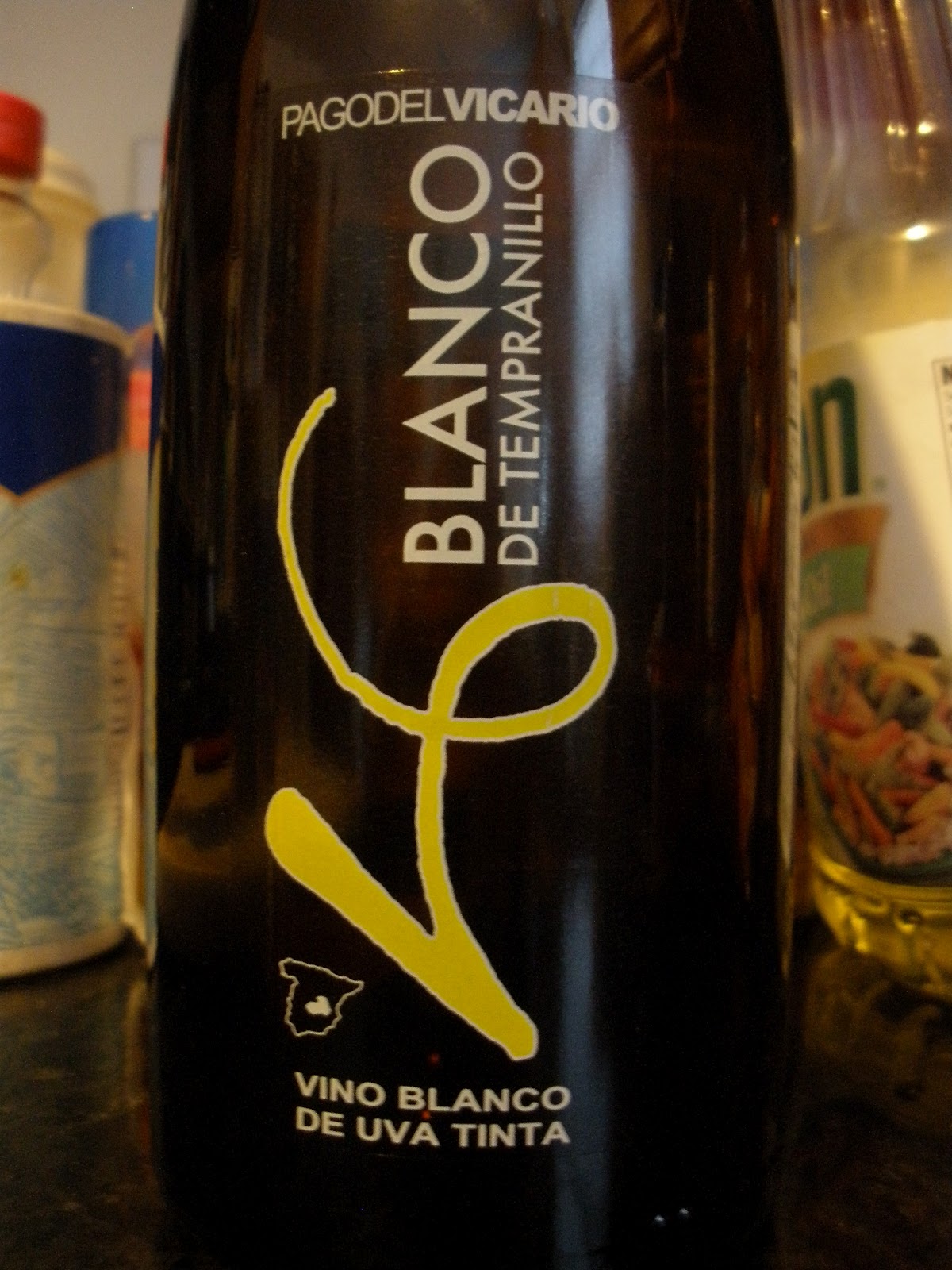
I visited Monica's warehouse a few weeks ago because she had some interesting wines come in that she wanted me to try with her. A winery in Spain called Pagodel Vicario, located in the Castilla-La Mancha region, had sent her several sample bottles for their entire line of wines, but two of them in particular stuck out to me (both were from the 2011 vintage). The first was called Blanco de Tempranillo and when Monica first told me about it, I got really excited. I have been trying to track down a wine made from Tempranillo Blanco, which is a white-berried mutation of the Tempranillo grape, for several months now, with no luck. I was hoping that I might finally be able to try a wine made from this grape, but as soon as I saw the label, I knew it was not to be. The label says "Vino blanco de uva tinta," which means something like "white wine made from red grapes." Rather than the white-berried mutation, this was more like a blanc de noir, where the red-berried grapes are pressed lightly with as little skin contact as possible in order to collect only the white juice for fermentation, which is the same processed used to make this Blanc de Franc wine previously featured on this site.
Despite my initial disappointment, I was still eager to try this wine since I'd never seen Tempranillo vinified this way before. The winery's website says that they picked the grapes for this wine on August 11, which is incredibly early, in order to retain freshness and acidity. The wine is vinified and aged in temperature controlled stainless steel prior to bottling. In the glass the wine was a silvery color with a slight pinkish tinge. It's hard to tell from the winery's site whether the grapes were crushed then pressed or just pressed whole, but whichever the case there was just a bit of pigmentation that found its way into this wine. On the nose the wine was fairly intense with apple, strawberry and cherry fruit aromas. If I was smelling this blindfolded, I probably would have guessed that it was a rosé wine rather than a white. On the palate the wine was on the fuller side of medium with medium acidity. There were flavors of creamy ripe pear, strawberry and tart cherries. Everything about this was screaming rosé to me except for the color of the wine in the glass. This is a really cool wine with some pretty unique characteristics, even if it isn't necessarily all that complex. I'm not sure what the retail price for something like this is, but if you're interested, feel free to email Monica at info@mbjwine.com.
The second wine that I tried was a rosé wine made from Petit Verdot grapes. We've explored Spanish Petit Verdot around here before, so interested readers are advised to read this post for more information about the grape itself. Every Petit Verdot based wine that I've ever tried has been inky black due to the grape's thick skins and small berry size, so I was very curious to see what a rosé wine made from 100% Petit Verdot would be like. The winery's website indicates that the juice was left in contact with the skins for only 8 hours in making this wine, but the result is one of the most intensely colored rosé wines that I've ever seen. In the glass this wine was a medium purple ruby color with a bright magenta rim. The intensity of the color was shocking as I know I've had red wines that weren't this deep (like wines made from Schiava or even some Pinot Noir). The nose was intense with waxy cherry and raspberry fruit along with a touch of licorice and rose petal. On the palate the wine was on the fuller side of medium with fairly high acidity. There was a bit of tannic grip to the wine as well, despite the brief skin contact time. There were bright, electric flavors of red berry fruit and waxy candied cherries. It wasn't complex, but it was intense and powerful. This is the biggest, most insane rosé wine I've ever tasted. It clocks in at 15% abv and in all honesty should probably be considered a red wine for food-matching purposes. It is much friendlier and more approachable than a varietal red wine made from Petit Verdot grapes, as it doesn't have the tight, tough, intense tannins that those wines carry along for their first decade or so in bottle, but it is definitely not the kind of light, crisp, refreshing wine that most people are looking for when buying a rosé. Drinking this is definitely a unique experience, so if you're interested, feel free to email Monica at info@mbjwines.com for more information.
A blog devoted to exploring wines made from unusual grape varieties and/or grown in unfamiliar regions all over the world. All wines are purchased by me from shops in the Boston metro area or directly from wineries that I have visited. If a reviewed bottle is a free sample, that fact is acknowledged prior to the bottle's review. I do not receive any compensation from any of the wineries, wine shops or companies that I mention on the blog.
Friday, June 8, 2012
Thursday, June 7, 2012
Croatina - Colli Tortonesi, Piemonte, Italy
One of my favorite posts from the early days of this site is this one about the Bonarda grape from Argentina. I remember being fascinated by the confusion surrounding the grape and having a blast trying to sort through and write about it. This was before I had discovered the wealth of literature about DNA analysis and grape varieties, but the roots of that interest and a lot of the subsequent research I've done for the posts on this blog can be traced back to that piece.
I bring that post up because today's grape, Croatina, is also known as Bonarda in some regions of Italy. We've taken a look at Croatina before here on this site, as it is an important component of a wine called Sangue di Giuda from Lombardia, Italy. It is found primarily in northwestern Italy, in Piemonte and Lombardia, and is one of three different grapes in Italy that goes by the name of Bonarda. In Piemonte, what is called Bonarda is typically either Uva Rara or Bonarda Piemontese. When you're in the Oltrepò Pavese region of Lombardia in Italy, Bonarda refers to Croatina. Today's wine is actually from Piemonte, and so the wine is labeled as Croatina rather than Bonarda, since Bonarda refers either to Uva Rara or Bonarda Piemontese here. Argentine Bonarda is, of course, none other than the Charbono of California, which is known as Corbeau in France (see citation 1 below for further reading). Interestingly enough, none of the grapes that are known as Bonarda are related to one another.
The name of the grape might make you think that it has something to do with the nation of Croatia, and you might be right, though just what that link might be is unclear. Some believe that the grape came into Italy via Croatia and picked up its name in the same way that Greco or Grechetto picked up their names from Greece. For awhile, Croatina was thought to be the same grape as Croatia's Hrvatica, since Hrvatica means "Croatian girl" in the Croatian language while Croatina means something like "Croatian girl" in Italian, but DNA studies have shown that these two grapes are not related to one another. As far as I know, Croatina has not been shown to be identical to any grape currently grown in Croatia and I haven't found any studies that link its pedigree to any grape in Croatia either.
It is somewhat unusual to find a varietal Croatina labeled as such, but I was able to find a bottle in a local shop for about $25. The wine was the 2006 Vignetti Massi "Pertichetta" Croatina from the Colli Tortonesi region of Piemonte. In the glass the wine was a deep purple ruby color. The nose was fairly intense with wild berry fruit aromas like blackberry, black cherry and blackcurrant along with some leather, smoke, black tea leaves and underbrush. On the palate the wine was on the fuller side of medium with fairly high acidity and big, grippy tannins. There were flavors of wild blackberry, black cherry, smoke, charcoal, old leather and blackcurrant. This wine was big, brambly and wild with dark, dense, powerful flavors. Croatina is typically a blending grape but if this bottle is any indication, it is a grape that deserves more attention as a varietal wine. The flavors were rich and deep, but the wine was still very well balanced and had enough structure to endure even more bottle age than the six years this bottle already had on it. This is a phenomenal wine for the money and is something I would not hesitate to buy again if I ran across it.
CITATIONS
1) Martinez, L., Cavagnara, P., Boursiquot, J.M., Aguero, C. (2008) Molecular characterization of Bonarda-type grapevine (Vitis vinifera L.) cultivars from Argentina, Italy and France. American Journal of Enology and Viticulture. 59(3). 287-291
Monday, June 4, 2012
Tintilla de Rota - Jerez, Spain
Some grapes are fairly easy to write about and some are much more difficult. At the moment, I have five different browser windows open with 20 tabs open between them as well as a handful of PDF files littering my taskbar. All of these windows are open because I was trying to find the answer to one single question: is Tintilla de Rota the same grape as Graciano? After several hours of digging and reading (and some money shelled out for access to specific articles), I think that I may have found an answer, but before I tell you what it is, I'm going to take you on the journey with me to give you a sense of how confusing this stuff can be, and how, despite the claims of many that this kind of technology will eventually rid us of a lot of unnecessary confusion, a lot of confusion still exists.
As in many other posts (see Turbiana and Hondarrabi Zuri, among others), my journey began with with The Oxford Companion to Wine, whose online version automatically redirects you to the entry on Graciano when you try to search for Tintilla de Rota. Within the entry for Graciano the writers state "it has also been certified through DNA profiling that the Tintilla de Rota grape of Jerez and Bovale Sardo on Sardegna are both Graciano." Since I've found mistakes in the Oxford Companion in the past regarding these kinds of issues, I set about trying to find the articles that would corroborate their account. The first article that I found was about the Tintilia grape from the Molise region of Italy (citation 1 below). In this article, the researchers analyzed several different examples of the Tintilia grape to see if it had any relationship to Tintilla de Rota (which they equate with Graciano with no discussion), Aglianico, a grape called Tintilia from Sardinia, several different grapes called Bovale Sardo or Bovale Grande and Monastrell, among others. This team found no relationship between any of the grapes listed above and were able to establish that each was a separate cultivar. In 2007, another Italian team (citation 2 below) analyzed the Bovale family of grapes on Sardinia and their research found that Bovale Sardo was identical to Graciano and another grape called Cagnulari. Who do we believe? The first study above was published in a peer reviewed journal, while the second was presented at a conference and published in the proceedings, so I'd be inclined to lean towards the former, but the OCW seems to lean more towards the latter.
Whatever the relationship is between Graciano and Bovale Sardo, what I was really interested in was the relationship between Graciano and Tintilla de Rota. Searching for that link, I came across this site (in Spanish) which seems to refer to a study that linked not only Graciano and Tintilla de Rota, but also a grape called Parraleta from the Somontano region of Spain. When I tried to track this article down, I came across another article (citation 3 below) from a Spanish research group (one of whom was supposedly in the research group in the study that I was actually trying to find) whose final sentence reads: "Results of this work confirm the trueness-to-type of 'Parraleta' accessions studied and also that this variety is not a synonymy of 'Graciano' cultivar."
None of this was really getting me that much closer to answer the question that I started with, but it was starting to make me wonder. I understand that scientific discovery is a process, but it's really difficult to get a feel for what's going on just by following the literature. For one thing, the literature is really spread out. I've had to look in about a dozen different journals to find some of these articles and have had to consult a few different academic search engines. For another thing, much of the literature is contradictory and there's rarely a third article published that definitively settles the score between two previously published papers that are at odds with one another. Since most of these grapes are pretty obscure there isn't exactly a continuing dialogue about them, and once a team has published their results, they seem to move on to the next project and not really engage with any contradictory studies.
By far the biggest problem, and the one that I think poses a serious danger to the credibility of the whole enterprise, is the way in which the researchers gather samples. I mention in my post on Hondarrabi Zuri that the root of that confusion was a mislabeled plant in a university collection. This problem is apparently somewhat widespread, as it shows up in the papers above more often that I feel comfortable with. In one of the studies (citation 1), the research team took several samples of each plant to verify that each was identical and that their test was working correctly. They took two samples of Bovale Sardo and two of Bovale Grande, but each of these samples came back with different DNA profiles, indicating that they were actually different plants (the methodology wasn't flawed as they took 21 different samples of Tinitilia from Molise and all 21 came back the same). Another study (citation 4 below), which was an update to citation 2, indicates that one of the samples they tested that was labeled Graciano actually turned out to be Trepat, while one of the samples labeled Parraleta turned out to be Mandón.
The problem here forms a kind of a circle. The samples that the scientists use are held and labeled in a university collection. Those samples were obtained from the field at some point where they were identified either ampelographically or by the farmer to the person collecting the sample. The problem is that there isn't any good way to verify whether the identification is correct at this point. You can't run DNA testing on a plant that you don't have a DNA baseline for. When you go to run DNA analysis for the first time on something you're calling Graciano, you're calling it that based on a visual inspection of the grape or by someone else's testimony to that effect, and the DNA that you get as a result ends up defining Graciano whether it's actually Graciano or not. The exact problem that DNA analysis is trying to solve is ultimately rooted in the same methods of identification that caused the problem in the first place, namely visual inspection and morphological classification (ampelography, in short). If you're running a DNA analysis on a grape that was misidentified in the field (or in the lab due to bad labeling), then the analysis is based on a faulty premise and the information is no good. In the case of Hondarrabi Zuri that I wrote about previously, the error was fairly easy to spot, but what about in subtler cases? If two institutions have a vine called Graciano and analysis on each institution's sample shows that they're two different vines, how do you decide which is the real Graciano? What if 10 institutions have a sample called Graciano and four different DNA patterns are found between them? The situation isn't quite that dire, but it is troubling
In case you've forgotten during that extended digression, the question that I was ultimately trying to answer was whether Graciano and Tintilla de Rota were the same grape. After a great deal of searching, I believe I finally found the paper that everyone is referencing (citation 5 below). This study was done by a Spanish team on a wide variety of Spanish grapes, and their paper reads "microsatellite analysis alone established 'Graciano' (D.O.Ca. Rioja), 'Parraleta' (D.O. Somontano) and 'Tintilla de Rota' (variety traditionally cultivated in Jerez) as the same genotype." That's the only reference I've been able to find in the literature and I've found nothing anywhere else to contradict it, other than the fact that Parraleta and Graciano may actually not be identical after all. Nearly every secondary source is unanimous in their agreement that Graciano is Tintilla de Rota, and without any evidence to the contrary, it looks like we have to agree.
Tintilla de Rota is used in both table wine and fortified wine production around the Sherry region of Spain. Rota is the name of a town in the Sherry region whose sandy soils are particularly well suited to the cultivation of the Tintilla grape. It has been known in this region since the 1500's, but was pushed to the brink of extinction in the 1950's as an American military base was constructed where many Tintilla vines were once planted. The wine that I was able to find was the fortified version from Emilio Lustau, which I picked up my friends at the Spirited Gourmet for about $45 (I believe Curtis Liquors carries this as well). To make this wine, the grapes are picked and then left out in the sun for two or three weeks to dry out. They are then placed in tubs and covered with mats to minimize the amount of air contact. They're left in the tubs for about a month and periodically stirred before being pressed. The wine is fortified to about 17% (mine was 17.5%) and then aged for awhile in casks before being bottled.
In the glass this wine was an inky jet black color with a brownish-purple rime. The nose was moderately intense with licorice, raisins, prunes, figs and toasted nuts. The overall character was of dark, dried fruits. On the palate the wine was on the fuller side of medium with fairly high acidity. It was sweet and syrupy with flavors of raisin, prune and toasted nuts. It was very dark and little smoky. It was richly sweet but well balanced and carried its alcohol well. It tasted kind of like a ruby port spiked with a little Pedro Ximenez Sherry. It's comparable to other fortified wines in terms of price and is interesting enough (and definitely tasty enough) to carry that kind of price tag. Whether it's the same as Graciano or not, this is definitely unlike any Graciano-based wine you may have had before and is definitely worth a try if you run across it on the shelves of your local wine shop.
CITATIONS
1) Reale, S., Pilla, F., & Angiolillo, A. (2006). Genetic analysis of the Italian Vitis vinifera cultivar 'Tintilia' and related cultivars using SSR markers. Journal of Horticultural Science & Biotechnology, 81 (6), 989-994.
2) Nieddu, G., Nieddu, M., Cocco, G.F., Erre, P., & Chessa, I. (2007). Morphological and genetic characterization of the Sardinian 'Bovale' cultivars. Acta Horticulturae, 754, 49-54.
3) Montaner, C., Martin, J.P., Casanova, J., Marti, C., Badia, D., Cabello, F., & Ortiz, J.M. (2004). Application of microsatellite markers for the characterization of 'Parraleta': an autochthonous Spanish grapevine cultivar. Scientia Horticulturae, 101, 343-347.
4) Buhner-Zaharieva, T., Moussaoui, S., Lorente, M., Andreu, J., Nunez, R., Ortiz, J.M., & Gogorcena, Y. (2010). Preservation and molecular characterization of ancient varieties in Spanish grapevine germplasm collections. American Journal of Enology and Viticulture, 61 (4), 557-562.
5) Borrego, J., Rodriguez, I., de Andres, M.T., Martin, J., Chavez, J., Cabello, F., & Ibanez, J. (2001). Characterisation of the most important Spanish grape varieties through isoenzyme and microsatellite analysis. Acta Horticulturae, 546, 371-375.
Wednesday, May 30, 2012
Auxerrois - Alsace, France; Oregon, USA & Wormeldange Nussbaum, Luxembourg
Auxerrois is a grape that frequently travels in disguise. It covers nearly 5,000 acres of land in Alsace, more than Pinot Gris or Pinot Blanc, but you virtually never see its name on the label of a Alsatian wine. Quite a bit of it finds its way into wines labeled "Edelzwicker", which is a generic term for any blended wine in Alsace. Another portion of it ends up in the sparkling wines of Alsace which are simply labeled Cremant d'Alsace. The most common wines that Auxerrois grapes end up in, though, are actually varietally labeled wines, but they are labeled as Pinot Blanc. Exactly why has always eluded me but the fact of the matter is if you buy a wine from Alsace that is labeled as Pinot Blanc, there's a better than average chance that there's some Auxerrois juice in there somewhere. That wouldn't be all that surprising as most regions allow some percentage of varietally labeled wines to be made up of other grapes, but it is possible that an Alsatian Pinot Blanc can actually be made up mostly of Auxerrois juice, or possibly even be 100% Auxerrois. How can this be?
As mentioned above, I'm not exactly sure about the answer, but have found two explanations that are pretty similar. According to Wikipedia, the words Pinot Blanc on a label in Alsace don't refer to a grape variety but rather to a white wine that is made from any of the Pinot varieties, which, according to the authorities, are Pinot Blanc, Pinot Gris, Pinot Noir and Pinot Auxerrois, which is the same as Auxerrois blanc. The other theory I've seen in a few places (like the Wall Street Journal and whatever this is) simply states that the law says that wines labeled as Pinot Blanc can be made from either Pinot Blanc or Auxerrois with each grape allowed to comprise any part of the blend, from 0% to 100%. The Alsatian winemaker in this video indicates that the latter explanation is essentially right, though his reading of the law is that if a wine has at least 1% Pinot Blanc and the rest is Auxerrois, it is labeled as Pinot Blanc. I'm having a rather difficult time navigating the INAO website in order to find the relevant bit of legislation, so I'm afraid I can't really weigh in on the matter, though I do find myself leaning towards the latter explanation since it seems to have the most support online across sources and since I've not heard of Pinot Gris or Pinot Noir ever being used in Pinot Blanc labeled wines.
Whatever the case may be, it seems like it might be important to suss out the exact relationship between Auxerrois and Pinot Blanc as most explanations seem to hinge on it to some extent. Some sources indicate that Auxerrois is a clone/mutation of Pinot Noir, which, if true, would make it virtually identical to Pinot Blanc, as both would be simply white-berried mutations of the same parent plant. It also would explain the source for the name Pinot Auxerrois and would lend some credence to Wikipedia's assertion that the INAO regards it as a member of the Pinot family. Other sources indicate that Auxerrois is a sibling of Pinot Blanc, which would mean that the two grapes shared the same parentage and, further, that Auxerrois is a sibling to Pinot Noir as well. This explanation would seem to lend more credence to the second explanation above as it would mean that Auxerrois wasn't a member of the Pinot family (in the genetic sense, where members of a grape "family" are all clones from a single parent vine and not in the more common sense where members of a family are parents, siblings, cousins, etc.) but was related in some way that could explain its being lumped together with Pinot Blanc.
Though both of those explanations have some degree of explanatory power in trying to understand the INAO laws, both of them are wrong. In 1999, a team at UC Davis found that the grapes Pinot Noir (or one of the Pinots, in any case) and Gouais Blanc were the parents of a slew of French grapes such as Aligoté, Gamay and Chardonnay, among others (Bowers, J., Boursiquot, J., This, P., Chu, K., Johansson, H., & Meredith, C. (1999). Historical Genetics: The Parentage of Chardonnay, Gamay, and Other Wine Grapes of Northeastern France. Science, 285(5433), 1562). One of those offspring was none other than Auxerrois, which means that Auxerrois is related to Pinot Blanc, but as an offspring rather than as a clonal variant or a sibling (remember that Pinot Blanc is simply a mutation of Pinot Noir and that they are genetically indistinguishable using modern DNA analyses, so for pedigree reconstruction and family relation purposes, they're the same grape). This also means that Auxerrois is a full sibling of Chardonnay, Gamay Noir, Aligoté, Romorantin and Melon (more commonly known as Muscadet), among others.
To add to the confusion, the name Auxerrois is also used for a handful of other grapes. In the Moselle region of France, Chardonnay was once known as Auxerrois Blanc while Auxerrois proper is known as Auxerrois Blanc de Laquenexy. I don't know what, who or where Laquenexy is, so if someone else knows, please enlighten me. Auxerrois is also occasionally used to refer to Malbec in the Cahors region of France, though the two grapes are not related to one another. In Alsace, Pinot Gris is sometimes known as Auxerrois Gris, though I don't believe that term ever finds its way onto a bottle.
As mentioned above, Auxerrois is most widely grown in the Alsace region of France, but it is planted in limited quantities in Germany and is especially prized in the tiny country of Luxembourg, which is located just west of Germany and just south of Belgium. The entire country of Luxembourg is fewer than 1000 square miles and has a population of about half a million. The entire country has about 3200 acres planted to the vine, which is less than the total amount of Auxerrois grown in Alsace. Luxembourg is pretty far north so ripening is an issue here, but since Auxerrois is pretty naturally low in acid, slightly under-ripe versions are palatable and, some might argue, more interesting than wines made from fully ripened grapes. The Mosel River forms part of the country's border with Germany to the southeast and this is where much of the vineyard land is concentrated.
As you might imagine, Luxembourg doesn't produce a ton of wine, but I was able to find a bottle of the 2009 Clos des Rochers Auxerrois from the Wormeldange Nussbaum site in Luxembourg. The Cru system in Luxembourg appears to not be linked to geography (geographically all Luxembourg wines fall into the Moselle Luxembourgeoise appellation) but rather to the evaluations of a tasting panel who score the wines on a 20 point scale. This wine was labeled as Grand Premier Cru, which is the highest level, and which means that the wine was submitted for tasting at least three times, with one of those tastings happening prior to bottling. The wine is then tasted again after bottling and if it is scored higher than 16, it can be re-submitted for a third tasting. If it scores above an 18 at the third tasting, then and only then can it be labeled Grand Premier Cru (it's an odd system you can read more about here). I picked this bottle up for about $15 from my friends at Bin Ends. In the glass this wine was a pale silvery lemon color with greenish tints. The nose was moderately intense with white peach, lemon peel, honey and honeysuckle aromas. In the glass the wine was medium bodied with fairly high acidity. It was off-dry with flavors of ripe peaches, pineapple, orange cream, ripe pear and honey. It was a big, ripe, round wine that was somewhat Riesling-like but which lacked the laser sharp acidity that is the hallmark of great Rieslings. I enjoyed the wine quite a bit and found it to be a very good value at only $15.
The next wine that I was able to try was the 2009 Adelsheim Ribbon Springs Vineyard Auxerrois from Oregon. I picked this wine up locally for about $22. In the glass this wine was a medium silvery lemon color. The nose was moderately intense with delicate ripe pear and honey notes. The aroma kind of reminded me of clean river water as well. On the palate the wine was medium bodied with fairly high acidity. There were racy flavors of green apple and lime with a touch of white pear. The finish was clean and minerally, if a bit tart. This wine walks the fine balance between tart citrus and plump white fruits very well and the clean, stony finish is refreshing and lovely. It was much drier than the Luxembourg wine and also a bit leaner and more delicate as well. It's a nice wine but not really worth the step up in price from the Luxembourg wine.
The last wine that I tried was the 2010 Valentin Zusslin "Pinot d'Alsace" Auxerrois from Alsace. It can be difficult to find Alsatian Auxerrois that is labeled as such, so I was pretty excited when I found this bottle over at the Wine Bottega for about $25. In the glass this wine was a medium lemon gold color. On the nose the wine was fairly intense with aromas of peach, lemon curd, green tea, green apples and a touch of apple cider. On the palate the wine was medium bodied with fairly high acidity. There were racy flavors of ripe peach, green apple and apple cider. The flavors were pure and very intense, but overall the wine was nicely balanced with good acidity and a nice, clean, minerally finish. It had the intensity of the Luxembourg wine but was dry like the Oregon wine and really integrated the best qualities of both of those wines nicely. It was the most expensive of the three wines, but I felt like it was really worth the money.
I've always enjoyed Pinot Blanc wines from Alsace (especially Zind-Humbrecht's bottling), but I've found that I generally don't like Pinot Blanc based wines from other areas. Tasting through these three wines, I think that it's pretty clear that it's the presence of the Auxerrois grape that I'm really responding to. Auxerrois has a reputation of making flabby, low-acid wines, but I found that the acid content in these three wines was nicely managed and the purity and intensity of the fruit really put the best examples over the top. I'd definitely recommend picking one up if you come across it, especially with the warmer months of summer on the way.
Labels:
Alsace,
Auxerrois,
France,
Luxembourg,
Oregon,
USA,
White Wine
Thursday, May 24, 2012
Passerina - Marche, Italy
I've mentioned in the past that doing Google image searches on grape names often yields unexpected results. In doing this I've learned about a video game character named Verdelet and a painter named Grechetto. I've also learned that Grillo is the Italian word for cricket and that Trousseau is the name of a company that makes bridal gowns (that post was a two-fer as I also learned about a baseball pitcher named Bastardo, which is one of the synonyms for Trousseau). Today's Google image search on the Passerina grape was definitely the most colorful, though, as apparently Passerina is a bird genus within the Cardinal family. The North American Buntings belong to the Passerina genus and are quite colorful and vibrant to look at so if you're having a dreary kind of day, take a quick break to look at this page of birds and hopefully they'll brighten your day a bit.
Feel better? Good. The eagle-eyed among you may have noticed that around page 2 of the GIS, pictures of some plants start to show up that definitely aren't grapevines. There is also apparently a genus of plants called Passerina which you can read all about here. Believe it or not, there is a common link between the birds, the plants and the grape. In all three cases, the name Passerina comes from the Latin word Passerinus, which means "sparrow-like." This is pretty self-explanatory for the birds, as they do in fact resemble sparrows, though they are not related to them. The plants that belong to the Passerina genus have seeds that are curved and somewhat beak-like so their name comes from the fact that they're said to resemble sparrows' beaks. The grape Passerina is so named because it is apparently the snack of choice for the sparrows in the Marche region of Italy where it is grown.
Fascinating as all that may be, we're not interested in sparrows, buntings or weird plants here. We're interested in grapes and wines and the one we're interested in today is called Passerina. Passerina is grown exclusively in the Marche region on Italy's eastern coast. It's not a very common grape, but it does find its way into a few DOC wines like those of Offida (where it can be made into a dry table wine, a passito style dessert wine, a vin santo style dessert wine or a metodo classico sparkling wine) or of Falerio dei Colli Ascolani. It gets a cursory treatment in the Oxford Companion to Wine whose entry on it reads in full: "white variety from Italy's Adriatic coast." Wikipedia offers a little more, telling us that the vine has "large berries, high yields and a long ripening period" and that the grape makes "appealing wines with clear, focused fruit."
Once we move away from these two sources, Passerina becomes a bit more complicated. In his Brunello to Zibibbo, Nicolas Belfrage mentions that Passerina may be the same grape as Biancame and Bianchello, though he notes that his sources are not in unanimous agreement on the matter. The New York Times Wine Club website takes this position as well, but I can't find any other sources that agree. I checked the VIVC database but the information that they have only muddies the water. According to the VIVC, Passerina is a synonym for both Trebbiano di Toscana as well as Mostosa in Italy (with presumably the same etymological link to sparrows), though those grapes aren't grown in the Marche so they probably aren't what we're dealing with here. The only entry listed with Passerina as the prime cultivar name is for a Greek grape, and though this (admittedly non-academic and sales oriented) source posits a Greek origin for Passerina, they're the only ones who make that assertion so I'm taking it with a grain of salt. Since it doesn't look like anyone's done the DNA studies to prove or disprove the link between Passerina and Bianchello, the only option seems to be to note that the Italian government treats the two grapes as individual cultivars and follow suit.
I was able to find a bottle of the 2008 Capestrano Passerina from my friends at Curtis Liquors for about $8. In the glass this wine was a medium lemon gold color. The nose was reserved with some lemon peel and fennel bulb aromas. It was subtle, but the overall sensation from the nose was herbaceous. On the palate the wine was medium bodied with medium acidity. There were some ripe apple and lemony citrus flavors along with a stony minerality and a vegetal, herbaceous kind of fennel bulb edge. The flavors were very subdued and washed out. This wine was almost certainly past its prime and was mostly just kind of clean and minerally, which isn't always a bad thing, but it really lacked the acidic backbone that it needed to make it refreshing and interesting to drink. It certainly resembled the Bianchello I tried before, but it's hard to draw any real conclusions from that since the bulk of their similarities have to do with their lack of flavor and interest, which can honestly be said about an awful lot of white wines throughout the world. I'd be interested to try a DOC version sometime and if I run across any I'll be sure to post any notes here.
Subscribe to:
Posts (Atom)


