A blog devoted to exploring wines made from unusual grape varieties and/or grown in unfamiliar regions all over the world. All wines are purchased by me from shops in the Boston metro area or directly from wineries that I have visited. If a reviewed bottle is a free sample, that fact is acknowledged prior to the bottle's review. I do not receive any compensation from any of the wineries, wine shops or companies that I mention on the blog.
Showing posts with label Loire Valley. Show all posts

Friday, January 11, 2013

Odds and Ends - Sparkling Malbec, Botrytized Rkatsiteli, White Pinot Noir, Rufete Rosado and Pignoletto Redux

Today I'd like to introduce a new erratic feature where I provide a few tasting notes for some unusual wines that I've come across lately that I either don't want to write a whole post about or which feature grapes that I've already written a full post about and just don't want to fully revisit.  The former group mostly features wines made from common grapes but made in unusual styles and while I enjoy drinking these wines, I find that I don't have much to say about them, so when I go to write a new post, I tend to skip over those entries in my tasting notebook for those featuring novel grapes.  I'm starting to accumulate quite a few notes like that, though, so I decided to unload some of them here.  I also have a tendency to buy bottles made from unusual grapes I've already covered here so that I can compare them to the wines I've previously written about.  I used to just updat those prior posts with these new tasting notes, but since new posts get more readers than old ones, I thought that those notes may be missed by many readers, so I decided to include them in this little feature as well.

The first wine I'd like to write about is the NV Domaine Augis "La Rosée" sparkling Malbec from the Valency region of the Loire Valley in France.  Though Malbec is currently the superstar grape of Argentina, its original home is France and in many French areas, including this one, the grape is known as Côt.  This is a traditional method rosé sparkler that I picked up for around $17 from my friends at the Wine Bottega.  In the glass the wine was a fairly deep violet pink color with vigorous bubbles.  The nose was somewhat reserved with aromas of fresh cut strawberries and crushed raspberries.  On the palate the wine was light bodied with fairly high acidity and smooth, creamy bubbles.  There were flavors of bitter cherry, fresh strawberry, red currant and crushed red berries.  I found the wine very clean and refreshing and enjoyed it with a pan seared swordfish steak.  I think it's a tremendous value for a traditional method sparkler at less than $20 a bottle and would recommend it unreservedly.

The next wine I'd like to talk about is the 2006 Satrapezo "Gviani," which is a dessert wine made from botrytized Rkatsiteli grapes (retail around $30 for 375 mL).  I've written about Rkatsiteli many times (here and here and here), but this is the first dessert wine made from the grape that I've been able to try.  The grapes for this wine were grown on the banks of the Alazanis river in Georgia where mists and morning dew from the river combined with warm afternoon sun provide the ideal conditions for the development of botrytis cinerea, which is perhaps better known as noble rot.  This fungus infects the berries by piercing the grape's skin, causing much of the water in the berry to evaporate, leaving a dense, sticky, sugary liquid behind.  This liquid is fermented as much as possible and, in this case, aged for a short time in oak barrels prior to bottling.  In the glass the wine was a fairly deep lemon gold color.  The nose was fairly reserved with aromas of apricot, mint, orange marmalade, vanilla and pineapple.  On the palate the wine was full bodied with fairly high acidity.  It was very sweet with flavors of apricot, orange marmalade, honey, red grapefruit and peach cobbler with a clean, minty finish.  I found this wine pretty shut down at fridge temp, but much more generous and open at cellar temp.  I enjoyed this wine and thought it was a reasonable value, but it really lacked the complexity of fine Sauternes or BA/TBA wines from Germany.  Fans of botrytized wines should probably check this out, but connoisseurs may want to skip it.

Next up is the 2008 Trenz Spätburgunder Blanc de Noir from the Rheingau region of Germany, which I picked up from my friends at Curtis Liquors for around $18.  Spätburgunder is the German word for Pinot Noir and while German Pinot Noir certainly isn't that unusual, white wines made from the grape are.  I took a look at a Cabernet Franc wine (and a Nebbiolo wine) made using this method a few months back so readers looking for technical information on how the wine is made are referred to the Cab Franc post.  In the glass the wine was a medium lemon gold color.  The nose was fairly intense with funky, leesy aromas of candied strawberry, watermelon and candied apple.  It smelled more like a rosé than a white wine, which is what I also found in that Blanc de Franc.  On the palate the wine was medium bodied with fairly high acidity.  It was off-dry with honey, peach, candied strawberry, candied green apple and lemon curd flavors.  It was bright and zippy and walked that line between sweet and tart that the Germans are so fond of exploring.  I've had a few other Blanc de Noir style Pinot Noir table wines before, but this is definitely the best that I've ever had.

Next up is the 2008 Vina Salamanca Rufete rosado, which I also picked up from Curtis Liquors for around $13.  I wrote about the Rufete grape a few years back, but at the time, the only wine I could find containing the grape was 50% Rufete and 50% Tempranillo.  This wine is from the same producer, but is made from 100% Rufete grapes.  In the glass the wine was a light salmon pink color.  The nose was moderately intense with funky, leesy aromas of strawberry and not much else.  On the palate this wine was on the lighter side of medium with fairly high acidity.  There were flavors of red cherry, fresh cut strawberry, raspberry and a touch of leesy funk.  This wine was definitely in decline a bit as it was a few years old by the time I got my hands on it, but it was still crisp, fruity and refreshing, which is all I really ask of my pink wines.  I know that there are red wines made from the Rufete grape out there, but I have been unable to track any of them down thus far.  When I finally do, you can bet that tasting note will be up on the site somewhere.

The final wine that I'd like to write about was the 2008 Branchini Pignoletto from the Emilia-Romagna region of Italy (which I picked up at Panzano Proviste for around $18).  I wrote about the Pignoletto grape a few months back and took a look at two wines from Alberto Tedeschi which were very good but were hardly what you might consider traditional.  When I came across this example from Branchini, I decided to try it out to see what a regular table wine made from the grape might be like.  In the glass the wine was a fairly deep lemon gold color.  The nose was somewhat reserved with ripe apple, lemon and mint aromas along with something vaguely floral.  On the palate the wine was on the fuller side of medium with medium acidity.  There were flavors of white peach, mint and Meyer lemon with a bit of nuttiness on the finish.  The citrusy lemon notes were dominant at fridge temp, but the peachy flavors woke up and became a bit more generous as the wine warmed up.  This wine was probably a little over the hill, but it still provided an interesting counter point to the more avant garde efforts from Tedeschi.  Overall, I thought it was OK, but probably not worth the price tag.  The Tedeschi wines were much more interesting and characterful and only a few dollars more than this example, thought they're also probably more of an acquired taste.

Thursday, November 15, 2012

Menu Pineau (Arbois/Orbois) - Loire Valley, France

Menu Pineau was not a grape that I intentionally set out to try.  When I bought the bottle that I'll be reviewing below, I thought that it was made mostly from the Romorantin grape with a dash of something called Orbois tossed in for good measure.  It's a French wine that is bottled as a vin de table, which means that the producer is not allowed to mention any grape names, vintage information or regional information on the front or the back labels, so all I had to go on was the store owner's word.  When I got home later and looked the wine up online, the producer's website indicated that the grape mixture was actually the reverse of what the shop owner had told me (about 80% Menu Pineau and 20% Romorantin)*.  This actually turned out to be a great thing for me, since I had a few other examples of Romorantin to write about and had nothing from the Menu Pineau grape, so the result of the happy accident is today's post.

Menu Pineau is a very old grape that has been cultivated in the Loire Valley since at least the 16th Century, where it was first mentioned in print by François Rabelais.  When I went to tag today's entry, I was surprised to see that I already had an Arbois tag, since I didn't remember ever writing about this grape before, but it turns out that I have previously used the Arbois tag to refer to the Arbois sub-region of the Jura and not to the grape.  The two names are apparently completely unrelated, as Menu Pineau has not ever been cultivated in the Jura, according to Robinson & Co. in Wine Grapes.  They say that the Arbois/Orbois name is a corruption of the name Herbois, which is what the grape was called in the Loir-et-Cher region where it is most widely grown.  In the local dialect, Herbois was spelled/pronounced Orboé or Orboué, which ultimately became Orbois and then Arbois.  It is officially known as Orbois in France, as Arbois Blanc in the VIVC database, and as Menu Pineau in Wine Grapes.

The Menu Pineau name may lead you to believe that it is somehow related to Pinot Noir or to the Pinot family of grapes, but that doesn't appear to be the case.  It was named Menu Pineau to differentiate it from Gros Pineau, which is another name for Chenin Blanc, which is widely grown in many of the same areas as Menu Pineau.  Gros means large and menu means small, while Pineau (or Pineau de la Loire) has just historically been one of Chenin Blanc's many names.  Menu Pineau does seem to have a parent/offspring relationship with Gouais Blanc, the other half of the famous Pinot x Gouais duo (see my post on Romorantin for more details) that was responsible for so many of the grapes we enjoy today.  This means that Menu Pineau is a half-sibling of all the grapes from that crossing, but more amazingly, is also at least a half sibling of at least 78 other grapes.  This study (in French...the link is to the download page, which will allow you to DL the entire bulletin...the relevant paper is the first one in the bulletin) shows that Gouais Blanc shares 50% of its DNA markers with these 78 grapes, meaning that it is likely one of the parents for nearly all of them.  The list includes such luminaries as Riesling, Furmint, Jacquère, Frâncuşă,  Grolleau, Colombard, Folle Blanche, and Muscadelle, among many others.

Menu Pineau is authorized for use in a handful of AOC wines in the northern Loire Valley, but it is being phased out of at least one major one.  As of 2016, Menu Pineau will be forbidden in AOC wines from Touraine (as will all other white grapes not named Sauvignon...only Sauvignon Gris and Sauvignon Blanc will be permitted).  Sauvignon Blanc has actually supplanted Menu Pineau in most of the areas in which the grape was once widely cultivated, as plantings in France have fallen from almost 1500 hectares in 1968 to fewer than 300 hectares in 2004.  It is generally faulted for having low acidity, and when it shows up, it typically shows up as a minor blending component to cut the acid of its more popular running-mates Chenin Blanc and Sauvignon Blanc.  There are a handful of producers making varietal wines from the grape, but I haven't been able to track any of them down.

I was able to pick up the 2007 Julien Courtois "Originel" bottling, which, as mentioned above, is about 80% Menu Pineau and 20% Romorantin.  This wine is bottled as a vin de table, so the vintage information is buried in a lot number on the back of the bottle (and I may be misinterpreting it), while the grape breakdown comes from the producer's website.  I picked this bottle up from my friends at the Wine Bottega for around $35.  In the glass the wine was a medium golden bronze color and was a little bit hazy.  The nose was intense with apple cider, peach and honeysuckle aromas.  On the palate the wine was on the fuller side of medium with fairly high acidity.  There were flavors of apple cider and fresh cut green apples along with apricot, honey and lemony citrus.  The acidity was surprisingly sharp here and was a bit too much to handle at room temperature.  Cellar temp or just slightly colder was the way to go, as the flavors became very muted at fridge temp.  I really liked the balance between the fresh fruits and the slight oxidation in the wine and found the wine enjoyable on the whole.  It is a bit pricey, but I don't think it's overpriced for what you get.  It's actually a great Fall wine that would probably provide a lot of interesting pairings at the Thanksgiving table, if you're looking for a nice oddball wine to serve your guests.

*I want to be clear that I think it's amazing how much most wine shop workers know and remember about their stock off the top of their heads, especially considering the crazy kinds of questions I sometimes throw at them.  Matt at the Wine Bottega is an unbelievable fount of knowledge and this anecdote isn't intended to cast any aspersions on him or his store.  The whole crew at the Bottega are insanely knowledgeable and just all around good people.  The anecdote is merely to explain a happy accident that resulted in me getting something more interesting than I bargained for (I had a similar experience with the Kanzler grape as well).  Not all mistakes are bad things...think about the discovery of penicillin or Champagne or possibly even wine itself for examples of mistakes or accidental discoveries leading to wonderful new things.

Wednesday, October 10, 2012

Folle Blanche (Gros Plant) - Nantais, Loire Valley, France

Folle Blanche was, at one point in time, a very important grape, but not for wine production.  Rather, it was the most important variety grown for the production of Armagnac and Cognac, the famous distilled spirits of western France.  It was the workhorse grape of these regions before phylloxera struck, but once those vineyards were decimated by the pest, the grape was never able to reclaim its former glory.  Plantings have declined throughout the 20th Century from nearly 30,000 acres in 1968 to fewer than 6,500 by 2000.  We'll take a look at some of the reasons for this decline and also take a look at a few table wines made from the grape below.

You might think that whatever grape makes a good wine would also make a great brandy, since brandies are essentially just distilled wines, but it turns out that isn't the case.  The qualities that distillers look for in a base wine for brandy are high acid and light flavor, as heavily flavored base wines apparently make for clumsy brandies while high acids amplify aromas and help balance the finished liquor.  Wines made from Folle Blanche grapes posses both of these characteristics, and for many years the vine was prized for the fine brandies that resulted from its distillation.  The vine was somewhat problematic to grow, though, as it tended to be very vegetatively vigorous and demanded a lot of pruning in order to avoid problems with botrytis bunch rot and black rot, two fungal diseases to which it is particularly prone.  This problem actually got worse after the phylloxera epidemic, as it turned out that Folle Blanche vines became much more vigorous after being grafted onto native American rootstocks.

As we've covered many times on this site, the war against phylloxera was fought on several different fronts.  Once people began to notice that native American grape varieties were largely unaffected by the louse, many people, like Albert Seibel and JF Ravat, tried to create new grape varieties by breeding vinifera vines with native American vines in order to try to retain the quality winemaking characteristics of vinifera with the phylloxera resistance of the other varieties.  One of those hybridizers was François Baco who, in 1898, crossed Folle Blanche with Noah (itself a riparia x labrusca hybrid that is definitely not the same as the Hondarrabi Zuri grape) to create Baco 22A, or Baco Blanc (he also created Baco Noir which also has Folle Blanche as one parent but a different riparia vine for the other).  Baco Blanc also made wines that were lightly flavored and high in acid, but the vines were also resistant to many of the diseases that plagued Folle Blanche vines, and many growers opted for Baco Blanc over Folle Blanche for these reasons.  It turns out that the EU ban on hybrid grapes only applies to quality wine production, so the use of a hybrid vine to make a distilled spirit was legally fine.  Plantings of Baco Blanc have been steadily declining, though (to about 5,000 acres as of 2000), as many Armagnac and Cognac growers have begun either making their own wines from their grapes or trying to sell some of their crop to table wine producers.  Since Baco Blanc is a hybrid, it cannot be used for this purpose, and many growers are opting to plant more Colombard and Ugni Blanc, the other great vinifera vines used in the production of Cognac and Armagnac, in order to have more options for the fruits of their vines.

Folle Blanche is thought to be a half-sibling to many of the great grapes of France. One of its parents has been identified as Gouais Blanc, which was also parent to Romorantin, Chardonnay, Gamay, Auxerrois, Aligoté, Melon de Bourgogne (aka Muscadet) and many others.  Pinot Noir was identified as the other parent for those grapes, but Folle Blanche's other parent is currently unknown.  Folle Blanche has many synonyms, many of which can be confusing.  It is known as Picpoul, or lip-stinger, though it doesn't seem to be related to Picpoul-de-Pinet.  It also has Dolcetto and Ugne Blanche as accepted synonyms, but is not related to the Italian Dolcetto or Ugni Blanc, as far as I know.  It is also known as Enrage, Enrageade and Enrageat, which I just find kind of funny.  The VIVC lists 62 accepted synonyms for Folle Blanche, which you can peruse at your leisure here.  The only one I happened across was Gros Plant, which is commonly used on the labels of wines made from Folle Blanche in the Nantais region at the far western end of the Loire Valley.

I was able to find a bottle of the 2009 Domaine des Troit Toits Gros Plant from my friends at the Spirited Gourmet for around $16.  In the glass the wine was a pale silvery lemon color with greenish tints.  The nose was moderately intense but delicate and subtle with white pear and golden apple fruits along with a touch of lees (the wine is aged sur lie, as you can see at right).  On the palate the wine was light bodied with searingly high acidity.  There were flavors of raw lemon-lime citrus and green apple, but it was difficult to get a bead on anything as the acid was just sky high.  I've had some wines before that people told me were high-acid, but I've never had anything quite like this.  It was just raw, tooth-stripping power that was frankly a little difficult to even drink.  I'm a fan of acidic wines and love sour candy, but this was a little bit too much for me.  If the ideal base wine for brandy is high acid and light flavor, this bottle would seem to be the Platonic ideal.

High acid wines are not only good for distillation, though.  The Champagne region of France has made many fortunes turning the high-acid, underripe juice of grapes into beautiful wines by forcing them through a second fermentation in bottle and trapping the resulting bubbles in the wine.  The second wine that I tried, the NV "Atmosphères" from Jo Landron ($18 from the Wine Bottega), was a traditional method sparkler made from 80% Folle Blanche and 20% Pinot Noir.  In the glass this wine was a medium lemon gold color with big, steady bubbles.  On the nose the wine was fairly intense with funky apple and lemon fruits wrapped up in a freshly baked yeast roll.  On the palate the wine was light bodied with high acidity.  There were flavors of toasted bread, golden apples, lemon juice and fresh yeast rolls again.  This wine was highly acidic, but it was much more manageable and better integrated into the wine.  It wasn't a deeply complex wine, but it was simple and clean and would make a nice aperitif.  It was certainly much more approachable and friendly than its still wine counterpart and, for only $2 more, is a much better value as well.

Thursday, August 23, 2012

Romorantin - Cour-Cheverny, Loire Valley, France

One of the landmark papers in the young science of genetic grape analysis was published in the journal Science in 1999 and was titled "Historical genetics: the parentage of Chardonnay, Gamay and other wine grapes of northeastern France."  In that paper, the researchers discovered that two grapes, Pinot Noir and Gouais Blanc (also known as Heunisch Weiss), were the parents of 16 other French grapes.  About half of the discovered offspring are of limited importance for wine, but the other half include such well-known grapes as Chardonnay, Gamay Noir, Auxerrois, Aligoté, Melon (sometimes known as Muscadet), Sacy (sometimes known as Tressallier) and Romorantin.

This paper was extraordinary for several reasons.  The most important finding was the discovery of the parentage of Chardonnay and Gamay, which are obviously two of the most important vines in the world.  Another reason was just the sheer number of grapes whose pedigree was confirmed in the study.  Pedigree analysis is a difficult process (see my post on Ciliegiolo for in-depth info on it), and most studies are only able to confirm the pedigree for single grapes.  Finding a pair of grapes with so many offspring was very unusual and to able to link them to so many important grapes that are still in use today was really amazing.  Finally, many were surprised that Gouais Blanc, a grape which was not known for its quality and which had disappeared completely from French vineyards at the time of the study (existing only in the holding collection of a research institute), could be the progenitor of so many fine grapes.  It was widely thought that great grapes couldn't come from common stock, but this study (and later ones which showed that Gouais Blanc is also a parent to Riesling, among many others) showed that this simply wasn't the case.

Romorantin is listed in the body of the study as an offspring of Pinot and Gouais Blanc, but that's not entirely accurate.  In a footnote, the authors indicate that Romorantin actually didn't match Pinot at one particular site, which is usually enough to indicate that there is no parent match.  There's a red-fleshed mutation of Pinot Noir called "Pinot fin teinturier," though, that, interestingly, also doesn't match Pinot Noir at the same site.  For the most part, berry color and flesh color mutations are indistinguishable from one another in microsatellite DNA tests, so Pinot Noir, Pinot Gris and Pinot Blanc would all look genetically identical using this method, but Pinot fin teinturier has this one microsatellite site (VVS2 for those interested) that's different from the other Pinots.  It turns out that if you run the parentage analysis with Pinot fin teinturier and Gouais Blanc, you get a perfect match for the parents of Romorantin.  For all intents and purposes, though, Romorantin's parents are Pinot and Gouais Blanc and it is a full sibling of Chardonnay and all of the other grapes mentioned in the study.

Romorantin is grown exclusively in the eastern part of the Loire Valley.  There is a legend that it was introduced to this area by King Francis I, who was from the nearby Romorantin commune, in the early 16th Century.  It was once widely grown throughout the Loire Valley, but today is limited to the Cheverny AOC. Chevrny consists of about 450 hectares of various vines, but there is a small region in the southeastern corner of the appellation that consists of about 50 hectares of Romorantin.  Wines from this area have their own AOC called Cour-Chevrny, and they must be made from 100% Romorantin grapes.

I was able to pick up a bottle of the 2008 Domaine de Montcy Cour-Chevrny from my friends at the Wine Bottega for about $25.  In the glass the wine was a medium lemon gold color.  The nose was reserved with subtle pear, lemon peel and pineapple aromas.  On the palate the wine was on the lighter side of medium with fairly high acidity.  There were flavors of lemony citrus, tropical pineapple and pear fruits along with something slightly sweaty and funky which was really only present for a few minutes after pulling the cork before it blew off.  The wine finished with a strong, steely minerality.  The wine was crisp, bright and refreshing which is mostly what I look for in a Loire Valley white. It is a bit on the expensive side for what you're getting, but is interesting and unusual enough to justify the expense.  With enough imagination, you can kind of see how this might be related to Muscadet or to Chardonnay (of the unoaked variety) and fans of those kinds of wines will probably find a lot to like here.

CITATIONS

Bowers, J., Boursiquot, J.M., This, P., Chu, K., Johansson, H., & Meredith, C.  1999.  Historical genetics: the parentage of chardonnay, gamay, and other wine grapes of northeastern France.  Science: 285. pp 1562 - 1565.

Monday, January 30, 2012

Pineau d'Aunis - Coteaux du Vendômois, Loire Valley, France

Pineau d'Aunis is a grape whose many names can give the illusion of familiarity.  Its most common name, Pineau d'Aunis, puts one in mind of the Pinot family of grapes, which it is related to only linguistically, as there is no genetic relationship between the Pinot family and Pineau d'Aunis that I am aware of.  Both Pinot and Pineau come from the French word for "pine" because the bunches of grapes supposedly looked like pine cones to those who were naming them (think of Pignolo or Pignoletto in Italy).  The d'Aunis part of the grape's name comes from the Prieure d'Aunis, a monastery located near the Saumur region of the Loire Valley.  It is thought that the grape was first "discovered," or, more accurately, selected for by the monks there.

Many local growers throughout the Loire Valley also refer to the grape as Chenin Noir, suggesting some kind of relationship to the Chenin Blanc grape that has made so many areas of the Loire Valley famous.  Confusingly enough, one of the alternate names for Chenin Blanc is Pineau de la Loire, which certainly might make one wonder about the relationship between the two grapes.  Wikipedia has it that Chenin Blanc is a mutation of Pineau d'Aunis, but if you follow the source cited for that bit of information, you can see that there is no such claim made in the original material and, further, that the source material makes no reference to the Pineau d'Aunis grape at all.  The common consensus seems to be that Chenin Blanc and Pineau d'Aunis are, in fact, completely unrelated, and the Chenin name common to the two of them comes from a site known as Mont Chenin in the Loire Valley where the Chenin Blanc grape was planted by the Lord of Chenonceaux in the 15th Century.  The Chenin name most likely got moved over to the Pineau d'Aunis grape at a time when its plantings were as significant as those of Chenin Blanc in some areas of the Loire Valley and many farmers began to refer to the grapes as Chenin Blanc and Chenin Noir for convenience's sake.

DNA analysis would clear the whole matter up, but it would seem that no one has bothered to give it a try.  Which is too bad, really, because the grape is old enough and has been in the region for long enough that there may be some interesting discoveries to be had.  It's said that Henry III of England was a fan of the wine and had it imported in from France in the mid 13th Century.  Apparently the English ruled over Anjou, located in the Loire Valley, for a few decades before Henry III came into power and Henry tried, in vain, to bring the region back under English rule throughout his reign.  I doubt that Pineau d'Aunis wine had too much to do with Henry's motivations, given the extraordinarily complex web of political intrigue throughout Western Europe at the time, but it certainly could have played some role.  Wars have been waged for far less important reasons than a barrel or two of wine.

Today, it would be a wild exaggeration to call Pineau d'Aunis a "wine for Kings."  I'm not entirely sure what the reason for the grape's ultimate decline was, but my guess is that the white wines of the Loire Valley began to gain in popularity and profitability at some point and many growers pulled up their red grapes in favor of the twin darlings of the Loire Valley, Sauvignon Blanc and Chenin Blanc.  As of the year 2000, there were fewer than 1000 acres (about 430 hectares) planted to Pineau d'Aunis, most of which ends up as an anonymous minority component in some Loire Valley red or rosé wine.  You're most likely to find it as a varietal wine in the Coteaux du Vendômois, which is around the center of the Loire Valley (from east to west), just north of Vouvray.  Most wine made under this appellation is rosé, and I was able to find two examples in this particular style.  There are also a handful of producers who make red wines that are all or nearly all from the Pineau d'Aunis grape, and I was able to try one of those bottlings as well.  Finally, there are some people who are just doing crazy things with the grape, and from one of those producers I was able to find a fully sparkling white wine made from Pineau d'Aunis grapes.

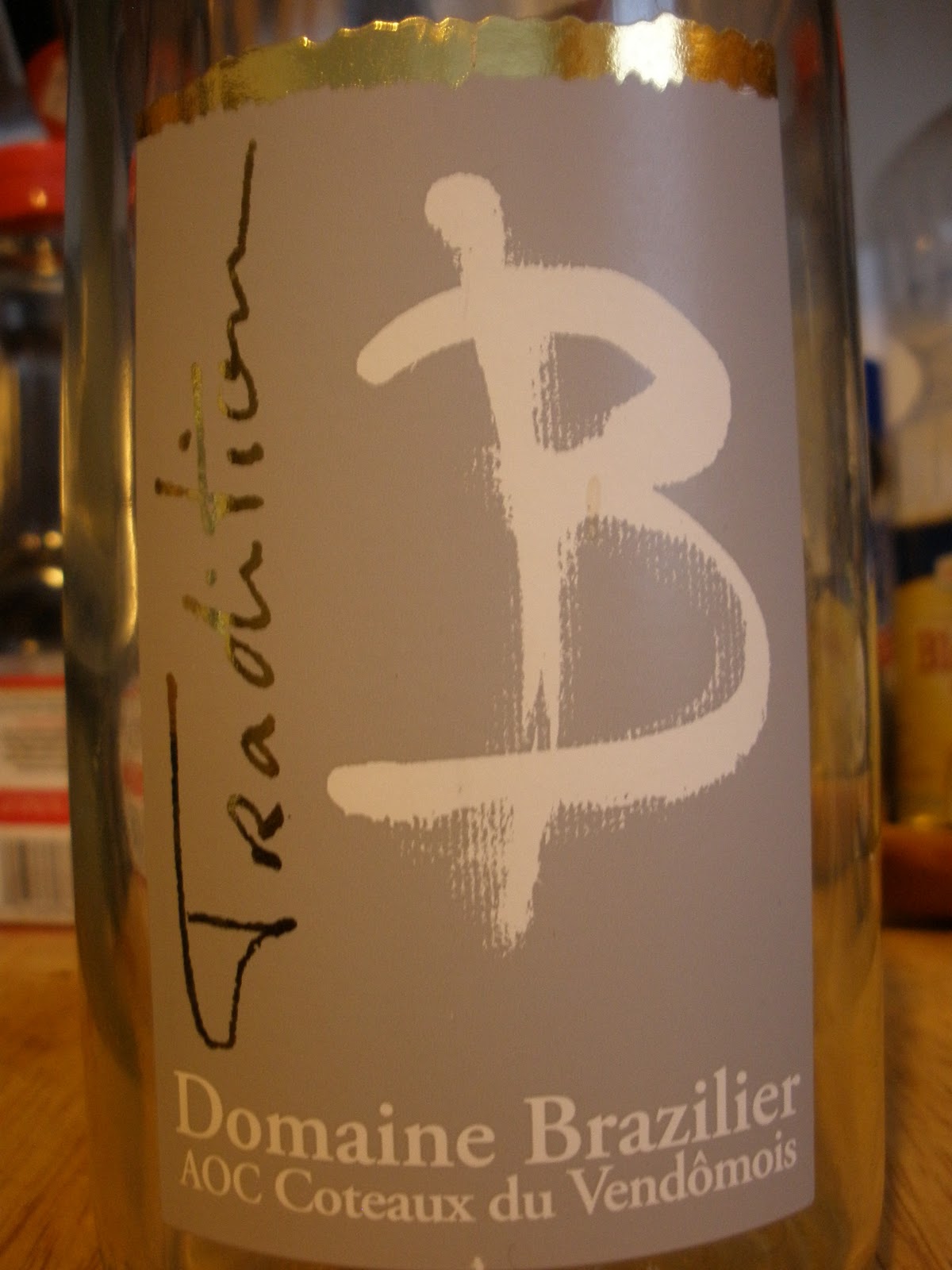
The first bottle that I was able to find was the Domaine Brazilier Pineau d'Aunis rosé from the Coteaux du Vendômois AOC which I picked up for about $17.  If my bottle had a vintage, I wasn't able to locate it.  In the glass, the wine was a very pale salmon pink color.  The nose was moderately aromatic with aromas of fresh cut watermelon and strawberry fruit.  On the palate, the wine was on the lighter side of medium with medium acidity.  There were light, delicate flavors of strawberry, raspberry and watermelon fruit with a touch of herbaceousness to it.  Given the price tag on this wine, I was a little disappointed in how straightforward and simple the aroma and flavor profiles were.  I don't generally buy rosé wines with the expectation that they are going to be much more than fruity and refreshing, but once I pass a certain price threshold, I do begin to expect a little more out of a wine.  At nearly $20 per bottle, I feel that this probably should have been more complex and interesting than it was.  It's entirely possible that this wine was past its prime, but without a vintage date, it's hard to say.  Since there are other examples of this grape in this style for much less money, I'd advise caution with this particular bottling at this price point.

The second rosé that I was able to try was the Cave Cooperative du Vendômois bottling from the Coteaux du Vendômois AOC which I picked up for about $10.  As you can see on the label, the wine is labeled as "Lieu-dit Cocagne," which I believe means that the grapes came from a specific parcel of land referred to as Cocagne, though I don't have any idea what or where that is.  The wine is made by a cooperative comprised of 25 growers and about a dozen different winemakers who, together, farm about 160 hectares of land, about 50 of which are devoted to the Pineau d'Aunis grape.  In the glass, the wine was a pale pink color.  The nose was very aromatic, dominated by pink grapefruit and fresh strawberry fruits.  On the palate, the wine was medium bodied with high acidity.  There were flavors of watermelon, pink grapefruit and grapefruit peel with a touch of grassy herbaceousness that put me in mind of Sauvignon Blanc.  The wine had the kind of wonderfully clean, minerally finish to it that makes you keep reaching for the glass..  This wine was beautifully perfumed with deep, pure fruit flavors and an electric nerve of acid that kept it bright and refreshing.  THIS is the kind of rosé that I love to drink and at only $10 a bottle, it's really an incredible value.

The next wine that I tried was the 2010 Olivier Lemasson "Poivre et Sel" bottling from Touraine in the Loire Valley.  I picked this bottle up from my friends at the Wine Bottega for about $20.  I've read online that this wine is 50/50 Pineau d'Aunis and Gamay, but the bottle says"Pineau d'Aunis...un peu de Gamay," which my high school French tells me means there's just a little bit of Gamay in it (the importer website says it is 90/10, which is probably the more accurate figure).  The Poivre and Sel ("pepper and salt") is a reference to the fact that many people find a peppery aroma and flavor in the Pineau d'Aunis grape which the winemaker believes is perfectly complemented by a little Gamay as the salt to Pineau's pepper.  In the glass, this wine was a fairly light purple-ruby color.  The nose was moderately aromatic with plummy, cherryish fruits and a bit of that natural wine funk.  On the palate the wine was medium bodied with fairly high acidity and medium tannins.  There were flavors of juicy, tart red cherry and red berry fruit and, yes, a hint of pepper. There was also a touch of tart cranberry and horsey funk on the finish.  This wine had a nice balance of bright and juicy fruit with just enough earthy funk to keep it interesting. I found it somewhat similar to the Grolleau that I wrote about a few months back.  Is it worth $20 a bottle?  If you're looking for an upscale alternative to Beaujolais or are looking for a conversation piece to have at a dinner with friends, then yes, I think the price is fair.

I've saved the most interesting bottle for last.  The final Pineau d'Aunis that I tried was the NV Jean-Pierre Robinot "Les Annes Folle" sparkling Pineau d'Aunis that I picked up from the Wine Bottega for about $30.  Robinot has two lines of wine that he makes: the "Domaine de L'Ange Vin," which are made from his own grapes, and the "L'Opéra des Vins" which are made from grapes he buys from other local growers.  This bottle is in the latter category.  The wine about 80% Pineau d'Aunis and 20% Chenin Blanc.  In the glass, the wine was a bronze-gold, almost russet kind of color that was very fizzy and slightly cloudy (the method used here is méthode ancestrale, like in our old friend Mauzac).  The nose was fairly reserved with some green and baked apple aromas with a bready, yeasty kind of undercurrent.  On the palate, the wine was medium bodied with high acid and a lot of bubbles.  I was expecting this to be closer to frizzante, but the bubbles were pretty serious and vigorous.  The flavor profile was yeasty and bready with some tart apple fruit that was almost a little cidery and just a touch of pastry dough.  The secondary flavors and aromas were much more noticeable than the fruits here, so if you're looking for something like Prosecco or Moscato d'Asti, keep looking.  I'm conflicted about this wine because on the one hand, it's a really cool and interesting wine, but on the other, it's hard to say if it's tasty enough to really warrant the $30 price tag.  I personally enjoyed it, but it's not going to be for everyone.  I would guess if you've read this far, you probably already know whether this is something you'd be really into or really afraid of, so I guess you should just follow your gut.

Wednesday, September 28, 2011

Grolleau - Loire Valley, France

Grolleau is not a popular grape.  It is grown almost exclusively in the Loire Valley where it has few fans and a large number of very famous detractors.  In the Oxford Companion to Wine, the entry on Grolleau reads "it is to the benefit of wine drinkers that it is so systematically being replaced with Gamay and, more recently, Cabernet Franc."  Robert Parker has also bashed the grape, urging growers to replace all of their Grolleau vines with higher quality grapes like Gamay and Cabernet Franc.  As you may remember from my post on sparkling Gamay, Gamay isn't exactly a universally beloved grape itself so to see it held in such high esteem over the lowly Grolleau is cause for concern indeed.

The thing about Grolleau is that you have probably had the grape at some point but were unaware of it.  It is the main grape in the fairly common Rosé d'Anjou, which at one point in time accounted for over half of all production in the Anjou region of the Loire Valley.  It is permitted in a few other AOC rosé wines in the Loire Valley, but is not allowed in anything other than rosé wines.  The grape is thought so little of that the AOC does not allow red wine production from it at all, so Grolleau has ended up as one of the workhorse grapes for rosé wines, especially Rosé d'Anjou.  The popularity of Rosé d'Anjou has fallen off over the past few decades, though, and as a result of the lack of demand (and possibly of the pressure from high-powered wine critics), plantings of Grolleau have fallen substantially as well.

If nobody likes poor old Grolleau, then why grow it in the first place?  For starters, it's a reliably high-yielding vine, producing a large, steady crop which is a sure sign that growers are going to love it.  The name "Grolleau" comes from the French word grolle, which means crow, and when the berries are ripe, they can take on a very dark, almost black appearance which is thought to be reason for the name.  Though the skins can get very dark, they also tend to be fairly thin which means that it has problems in the vineyard and in the winery as it is susceptible to a large number of diseases and is unable to contribute a great deal of flavors since the thin skins lack the phenolic punch of thicker-skinned grapes.  It is thought to be related to Gouais Blanc, a seldom grown grape that is one of the parents of Chardonnay, Auxerrois, Gamay and a host of other grapes.

I was excited to come across a bottle of the 2010 Olivier Cousin "Le Cousin Rouge" at City Feed and Supply in Jamaica Plain for about $24.  The winemaker, Olivier Cousin, is a biodynamic farmer who has about 12 hectares of land under vine and who only uses indigenous yeasts for his wines.  He also submits many of them to extended skin contact to extract more color and flavor.  The grapes for this wine come from 30 year old vines that yield a paltry 30 hl/ha.  His total production for this particular wine is around 3,500 bottles.

In the glass, the wine was a deep purple-ruby color which was nearly opaque in the center.  The combination of the grape's naturally dark skins and an extended maceration period yielded a very dramatic result in this case.  The nose was nicely aromatic with brambly purple and black fruits like cherry and blackberry with more than a hinty of sweaty, leathery, barnyardy aromas.  This wine was powerfully earthy and funky with a touch of smoke in the background.  On the palate, the wine was on the fuller side of medium with medium acidity and a touch of residual CO2.  There were purple fruit flavors, some black cherry, a bit of grape soda and a lot of sweaty, horsey funk.  The fruit is more subdued on the palate than on the nose and the finish comes up a little short.  In my notes, I have a description of the wine that reads "tastes like what might happen if you dipped a sweaty horse in a vat of Dornfelder or Beaujolais," and I stand by that assessment.  Your enjoyment of this wine will line up almost exactly with your tolerance for and enjoyment of funky secondary flavor and aroma characteristics.  If you like your wine squeaky clean, steer clear of this as it has nothing that you're looking for.  If you love the smell of a horse barn on a screaming hot day, then you may have just discovered your vinous Nirvana.

Friday, August 19, 2011

Blanc de Franc (White Cabernet Franc) - Chinon, Loire Valley, France

If I only gave you two out of the three pertinent pieces of information about today's wine, you would rightfully be wondering what on earth I was doing writing about it.  If I told you, for instance, that today I was writing about a wine made from the Cabernet Franc grape from the Chinon region of the Loire Valley, you might think that I had finally abandoned the conceit of this website and decided to just write about any old thing that ended up in my glass.  Well, I haven't, and today's wine, while made from a very well known grape in a very well known region, is one of the more unusual wines I've ever tried.  It's a white wine made from the red Cabernet Franc grape.

How is that possible?  Well, for those of you unfamiliar with grape physiology, the fleshy pulp in the middle of a grape is almost always white and, when pressed, will give white juice.  To make a red wine, you need for the juice to be in contact with the skins of the grape for an extended period of time so that the pigments in the skins can be leeched out into the juice.  There are a few grapes that have red pulp in the middle, but they're fairly rare.  They're called teinturier grapes and there are only a few species that are used to make wines (Alicante Bouschet is probably the most common and Saperavi is the only one that we've covered on this blog).


So to make a white wine from red grapes, all you really need to do is press the grapes gently and do everything possible to minimize the amount of time that the juice spends in contact with the skins.  This is common practice in many areas where sparkling wine is made as two of the three most common sparkling wine grapes are actually red grapes (Pinot Noir and Pinot Meunier).  But in still wine production, it's a very rare thing indeed.  The only other examples I have ever seen have been German Pinot Noir wines that were made into white wines (I hope to be able to write about a few of those in the future).

There are probably a lot of reasons that we don't typically see white wines made from red grapes.  Red wines, as a general rule, tend to command higher prices than white wines, so it makes more sense for people with red grapes to go ahead and make red wines.  The skins of red wines are also loaded with compounds that add a great deal of complexity to a finished wine and many winemakers are probably very uncomfortable with throwing away anything that can add character and complexity to their wines.  Finally, there are white skinned grapes that make white wines, so why would you bother to try and do the same kind of thing with a grape with a red skin?

For winemakers in sparkling wine regions and for those making white wines from Pinot Noir in Germany, the reason is probably because their climate is so cool that they have a very hard time getting those dark-skinned grapes to ripen fully.  Under-ripe red grapes tend to have weedy, vegetal flavors and tough, unpleasant tannins that become more pronounced if the juice spends a lot of time in contact with the skins.  These growers get around that by just jettisoning the skins and making wine from the white juice that is pressed out.

Which is all well and good for those growers, but why would someone want to do that with a grape like Cabernet Franc in an area like Chinon in the Loire Valley where the grape usually thrives?  To be honest, I don't have a clue.  It could be that they made a selection of grapes that weren't ripe enough to make it into one of their red cuveés and decided to make a white wine from those as an experiment.  The most likely explanation is that they just decided they wanted to try it and went for it.  It's hard to say, especially because the wine itself isn't listed on the producer's website at all.  All I can say for sure is that someone decided to give it a shot and I was able to taste the results.

The producer in question is Couly-Dutheil, a well-established estate in the Chinon region of the Loire Valley.  The bottle itself is technically a non-vintage bottling and technically we aren't supposed to know what grape it was made from.  The AOC laws do not recognize white wines made from Cabernet Franc grapes in this region, so the only category available for this to be bottled as was vin de table which, by law, is prohibited from mentioning any regions, grapes, or vintages.  Proprietary names are allowed on the bottle, though, so the house decided to call this "Blanc de Franc," which is technically still legal since it doesn't mention the full name of the grape on the label though it gives us a huge clue as to what's inside the bottle.  As for the region, since we know where the producer is located, it's easy for us to fill that blank in as well.  The vintage is usually indicated in some kind of code somewhere on the bottle, but I didn't spend a lot of time searching for it.  Other online sources that have reviewed this wine all seem to have a 2008 bottling, so there's a good chance that this is from that vintage as well.  I've read on a few of those that only about 25 cases of this wine made it into the US, so good luck trying to find a bottle for yourself.

The bottle I picked up cost $29 from Cardullo's in Harvard Square.  In the glass, the wine was a pale, silvery lemon color.  The nose was very aromatic and puzzling.  It had aromas of raspberries and peaches with some ripe apple and something like pie dough mixed in.  It's a disconcerting feeling to look at a glass of white wine and smell red fruits in it, but that's what was happening here.  On the palate the wine was medium bodied with medium acidity.  There was light raspberry and apple fruit with a biscuitty, pastry dough kind of character to it.  If you had blindfolded me and had me try this wine, I probably would have sworn it was a rosé or a very light bodied red wine.  It was probably more interesting than it was good, but it was still a very cool wine to try.