A blog devoted to exploring wines made from unusual grape varieties and/or grown in unfamiliar regions all over the world. All wines are purchased by me from shops in the Boston metro area or directly from wineries that I have visited. If a reviewed bottle is a free sample, that fact is acknowledged prior to the bottle's review. I do not receive any compensation from any of the wineries, wine shops or companies that I mention on the blog.
Showing posts with label Canary Islands. Show all posts

Tuesday, February 5, 2013

Tinta Negra (Negramoll) - Canary Islands, Spain

Over the past few months I've been slowly making my way through the noble grapes of Madeira and have thus far covered Sercial, Bual (Malvasia Fina) and Verdelho.  I also have plans to cover Malmsey (aka Malvasia Branca de São Jorge) and the rare Terrantez in the near future, but today I'd like to take a look at the workhorse grape of the island of Madeira, Tinta Negra.  This grape used to be known as Tinta Negra Mole in Portugal, but the name was recently changed to avoid confusion with another grape grown in Algarve on the Portuguese mainland which is also (and now officially) called Tinta Negra Mole.  Tinta Negra is also known as Negramoll in the Canary Islands of Spain (which is where both wines we'll be looking at today are from) and as Mollar in parts of the Spanish mainland (especially in southern Spain).  Though I won't be writing about any wines from Madeira in today's post, I'd still like to start off by talking a little bit about the grape's importance on that island before moving to the Spanish examples I was recently able to try.

Tinta Negra is planted on about 680 acres on Madeira but is responsible for making about 80% of the wines there.  If you've ever bought a wine for around $10 - $20 that was just labeled "Madeira," chances are that it was made from Tinta Negra grapes.  The fortified wines made from Tinta Negra are generally thought to be much inferior to those made from the noble varieties mentioned above, so one may wonder why so much more wine is made from it than from those other grapes.  The reason can be traced back to the twin catastrophes that visited the vineyards of Madeira in the mid 19th century.  In 1851, powdery mildew arrived on Madeira and since many of the noble grape varieties of the island are particularly susceptible to fungal infections like powdery mildew, the vineyards all over the island were completely decimated.  It was soon discovered that applying sulfur to the vines could combat this fungus and many growers began to replant, but in the 1870's phylloxera arrived and wiped out the vineyards all over again.  Rather than replant those vines which had proven so susceptible to these diseases, many growers elected to plant hybrid and native American vines (called direct producers because they did not need to be grafted onto resistant rootstock) or vines like Tinta Negra which has very good fungal resistance and which yields generously and reliably.  When the EU banned the use of hybrid and native American vines for quality wine produced in the EU, Tinta Negra's plantings rose even more.  Though there are some producers who are making high quality fortified wines from the grape, most of the wines made from Tinta Negra on Madeira are generic and uninteresting.

The grape is actually much more widely planted throughout the Canary Islands of Spain, where there are just over 3,000 acres under vine.  It is known as Negramoll in the Canary Islands and is used primarily to make red table wines rather than fortified wines.  It had long been thought that Negramoll was either native to the Canary Islands or to the island of Madeira, but a study published in 2006 (citation 1) found that the variety known as Negramoll was identical to a vine grown in Andalusia on the Spanish mainland called Mollar Cano.  The name Mollar comes from the Latin word mollis, which means soft (apparently because the berries are soft to the touch), and so Negramoll basically means something like "soft black."  References for Mollar can be traced back a few hundred years and many of those references are to vines grown throughout South America (where there are still vines called Mollar, some of which have been recently shown to be genetically identical to Negramoll [citation 2]), which means that this particular vine, like the Mission grape, was widely disseminated throughout the new Spanish world by missionaries who were planting vines to make sacramental wine. As we saw in my post on Listán Negro, the Canary Islands were often the last stop for ships on their way to the new Spanish colonies in the Americas and many of the vines that were destined for those new lands ended up in the Canaries as well.  It is now thought that Negramoll is likely from Andalusia and was brought to the Canary Islands and to Madeira on ships that were ultimately bound for the New World.

Since Tinta Negra is rarely mentioned by name on bottles from Madeira and since generic bottles of Madeira are available at every corner liquor store on Earth, I decided it probably wasn't necessary to write a review of one of them.  Instead, I recently was able to try two different table wines from the Canary Islands. The first was the 2009 Tinto Negramoll from Bodegas Carballo, which I picked up for around $22 from my friends at Curtis Liquors.  In the glass the wine was a fairly light brickish garnet color with some orange-brown tints to it.  The nose was fairly intense with aromas of red cherry, wild strawberry, stewed tomato, licorice, damp leafy earth and spice.  On the palate the wine was medium bodied with fairly high acidity and low tannins.  There were flavors of wild strawberry, tart cherry, damp leaves, canned tomatoes and green bell pepper.  The nose was quite lovely but I found the palate bitter, metallic and a little harsh.  I was a little disappointed in this wine because I enjoyed the Listán Blanco from this winery quite a bit, but I really had a hard time drinking this particular bottle.

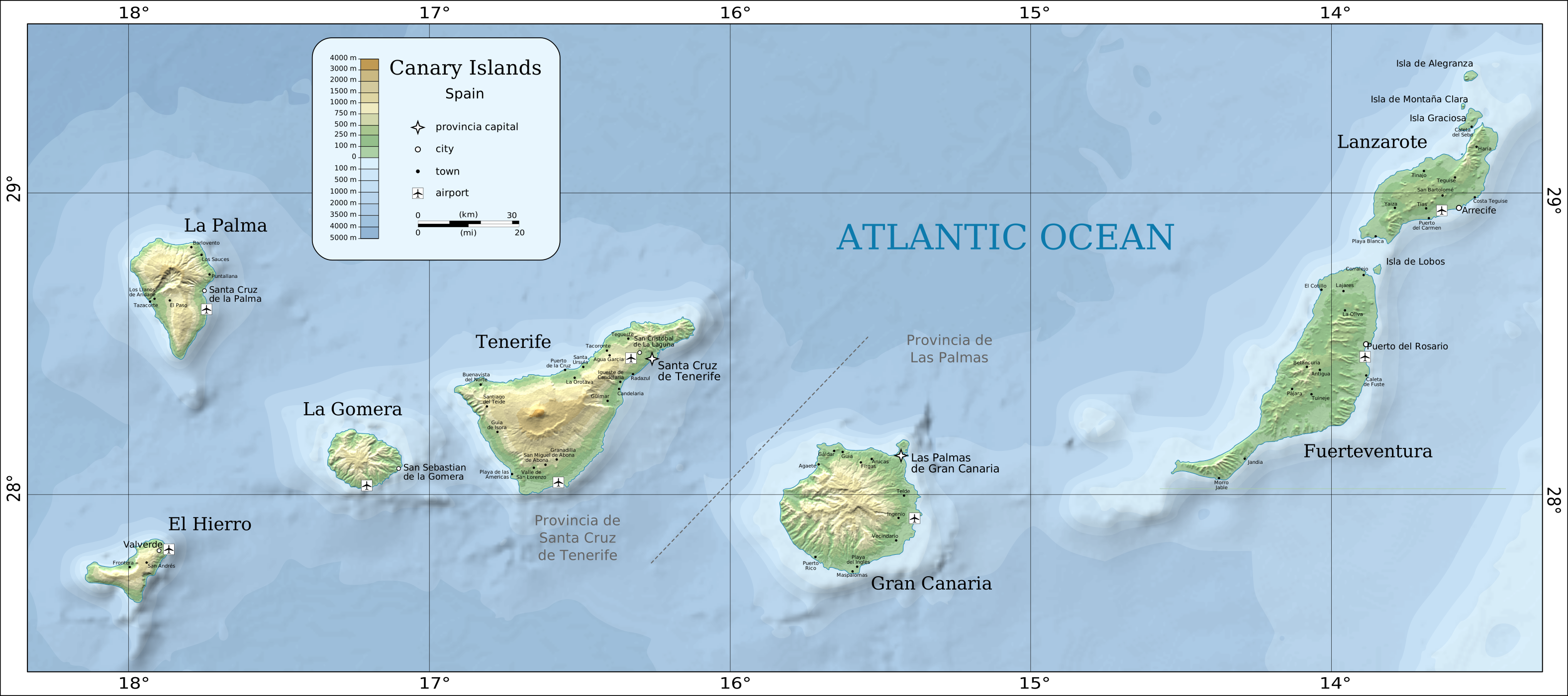
I also picked up a bottle of the 2009 Bodegas Juan Matias Torres Perez "Vid Sur" Negramoll from my friends at the Wine Bottega for around $20.  This wine was from the island of La Palma, which is the most northwesterly of the Canary Islands and is the fifth largest in that chain.  In the glass the wine was a fairly light brickish ruby color with a bit of brown to it.  The nose was moderately intense with aromas of dusky wild strawberry, red cherry, canned stewed tomatoes, damp leaves and earth.  On the palate the wine was medium bodied with fairly high acidity and low tannins.  There were flavors of wild strawberry, tart cherry, cranberry, wet leaves, stewed tomato and cola.  I picked up the same harsh metallic notes in this wine as in the other and while it wasn't quite as unpleasant to drink, it wasn't exactly a pleasure either.  If they packaged cheap Pinot Noir in tin cans, I bet the result would taste a lot like these two wines.  I really didn't expect to end up preferring those simple Madeira wines made from this grape to these two table wine examples, but that's pretty much what happened.  There may be producers out there doing amazing things with this grape, but I just don't think that it's for me.

CITATIONS

1)  Martin, JP, Santiago, JL, Pinto-Carnide, O, Leal, F, Martinez MC, & Ortiz, JM.  2006.  Determination of Relationships among Autochthonous Grapevine Varieties (Vitis vinifera L.) in the Northwest of the Iberian Peninsula by using microsatellite markers.  Genetic Resources and Crop Evolution, 53(6), pp 1255-61.

2) Martinez, LE, Cavagnaro, P, Masuelli, RW & Zuniga, M.  2006.  SSR-based Assessment of Genetic Diversity in South American Vitis Vinifera varieties.  Plant Science, 170(6), pp 1036-44.

Friday, February 1, 2013

Odds and Ends - Sparkling Turbiana, Picpoul de Pinet, Frappato, Verdejo & Listán Blanco

Hello everyone and welcome once again to my erratic Odds and Ends feature, where I take a look at a few wines I've tried recently that I feel either don't warrant a full post or which feature grapes that I've already written a full post about.  I've got a handful of interesting wines here that I hope you'll enjoy reading about, so without further ado, let's get to them!

I've written several times (as in my posts on Groppello, Vespaiola, Grechetto and Sagrantino) about the wines of Paul Turina, an Italian importer from Maine who is a friend of mine.  Paul has some distant relatives who make wine in the area around Lake Garda in Italy and I've written about some of their offerings in the post on Groppello linked above.  His family also works with the Turbiana grape, which, as we discovered in my post on that grape last year, is actually Verdicchio.  I've tried a sparkling Verdicchio from the Marche, but I've never tried a sparkling Turbiana from Lugana so when Paul gave me the opportunity to taste his family's wine, I graciously took him up on it.  In the glass the wine was a fairly pale lemon gold color with steady bubbles.  The nose was somewhat reserved with aromas of apple and pineapple and little else.  On the palate the wine was on the lighter side of medium with fairly high acidity and a loose bubble structure.  There were flavors of ripe apple, pear, baked white fruits, candied apple and pineapple.  This is a tank fermented wine that has more complexity and depth than your average prosecco.  It's really a lovely little bottle and those interested in trying it are advised to contact Paul via his website.

Next up is a wine made from one of the very first grapes that I wrote about, Picpoul Blanc.  Even though that post was only the tenth one that I had written, I really don't have any new information to add to it.  Picpoul is a pretty straightforward grape without any real controversies or interesting family connections.  I'm still a big fan of it, though, and this bottle, the 2010 vintage from the Saint-Peyre winery in the Coteaux du Languedoc region of France, was given to me as a gift by my wife (retail is around $11).  In the glass the wine was a fairly light silvery lemon color.  The nose was fairly intense with aromas of grapefruit, grapefruit peel, pear and some grassy herbs.  On the palate the wine was medium bodied with fairly high acidity.  There were flavors of pear, grapefruit peel, golden apple, lemon and cut grass.  Picpoul always reminds me a bit of Sauvignon Blanc, and this wine was certainly no exception.  It's bright and zippy with a wonderful wild, grassy vein running through it as well.

I've mentioned one of my favorite shops, The Wine Bottega in the North End of Boston, over and over again because they always have an interesting selection and are always incredibly nice and knowledgeable about their merchandise.  Matt is one of the co-owners of the shop and he has recently started his own importing label on the side called Selectio Naturel.  Like the Bottega, Selectio Naturel is focused on representing small producers making natural wines.  One of those producers is Lamoresca whose vineyards are located deep in the hills of central Sicily at an altitude around 430 meters above sea level.  Their approach in the vineyard and in the winery is minimalistic, and you can read more about it here.  Matt imports their Rosso, which is a blend of Nero d'Avola and Frappato, their Bianco, a blend of Vermentino Corse and Roussanne which I'll have a full review of shortly, and the Nerocapitano, which is 100% Frappato.  Frappato is absolutely one of my favorite grapes and in my prior post on it, I got a little carried away with an example from Occhipinti, so I had high hopes for this bottle, the 2011 vintage, which I picked up at the Bottega for around $30.  In the glass this wine was a fairly light pinkish ruby color.  The nose was intense with aromas of red cherry, wild strawberry, raspberry and rose petals.  On the palate the wine was medium bodied with fairly high acidity.  There were flavors of bright red cherry, raspberry, rose water and wild strawberry.  While it wasn't as intoxicating as the wine from Occhipinti, it was still gorgeous with a beautiful perfume and pure fruit flavors on the palate (and it costs about $20 less per bottle).

Another one of my very early posts was on the Verdejo grape from Spain.  In that post, I wrote that Verdejo was best known in Rueda, Spain, but the bottle that I was able to try was from La Mancha, which is a little further south, a little further inland, and a bit hotter and drier than Rueda.  I enjoyed the bottle that I had picked up, but I was curious to try a more representative sample from an area where the grape was more traditional and more highly regarded.  I found the 2009 Shaya Verdejo ($17) a few months after I wrote my initial post and have had the tasting note kicking around in a notebook for quite some time now.  In the glass the wine was a pale silvery lemon color.  The nose was moderately intense with aromas of pear, white peach and fresh cut lemon.  On the palate the wine was medium bodied with medium acidity.  There were flavors of pear, lemon peel, and lees with a stony, chalky minerality on the finish.  It was an OK wine, but I didn't like it as much as the example from La Mancha, which was actually a little bit cheaper than this bottle.

A few months ago, I was shopping at another one of my favorite local stores, the Spirited Gourmet in Belmont, and came across a bottle of wine made from the Listán Blanco grape (the 2008 Bodegas Carballo, which cost around $24). I had recently picked up a few bottles made from Listán Negro and was excited to find something that I didn't think I had tried before. I bought the bottle without asking anyone about it or bothering to look it up on my phone and so was somewhat disappointed when I looked it up at home and discovered that Listán Blanco is actually just another name for Palomino, which I've already written about.  This wine was from the Canary Islands, though, and was made with some skin contact, so I was curious to see what it was like.  In the glass the wine was a fairly deep lemon gold color just starting to go bronze.  The nose was intense with aromas of red apples, apple cider, fresh cracked pecans, seawater and autumn spice.  On the palate the wine was medium bodied with medium acidity.  There were flavors of baked apple, apple cider, fresh cracked pecans, toasted walnuts, autumn spice and dried leaves.  When I used to jump into raked leaf piles as a kid, I remember there being a particular smell and taste that would result from the leaves being crushed by our bodies.  A fine powder would form and coat the inside of our noses, our mouths and our clothes and that powder had a very distinct kind of taste and smell that I had essentially forgotten about until I drank this wine.  Everything about this bottle screams autumn and I almost felt like the wine had a kind of mulled character to it.  This was miles better than the Palomino I tried previously and it gives a hint as to what Palomino may be capable of in careful hands.

Wednesday, November 14, 2012

Boal/Bual/Gual/Malvasia Fina - Madeira, Portugal and Canary Islands, Spain

When I decided to try and write about each of the major Madeira grapes, I really wasn't anticipating any problems or confusion.  Everything I had read said that there were four major grapes that produced four different styles of Madeira.  Easy peasy.  I got through two of the four major grapes, Sercial and Verdelho, with little problem, but then I came up against Boal, and things started to get a little dicey.  It turns out that there are a handful of grapes that are called Boal or Bual and unless you are familiar with some of the recent legislation regarding grape names in Portugal, you may be misled in your search for information about the Boal of Madeira.  You might be inclined, as I was at first, to think that Boal Branco is the grape you're after...after all, it does list Boal de Madere as one of its synonyms.  It turns out that Boal Branco, which is sometimes used a synonym for Sémillon in the Douro Valley, is actually a very obscure grape that is hardly cultivated any more (at least according to Wine Grapes, the massive new grape book from Jancis Robinson & Co. that I hope to review very shortly).

If you're looking for Boal, you actually need to start looking in that tangled web of grapes that is the Malvasia "family."  I have "family" in scare quotes, because it turns out that many of the grapes called Malvasia Something are actually not related to one another at all.  The story goes that these grapes are ultimately named for the port of Monemvasia in Greece, which was at one time (many hundreds of years ago) a major hub for wine commerce.  There were many different sweet wines coming out of the port of Monemvasia, and it is thought that the place name became a kind of substitute for the grape name and many of the wines being shipped out of there just came to be called vinum de Malvasias or some variant of that.  Before the heyday of ampelography (and, more recently, DNA analysis), it was probably the case that any grape making wines similar in style to these wine were called Malvasia, regardless of whether they were related to any of the grapes making the wines coming out of Monemvasia or not.  Wines with "Malvasia" somewhere in their name are genetically and geographically diverse, which would seem to lend credence to a stylistic basis for the common root rather than a genetic one.  Malvasia grapes are especially common in Italy, Spain and Portugal and there have been numerous studies done to try and see how they are (or are not) related to one another.  Many of the Malvasias do have some kind of genetic connection, but there are others that are obvious outliers, so if we speak of Malvasia as a family, we really are only doing so in a linguistic sense.

All of which is wonderful, but what does any of this have to do with Boal, you may be asking.  Well, in the year 2000, the Portuguese authorities officially renamed the Boal/Bual grape Malvasia Fina (Boal is the Portuguese name while Bual is the Anglicization of it...remember that Madeira was a British dominated market for a very long time and the British apparently had a tough time with the "oa" diphthong  so they changed it to "ua"...go figure).  This wasn't done on a whim, but rather based on genetic and ampelographic information that showed that these two grapes were actually one and the same (and also showed that Malvasia Fina had a parent/offspring relationship with another grape known as Boal Ratinho).  Malvasia Fina is one of the Portuguese specialties of Malvasia and it is grown on about 2,200 hectares throughout that country.  It is mostly found in the Douro, where it is thought to have originated, and the Dão in the northern part of the country, but it is really grown throughout Portugal, as evidenced by its appearance on Madeira and the Azores islands.

Those familiar with the wines of Madeira may be starting to wonder about something right about now.  The four styles of quality Madeira are Sercial, Verdelho, Bual and Malmsey, and Malmsey is supposed to be made from Malvasia grapes.  Is the Malvasia used for Malmsey the same or different from the Malvasia Fina used for Bual?  This question was much more difficult to answer than I had thought as nearly all sources that I consulted simply say that Malmsey is made from Malvasia grapes with no further elaboration.  I actually put off even writing this post until my copy of Wine Grapes arrived, as I was hopeful that they could shed some light on it.  According to them, the grape used for Malmsey production on Madeira is a variety known as Malvasia Branca de São Jorge, which doesn't appear to be grown anywhere else or used for any other wines.  We'll get into more detail about it when I take a look at a Malmsey Madeira, but for now, suffice it to say that it is a distinct variety of Malvasia from Malvasia Fina, and wines labeled Bual and Malmsey are made from different grape varieties.

Having sorted all of that out, I still wasn't quite out of the woods.  I also had picked up a wine from the Canary Islands of Spain which was labeled as Gual and which I was told (and had no reason to disbelieve)  was made from the Bual grape of Madeira.  When I tried to search for Gual in the VIVC database, though, the only result that came back showed that Gual was a synonym of Albillo Mayor, the recently proven parent of Tempranillo that I'm not sure whether I tried or not.  After a bit of digging, I found this paper (in Spanish) which seems to confirm that the Gual of the Canary Islands is in fact the same as the Bual/Boal/Malvasia Fina of Madeira.

On the ascending sweetness scale for Madeira wines, Bual sits in third position, generally a little sweeter than Verdelho, but not as sweet as Malmsey.  I was able to try the NV Boston Bual from Vinhos Barbeito, which I picked up locally for around $40. In the glass the wine was a medium tawny brown with a kind of greenish-yellow tint at the rim.  The nose was intense with very nutty aromas of raisin and burnt sugar.  On the palate, the wine was on the fuller side of medium with fairly high acidity.  It was medium-sweet with flavors of burnt sugar, dark caramel, tart apple, crème brûlée, toasted nuts, maple syrup and raisins.  It was very well balanced wine, as many of these Historic Series Madeiras are, with a really lovely mix of acid and sugar that made it very easy to drink.  It was not as searingly acidic as the Sercial and was a bit richer than the Verdelho, and would be an easy slam dunk with nut or caramel based desserts.  I plan on serving the Malmsey from this same line with a pecan pie this coming Thanksgiving, and will report the results when I write about that grape and wine.

The second wine that I tried was the 2008 Vinatigo Gual from the Ycoden Daute Isadora region of Tenerife in the Spanish Canary Islands.  I picked this wine up from my friends at the Spirited Gourmet for around $32.  In the glass the wine was a medium lemon gold color.  The nose was fairly intense with aromas of apricot, cantaloupe, honey and red grapefruit.  On the palate the wine was on the fuller side of medium with fairly high acidity.  There were flavors of leesy dried apricot and cantaloupe fruit along with a bit of honeysuckle flower as well.  It was difficult to find a good temperature to drink this at, as it was a bit too alcoholic at room temperature, but was also too austere and bitter at fridge temp.  Cellar temperature or a little bit cooler seemed to really be the sweet spot for the wine.  It's a nice, interesting wine, but is difficult to justify at the price point.  I'd much rather pay the little bit extra for the Madeira and enjoy Bual in its traditional incarnation.  Those interested in finding out what the wine might taste like before it finishes its journey to becoming Madeira may be better served tracking down a Malvasia Fina from mainland Portugal if price is a concern, but those interested in an island wine showing a different side of the grape should definitely give this a shot.

Monday, September 24, 2012

Verdelho - Madeira, Portugal; Canary Islands, Spain & California, USA

Several months ago, I wrote a post about the Sercial grape, in which I indicated that  I was planning a series of posts that would deal with the major grapes used in the production of Madeira.  That project is taking longer than I would have liked, but today I'd like to continue it with a look at another of the "classic" Madeira grapes, Verdelho.  In my Sercial post, I briefly outlined the history of Madeira wine, and readers interested in that topic are advised to read through that post, as today I'm more interested in taking a look at what makes Madeira different from other wines, and to do that we need to take a closer look at how it is made.

Before it was the name of a wine, Madeira was the name of a place, namely an island group about 600 miles west of Portugal.  It was one of the last stops for European ships on their way to the Americas, and many of them stocked up on the wines of the islands before setting off on their journeys.  In the early days, the wines made on the Madeira Islands were ordinary table wines, but it was found that they spoiled very quickly on board the ships, as they were stored in large barrels and exposed to the elements, particularly the sun, which deteriorated them rapidly.  Eventually it was found that adding brandy to the wines helped them last longer while on board traveling ships, but even these fortified wines eventually cooked in the merciless sun in the middle of the ocean.  While the resulting product was very different from everyday wine, it was found that it picked up some new and interesting flavors not found in any other wines, and many people began to develop a taste for it.  In particular, the US Colonies were very fond of these wines from Madeira and became a large export market for them.

Up until the early 20th Century, some Madeira houses still put barrels of wine on ships in order to properly age them, but virtually no one does that anymore.  Today, there are basically two different methods used to properly age Madeira: estafugem and canteiro.  Estafugem is the quick and dirty method where the wine is placed in large stainless steel vats that are heated either via a hot water jacket on the outside of the tank or by immersing a heating coil in the wine itself.  The vats are sealed, but not filled to capacity and are usually agitated in some way to aid oxidation as well.  The heat is applied for about three months before being bottled.  This method is fast and cheap and is used for the production of low-quality Madeiras, as the secondary flavor characteristics prized by Madeira enthusiasts are at best only hinted at using this method.

The canteiro method is the one preferred for the production of higher quality Madeiras, especially for vintage or varietal Madeiras.  Here, the wines are placed in wooden casks that can vary from 300 to 2500 litres, and the casks are placed in a warm place.  Many lodges place them in lofts or in areas as high as possible (since heat rises, after all), though others just place them outside in the sun.  The casks are typically left alone for at least two years, and the wines made in the canteiro style cannot be sold until at least three years from the January 1st following the harvest.  The casks are not topped up, and most barrels lose about 5% of their liquid each year due to evaporation.  Basic Madeiras sold with the name of one of the four "noble" Madeira grapes, Sercial, Bual, Verdelho or Malmsey, usually go through this process, while vintage Madeiras are typically aged for much, much longer.

As mentioned above, Verdelho is one of the four noble Madeira grapes.  Each of the four noble grapes maps roughly on to a particular style of Madeira with Sercial being the driest, Verdelho the next driest, Bual a little sweeter and Malmsey the sweetest.  The Verdelho of Madeira is not the same as the Verdelho of mainland Portugal, which is now known as Gouveio (or Godello, in Spain).  The Madeira Verdelho is also widely grown in the Azores, and it is thought that vines from the Azores were brought to Australia in the 19th Century.  Verdelho is still relatively widely planted throughout Australia, to the extent that the Australian Alternative Varieties Wine Show does not consider Verdelho to be an alternative variety and will not consider entries made from it.  I must admit that I came across more examples of wine made from the Verdelho grape than I had anticipated, but in the end decided it was still unusual enough to merit inclusion here.

The first wine that I tried was the 2005 Twisted Oak Verdelho made from grapes grown in the Silvaspoons Vineyard in Lodi, California, which I picked up from my friends over at the Gypsy Kitchen for about $16.  As mentioned in my recent post on Torrontés, the Silvaspoons Vineyard is owned and maintained by Ron Silva, who primarily grows Portuguese grape varieties there.  In the glass, this wine was a light silvery lemon color with greenish tints. The nose was fairly reserved with some green apple and lemon-lime citrus fruits along with some slighly oaky and buttery aromas as well.  On the palate the wine was on the fuller side of medium with fairly low acidity.  There were flavors of vanilla, ripe pear, buttery pie dough, ripe apple, coconut and pineapple candy.  I had half expected that the wine would be shot as it was 7 years old when I tried it, but it was drinking very well.  It's not really my style of wine, though, as the low acid and prominent oak are a deadly combination for my taste buds.  Fans of moderately oaked California Chardonnay will find a lot to like here, though, especially for the money.

The next wine that I tried was the 2007 Bodegas Viñátigo Verdello from the Ycoden Daute Isadora region on the western tip of the Tenerife island in the Canary Island chain.  I picked this wine up for around $32 from my friends at the Spirited Gourmet.  In the glass the wine was a fairly deep bronze-gold color.  The nose was fairly intense with leesy aromas of red apple, pear and honey with a little nuttiness and a little cheesy funk as well.  On the palate the wine was medium bodied with fairly high acidity.  There were flavors of toasted almonds and sawdust along with some honey, red apple, dried apple, dried apricot and baking spice.  This is a wine that really needs to be served as close to room temperature as you can manage, as it is harsh and spare when chilled too much.  As it warms up, though, the spice and dried fruits really become more apparent and the wine becomes much more generous and appealing.  It's not a cheap wine, but it is both good and interesting, which are the two major requirements I have for wines in this price range.

The final wine that I tried was the NV Vinhos Barbeito "Savannah Verdelho" from their Historic Series, which set me back about $40.  As a proud Georgia native, I was gratified to learn about the strong history of Madeira in the city of Savannah.  In addition to being a major port city for the import of Madeira wine in the early days of America, the city was (and I believe still is) the home to the Madeira Club of Savannah, a group of Madeira enthusiasts who gather monthly to drink fine old Madeiras, dine together and discuss issues of the day.  While this wine probably wouldn't be served at one of their functions, I found it plenty enjoyable.  In the glass the wine was a dark, deep tawny-brown color.  The nose was very intense with powerful roasted nut and burnt sugar aromas.  On the palate the wine was on the fuller side of medium with high acid and medium sweetness.  There were zippy flavors of green apple, tasted walnuts and pecans, burnt sugar and smoke along with a slight salinity as well.  This wine was exceptionally balanced with an electric vein of acidity that really supported the sugar and nutty fruits.  This would be amazing with nutty desserts like pecan pie or baklava, but would also be nice with salty, funky cheeses as well.

Much of the discussion about the methods of producing Madeira wine is adapted from Trevor Elliott's The Wines of Madeira, which interested readers can order here.

Monday, August 13, 2012

Listán Negro - Tenerife, Canary Islands, Spain

Pop quiz time: what Vitis vinifera grape has been grown in California the longest?  Though Chardonnay and Cabernet Sauvignon are currently the kings of California viticulture, they are relative newcomers compared to the Mission grape.  It is thought that the Mission grape was first brought to California in the mid 18th Century, and it was pretty much the only grape grown in the entire area until the  late 19th Century, though there are less than 1,000 acres remaining in California today.  At this point, you might notice that the title of today's post says Listán Negro from the Canary Islands and not Mission from California and may be wondering just what is going on.  Hold on to your hats and we'll see how these two grapes and two areas nearly 6,000 miles away from one another are related.

Those of you up on your American history will remember that before California became a part of the United States, it was a part of Mexico, and before that, it was a part of Spain.  Way back in the 15th Century or so, when Spain colonized a new region, one of the first things that they did was set up missionaries there in order to spread Christianity throughout their new colonies.  Wine was an important part of religious life, as it was used in many different ceremonies, but the Spanish had difficulty shipping wine across the Atlantic Ocean to its new colonies in the Americas.  The wine typically spoiled before it arrived at its destination, so rather than ship barrels of wine to the new colonies, the Spanish began to send vines instead.

The vines were first sent to the Spanish colonies of Peru and Mexico in the early 16th Century.  As the missionaries moved north through Mexico and into modern-day Texas, they established missionary outposts and planted grapes so that the missions could produce all of the sacramental wine that they needed. The most popular grape came to be known as Mission, for fairly obvious reasons.  This grape was adaptable to a wide range of climatic conditions and also tended to yield very generously, though the wine made from it wasn't particularly good.  Since this was sacramental wine and not quality wine, this particular flaw was overlooked , and the grape slowly worked its way through the American southwest in the 17th Century before finally making it to California around 1769.  For many years, Mission was the only grape grown in California, and it can be said that the foundation of California wine making was built with the Mission grape.

You might be thinking that Phylloxera was the ultimate undoing of the Mission grape, as it was a Vitis vinifera vine and is susceptible to the louse, but that's not the case.  Phylloxera was mostly an issue in the eastern United States and it didn't make its way into California until the late 19th Century.  Before Phylloxera hit, California became a part of the United States in 1847 and the importance of the Spanish missions began to decline.  There was also the gold rush in the mid 1800's which brought a huge wave of immigrants who were seeking their fortune.  The gold rushers needed something to drink and a number of private wineries were founded to provide for these thirsty prospectors.  Nobody was really crazy about the wines made from the Mission grapes, so other grape varieties were brought in in large numbers.  By the time Phylloxera finally did arrive in California, Mission was already mostly on its way out and Phylloxera was merely the final nail in its coffin.

All of which is very interesting, but we're not here to talk about Mission, we're here to talk about Listán Negro.  Listán Negro is also known as Listan Prieto or Palomino Negro, and it is the red-berried form of the same Palomino vine used in Sherry production on the Spanish mainland.  Listán Negro is hardly grown at all on the European mainland, but it is widely planted on the Canary Islands, where it covers almost 12,000 acres of land.  The Canary Islands are a small archipelago located off the western coast of Africa (map) which belong politically to the nation of Spain and have for many centuries.  The Canary Islands were often the last stop for ships headed to the new world colonies in the Americas, and it is thought that Listán Negro was originally from mainland Spain, but was brought to the Canary Islands by Spanish settlers.  From there, the vine was carried to the new world colonies, particularly those in the Americas, and planted.  Phylloxera wiped out virtually all of the Listán Negro planted in Europe, but the louse never reached the Canary Islands and so the vine has continued to flourish there.

In 2007, a Spanish research team (citation below) discovered that vines growing in California under the name of Mission were identical to many vines growing in South America under the names of País and Criolla.  Furthermore, all of these vines were identical to Listán Negro, which means essentially that the Listán Negro of the Canary Islands is the same as the Mission grape that was grown so widely in the early days of California viticulture!  Though Canary Islands wines aren't exactly widespread, they are much easier to find than California wines made from the Mission grape, so if you've always wondered what wines from the Mission grape might be like, just hunt down a Listán Negro based wine and give it a try.

I was actually able to find two different Listán Negro based wines, both from the island of Tenerife in the Canary Islands.  Tenerife is located right in the middle of the Canary Islands archipelago (map), and it is dominated by the Teide volcano, which is the highest mountain in Spain and the third tallest volcano on earth.  There are a handful of sub-regions on Tenerife, and this 2008 Monje "Tradicional" (which I picked up from my friends at the Spirited Gourmet for about $23) is from the Tacoronte-Acentejo region in the northwestern portion of the island. This wine is mostly Listán Negro with a little bit of Negromoll blended in.  In the glass the wine was a medium purple ruby color.  The nose was moderately intense with bright black cherry and crushed berry fruit along with a touch of smoky charcoal.  On the palate the wine was medium bodied with fairly high acidity and medium tannins.  There were flavors of black cherry and black plum fruit along with smoky char, baking chocolate, coffee and black pepper.  It was very dark, smoky and spicy with nice black fruits.  I found it pretty enjoyable and think it's probably priced about right at just over $20.

The second wine that I tried was the 2010 Bodegas Tajinaste Tinto Tradicional ($25), which is from the Valle de la Orotava region of Tenerife.  This area is on the western side of the island in the foothills of the Teide volcano.  In the glass the wine was a fairly deep purple ruby color.  The nose was very intense with wild, brambly crushed blackberry, raspberry and red currant fruit.  On the palate the wine was on the fuller side of medium with fairly high acidity and low tannins.  There were flavors of black cherry and wild blackberry fruit, smoke and tar.  Right out of the bottle this was very smoky with lots of dark black fruits, but as it opens up, the smoke blows off a bit and the fruits move more towards the red end of the spectrum.  This wine was  bit more energetic and wild than the other example and its relative youth probably had a lot to do with it.  Both wines were very good, but neither really represents a great value.  If you're a value wine shopper, the Canary Islands really aren't for you, though, as prices for these wines tend to be on the high side.  They're unique and distinctive, though, and offer opportunities to not only taste interesting grapes, but also historical ones as well.

CITATION

Tapia, A.M., Cabezas, J.A., Cabello, F., Lacombe, T., Martinez-Zapater, J.M., Hinrichsen, P., & Cervera, M.T. 2007.  Determining the Spanish origin of representative ancient American grapevine varieties.  American Journal of Enology and Viticulture, 58(2).  pp. 242-251.