A blog devoted to exploring wines made from unusual grape varieties and/or grown in unfamiliar regions all over the world. All wines are purchased by me from shops in the Boston metro area or directly from wineries that I have visited. If a reviewed bottle is a free sample, that fact is acknowledged prior to the bottle's review. I do not receive any compensation from any of the wineries, wine shops or companies that I mention on the blog.
Showing posts with label Sparkling Wine. Show all posts

Friday, April 5, 2013

Know Your Lambrusco - Salamino, Emilia-Romagna, Italy

Last week, I started a new series called Know Your Malvasia where I take a look at different Malvasia-named grapes and explain where they're grown and how they do or do not relate to other Malvasia grapes.  Today I'd like to expand that concept a little and start to talk about the various Lambrusco-named grapes.  There is a lot of bad information out there about Lambrusco grapes and over the next few weeks, I'd like to try to set as much of it right as I can, starting with the Salamino grape today.

The two most common bits of misinformation regarding the Lambrusco grapes are pretty much the same as for the Malvasias.  Some people will tell you about the Lambrusco "family" of grapes, while others will tell you that the various Lambruscos are made from "sub-types" or "sub-varieties" of a single Lambrusco cultivar.  The people that tell you this are wrong.  A study done in 2005 (citation 1 below) analyzed most of the Lambrusco-something cultivars grown throughout Emilia-Romagna and while they found first degree (parent/offspring) relationships between a few of the grapes in the study, pretty much none of the major of Lambrusco cultivars were found to be that closely related to one another.  Which isn't to say that they aren't related at all.  When the team analyzed genetic similarities for all of the grapes in the study, they did find that most of the Lambrusco grapes clustered together, indicating that they probably share a common ancestor at some point along the line, but how distant that relative might be is difficult to say. 

As we learned in my last Know Your Malvasia post, there really is no such thing as "sub-varieties" of grapes.  But one might wonder, if there isn't any direct familial relationship and if they aren't "sub-varieties," then why do they all have the same word in their name?  The word "Lambrusco" means "wild grape" in Italian, and it was long thought that the Lambrusco grapes were domesticated from wild vines around Emilia-Romagna.  A study done in 2009 (citation 2 below) analyzed many wild grape varieties in Piemonte and compared their DNA with several Lambrusco varieties as well as several other cultivated grape varieties of the region.  They found that the Lambrusco grapes had more DNA in common with the wild grapes than the other cultivated varieties, indicating that they were more closely related to the wild vines and may have been domesticated more recently.

It's worth noting that here in the United States, when we think "wild vines" we think of Vitis labrusca or some of the other "foxy," native American varieties.  In Europe, the situation is a little bit different.  Wild vines in Europe are still Vitis vinifera, but there is actually a sub-species of the vinifera species called sylvestris.  Please note, this is a sub-species, not a "sub-type" or "sub-variety."  Vitis vinifera subsp. sylvestris is differentiated from Vitis vinifera subsp. vinifera mainly by the fact that vinifera flowers are hermaphrodites, meaning that they have both male and female organs and so can pollinate themselves, while sylvestris flowers are dioecious, which means that some flowers are male and produce pollen while others are female and need to receive pollen from males in order to produce fruit (unpollenated flowers just fall off a vine and die, while pollinated flowers produce berries). One can easily understand why hermaphroditism was selected for by early farmers, since the ability to self-pollinate produces a more reliable and a larger crop.  Interestingly, there are a handful of Vitis vinifera subsp. vinifera vines that are not self-pollinating, but which are not necessarily dioecious.  Lambrusco Sorbara, for example, only has female flowers, so it must receive its pollen from other vines.  As a result, Sorbara is often inter-planted with Lambrusco Salamino so that the Salamino pollen can pollinate the Sorbara flowers. 

What all this means is that though many of the Lambrusco grapes may be distantly related to one another, they're not exactly a "family."   Furthermore, they are all separate grape varieties and are not "sub-types" of any single Lambrusco grape.  So how do you know which Lambrusco grape you're drinking?  Like Malvasia, it often depends on where you are.  Some of the Lambrusco grapes are easy to spot, since their names are typically printed right on the label.  Lambrusco di Sorbara is made from the Sorbara grape, while Lambrusco Grasparossa di Castelvetto is made from the Grasparossa grape.  Lambrusco Salamino can be found in the Lambrusco Salamino di Santa Croce DOC wines, but can also be found in basic Reggiano DOC wines as well as the wines of Lambrusco Mantovano and the Colli di Scandiano e di Canossa.  You can always check the DOC regulations for the region of wine that you're drinking, but if there are many different varieties authorized for use or if your wine is labeled as IGT, then you may just have to live with the mystery.

Lambrusco Salamino is the most common of the Lambrusco varieties and is planted on over 10,000 acres of land (mostly in Emilia-Romagna, though a little bit is surprisingly found in Sardinia).  The name "Salamino" comes from the fact that the grape bunches are long and cylindrical and thus thought to resemble little sausages, or "little salamis."  There are at least five different clonal variants of Salamino that are recognized by ampleographers: tender, red-leaved, green-leaved, red-stalked, and green-stalked.  Salamino grapes are naturally very high in sugar and so they lend themselves to the production of sweet and off-dry wines, though bone-dry wines made from the grape are also widely available. The berries are deeply colored and can provide quite a bit of tannic grip to the finished wine, and Salamino-based Lambruscos are typically heavier-bodied and more aromatic than those from other Lambrusco grapes.

For those who might object that Lambrusco is far too common for me to write about here, I would counter by saying that the first of the three Salamino-based wines that I'll be reviewing is actually a Lambrusco Bianco, which is made from 100% Salamino grapes that were crushed and rapidly moved off the skins before picking up any coloring, as in a Blanc de Noirs Champagne.  The wine was the NV Lini 910, which I picked up from my friends at Curtis Liquors for around $16.  In the glass the wine was a fairly pale silvery lemon color with nice frothy bubbles.  The nose was fairly intense with aromas of toasty bread, apple, green apple candy, toasted nuts and a touch of raspberry.  On the palate the wine was medium bodied with high acidity.  There were flavors of toasted nuts, toasted bread, ripe apple, pear, fresh cut lemon and lemon peel.  The fruits were a bit subdued, but there was a lot of secondary fermentation aromas and characteristics that were quite nice indeed (which is interesting, since this is a tank-fermented wine).  I found the wine both interesting and delicious and thought that it was a really great value for the money.

I also had the opportunity to taste Lini 910's regular Lambrusco bottling ($17), which their website says is 85% Salamino and 15% Ancelotta, which is a common Lambrusco blending grape that tends to soften the tannic edges of other grapes and round out the flavor profile a bit. In the glass this wine was a fairly deep purple ruby color with lots of fizz.  The nose was fairly intense with aromas of blackberry and black cherry fruit along with grape soda and leather.  On the palate the wine was medium bodied with fairly high acidity.  It was dry with flavors of black cherry, blackberry, cola, grape soda and a touch of smoky charcoal.  It was very fresh and very fruity, but also dry and very refreshing.  This wine is also tank-fermented, and I definitely think it helped to accentuate the fresh fruit flavors.  I had this wine with an Italian cold-cut calzone, and it was absolutely perfect, cutting through the oily meats while also standing up to and complementing the tomato sauce I was dipping into.

A few months ago, I wrote about a wine being imported by my friend Matt, who is a co-owner of the Wine Bottega in the North End of Boston, and his new company Selectio Naturel.  Matt brings in wines from all over Italy (and some from France too), and he has a handful of really killer Lambruscos in his portfolio.  One of them is the 2010 Fondo Bozzole "Giano," which is made from 100% Salamino grapes ($18 at the Bottega).  In the glass this wine was a deep, inky ruby-black color with bright purple fizz.  The nose was moderately intense with aromas of grape soda, black-berried fruits, dark chocolate, cocoa and char.  On the palate the wine was medium bodied with fairly high acidity.  It was dry, but absolutely loaded with blackberry and black cherry fruits and dry grape soda flavors as well.  There was a savory edge to the wine as well and I thoroughly enjoyed it with some ground-turkey lasagna.  It is versatile enough to pair nicely with a variety of foods, but is also delicious enough to just drink on its own. 

CITATIONS

1)  Boccacci, P, Marinoni, DT, Gambino, G, Botta, R, & Schneider, A.  2005.  Genetic characterization of endangered grape cultivars of Reggio Emilia province.  American Journal of Enology and Vititculture, 56(4), ppl. 411-416.

2)  Schneider, A, Marinoni, DT, Raimondi, S, Boccacci, P, Gambino, G.  2009.  Molecular characterization of wild grape populations from north-western Italy and their genetic relationship with cultivated varieties.  Acta Horticulturae, 827, pp. 211-216.

Monday, March 18, 2013

Terrano - Carso, Friuli, Italy

In the very early days of this blog, I went through a few of the wine books that I had and tried to put together a grape "wish list."  The first list had about two dozen grapes on it and I sent it around to a few of the wines shops that I frequented to see if they had any of them in stock or to see if they could possibly order some of them for me.  The Terrano grape was on that list, and I'm happy to say that not only were my wine shop friends able to help me track that particular grape down, but also every other grape that I could come up with at that time.  I don't really keep a list any more these days (though I do have a kind of unofficial list in my head of things that I'm always on the lookout for) but I do still hang on to that first one so I can see just how much ground we've covered here in only a few years time.

Which brings us to today's grape, Terrano.  Terrano has been around for a very long time, with the first mention of it actually coming all the way back in 1340 AD.  These old references mention both a white and a red-berried Terrano, but the white-berried form seems to have been lost to history.  The very earliest mentions of Terrano in print are to plantings in modern day Slovenia, where it is currently known as Refošk.  Slovenia is the world leader for plantings of Terrano with a couple thousand hectares under vine around the city of Trieste, which is actually  in the region of Friuli in Italy, but it's in that weird little finger of Italy in the extreme northeast that is practically surrounded by the nation of Slovenia (see map).  Most Slovenian plantings are just north and south of the city of Trieste, and many of the Italian plantings can be found around Trieste as well (there were only about 200 hectares of Terrano in Italy as of 2000).  If you go south from Trieste and through the narrow band of Slovenia into the Istrian peninsula of Croatia, you will find more plantings of Terrano, as Croatia has nearly 500 hectares of Terrano (known here as Teran) under vine.

 There is a particular kind of soil called Terra Rossa, or "red earth," in this little corner of the world and it is said that Terrano reaches its greatest heights only when grown on this terra rossa soil.  When dirt turns red, it is usually because of high iron content, and according to Wikipedia, wines made from Terrano are unusually high in iron.  Wikipedia's source is a link to this page, which says that Terrano's unique flavor is actually due to the iron (bivalent iron, whatever that means) reacting to lactic acid in the finished wine, and, further, that wines made from Terrano tend to deteriorate quickly because the iron levels drop rapidly within a year or two of fermentation and this special chemical bond dissipates.  There are no sources cited and I haven't found any evidence elsewhere to support these claims, so caveat emptor etc (though if commenter WineKnurd is reading, I'd be very interested to hear his take in the comments below).

Terrano belongs to something called the Refoschi Family, whose name is a bit misleading since many of the grapes in this family aren't actually related to one another.  Like the word Trebbiano or Malvasia, over the years the word Refosco has been used to describe a number of different grape varieties grown in and around this little area where Italy, Slovenia and Croatia meet.  The most common Refosco grape is Refosco dal Peduncolo Rosso, which we covered here some time ago.  There is also Refosco di Faedis, Refosco d'Istria (which is the same as Terrano), Refosco di Guarnieri, Refosco del Botton (which is the same as Tazzalenghe) and Refosco Gentile.  Of these grapes, only Refosco del Botton, Refosco Gentile and Refosco di Faedis seem to have any genetic relationship to one another (the former two seem to have a parent-offspring relationship with the third).  While the others do share many ampelographic traits, to the extent that Terrano and Refosco dal Peduncolo Rosso were long thought to be the same variety, the DNA evidence seems to show that they are actually distinct varieties*.  Interestingly, the grape known as Cagnina in Emilia-Romagna (where it is made into sweet red wines) is the same grape as Terrano, and this is one of the very few places outside of Friuli/Slovenia/Croatia where this grape can be found.

I was able to try two different wines made from the Terrano grape.  The first was the 2009 Tenuta Amalia "Mamertino," which I picked up from my friends at the Spirited Gourmet for around $12.  I don't know very much about this wine since the bottle just says "Product of Italy" and "Italian Frizzante Red Wine."  The importer's website says it is 100% Terrano, but I have no idea where the grapes are from.  The back labeling almost seemed to be saying that the grapes come from Italy, but the wine itself may be made, or at least bottled, here in the US.  In any case, the wine was a medium purple ruby color in the glass.  The nose was reserved with aromas of black cherry, blackberry and grape soda.  On the palate the wine was medium bodied with medium acidity.  It was also sweet with just a touch of fizziness to it.  There were flavors of grape Kool-aid, black cherry and grape soda.  The finish was astoundingly short and really tasted more like soda or juice than wine.  I don't really know what this is or what it's supposed to be, but I don't think I'm a fan of it.

I figured there had to be more to Terrano than this, so when I found a bottle of the 2011 Catelvecchio Terrano from the Carso region of Friuli, I snapped it up ($20 from Vintages in Concord, MA).  As I mentioned above, I had read that Terrano-based wines are really not meant for ageing, so I figured I'd give a newer vintage a shot.  In the glass the wine was an inky purple black color with a bright purple rim.  The nose was moderately intense with aromas of smoke, sour cherry, cranberry, wet leather, blackberry and black cherry.  On the palate the wine was on the lighter side of medium with very high acidity and medium tannins.  It was sour with flavors of tart cherry, cranberry, under-ripe blackberry and leather.  It was bright and zippy, but also almost painfully sour to drink and really demanded some high acid, tomato-saucy kind of food.  It was miles better than the Mamertino, but still wasn't something that I think I'll find myself reaching for very often.

*This is according to Jose Vouillamoz's private research reported in Wine Grapes, which you can read all about here to decide how big a grain of salt is required.

Friday, March 1, 2013

Odds and Ends - Turina Wines Edition (Marzemino, Friulano, Schioppetino and sparkling Groppello/Marzemino)

Hello everyone and welcome to another edition of Odds and Ends, where I write about interesting wines that I've tried lately which I don't think merit a full post on their own.  All of the wines I'll be writing about today are made from grapes that I've already written extensively about in the past and those relevant links will be included in each write-up.  Additionally, all of the wines I'll be looking at today are imported by my good friend Paul Turina, whose new and improved company website can be perused here.  I profiled Paul and his company about a year ago (read here) and have since tried a handful of wines from various producers that he imports.  All of the wines I'll be writing about below were provided to me as samples by Paul, but all opinions expressed are entirely my own and I have received no compensation for any of the reviews below other than the wines themselves.

About a month after I first met Paul, I was introducing him to some people in the Boston area to try and get his wines distributed here (he is still looking for a Massachusetts distributor, so if anyone is interested, please email him).  One of the wines he poured at a meeting that I accompanied him to was this sparkling pink wine made by some distant relatives of his around Lake Garda in Italy.  I wasn't able to get a note written on the wine (unlike the sparkling Turbiana he also brought which I wrote about here), but I remember enjoying it quite a bit.  I asked him a few weeks ago if he still had any around and he said he had a few bottles from a recent shipment.  He handed the bottle off to me the next time he was in town and I promptly popped the cork on it.  It's a non-vintage, tank-fermented sparkling wine that is made from about 50% Groppello and 50% Marzemino and retail on the bottle (from Paul's website) is about $17.   In the glass the wine was a medium salmon pink color with fine steady bubbles.  The nose was fairly intense with aromas of fresh cut strawberry, red cherry, watermelon and pink bubblegum.  On the palate the wine was on the lighter side of medium with fairly high acidity.  It was dry and tasted like cut watermelon and strawberries with a touch of red cherry.  It finished with a clean, almost quinine-like bitterness.  It's a fun wine, but it's well structured enough to be serious as well.  I drank it around Valentine's Day and it's the perfect wine for that occasion.

His distant Italian relatives not only make wines from Groppello and Turbiana, but also from the Marzemino grape, which I wrote about around a year and a half ago.  Paul recently let me try his family's 2009 Marzemino from the Brescia region of Lombardy on the western shore of Lake Garda.  In the glass the wine was a medium purple ruby color.  The nose was moderately intense with aromas of sour cherry, blackberry, cocoa powder and leather.  On the palate the wine was on the lighter side of medium with high acid and fairly soft tannins.  There were flavors of tart cherry, blackberry, old dusty leather, black plum and cocoa powder.  It was a little lean, but it made up for it with a nice, bright, racy streak of acidity.  As I said in my previous post, Marzemino seems like a grape tailor-made for tomato sauces and pizza.  I had this wine with a big plate of spaghetti and it was a near perfect match.  While I'm not as fond of Marzemino in general as Don Giovanni was, I do like it in the right circumstances and this is a very well made example.

Paul imports wine from a number of different regions in Italy and from a number of different producers.  I've taken a look at some of his producers making wines from Vespaiola, Grechetto and Sagrantino in the past, but today I'd like to take a look at a couple of wines from a producer he works with in Friuli called Petrussa.  Petrussa is located in the Colli Orientali del Friuli region of northeastern Italy and they deal with many of the grapes that are common to that region.  One of them is Friulano, which we took a look at about a year ago.  This particular bottling is from the 2009 vintage.  In the glass the wine was a medium lemon gold color.  The nose was fairly reserved with aromas of white pear, lilac and eucalyptus.  On the palate the wine was on the fuller side of medium with fairly low acidity and a kind of oily mouthfeel.  There were flavors of eucalyptus, pear and lime with a kind of stewed vegetable quality that I find in many of the wines made from the Friulano grape.  This is a well-made wine, but it's a grape that I just can't fall in love with.

The next wine from Petrussa that I tried was made from the Schioppettino grape, which I did like quite a bit when I was able to try it before.  This particular wine was from the 2008 vintage and in the glass it was a medium purple ruby color.  The nose was moderately intense with aromas of black cherry, plum, fresh turned earth, damp leaves and leather.  On the palate the wine was medium bodied with high acidity and soft tannins.  There were flavors of tart cherry, blackberry, old leather and wet leaves.  Right after the cork was pulled, the wine was searingly, almost abrasively sour but it does round out a bit as it settles into the glass.  It's bright and zippy the whole time, though, so fans of high-acid red wines probably need not apply here.  The bright, tart fruits are really well balanced by the damp earthy flavors and the wine reminds me a bit of an electrified Pinot Noir.  It needs food and it needs high acid food so anything with tomato sauce would go quite nicely here.

Friday, February 1, 2013

Odds and Ends - Sparkling Turbiana, Picpoul de Pinet, Frappato, Verdejo & Listán Blanco

Hello everyone and welcome once again to my erratic Odds and Ends feature, where I take a look at a few wines I've tried recently that I feel either don't warrant a full post or which feature grapes that I've already written a full post about.  I've got a handful of interesting wines here that I hope you'll enjoy reading about, so without further ado, let's get to them!

I've written several times (as in my posts on Groppello, Vespaiola, Grechetto and Sagrantino) about the wines of Paul Turina, an Italian importer from Maine who is a friend of mine.  Paul has some distant relatives who make wine in the area around Lake Garda in Italy and I've written about some of their offerings in the post on Groppello linked above.  His family also works with the Turbiana grape, which, as we discovered in my post on that grape last year, is actually Verdicchio.  I've tried a sparkling Verdicchio from the Marche, but I've never tried a sparkling Turbiana from Lugana so when Paul gave me the opportunity to taste his family's wine, I graciously took him up on it.  In the glass the wine was a fairly pale lemon gold color with steady bubbles.  The nose was somewhat reserved with aromas of apple and pineapple and little else.  On the palate the wine was on the lighter side of medium with fairly high acidity and a loose bubble structure.  There were flavors of ripe apple, pear, baked white fruits, candied apple and pineapple.  This is a tank fermented wine that has more complexity and depth than your average prosecco.  It's really a lovely little bottle and those interested in trying it are advised to contact Paul via his website.

Next up is a wine made from one of the very first grapes that I wrote about, Picpoul Blanc.  Even though that post was only the tenth one that I had written, I really don't have any new information to add to it.  Picpoul is a pretty straightforward grape without any real controversies or interesting family connections.  I'm still a big fan of it, though, and this bottle, the 2010 vintage from the Saint-Peyre winery in the Coteaux du Languedoc region of France, was given to me as a gift by my wife (retail is around $11).  In the glass the wine was a fairly light silvery lemon color.  The nose was fairly intense with aromas of grapefruit, grapefruit peel, pear and some grassy herbs.  On the palate the wine was medium bodied with fairly high acidity.  There were flavors of pear, grapefruit peel, golden apple, lemon and cut grass.  Picpoul always reminds me a bit of Sauvignon Blanc, and this wine was certainly no exception.  It's bright and zippy with a wonderful wild, grassy vein running through it as well.

I've mentioned one of my favorite shops, The Wine Bottega in the North End of Boston, over and over again because they always have an interesting selection and are always incredibly nice and knowledgeable about their merchandise.  Matt is one of the co-owners of the shop and he has recently started his own importing label on the side called Selectio Naturel.  Like the Bottega, Selectio Naturel is focused on representing small producers making natural wines.  One of those producers is Lamoresca whose vineyards are located deep in the hills of central Sicily at an altitude around 430 meters above sea level.  Their approach in the vineyard and in the winery is minimalistic, and you can read more about it here.  Matt imports their Rosso, which is a blend of Nero d'Avola and Frappato, their Bianco, a blend of Vermentino Corse and Roussanne which I'll have a full review of shortly, and the Nerocapitano, which is 100% Frappato.  Frappato is absolutely one of my favorite grapes and in my prior post on it, I got a little carried away with an example from Occhipinti, so I had high hopes for this bottle, the 2011 vintage, which I picked up at the Bottega for around $30.  In the glass this wine was a fairly light pinkish ruby color.  The nose was intense with aromas of red cherry, wild strawberry, raspberry and rose petals.  On the palate the wine was medium bodied with fairly high acidity.  There were flavors of bright red cherry, raspberry, rose water and wild strawberry.  While it wasn't as intoxicating as the wine from Occhipinti, it was still gorgeous with a beautiful perfume and pure fruit flavors on the palate (and it costs about $20 less per bottle).

Another one of my very early posts was on the Verdejo grape from Spain.  In that post, I wrote that Verdejo was best known in Rueda, Spain, but the bottle that I was able to try was from La Mancha, which is a little further south, a little further inland, and a bit hotter and drier than Rueda.  I enjoyed the bottle that I had picked up, but I was curious to try a more representative sample from an area where the grape was more traditional and more highly regarded.  I found the 2009 Shaya Verdejo ($17) a few months after I wrote my initial post and have had the tasting note kicking around in a notebook for quite some time now.  In the glass the wine was a pale silvery lemon color.  The nose was moderately intense with aromas of pear, white peach and fresh cut lemon.  On the palate the wine was medium bodied with medium acidity.  There were flavors of pear, lemon peel, and lees with a stony, chalky minerality on the finish.  It was an OK wine, but I didn't like it as much as the example from La Mancha, which was actually a little bit cheaper than this bottle.

A few months ago, I was shopping at another one of my favorite local stores, the Spirited Gourmet in Belmont, and came across a bottle of wine made from the Listán Blanco grape (the 2008 Bodegas Carballo, which cost around $24). I had recently picked up a few bottles made from Listán Negro and was excited to find something that I didn't think I had tried before. I bought the bottle without asking anyone about it or bothering to look it up on my phone and so was somewhat disappointed when I looked it up at home and discovered that Listán Blanco is actually just another name for Palomino, which I've already written about.  This wine was from the Canary Islands, though, and was made with some skin contact, so I was curious to see what it was like.  In the glass the wine was a fairly deep lemon gold color just starting to go bronze.  The nose was intense with aromas of red apples, apple cider, fresh cracked pecans, seawater and autumn spice.  On the palate the wine was medium bodied with medium acidity.  There were flavors of baked apple, apple cider, fresh cracked pecans, toasted walnuts, autumn spice and dried leaves.  When I used to jump into raked leaf piles as a kid, I remember there being a particular smell and taste that would result from the leaves being crushed by our bodies.  A fine powder would form and coat the inside of our noses, our mouths and our clothes and that powder had a very distinct kind of taste and smell that I had essentially forgotten about until I drank this wine.  Everything about this bottle screams autumn and I almost felt like the wine had a kind of mulled character to it.  This was miles better than the Palomino I tried previously and it gives a hint as to what Palomino may be capable of in careful hands.

Wednesday, October 10, 2012

Folle Blanche (Gros Plant) - Nantais, Loire Valley, France

Folle Blanche was, at one point in time, a very important grape, but not for wine production.  Rather, it was the most important variety grown for the production of Armagnac and Cognac, the famous distilled spirits of western France.  It was the workhorse grape of these regions before phylloxera struck, but once those vineyards were decimated by the pest, the grape was never able to reclaim its former glory.  Plantings have declined throughout the 20th Century from nearly 30,000 acres in 1968 to fewer than 6,500 by 2000.  We'll take a look at some of the reasons for this decline and also take a look at a few table wines made from the grape below.

You might think that whatever grape makes a good wine would also make a great brandy, since brandies are essentially just distilled wines, but it turns out that isn't the case.  The qualities that distillers look for in a base wine for brandy are high acid and light flavor, as heavily flavored base wines apparently make for clumsy brandies while high acids amplify aromas and help balance the finished liquor.  Wines made from Folle Blanche grapes posses both of these characteristics, and for many years the vine was prized for the fine brandies that resulted from its distillation.  The vine was somewhat problematic to grow, though, as it tended to be very vegetatively vigorous and demanded a lot of pruning in order to avoid problems with botrytis bunch rot and black rot, two fungal diseases to which it is particularly prone.  This problem actually got worse after the phylloxera epidemic, as it turned out that Folle Blanche vines became much more vigorous after being grafted onto native American rootstocks.

As we've covered many times on this site, the war against phylloxera was fought on several different fronts.  Once people began to notice that native American grape varieties were largely unaffected by the louse, many people, like Albert Seibel and JF Ravat, tried to create new grape varieties by breeding vinifera vines with native American vines in order to try to retain the quality winemaking characteristics of vinifera with the phylloxera resistance of the other varieties.  One of those hybridizers was François Baco who, in 1898, crossed Folle Blanche with Noah (itself a riparia x labrusca hybrid that is definitely not the same as the Hondarrabi Zuri grape) to create Baco 22A, or Baco Blanc (he also created Baco Noir which also has Folle Blanche as one parent but a different riparia vine for the other).  Baco Blanc also made wines that were lightly flavored and high in acid, but the vines were also resistant to many of the diseases that plagued Folle Blanche vines, and many growers opted for Baco Blanc over Folle Blanche for these reasons.  It turns out that the EU ban on hybrid grapes only applies to quality wine production, so the use of a hybrid vine to make a distilled spirit was legally fine.  Plantings of Baco Blanc have been steadily declining, though (to about 5,000 acres as of 2000), as many Armagnac and Cognac growers have begun either making their own wines from their grapes or trying to sell some of their crop to table wine producers.  Since Baco Blanc is a hybrid, it cannot be used for this purpose, and many growers are opting to plant more Colombard and Ugni Blanc, the other great vinifera vines used in the production of Cognac and Armagnac, in order to have more options for the fruits of their vines.

Folle Blanche is thought to be a half-sibling to many of the great grapes of France. One of its parents has been identified as Gouais Blanc, which was also parent to Romorantin, Chardonnay, Gamay, Auxerrois, Aligoté, Melon de Bourgogne (aka Muscadet) and many others.  Pinot Noir was identified as the other parent for those grapes, but Folle Blanche's other parent is currently unknown.  Folle Blanche has many synonyms, many of which can be confusing.  It is known as Picpoul, or lip-stinger, though it doesn't seem to be related to Picpoul-de-Pinet.  It also has Dolcetto and Ugne Blanche as accepted synonyms, but is not related to the Italian Dolcetto or Ugni Blanc, as far as I know.  It is also known as Enrage, Enrageade and Enrageat, which I just find kind of funny.  The VIVC lists 62 accepted synonyms for Folle Blanche, which you can peruse at your leisure here.  The only one I happened across was Gros Plant, which is commonly used on the labels of wines made from Folle Blanche in the Nantais region at the far western end of the Loire Valley.

I was able to find a bottle of the 2009 Domaine des Troit Toits Gros Plant from my friends at the Spirited Gourmet for around $16.  In the glass the wine was a pale silvery lemon color with greenish tints.  The nose was moderately intense but delicate and subtle with white pear and golden apple fruits along with a touch of lees (the wine is aged sur lie, as you can see at right).  On the palate the wine was light bodied with searingly high acidity.  There were flavors of raw lemon-lime citrus and green apple, but it was difficult to get a bead on anything as the acid was just sky high.  I've had some wines before that people told me were high-acid, but I've never had anything quite like this.  It was just raw, tooth-stripping power that was frankly a little difficult to even drink.  I'm a fan of acidic wines and love sour candy, but this was a little bit too much for me.  If the ideal base wine for brandy is high acid and light flavor, this bottle would seem to be the Platonic ideal.

High acid wines are not only good for distillation, though.  The Champagne region of France has made many fortunes turning the high-acid, underripe juice of grapes into beautiful wines by forcing them through a second fermentation in bottle and trapping the resulting bubbles in the wine.  The second wine that I tried, the NV "Atmosphères" from Jo Landron ($18 from the Wine Bottega), was a traditional method sparkler made from 80% Folle Blanche and 20% Pinot Noir.  In the glass this wine was a medium lemon gold color with big, steady bubbles.  On the nose the wine was fairly intense with funky apple and lemon fruits wrapped up in a freshly baked yeast roll.  On the palate the wine was light bodied with high acidity.  There were flavors of toasted bread, golden apples, lemon juice and fresh yeast rolls again.  This wine was highly acidic, but it was much more manageable and better integrated into the wine.  It wasn't a deeply complex wine, but it was simple and clean and would make a nice aperitif.  It was certainly much more approachable and friendly than its still wine counterpart and, for only $2 more, is a much better value as well.

Wednesday, September 26, 2012

Spergola - Emilia-Romagna, Italy

If you only looked up the Spergola grape in the Oxford Companion to Wine, you might think it was a little disingenuous to include it on a site focusing on unusual wines.  The OCW entry for Spergola reads in full: "occasional name for Sauvignon Blanc in the Emilia region of Italy."  The online version of the OCW is generally kept pretty up-to-date with the latest information on grape synonymies, homonymies and relations, especially since they've been working so hard on their upcoming book all about wine grapes, which is due out late next month, so you might be inclined to take their word for it regarding Spergola and move along.  If you've followed this blog at all over the past year or so, though, you know that that's not how I do things around here.  I don't care who says it, I don't ever believe that something is true unless I can at least find corroboration from other sources or, preferably (where applicable), scientific evidence that clearly demonstrates the truth or falsity of a given claim.

My search for the truth about Spergola led me in a few different directions.  Tar and Roses has an entry on Spergola with some interesting historical information, such as the fact that the first mention of Spergola can be traced back to the 15th Century.  Their take on Spergola's relationship to Sauvignon Blanc is the same as the OCW, though, which was not an encouraging start.  On the other hand, the VIVC has a stand-alone entry for Spergola, which is usually a solid indication that it is a separate cultivar (if it was just another name for Sauvignon Blanc, searching for Spergola would lead you to the SB entry and Spergola would merely be listed in the accepted synonyms section).  Finally, the importer's website (the indomitable Louis/Dressner), in their section on the winery who made the bottle I'll be taking a look at below, says "for many years [Spergola] was considered a type of Sauvignon, but has now been genetically proven to be a grape variety of its own."

While I don't ever just accept the phrase "genetically proven" or "DNA studies have shown," seeing that phrase at least lets me know that someone has done the work and all I need to do is track it down.  For those interested, the two best ways that I've found to try and find academic papers published about wine are Google Scholar and the Vitis-Vea database.  A simple search for "spergola" in the Vitis-Vea database yielded only three results, but the title of the second result ("Morphological and genetic characterisation of the white grape cvs Spergola, Sauvignon and Sémillon") immediately told me that I'd found what I was looking for.  The problem was that the Vitis-Vea database doesn't have PDF copies of all of the papers they have abstracts for and since the university I work for (in an administrative and not an academic capacity) isn't primarily an agricultural school, it can be difficult to actually get my hands on some of these papers.  To compound matters, this particular paper was published in an Italian journal and was likely also written in Italian, so even if I could get the article, I probably wouldn't be able to understand it.

Fortunately, nearly every journal offers the abstracts of their papers for free, and for this particular paper, the abstract was not only very comprehensive, but it was also written in English.  Those interested can read the full abstract here, but in brief, the researchers decided to test whether Spergola and Sauvignon Blanc were the same grape.  Spergola is also known as Spergolina Verde in some places, and some believed that it could be the same as Sémillon, so the scientists tested that as well.  Their ampelographical and their genetic tests were all unequivocal and demonstrated conclusively that Spergola, Sauvignon Blanc and Sémillon were all separate, genetically distinct grape varieties.  They advise that "the name Spergola should be stricken from the list of the Sauvignon synonyms recognised in the National Catalogue of Grape Varieties and registered therein as a variety in its own right. It should, at the same time, be listed among the recommended varieties in the Reggio Emilia province areas, with the consequent changes in the CDO labelling for Colli di Scandiano e di Canossa white wine, in which at present it is indicated as a synonym for Sauvignon and Spergola."

This paper was published in 2001, and as far as I can tell, there hasn't been any further work to disprove the findings, so it seems like it's pretty safe to say that Spergola is definitely different from Sauvignon Blanc.  It seems to be grown almost exclusively in the Emilia-Romagna region of Italy, where its naturally high acidity means that it is usually made into a sparkling wine of some sort.  Some sources also indicate that Spergola is sometimes used in the production of Balsamic Vinegar, but the Consorzio Produttori Antiche Acetaie says that for traditional Balsamic Vinegar, "the grapes harvested must be those 'used for the wine traditionally cultivated in the province of Modena,' and in particular from Lambrusco and Trebbiano grapes." It's not inconceivable that some Spergola may find its way into some form of Balsamic Vinegar somewhere, but if you're interested in tasting what the Spergola grape is all about, Balsamic Vinegar is probably not your best bet (delicious as it may be).

I was able to try a bottle of the 2007 Ca de Noci "Querciole," which I picked up from my friends at the Wine Bottega for around $35.  This wine is 100% Spergola that undergoes a natural re-fermentation in the bottle to give it a little bit of fizz (the same winery also makes a traditional method sparkler from Spergola that I have not had the chance to try).  It's also unfiltered, so there are almost certainly going to be some little floaty things in your bottle and possibly your glass if you don't pour carefully.  In the glass this wine was a medium bronze color with steady bubbles.  The nose was fairly intense with yeasty bread dough, ripe apple and toasted nut aromas.  On the palate the wine was on the lighter side of medium with fairly high acidity. It was lightly fizzy and really heavy on secondary fermentation and oxidative characteristics.  There was some ripe apple and apple skin fruits along with a bit of apple cider, but it was mostly nutty, dusty and yeasty.  It looked and drank more like beer than wine, which is either a good thing or a bad thing depending on your preferences, I suppose.  Button-down Chardonnay and Pinot Grigio lovers will probably want to give this wine a wide berth, but adventurous wine drinkers will certainly find a lot to intrigue and provoke here.

Friday, April 27, 2012

Sparkling Nebbiolo and Nebbiolo Bianco - Piemonte and Lombardy, Italy

At some point in the next few hours, Fringe Wine will pass the 50,000 page view mark.  When I first started writing this blog, I had no idea if anyone would care about these grapes and wines and, further, I didn't know if anybody would care what I had to say about them.  The first full month that the blog was online I got a total of 21 pageviews.  The next month was somehow worse as there was only  a total of 20 pageviews.  I kept plugging away at it and slowly but surely traffic started to rise.  It has taken 19 months to get to 50,000 views, but if traffic holds steady, it will only take about another 7 to get 50,000 more (and if it continues to increase as it has, we'll get there in about half that time).  I've learned so much in the course of writing this blog and have gotten to meet many interesting and amazing people.  I'm blown away every day to see how many people are reading the things that I've written and am grateful to everyone who takes the time to check it out.

In celebration of reaching this milestone I'd like to write about a couple of really interesting wines I've had recently that were made from the Nebbiolo grape.  Nebbiolo is one of the world's great grapes, forming the base of two of the world's most spectacular wines, Barolo and Barbaresco.  I wouldn't ordinarily write about wines made from it, but these two wines were made in very unique styles.  One of them was a white table wine, similar in style to the Blanc de Franc I took at look at a few months back, while the other was a fully sparkling metodo classico rosé wine made by four young winemakers in Piemonte who became friends while attending oenology school together.  But before we get to those wines, let's take a look at the Nebbiolo grape and see if we can learn a bit more about it.

Nebbiolo's name is thought to come from the Italian word nebbia, which means fog and is a reference to the dense fog that tends to form in the Langhe river around harvest time each year.  To be as widely esteemed as it is, plantings of Nebbiolo are shockingly low and not geographically widespread at all.  It is planted on only about 5,000 hectares (about 12,700 acres) of land, which places it well outside of the top 20 most widely planted grapes in Italy (Aglianico sits at number 20 with just over 18,000 acres planted as of 2000).  For comparison's sake, Catarratto is planted on over 100,000 acres of land in Italy, but you'd have a much more difficult time finding a wine made from Catarratto at your local wineshop than you would one from Nebbiolo.  Nebbiolo is planted almost exclusively in northwestern Italy in various parts of Piemonte, the Valle d'Aosta and Lombardia.  There are plantings scattered in other areas of the world, but the grape just doesn't seem to do well outside of very selected areas in Italy.  It is a unique grape in that it seems to perform well in a few very specific, very small places and nowhere else.  Of all of the great wine grapes in the world, Nebbiolo is far and away the most scarce and prices for the best wines made from it definitely show it.

There are three main Nebbiolo clones that make up most of the plantings of the grape: Lampia, Michet and Rosé.  Nebbiolo Lampia is the most common of the three and is the vine we are generally referring to when we talk about Nebbiolo.  The Nebbiolo vine is particularly susceptible to viral infections and Nebbiolo Michet is essentially a Nebbiolo Lampia vine that has been infected with a particular virus which causes the vine's canes to fork.  In a presentation (link is currently dead...similar paper can be found here, in Italian) given at the Nebbiolo Grapes conference in 2004 (in Italian), a team of scientists reported that Nebbiolo Rosé is actually a genetically distinct variety, though it does have a parent-offspring relationship with Nebbiolo Lampia (though we don't know which way the arrow is pointing).  This team also found that Nebbiolo Lampia was very closely related to Freisa and to Vespolina, among a handful of other Piemontese obscuranda.  Decanter filed a report based on this presentation later that year where they claim that Nebbiolo is related to Viognier, though close reading of the article shows that they are overstating the case.  Since Freisa is related to Nebbiolo, then grapes that Freisa are related to are also grapes that Nebbiolo is related to.  The research team found that Freisa had a lot of genetic similarities to Viognier, but they stopped short of saying that there was any provable familial relationship and I've not been able to find any publications since that time which were able to comment on the case with any certainty.  It seems likely that there's some kind of relationship, but we just don't have enough evidence at this point to say one way or the other.

The first of the two wines that I'd like to talk about was the 2010 Pietro Nera "La Novella" from the Terrazze Retiche di Sondrio IGT, which I believe is in the Valtellina area of Lombardia.  The wine is made from 80% Nebbiolo and 20% Chardonnay and, as mentioned above, is a white wine.  I picked this bottle up from my friends at the Gypsy Kitchen for about $21.  In the glass the wine was a very pale silvery lemon color with some greenish tints to it.  The nose was moderately intense with aromas of pears and ripe red apples.  On the palate the wine was on the lighter side of medium with high acidity.  There were flavors of green apple and meyer lemon with some ripe pear and white peach.  It was sharp and zippy but had a bitter, pithy kind of finish.  From the nose you'd expect a broad, ripe flavor profile, but it's actually fairly lean and little bit tart.  It's a really cool wine and it's good, but the price is a little high for what you get.  It's an interesting novelty but it's hard to imagine buying a case of something like this.

The second wine that I tried was the 2006 Erpacrife sparkling Nebbiolo which I picked up from my friends at the Wine Bottega for $75.  This wine is made by four young winemakers who met in oenology school and decided to make a sparkling Nebbiolo for their thesis project.  They continued to make it after they graduated by using the fruit from some of the younger Nebbiolo vines on their properties.  The name "Erpacrife" is a combination of the first syllable of each of their names: Erik, Paolo, Cristian and Federico.  It's a traditional method sparkler with no added dosage.  In the glass this wine was a medium pink color with vigorous bubble.  The nose was strikingly intense with candied strawberry and rose petal aromas.  On the palate the wine was light bodied with very high acid and intense bubbles.  The flavor was very floral with rosewater, dried strawberries and something a little bit tarry.  There wasn't a great deal of depth to the wine but the flavors were pure and intense.  $75 is a lot of money to pay for wine but this was so unique and so tasty that I wouldn't have any problem at all paying that amount again for another bottle.  It's really just a fantastic wine.

Thursday, March 29, 2012

Pignoletto - Emilia-Romagna, Italy

My first exposure to the Pignoletto grape was in the dimly lit tasting cellar at the Wine Bottega in the North End of Boston.  The Bottega had invited Alberto Tedeschi, a winemaker from Emilia-Romagna, to come over and present his wines, all of which are made from the Pignoletto grape.  It's not often that I am able to meet the person who makes the unusual wines that I buy, so this was a real treat.  I found the wines and the man very interesting and picked up a couple of bottles that we'll get to in a bit.  First, though, I'd like to take a closer look at Alberto's grape of choice, Pignoletto.

The Pignoletto grape is considered the "king of the Colli Bolognese wine zone," but few have heard of it outside of this region.  The grape is grown on over 17,000 acres of land in Italy, but it can be very difficult to find wines made from it here in the US, and in fact I've not been able to find another wine made from Pignoletto other than these Tedeschi bottles.  For some reason, wines from the Emilia-Romagna region within Italy, other than Lambrusco, can be difficult to find in general.  Today's post marks only the second time I've written about a wine from Emilia-Romagna (the first was Mostosa/Pagadebit), and I only have two or three more in my cellar that I hope to write about in future posts.  There are a lot of really cool grapes grown in Emilia-Romagna, but for some reason, few of them make it to us over here.

Unfortunately, information about the grapes from Emilia-Romagna is about as scarce as the wines themselves. Wikipedia has no entry for the grape and the Oxford Companion to Wine's entry reads in full "lively, crisp white grape grown around Bologna in northern Italy on an area totalling almost 7,000 ha/17,300 acres according to the 2000 vineyard census." What information I've found is scattered on various sites online.  Some of those sources indicate that Pignoletto is the same as the Grechetto grape grown primarily in Umbria, but I don't believe that's the case.  The VIVC does list Pignoletto as an accepted synonym for Grechetto, but it also has a separate listing for Pignoletto itself, so I believe that the Pignoletto grown in Emilia-Romagna is distinct from Grechetto.  The name Pignoletto probably comes from the word pigna, which means "pine cone" in Italian, which is the same root as the red Pignolo grape grown in Friulia, though the two grapes are not related.  In both cases, the name comes from the fact that the bunches of grapes produced by the vines resemble pine cones.  Some believe that the Pino Lieto referenced by the Roman writer Pliny is the same as the modern Pignoletto, but as we've found before, linking Roman grape names to modern grapes is a virtually impossible task.  The grape is unusual in that it has very thick skins which are very high in tannins so most white wines made from the grape are pressed very lightly and moved away from the skins as soon as possible in order to avoid too much tannic extraction into the wine.

Alberto Tedeschi leases several small vineyard sites, a one hectare site called Spungola and another small site called Bellaria, that are devoted entirely to the Pignoletto grape.   He farms organically and does all of the vineyard work and cellar work himself.  He uses natural yeasts for his fermentations and doesn't fine or filter his wines.  The first wine of his that I tried was the 2007 "Spungola Bellaria," which is his still wine that is named for his two vineyard sites.  I picked this up from the Wine Bottega for about $20.  For this wine, Alberto presses the grapes very gently and leaves the juice outside overnight.  He then transfers the juice to stainless steel containers and allows the natural fermentation to occur over a 3-4 day span.  He then racks the fermented wine into neutral oak containers where the wine ages for at least 12 months on the lees.  In the glass, this wine was a deep bronze tinted gold color.  The nose was reserved with apple cider, pastry dough and toasted nut aromas.  On the palate the wine was on the fuller side of medium with  fairly high acidity and a surprising little bit of a tannic grip.  There were flavors of toasted nuts and golden apples with a cidery kind of character to it.  It wasn't oaky, but did taste kind of woody, like sawdust or like cracked pecan shells or something like that.  It was definitely a bit oxidized, though that's almost certainly by design.  It was a very unique wine that is definitely not for those looking for squeaky clean, fresh white wines.  Fans of the oxidized white wines of the Jura will find a lot to like here.

The second wine that I tried was the 2008 Pignoletto Sur Lie, which is a frizzante wine made from Pignoletto grapes, which I picked up from the Wine Bottega for about $25.  For this wine, Alberto ages the wine on its lees for at least a year in stainless steel containers.  He bottles this wine with a bit of unfermented must which he had kept refrigerated, and the sugar in the unfermented must causes a secondary fermentation in the bottle giving the wine its fizzy character.  In the glass, this wine was a deep golden bronze color with light fizz and some cloudy sediment floating around.  The nose was fairly aromatic with ripe cidery apples, apple peel, nuts and sweet yeast rolls.  On the palate the wine was medium bodied with medium acidity and light fizz.  There were flavors of toasted nuts, ripe apples and apple cider with a bit of a yeasty character to it.  It too is a bit oxidized, though not to the same degree as the still wine.  The wine needs to be carefully served as the cloudy sediment is bitter and the less of it that ends up your glass, the better.  It is a very unique wine that is difficult to compare to anything else I've had.  Tedeschi only farms about 2.5 hectares of land in total so the quantities for these wines are limited, but they're distinctive and interesting enough that I'd definitely recommend more adventurous wine drinkers seek them out.  Even if you've had wines made from the Pignoletto grape before, you've probably not had one quite like either of these two.

**UPDATE** I recently was able to try a more traditional wine from the Pignoletto grape and my tasting note can be found in this post.

Monday, January 30, 2012

Pineau d'Aunis - Coteaux du Vendômois, Loire Valley, France

Pineau d'Aunis is a grape whose many names can give the illusion of familiarity.  Its most common name, Pineau d'Aunis, puts one in mind of the Pinot family of grapes, which it is related to only linguistically, as there is no genetic relationship between the Pinot family and Pineau d'Aunis that I am aware of.  Both Pinot and Pineau come from the French word for "pine" because the bunches of grapes supposedly looked like pine cones to those who were naming them (think of Pignolo or Pignoletto in Italy).  The d'Aunis part of the grape's name comes from the Prieure d'Aunis, a monastery located near the Saumur region of the Loire Valley.  It is thought that the grape was first "discovered," or, more accurately, selected for by the monks there.

Many local growers throughout the Loire Valley also refer to the grape as Chenin Noir, suggesting some kind of relationship to the Chenin Blanc grape that has made so many areas of the Loire Valley famous.  Confusingly enough, one of the alternate names for Chenin Blanc is Pineau de la Loire, which certainly might make one wonder about the relationship between the two grapes.  Wikipedia has it that Chenin Blanc is a mutation of Pineau d'Aunis, but if you follow the source cited for that bit of information, you can see that there is no such claim made in the original material and, further, that the source material makes no reference to the Pineau d'Aunis grape at all.  The common consensus seems to be that Chenin Blanc and Pineau d'Aunis are, in fact, completely unrelated, and the Chenin name common to the two of them comes from a site known as Mont Chenin in the Loire Valley where the Chenin Blanc grape was planted by the Lord of Chenonceaux in the 15th Century.  The Chenin name most likely got moved over to the Pineau d'Aunis grape at a time when its plantings were as significant as those of Chenin Blanc in some areas of the Loire Valley and many farmers began to refer to the grapes as Chenin Blanc and Chenin Noir for convenience's sake.

DNA analysis would clear the whole matter up, but it would seem that no one has bothered to give it a try.  Which is too bad, really, because the grape is old enough and has been in the region for long enough that there may be some interesting discoveries to be had.  It's said that Henry III of England was a fan of the wine and had it imported in from France in the mid 13th Century.  Apparently the English ruled over Anjou, located in the Loire Valley, for a few decades before Henry III came into power and Henry tried, in vain, to bring the region back under English rule throughout his reign.  I doubt that Pineau d'Aunis wine had too much to do with Henry's motivations, given the extraordinarily complex web of political intrigue throughout Western Europe at the time, but it certainly could have played some role.  Wars have been waged for far less important reasons than a barrel or two of wine.

Today, it would be a wild exaggeration to call Pineau d'Aunis a "wine for Kings."  I'm not entirely sure what the reason for the grape's ultimate decline was, but my guess is that the white wines of the Loire Valley began to gain in popularity and profitability at some point and many growers pulled up their red grapes in favor of the twin darlings of the Loire Valley, Sauvignon Blanc and Chenin Blanc.  As of the year 2000, there were fewer than 1000 acres (about 430 hectares) planted to Pineau d'Aunis, most of which ends up as an anonymous minority component in some Loire Valley red or rosé wine.  You're most likely to find it as a varietal wine in the Coteaux du Vendômois, which is around the center of the Loire Valley (from east to west), just north of Vouvray.  Most wine made under this appellation is rosé, and I was able to find two examples in this particular style.  There are also a handful of producers who make red wines that are all or nearly all from the Pineau d'Aunis grape, and I was able to try one of those bottlings as well.  Finally, there are some people who are just doing crazy things with the grape, and from one of those producers I was able to find a fully sparkling white wine made from Pineau d'Aunis grapes.

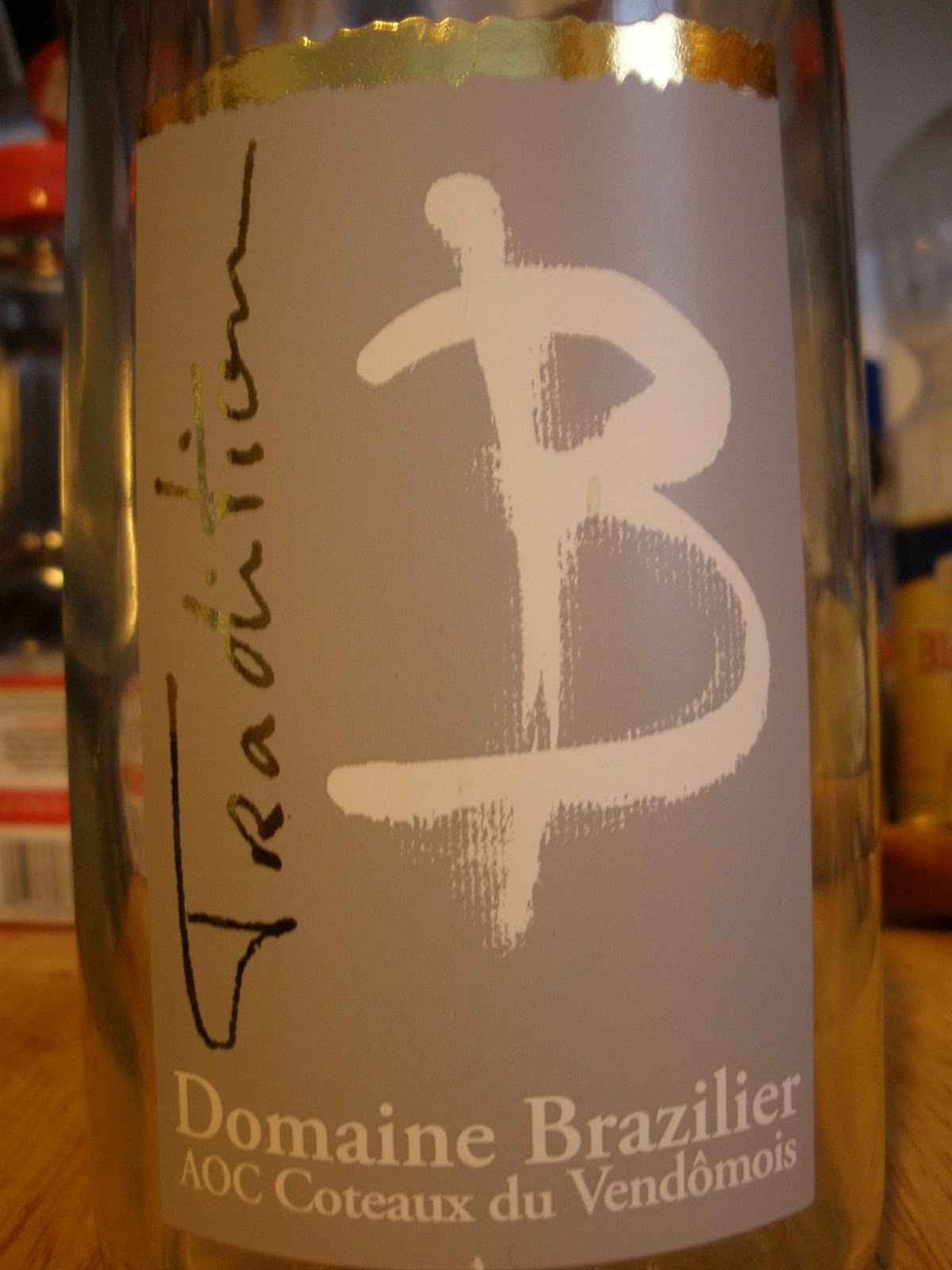
The first bottle that I was able to find was the Domaine Brazilier Pineau d'Aunis rosé from the Coteaux du Vendômois AOC which I picked up for about $17.  If my bottle had a vintage, I wasn't able to locate it.  In the glass, the wine was a very pale salmon pink color.  The nose was moderately aromatic with aromas of fresh cut watermelon and strawberry fruit.  On the palate, the wine was on the lighter side of medium with medium acidity.  There were light, delicate flavors of strawberry, raspberry and watermelon fruit with a touch of herbaceousness to it.  Given the price tag on this wine, I was a little disappointed in how straightforward and simple the aroma and flavor profiles were.  I don't generally buy rosé wines with the expectation that they are going to be much more than fruity and refreshing, but once I pass a certain price threshold, I do begin to expect a little more out of a wine.  At nearly $20 per bottle, I feel that this probably should have been more complex and interesting than it was.  It's entirely possible that this wine was past its prime, but without a vintage date, it's hard to say.  Since there are other examples of this grape in this style for much less money, I'd advise caution with this particular bottling at this price point.

The second rosé that I was able to try was the Cave Cooperative du Vendômois bottling from the Coteaux du Vendômois AOC which I picked up for about $10.  As you can see on the label, the wine is labeled as "Lieu-dit Cocagne," which I believe means that the grapes came from a specific parcel of land referred to as Cocagne, though I don't have any idea what or where that is.  The wine is made by a cooperative comprised of 25 growers and about a dozen different winemakers who, together, farm about 160 hectares of land, about 50 of which are devoted to the Pineau d'Aunis grape.  In the glass, the wine was a pale pink color.  The nose was very aromatic, dominated by pink grapefruit and fresh strawberry fruits.  On the palate, the wine was medium bodied with high acidity.  There were flavors of watermelon, pink grapefruit and grapefruit peel with a touch of grassy herbaceousness that put me in mind of Sauvignon Blanc.  The wine had the kind of wonderfully clean, minerally finish to it that makes you keep reaching for the glass..  This wine was beautifully perfumed with deep, pure fruit flavors and an electric nerve of acid that kept it bright and refreshing.  THIS is the kind of rosé that I love to drink and at only $10 a bottle, it's really an incredible value.

The next wine that I tried was the 2010 Olivier Lemasson "Poivre et Sel" bottling from Touraine in the Loire Valley.  I picked this bottle up from my friends at the Wine Bottega for about $20.  I've read online that this wine is 50/50 Pineau d'Aunis and Gamay, but the bottle says"Pineau d'Aunis...un peu de Gamay," which my high school French tells me means there's just a little bit of Gamay in it (the importer website says it is 90/10, which is probably the more accurate figure).  The Poivre and Sel ("pepper and salt") is a reference to the fact that many people find a peppery aroma and flavor in the Pineau d'Aunis grape which the winemaker believes is perfectly complemented by a little Gamay as the salt to Pineau's pepper.  In the glass, this wine was a fairly light purple-ruby color.  The nose was moderately aromatic with plummy, cherryish fruits and a bit of that natural wine funk.  On the palate the wine was medium bodied with fairly high acidity and medium tannins.  There were flavors of juicy, tart red cherry and red berry fruit and, yes, a hint of pepper. There was also a touch of tart cranberry and horsey funk on the finish.  This wine had a nice balance of bright and juicy fruit with just enough earthy funk to keep it interesting. I found it somewhat similar to the Grolleau that I wrote about a few months back.  Is it worth $20 a bottle?  If you're looking for an upscale alternative to Beaujolais or are looking for a conversation piece to have at a dinner with friends, then yes, I think the price is fair.

I've saved the most interesting bottle for last.  The final Pineau d'Aunis that I tried was the NV Jean-Pierre Robinot "Les Annes Folle" sparkling Pineau d'Aunis that I picked up from the Wine Bottega for about $30.  Robinot has two lines of wine that he makes: the "Domaine de L'Ange Vin," which are made from his own grapes, and the "L'Opéra des Vins" which are made from grapes he buys from other local growers.  This bottle is in the latter category.  The wine about 80% Pineau d'Aunis and 20% Chenin Blanc.  In the glass, the wine was a bronze-gold, almost russet kind of color that was very fizzy and slightly cloudy (the method used here is méthode ancestrale, like in our old friend Mauzac).  The nose was fairly reserved with some green and baked apple aromas with a bready, yeasty kind of undercurrent.  On the palate, the wine was medium bodied with high acid and a lot of bubbles.  I was expecting this to be closer to frizzante, but the bubbles were pretty serious and vigorous.  The flavor profile was yeasty and bready with some tart apple fruit that was almost a little cidery and just a touch of pastry dough.  The secondary flavors and aromas were much more noticeable than the fruits here, so if you're looking for something like Prosecco or Moscato d'Asti, keep looking.  I'm conflicted about this wine because on the one hand, it's a really cool and interesting wine, but on the other, it's hard to say if it's tasty enough to really warrant the $30 price tag.  I personally enjoyed it, but it's not going to be for everyone.  I would guess if you've read this far, you probably already know whether this is something you'd be really into or really afraid of, so I guess you should just follow your gut.

Tuesday, December 13, 2011

Négrette - Fronton, France

We've recently been visiting Southwest France quite a bit around here, having taken a look at the Fer Servadou grape from Gaillac and Marcillac, the Duras grape from Gaillac, and the Gros Manseng grape from the Jurancon region.  There are a number of really interesting grapes grown only in Southwest France and today we're going to take a look at yet another of them, the Négrette grape.

Négrette is grown in a few different areas, but Fronton is its best known home.  The Côtes du Frontonnais is located just southwest of Gaillac and just north of the city of Toulouse, on the western bank of the Tarn river.  The viticultural history of the region can be traced back to Roman times, as the city of Montauban, located just across the Tarn river from Fronton, was an early Roman outpost before they went on to conquer all of Gaul.  The fall of Rome resulted in a very turbulent time as many Barbarian tribes invaded the region repeatedly.  The mood was so bleak that many of the locals believed that the world was going to come to an end after the first millennium AD.  As we all know, the year 1000 came and went without incident, and many of the landholders were so grateful for their continued existence that they donated large tracts of their land to the Catholic Church. 

Around the same time, an organization known as the Knights of Saint John came into the region.  The Knights were a charitable religious organization who were focused on providing food and shelter for religious pilgrims passing through the area on their way to the Holy City Santiago de Compostela (in western Spain) or on their way to the Holy Land.  The Knights were based on the Greek island of Cyprus, and it is said that they brought with them a grape called "Mavro," which means "black" in Greek, which is thought to be a direct ancestor of the modern Négrette grape.  Etymologically, this makes a certain sense, as both grapes are clearly named for the dark color of their skins, juice and the resulting wine.  It's a good story, but it's probably not true.  More recent research indicates that Négrette is probably a member of the côt family which also includes the Southwestern French grapes Malbec and Tannat.  This family is thought to have been brought from Spain in the Middle Ages before settling in Southwest France.  There's a story that Négrette first came to prominence in Gaillac, but that the locals believed that the grape wasn't worthy of their soils and they banished the grape to Fronton, in much the same way as Gamay was pushed out of the better vineyard sites of Burgundy. It turns out that this a great thing for the grape, as it is very prone to fungal diseases and needs a hot, dry climate such as that found in the Fronton region.  There are about 1300 hectares planted throughout France with the overwhelming majority in Fronton.  There is also some grown in California where it is known as Pinot St. George, though the grape appears to be unrelated to the Pinot family.

I was fortunate enough to try three different bottles containing Négrette.  The first was the 2007 Le Roc "Le Classique" that I picked up from my friends at Curtis Liquors for about $10.  The wine is 70% Negrette, 20% Syrah and 10% Cabernet Sauvignon.  The AOC regulations stipulate that the Négrette grape must make up 50 - 70% of the acreage of a grower's vineyard area, and that Cabernet Sauvignon, Cabernet France, Syrah or Gamay should make up no more than 25% of a final blend, while Malbec should only make up 10%.  In the glass, the wine was a deep purple-ruby color and was nearly opaque through its core.  The nose was very aromatic with funky wild blackberry and black cherry fruit with some wet leather.  The aromatics were lifted and powerful and the wine was a real pleasure just to sniff.  On the palate, the wine was medium bodied with acid just on the higher side of medium and medium, powdery tannins.  There were sour black cherry and blackberry fruit with some espresso and smoke.  The finish is a little short with a serious bitter bite on the end, though it spreads out a bit as it opens.  It was a disappointing follow-up based on the powerfully aromatic nose, but it was a very good wine, especially at the $10 price point.  Red wines from the Négrette grape are meant to be drunk young, and it this one may have been starting to fall apart a bit, but it was still hanging in there.

The second wine I was able to try was the NV Nicolas Gelis "Flambant" Bulles Rouge which I picked up from my friends at the Wine Bottega for about $15.  The blend here is about 85% Négrette and 15% Syrah.  In the glass, the wine was a deep lavender color with a bit of fizz to it.  The nose was very aromatic with blackberry candy and dusky cherry fruit with a savage, damp leaf sort of character to it.  On the palate, the wine was medium bodied with medium acid and a light fizz.  It was medium sweet and clocked in at only 8% alcohol.  It tasted kind of like a blackberry or a black cherry soda.  There were a lot of candied black fruits with a touch of wild, wet underbrush to it.  It reminded me a lot of Brachetto d'Acqui and had a lot of the candyish kinds of characteristics that I find in good Brachetto.  It did have just enough of that savage, foresty character to it so that it wasn't like pure sugar, but it was still very friendly and was a lot of fun to drink. 

I  recently was asked to take part in a virtual tasting of wines from Southwest France led by Master Sommelier Fred Dexheimer, which I will be writing more about soon, but one of the wines we took a look at was the 2008 Chateau Bellevue La Forêt "Ce Vin," which retails for about $11 a bottle.  I received this bottle as a free sample for the purposes of the online seminar.  They told us that the wine is 100% Négrette, which is very hard to find.  In the glass, the wine was a deep, inky purple-ruby color.  The nose was very aromatic with strawberry and red berry fruit with a floral, rosy kind of character to it.  The nose was intoxicating and reminded me a bit of the Frappato that I wrote about a few months ago.  On the palate the wine was medium bodied with medium acidity and low tannins.  Like the other Fronton above, the palate was a bit of letdown from the nose, as this wine had some raspberry and blackberry fruit with a touch of bitter smoke and spice.  Overall, it was a little hollow and thin and the bitterness was a little too pronounced for me.  I tasted all of the wines for the tasting the next day and this one had suffered the most, completely falling apart by day two.  I would have loved to try a Négrette from a more recent vintage, as most sources indicate that these wines deteriorate very rapidly after the vintage, but I've certainly seen enough in these three wines to excited about the possibilities for this grape.