A blog devoted to exploring wines made from unusual grape varieties and/or grown in unfamiliar regions all over the world. All wines are purchased by me from shops in the Boston metro area or directly from wineries that I have visited. If a reviewed bottle is a free sample, that fact is acknowledged prior to the bottle's review. I do not receive any compensation from any of the wineries, wine shops or companies that I mention on the blog.
Showing posts with label Weird Blend Wednesday. Show all posts

Wednesday, April 3, 2013

Weird Blend Wednesday - Xinomavro, Krassato & Stavroto, Rapsani, Greece

Mytikas Peak, the highest point on Mt. Olympus
When I was a kid, I used to love reading about Greek mythology.  The Gods and their stories were so interesting to me and I used to love to imagine what it must have been like for them on Mt. Olympus.  When I got a little older, I was surprised to learn that there was an actual Mt. Olympus in Greece, as I had always assumed it was just some made up place.  It is the highest mountain in Greece and actually has 52 peaks, the highest of which is called Mytikas (pictured at left).  Mytikas reaches a height of 9,570 feet, which makes it about 1/3 the size of Mount Everest, whose highest point is nearly 30,000 feet tall.  I'm pretty sure they don't grow grapes or make wine around Mt. Everest, but they do around Mt. Olympus, and I'd like to take a look at a wine from this area today.

Mt. Olympus is located on the border between the Greek regions of Thessaly and Macedonia in eastern Greece.  Just to the southeast of Mt. Olympus, there's a region called Rapsani which, perhaps unsurprisingly, surrounds a village called Rapsani which was founded in the late 15th Century (possibly from Greeks heading into the mountains to escape the Ottoman invaders).  Both the wine-growing region and the village of Rapsani are located in the foothills of Mt. Olympus, but not all of the vineyards are at altitude.  There are fertile valley floors from sea level to about 100 meters where the legal harvesting limit of seventy hectolitres per hectare is frequently exceeded.  As you might expect, these vineyards tend to produce the least exciting wines.  From about 100 meters to 200 meters, the soil type changes to loess, which is a dusty, sandy kind of soil.  These vineyards are also fairly high yielding and rarely exciting.  At higher elevations, the soil type changes again to a rocky schist and the cooling effect of the altitude starts to have a more noticeable effect on the acidity in the grapes.  The highest quality wines are made from these higher vineyard sites.

Rapsani is the only region in Thessaly that is authorized to make red wines.  The local regulations state that the red wines of Rapsani must be made from equal parts Xinomavro, Krassato and Stavroto.  We've taken a look at Xinomavro before, so interested readers should check out that post for more information on that grape.  Most Xinomavro in Greece is grown at more northerly latitudes, and Rapsani is one of the southernmost outposts for Xinomavro in Greece.  Stavroto, on the other hand, is typically found a little further south than Rapsani, though still mainly in the region of Thessaly.  In The Wines of Greece, Konstantinos Lazarakis describes Stavroto as "difficult to grow," and remarks that "by the time the grapes have reached 11.5 degrees Baumé it is usually half-rotten."  It is lower in sugar, acidity and color than either Xinomavro or Krassato, and Lazarakis remarks that "it is doubtful whether Stavroto imparts any meaningful elements to Rapsani."  Stavroto is also known as Ampelakiotiko Mavro, or "black from Ambelakia village," which is just southwest of the village of Rapsani, but most authorities, including Miles Lambert-Gócs (in his The Wines of the Greece), believe that Stavroto originated in Euboea, an island off the coast of Thessaly further to the southeast.

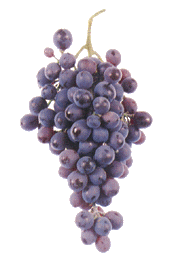
Krassato Grapes
Of the three grapes used for Rapsani wines, only Krassato is thought to be native to the region. Lazarakis describes Krassato as "relatively deep in colour...high in sugar and rich in dry extract," though Robinson & Co. temper this description in Wine Grapes by noting that Krassato has only moderate acidity and tannins and thus isn't conducive to extended aging.   Which isn't to say that Rapsani wines don't age well.  Xinomavro is rich enough in acidity and tannins that it contributes good structure to the finished wines even when it only makes up 1/3 of the final blend.  The name Krassato comes from the word krasáto, which means "wine-colored," according to Lambert-Gócs.  Like Stavroto, Krassato is mostly found in and around the area of Rapsani, though there are limited plantings just north and south of the region as well.  Unlike Xinomavro, Stavroto and Krassato are almost never made into varietal wines, since both grapes have flaws that usually need blending to even out.  Further, many of the vineyards of Rapsani have all three vines planted together throughout their vineyards, making varietal wine production especially challenging.

I was able to pick up a bottle of the 2008 Rapsani Chrisohoou from my friends at the Spirited Gourmet for around $17. In the glass the wine was a fairly light purple ruby color (I also have it described as deep lavender in my notes, so pretty much a deep light purple, if that makes any sense).  The nose was fairly intense with aromas of wild strawberry, raspberry, tea leaves, and dusty wood.  On the palate the wine was on the fuller side of medium with medium acidity and light tannins.  There were flavors of stewed strawberry, wild raspberry, tart plum, red cherry, black tea and chocolate.  It was a soft, smooth wine with lots of zippy red fruits balanced by some earthy tea and chocolate notes.  Wines featuring the Xinomavro grape can be lean and austere (particularly in their youth), but the addition of the other two grapes to this blend really rounds out the flavor profile.  It's a great food wine that would pair well with lighter meat dishes in fruit sauce.  It may not be the wine of the Gods, but it's certainly a wine that I think Bacchus would approve of from his perch on nearby Olympus. 

Wednesday, February 13, 2013

Weird Blend Wednesday - Araignan Blanc, Riveirenc Gris, Riveirenc Blanc & Grenache Gris, Cotes du Brian, France

Araignan Blanc grapes
(aka Picardan)
It has been several months since I last did a Weird Blend Wednesday post, which is entirely too long, so today I'd like to dust the old feature off and talk a bit about a really interesting white wine I tried a few months ago from the Cotes du Brian region of the Languedoc in southern France.  Back in August of last year, I wrote about a red wine from Clos Centeilles which was made from Picpoul Noir, Riveirenc Noir, Morastel Noir à Jus Blanc and Œillade grapes, all of which are pretty rare and very unusual.  Clos Centeilles also makes a white wine made from a handful of local heirloom varieties, and today I'd like to take a look at some of those grapes and the wine that is made from them.
The Clos Centeilles "C" blanc is made from 35% Araignan Blanc, 30% Riveirenc Blanc, 30% Riveirenc Gris and 5% Grenache Gris*.  Since we've already covered Grenache Gris, I'll mainly be focusing on the other three grapes that make up 95% of this particular wine.

Riveirenc Blanc
Araignan Blanc (pictured above) is perhaps the most well known of the bunch, but most people know it as Picardan, and it is one of the 18 approved varieties in the Chateauneuf-du-Pape AOC of the southern Rhone Valley.  It is a very old grape variety and the first mention of it in print can be traced back to 1544 AD.  It shares some synonyms with Bourboulenc and Clairette, though it doesn't appear that it is related to either of those grapes.  The name Picardan is thought to come from a combination of the French words piquer (to sting, as in Picpoul de Pinet) and ardent (burning) because of its high acid content.  The grape's primary synonym of Araignan was first mentioned in print in 1715, and is thought to come from the word araignée, or spider, because of the small hairs on the underside of the leaves which resemble spider's silk.  There are currently only about 1.2 acres (less than a hectare) of Picardan in all of France and though a little bit finds its way into some Chateauneuf-du-Pape blends (like Chateau Beaucastel), chances are pretty good that this particular bottling has the highest percentage of Picardan of any wine in the world.

Riveirenc Gris
Riveirenc Blanc and Gris are color mutations of Riveirenc Noir, which we took a brief look at in my post on the red wine from Clos Centeilles.  This group of grapes is more commonly known as Rivairenc or Aspiran, though very little acreage is devoted to any of the three varieties in France or elsewhere.  The Noir is the most common of the three and it is thought that the grape may be referenced as early as the 15th Century under the name Esperan, but it is difficult to say for certain.  The French registry of grape varieties spells the name of the grape Rivairenc and this is how it is listed in Wine Grapes, but the producer uses the Riveirenc spelling so that's what I've used as well.  The name Rivairenc is thought to come from from the word ribairenc, which in the Occitan dialect means "riparian," or having to do with river banks, possibly because the vines were discovered on a river bank or because they grow particularly well there.  Vouillamoz reports in Wine Grapes that his personal research indicates that there may be a parent/offspring relationship between Rivairenc and Cinsaut, but more markers need to be tested and since the third member of the family has not yet been identified, it is impossible to say what the precise nature of the relationship between the two grapes is.  I cannot find any planting statistics for Rivairenc Blanc or Gris, so there is also a really good chance that the 30% of each in this particular wine is the highest proportion you're likely to find anywhere.

I picked up the 2009* Close Centeilles "C" Blanc from my friends at Curtis Liquors for around $20.  This wine is a vin de pays from the Cotes du Brian, which I believe is in the area around Minervois in the Languedoc.  In the glass the wine was a fairly deep lemon gold color.  The nose was fairly intense with aromas of green apple, apple cider, Meyer lemon, pastry dough, pineapple and melon.  On the palate the wine was on the fuller side of medium with medium acidity.  There were broad, creamy flavors of pear, red apple, Meyer lemon creme and a touch of apple cider.  This wine is fermented on its lees before being drawn off the heavier lees into a neutral container.  It is stirred weekly for several months before being bottled for release and this stirring and lees contact definitely gives it a rich, creamy mouth-feel, though it does sharpen up a bit as it approaches room temperature.  Rosemary George reviewed this wine on her website in 2010 and remarked that it is "not a wine to age," and I agree with her assessment, having tasted the wine about a year and a half after she did.  It was an enjoyable wine, but I thought it was probably more interesting than good and much preferred the red from this estate.  It is a rare opportunity to try grapes that you may otherwise never taste, though, and is good enough that I wouldn't consider it a mere curiosity.

*These figures are for the 2007 vintage.  The winery website does not offer any more up-to-date information than this.

Wednesday, September 12, 2012

Weird Blend Wednesday - Bosco, Vermentino & Albarola, Cinque Terre, Liguria, Italy

Bosco Grapes
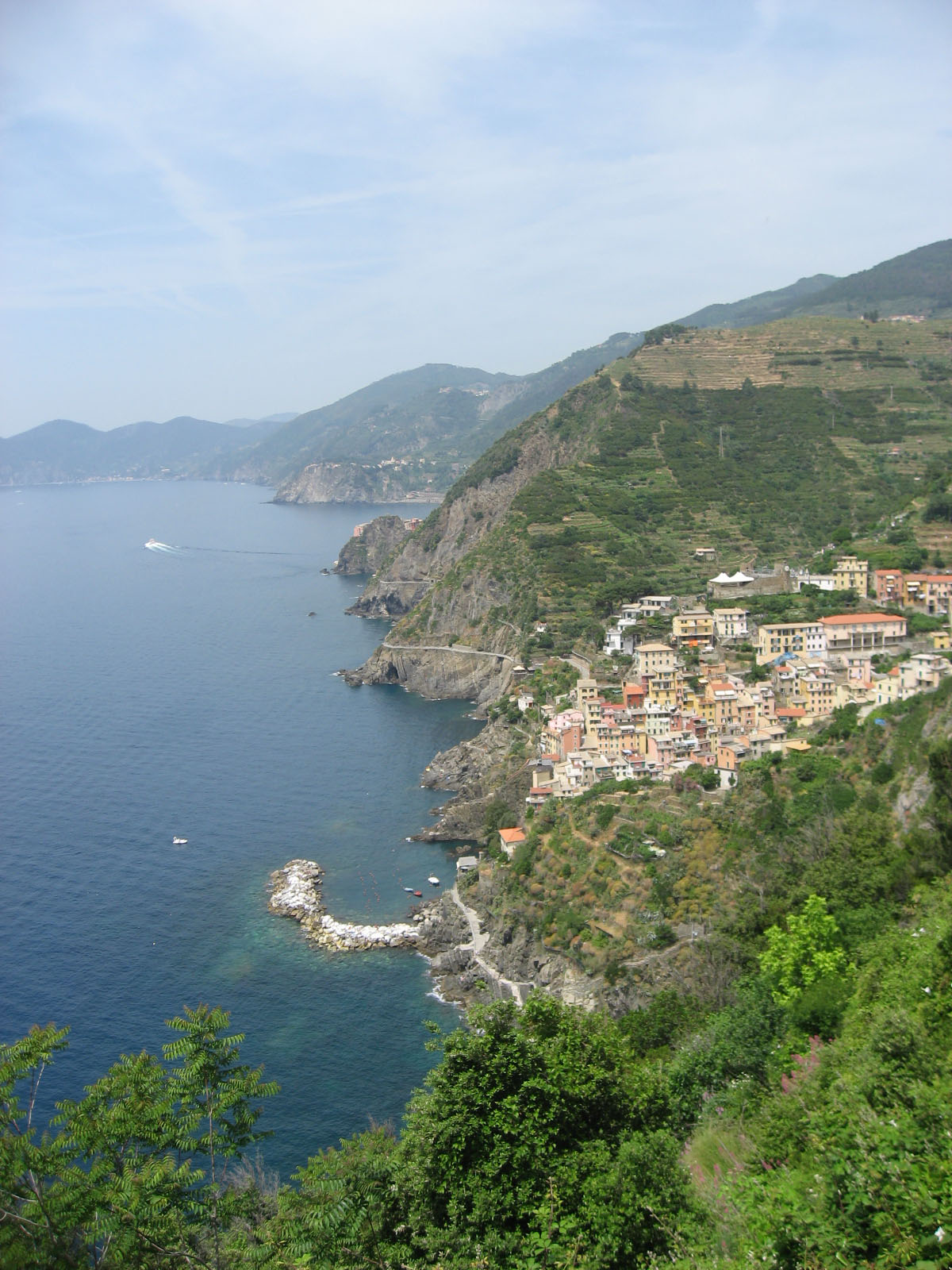
A few days ago we took a look at the Albarola grape, which is known as Bianchetta Genovese in the Golfo del Tigullio region of Liguria.  Today I'd like to take a look at another Ligurian wine that has a little Albarola in it, but is blended in such a way that Albarola isn't the star.  This wine is from the Cinque Terre region of Liguria, which is a little south and east from the Golfo del Tigullio, near the Ligurian border with Tuscany, but still right on the Ligurian Sea.  Cinque Terre means "five lands," and is so named for the five villages (Monterosso al Mare, Corniglia, Manarola, Riomaggiore and Vernazza) that compose it.  The villages are built right into the cliffs that overlook the Ligurian Sea and are accessible only via boat, train or on foot.  The entire landscape is steep and hilly and, as you might imagine, viticulture isn't exactly easy.  The locals have carved terraces into the hillsides to support both the buildings and any agricultural pursuits, such as growing vines (though olive trees are cultivated as well).  The hills are so steep that mechanized viticulture is virtually impossible and most vineyards are tended and picked by hand. Production is very small here since there isn't a lot of room for vineyards, and much of what is produced is drunk by tourists, both of which drive the price of the wines up a bit, though the labor-intensive nature of growing grapes here is also a contributing factor to the relatively high prices fetched by the wines.

Wines from the Cinque Terre DOC must be made up of at least 40% Bosco and can contain a maximum of 40% Vermentino and/or Albarola and a maximum of 20% of "other authorized white grapes."  As mentioned above, we just recently took a look at the Albarola grape, and we've taken a few indirect looks at the Vermentino grape (in the context of the Favorita and the Pigato grapes, which are genetically identical to Vermentino), which just leaves us the Bosco grape, about which there is apparently very little to say.  The Oxford Companion to Wine's entry reads in full: "ordinary white grape of Liguria."  Jancis Robinson's Guide to Wine Grapes adds little more, as that entry reads "very ordinary Ligurian that forms the basis of Cinqueterre and oxidizes easily."  Nicolas Belfrage, in his Barolo to Valpolicella calls the grape "strange, but not so wonderful."  Besides Cinque Terre, Bosco is permitted in only one other DOC region, the Val Polcevara just west of Genoa in central Liguria, where it is allowed to make up no more than 40% of the blend.

I was able to try the 2009 Bisson "Marea," which is 60% Bosco and 40% Vermentina/Albarola (the winery doesn't give a more precise breakdown).  I picked this bottle up for about $29 locally.  In the glass the wine was a fairly deep lemon gold color.  The nose was moderately intense with aromas of golden apples, fresh pears, honeysuckle flower, pineapple and lemon.  On the palate the wine was medium bodied with medium acidity.  There were flavors of ripe red apples, lemon, almonds and pecan.  It was bitter and kind of metallic tasting as well.  I noted above that Bosco oxidizes pretty easily, and it's possible that this wine was starting to go through that process.  This bottle is only about three years old and I wouldn't expect it to be shot this soon, especially at this price point, but it's hard to say whether I just got a bad bottle or whether this is a wine meant to be drunk as early as possible.  I don't exactly relish the idea of dropping another $30 to try to find out, so please leave a comment below if you've had some experience with this wine and want to share it.

Wednesday, August 15, 2012

Weird Blend Wednesday - Piquepoul Noir, Riveirenc Noir, Morastel Noir a Jus Blanc& Oeillade Noir - Languedoc, France

Piquepoul Noir Grapes
We've taken some looks at some fairly unusual blends here on Weird Blend Wednesday, but we've never tackled anything quite like today's wine.  All four of the grapes in this particular bottle are not just unusual, but extremely rare to boot.  I've done the best that I can trying to tease out exactly what's in this wine, but given the extraordinary scarcity of these grapes, it's hard to say how successful my effort has been.

Clos Centeilles was founded by husband and wife team Daniel and Patrica Boyer-Domergue in the late 1980's in the Minervois region of southern France.  In the mid 1990's, the duo planted a small vineyard with the aim of preserving some of the ancient native varieties that had been almost completely wiped out by phylloxera about a hundred years before.  They make both a white wine and red wine from these extraordinarily rare grapes and we'll eventually take a look at their white, but today I'd like to take a look at their red wine and the four grapes that are used in its creation.

The overwhelming majority of the blend for this wine (78%) is from a grape called Piquepoul (or Picpoul) Noir.  This is the dark berried form of the Picpoul grape used in the production of Picpoul de Pinet, and it is much more difficult to find than its light skinned twin (which is planted on about 2,500 acres of land throughout France).  Both Picpoul Noir and Picpoul Blanc are permitted varieties in Chateaneuf-du-Pape, but together they account for only about 0.15% of the total plantings there.  Picpoul Noir is also permitted in the Coteaux du Languedoc appellation, but is neither widely grown nor utilized there.   Wines made from the Picpoul Noir grape are richly perfumed but lightly colored so the grape tends to be used as a blending grape when it is used at all.  This particular wine is probably about as close as you can come to a varietal Picpoul Noir.

Riveirenc Noir makes up the second largest part of this wine at 15% of the blend, and I can find absolutely no online information about this grape outside of descriptions of this particular wine.  The VIVC database has no listings for a grape called Riveirenc, though there is a listing for a grape called Riveyrenc, which is either officially known as Aspiran Noir (according to the VIVC) or Rivairenc (according to the OCW, though the entry is given under Aspiran).  Riveirenc is not listed as an accepted synonym for Aspiran Noir in the VIVC, so it is unclear whether it is the same grape or not, but it seems likely given that Aspiran is still an accepted variety in the Minervois, where this particular wine is made.  There were only about 7 hectares of Aspiran Noir in France as of 1988, though at one time it accounted for almost a quarter of the plantings in the Hérault region of the Languedoc.  Phylloxera claimed many of the vines in the late 19th Century, and then a severe frost in 1956 claimed most of the rest.  It's not a particularly productive vine, so most growers elected to plant other varieties when their vines were stricken.

Morastel Noir à Jus Blanc is the third largest component of this particular wine, though it makes up only 5% of the blend.  Morastel is, generally speaking, a synonym for Mourvedre, but given that this estate has other vines that they identify as Mourvedre, it's unclear just what this variety might be.  In France, Morastel (sometimes also spelled Morrastel) refers to the Graciano grape, which was once widely planted in the Languedoc.  The "jus blanc" part of the name hints that it may be related to a teinturier variety (a grape with red flesh and thus red juice), as the "jus blanc," or "white juice" description is often used to differentiate white pulped clones from red pulped ones.  In this report on the Paris Exhibition of 1878, the author notes a few "red juice" varieties of grape, three of which have the word "Morastel" in them.  All three of these Morastel grapes were created by Henri Bouschet by crossing Morastel (presumably Graciano in this context), and Petit-Bouschet.  The OCW informs us that Morrastel-Bouschet (which I'm assuming was one of these crossings) eventually came to completely replace plantings of Morrastel/Graciano in southern France, so it is possible that one of these teinturier Morastel crossings mutated at some point into a non-teinturier vine, and that his mutation is now known as Morastel Noir à Jus Blanc.  It is also possible that  Morastel Noir à Jus Blanc was just the local name given to Graciano to differentiate it from the Morastel-Bouschet teinturier varieties after they came to dominate the landscape.  It's difficult to say for sure either way.

Œillade Noir Grapes     
Œillade makes up only 2% of the blend for this wine, and it has the same kind of naming issue as Morastel Noir à Jus Blanc.  Œillade is typically used as a synonym for Cinsaut, but, again, Clos Centeilles grows a lot of Cinsaut and bottles other wines under that particular name, so it doesn't seem likely that what they're calling Œillade is merely Cinsaut.  The VIVC does have a listing for an Oeillade Noire, which seems to be related to another grape called Araignan, which Clos Centeilles uses for the white version of this particular wine, so it's probably a safe bet that that's what we're dealing with here.  Oeillade Noire can sometimes resemble Cinsaut, which is probably where the confusion about the synonyms comes from, though wines from it are lighter in color and, according to some sources, slightly inferior in quality, which probably goes a long way towards explaining why there isn't that much of it around anymore.

I was able to get my hands on a bottle of the 2006 Clos Centeilles C de Ceinteilles Rouge from my friends at the Spirited Gourmet for about $18 (I believe the wine is also available in both Rouge and Blanc from Curtis Liquors as well).  In the glass this wine was a fairly light purple ruby color.  The nose was moderately intense with black cherry, blackberry, charcoal, smoke and black pepper aromas.  On the palate the wine was on the fuller side of medium with medium acidity and medium tannins.  There were flavors of red cherry and crushed red berries, smoke, and black pepper with a distinctively savory, meaty kind of character to it.  It wasn't incredibly complex, but it was very nice and represents a good bargain at under $20.  It's probably the only chance that most people will have to taste a wine made from these particular grape varieties and is worth the cost of the bottle for that fact alone.  Those of you who are a few grapes short on your Wine Century Club applications should track a bottle of this down as it's a sure-fire way to add four more grapes to your tasting resume.

Wednesday, August 8, 2012

Weird Blend Wednesday - Tsaoussi, Robola & Sauvignon Blanc - Cephalonia, Greece

Hello friends and neighbors, and welcome to another installment of my erratic Weird Blend Wednesday feature!  Today we're going to take a look at a blended white wine from the Greek island of Cephalonia that is composed of 40% Tsaoussi, 30% Robola and 30% Sauvignon Blanc.  I think.  See, the winery's website says that the wine is made from Tsaoussi and Muscat grapes, but the American importer's fact sheet on the wine gives the breakdown above.  After sampling the wine, I don't see any way that there's any muscat in it at all, so I'm choosing to believe the importer's breakdown.

We've talked a bit about the Robola grape before, but I think it's worth a quick revisit.  I mentioned in my previous post that there seemed to be some evidence that the Robola from Greece was distinct from the Ribolla of Italy.  Konstantinos Lazarakis brought this up in his excellent The Wines of Greece, but when I wrote the original post, I wasn't able to track down the specific studies that he was (loosely) referencing.  I still haven't been able to read the original papers, but it's because the main one is actually the UC Davis Master's Thesis of Mihalis Boutaris, and I'm not entirely sure how one goes about obtaining something like that.  It must be possible, though, because the site greekwinemakers.com have clearly read it, and give a good summary of the relevant content.

In short, what Boutaris found was that when he analyzed two different samples of Robola, one from California and one from Greece, the two samples turned out to be genetically distinct from one another.  Furthermore, it turned out that each Robola sample matched another Greek grape.  The California sample matched a grape called Thiako, while the sample from a collection in Athens matched something called Goustolidi.  This result leads Boutaris to question whether perhaps Robola isn't the name of a grape at all, but rather of a wine made from a variety of different grapes.  Over time, the name of the wine could have become confused with the name of the grapes, and people just started calling the grapes that went into the wine Robola.  That's certainly a possibility, but there needs to be more research done in order to verify it.  The Greek wine makers site also goes on to say that "no Greek Robola sample yet tested has displayed a close genetic relationship to the Italian Ribolla," but I haven't been able to find any studies at all that attempted to compare the DNA of the two grapes.  The VIVC database does list Robola as a separate entry from Ribolla, but neither it nor the Greek Vitis database has any microsatellite data on file for Robola, so it's hard to say what the relationship between the two grapes might be.

Fortunately, Tsaoussi (or Tsaoúsi) is a little bit easier to sort out.  There is some disagreement about its origins, with some sources indicating that it was transplanted from Egypt, others indicating that it arrived from Macedonia and others still claiming that it is indigenous to the island of Cephalonia, but this is really the only point of contention about the grape that I could find.  The vine produces large bunches of large grapes that are often used as table grapes in addition to being used in the winery.  It yields fairly generously, but can suffer from low acidity and is often blended with higher acid grapes in order to cover up this defect.  Tsaoussi is found almost exclusively on the island of Cephalonia off the western coast of Greece, though there is a small amount on the nearby island of Corfu and also some scattered plantings in northern Greece called Tsaousi which may or may not be the same grape.

I was able to pick up a bottle of the 2007 Gentilini Aspro Classic bottling for about $14 from my friends at the Spirited Gourmet.  Aspro means "white" in Greek, but it is also one of the few synonyms listed for the Tsaoussi grape.  In the glass the wine was a fairly deep lemon gold color.  The nose was mild and reserved with pear, baked apple and pastry dough aromas.  In the glass the wine was medium bodied with medium acidity.  There were flavors of baked apple, pie dough, toasted nuts and honey.  This wine needed a bit of time to open up, but when it did the honey notes really started to come on strong even though this is definitely a dry wine.  This was almost certainly past its prime, but it was still holding on and drinking decently.  As mentioned above, this wine is only about 40% Tsaoussi and I'm not aware of any commercially available 100% Tsaoussi wines, but Markus over at Elloinos has a nice video up featuring a special 100% Tsaoussi that the owner of Gentilini sent for him to try.

Wednesday, July 25, 2012

Weird Blend Wednesday - Channing Daughters "Meditazione," Long Island, NY, USA

After a very long hiatus, we're back with another installment of Weird Blend Wednesday!  Today I'd like to take a look at a wine that has a lot of interesting weird stuff going for it.  Not only are the grapes a little bit unusual, but the region and the style of this wine are a little out of the ordinary as well.

Channing Daughters winery is located on the south fork of Long Island, which the wealthier among you may know as the Hamptons.  For those unfamiliar with the geography of Long Island, the end of the island that is farthest away from New York City (and which is accessible via a short ferry ride from New London, Connecticut) is forked at the end (see a map here).  The north fork has historically been dominated by farmland, but over the past few decades, many people have started growing grapes and opening up wineries.  There are a few dozen wineries now on the north fork of Long Island making wines of varying quality levels from grapes like Cabernet Franc, Merlot and Chardonnay, among others.  The south fork has generally been a resort area for wealthy New Yorkers to keep a summer home, but there are just a handful of wineries, like Channing Daughters, that are located on the south fork of Long Island.

Though they're located on the south fork of the island, Channing Daughters sources grapes from all over the eastern end of Long Island, and they bottle wines from each of its three designated AVAs (North Fork, Hamptons, and Long Island).  The winery owns plots on both forks and also sources grapes from particular growers all over the island to make their wines, which are as varied and eclectic as I think I've ever seen from a single producer.  They have single vineyard wines and multi-vineyard blends, varietal wines and multi-grape blends, wines made from natural yeasts as well as wines made with cultivated yeasts, wines that are fined and filtered and wines that aren't, wines aged in any and every kind of oak barrel as well as wines done in 100% stainless steel.  The winery produces about 7000 cases of wine per year which is divided between twenty six different bottlings.

The wine that I picked up from them was their 2007 Meditazione, which is a wine made in the style of the "vino de meditazione" of the Friulia region of Italy.  This bottle was a blend of 35% Tocai Friulano, 35% Sauvignon Blanc, 13% Muscat Ottonel, 12% Pinot Grigio and 5% Pinot Bianco.  Channing Daughters has been making this wine for six years (the 2007 is actually the fourth vintage), and the particulars of it change from year to year.  The 2008, for example, was 27% Sauvignon Blanc, 27% Chardonnay, 16% Tocai Friulano, 16% Muscat Ottonel and 14% Pinot Grigio, while the 2009 is 27% Sauvignon Blanc, 6% Chardonnay, 1% Malvasia, 38% Muscat Ottonel, 26% Pinot Bianco and 2% Pinot Grigio.  The wine is made in an orange wine style, meaning that the juice is left in contact with the skins for some time after crushing, but even the timing of this varies from year to year.  I'm not sure how much time the 2007 spent on the skins, but the 2008 spent 10 days while the 2009 spent 30 days.  The wine is typically aged for about 18 months in Slovenian oak prior to bottling.  It has been called the greatest white wine in America by at least one prominent sommelier and inspired this comic and post from the always excellent wakawakawinereviews.

I picked up my bottle of the 2007 Meditazione from my friends at the Spirited Gourmet for about $30.  In the glass the wine was a deep orange-bronze color.  The nose was intensely aromatic with peach, orange blossom, honeysuckle, pineapple and lime notes.  It had a heady, gorgeous perfume that made it difficult to move on to the step of actually tasting the wine.  On the palate the wine was on the fuller side of medium with medium acidity and little bit of tannic grip.  I made the mistake of storing this bottle in the refrigerator and initially tried to taste it when it was very cold.  In this condition, it was no fun at all to drink, but once I let it come down to room temperature, the palate blossomed with rich apricot, honey and orange peel flavors along with some toasted nuts, flower petals, and sawdust.  There was a kind of savory salinity to the wine as well.  I wasn't blown away by this at first sip, but by the time I finished the bottle, I was moony-eyed in love with it.  I was able to pick up another bottle and drank it recently with some of the guys from the Wine Bottega, and my impressions were pretty similar.  This is an amazing, mind-blowing, incredible wine that is worth not only the $30 that I paid for these bottles, but easily worth the $40 that the new vintage is commanding from the winery.  I don't know if it's the best wine made in America, but it's definitely one of the most interesting.  I'm hoping to drop down to the winery in the next few months and try some of their other wines and chat with the winemaker a bit, so stay tuned for more about these guys and the amazing things that they're doing.

Wednesday, April 18, 2012

Weird Blend Wednesday - Vital, Fernão Pires & Arinto - Lisboa, Portugal

Weird Blend Wednesday has been on an extended hiatus since February, but today I'm dusting the old feature off and bringing it back!  Today I'd like to take a look at a wine from that most blendiferous of countries, Portugal.  Those of you who are familiar with how I like to set up my posts may notice that the picture on the left isn't a picture of a grape.  The reason for that is that I was unable to find a picture of a Vital grape and none of the images I found when searching for "weird blend" made any sense so I opted to go with a weird blender instead.  It turns out that most blenders just look like blenders and it took quite a bit of searching to find that Mickey Mouse inspired one, so please enjoy both it and the feature that no one has been clamoring for, Weird Blend Wednesday!

Today's weird blend is made from two grapes we've already taken a look at and one grape that's new to us.  We took a look at Fernão Pires, aka Maria Gomes, back in March and readers interested in more about that grape should check out this post.  A few days earlier, we took a look at the Arinto de Bucelas grape and spent quite a bit of time sussing out just what Arinto is.  Interested readers can read all about that grape and the Bucelas region where it is cultivated in this post.

Which brings us to the third grape, our new friend Vital.  It's no accident that I wasn't able to find any pictures of Vital since it has the unfortunate double-whammy of not only not being a featured grape anywhere and thus not demanding a lot of attention, but it also has a name that is a common English word which makes Google  searches very frustrating and borderline useless.  Nearly every result that did pop up from various combinations of "Vital," "grape," "Portugal," and "wine" was little more than a passing reference within a longer article about a particular region in Portugal (saying things like "Vital is grown in Estremadura," for example).  Wikipedia has no entry for the grape and the Oxford Companion to Wine's entry reads in full: "white grape grown in Estremadura in western Portugal which is known as Malvasia Corada in the Douro."

I did find this page, but as you can see, it's in Portuguese which is not a language that I'm fluent in (for those of you keeping track, English is the only language I am fluent in and I'm properly ashamed of that fact).  Running that page through Google Translate gives little bits of information about Vital's behavior in the vineyard, but little else.  It turns out that Vital is a vigorous vine that is prone to rot and which is capable of reaching high sugar levels in the vineyard (and thus high alcohol levels in the winery).  It is called Boal Bonifacio in some regions, though it is distinct from the Bual (or Boal) of Madeira.  It is also called Malvasia Corada in some places and Malvasia Fina or Malvasia Fina de Douro in others, and while it may be related to those grapes (distantly, if at all), it is definitely a distinct variety.  One research group (citation below) has shown that there is a bit of genetic overlap between Vital, Malvasia Fina and Bual, but not enough to establish any kind of a direct familial relation.  Another group has shown that Vital and Fernão Pires share some genetic similarities, but again, not enough to establish a specific relationship.

And that's pretty much all there is about Vital.  The region that this wine is from is called Lisboa, which used to be known as Estremadura (the change happened in 2009 because of a fear of confusion with the Spanish region called Extremadura).  It's on the western coast of Portugal and encompasses the large peninsula where the capital city of Lisbon sits and the area between the Atlantic ocean on the west and the Tagus River on the east (it's the upper area in black on this map).  Lisboa is a Vinho Regional which in the Portuguese classification system is similar to the Vin de Pays of France or the IGT of Italy.  There are nine smaller DOC regions within Lisboa, one of which is our old friend Bucelas.  The region is generally cooler and wetter than some of the other areas of Portugal due to its proximity to the Atlantic Ocean and the lack of any mountains or hills to block the cool sea breezes.  The temperatures do rise and the moisture drops as you move inland, but this is mostly white wine country.

The wine that I tried was the 2009 Quinta Cerejeiras which I picked up from my friends at Bin Ends for about $7.  In the glass this wine was a light silvery lemon color.  The nose was very aromatic and very citrusy with ripe pear, lemon peel and lemon juice.  On the palate it was on the fuller side of medium with fairly high acidity.  There were lemony citrus flavors with pineapple, ripe pear and green apple notes as well with just a hint of banana. The finish was mostly clean and minerally but there was a slightly bitter pithy note to it.  I was expecting something lightweight and crisp but this wine had a lot more body and weight than I would have guessed.  It was still bright and lively with very nice balance but it's not exactly the porch-sipper that I thought I was signing up for.  It is a very good value at only $7 a bottle and would be an excellent match for creamy chicken or pork or for richer fish dishes like salmon or tuna.

Citation:

Lopes, M.S., Sefc, K.M., Eiras Dias, E., Steinkellner, H., Laimer da Camara Machado, M., da Camara Machado, A. (1999) "The use of microsatellites for germplasm management in a Portuguese grapevine collection." Theoretical Applied Genetics, (99) 733-739

Wednesday, February 8, 2012

Weird Blend Wednesday - Petit Rouge, Cornalin, Mayolet & Vien de Nus, Valle d'Aosta, Italy

Mayolet Grapes
Hello, everyone and welcome back to Weird Blend Wednesday.  Today's wine is a fun little field blend from the Valle d'Aosta that is made up of several different grapes that are specialties of the region.  I think.  See, this wine is sold as a vino da tavola, or, this close to the French/Italian border, a vin de table, which means that the only thing that the bottle can say is whether the wine is white or red, who made it and the name that the producer has decided to give to the bottling, if any (in this case, the wine is called Cuvé de la Côte).  No vintage, geographical indication (other than the country of origin) or grape make-up is permitted on the bottle at all, which isn't usually a problem in this day and age since many producers just put that kind of stuff online and let the consumers find it themselves.  For this wine, though, the only information available is from the distributor (the great Louis/Dressner) who only offers that the wine "is a field blend from a parcel of particularly old vines."  There's really no telling exactly what is in this bottle, and it's possible that the winemaker may not even know, if the parcel is old enough.  The guys at the Wine Bottega, where I picked this bottle up, said that it was most likely a blend of the four grapes mentioned above, and so that's what I'm going with.

Vien de Nus Grapes
We've already taken a good, long look at two of the four alleged grapes in this blend.  Petit Rouge is the savage little grape that forms the base of the wines from the Enfer d'Arvier and Torrette sub-regions within the Valle d'Aosta.  Cornalin is the confusing little grape that is a different thing depending on where you find yourself.  If you're in Italy, you're probably talking about Cornalin d'Aoste, which is usually called Humagne Rouge in Switzerland.  If you're in Switzerland, Cornalin refers to a different grape, known as Cornalin du Valais, which is actually one of the parents for Cornalin d'Aoste.  It's a long, tangled story that you can peruse at your leisure via the link above.

The other two grapes are Mayolet and Vien de Nus.  Mayolet is certainly the more common of the two grapes and can occasionally be found in varietal form, while Vien de Nus is pretty much a blending grape.  Mayolet is referenced in writings dating back to the 18th Century and is thought to be indigenous to the Valle d'Aosta.  Recent DNA testing has shown that Mayolet is one of the parents of Cornalin du Valais (Petit Rouge is the other), which means that both Petit Rouge and Mayolet are the grandparents of Cornalin d'Aoste (Vouillamoz, J., Maigre, D., Meredith, C.P. (2003) Microsatellite analysis of ancient alpine grape cultivars: pedigree reconstruction of Vitis vinifera L. "Cornalin du Valais." Theoretical and Applied Genetics, (107) 448-454).  This wine, then, is kind of like a little family reunion in a bottle where Vien de Nus plays the role of a longtime neighbor who is like an honorary uncle, even though he isn't really related by blood to anyone there.  Vien de Nus also has a long history in the Valle d'Aoste and is thought to be native to the region, but if there is any genetic link between it and the other three grapes in this wine, I haven't been able to find it.

The wine that I was able to try was made by Franco Noussan who lives in the village of St. Christophe in the hills above the town of Aoste.  His bio on Louis/Dressner's site says that he works at the local university, which it turns out is the Institut Agricole Régional, the local agricultural school where the Cornalin and Prëmetta I wrote about earlier came from.  His winery is essentially an extension of his garage which he dug into the hillsides around his house.  He has several parcels scattered around St. Christophe including one with vines over 70 years old, which is where I presume the grapes for this wine came from.  Altogether he farms about 5.5 hectares of land which he works without herbicides.  He hand harvests all of his grapes and uses only indigenous yeasts in his fermentation.  He has been making wine for his family and friends for many years but has only been offering them commercially since 2005.

I picked up my NV bottle of the Noussan Cuvé de la Côte from my friends at the Wine Bottega for about $25.  In the glass, the wine was a medium purple ruby color.  The nose was very aromatic with black cherry, black plum and wild raspberry fruits with a touch of smoke.  There was something wild and savage to the nose that was very interesting and deeply compelling.  On the palate the wine was on the fuller side of medium with fairly high acid and medium tannins.  There were flavors of black cherry, dried cherry, wild raspberry and blackberry fruit with smoke, char and a little bit of funk.  It was wild and complex but really nicely balanced as well.  There was a good mixture of red and black fruits with nice charred, smoky undertones to it that was all held up with a lively vein of acidity.  I really felt like the wine over-delivered in terms of complexity and depth for the price, especially since wines from the Valle d'Aoste tend to be fairly expensive because of their limited production.  It would go well with all kinds of food but I think something with duck or sausage would be great as the bright acidity here would just cut through the fat and match well with meat that's a little funky.

Wednesday, February 1, 2012

Weird Blend Wednesday - Alvarelhão, Pedral & Vinhão - Vinho Verde, Portugal

Alvarelhão Grapes
Today I'm debuting a new feature that I like to call Weird Blend Wednesday, where I take a look at a wine I've tried that is a blend of several different unusual grapes.  As a general rule, I usually like to stick with varietal wines for this site, but sometimes I come across something that is full of really interesting grapes that I just can't pass up.  The problem is that they don't really fit in with the format that I've been working with over the past year or so, so I end up either not drinking them, which is no fun at all, or drinking them and staring at the tasting note for months with no idea how to incorporate it into the site.  So, if I have a wine that is made up of three or more different grapes and it isn't clear whether one of the grapes in the wine makes up at least 50% of the total blend, then I'll relegate it to this little corner of the blog.  Welcome, friends, to Weird Blend Wednesday.

Today's featured wine is from the Vinho Verde region of Portugal, which we've taken a brief look at before when we talked about the Espadeiro grape.  As mentioned in that post, Vinho Verde is a wine region in northern Portugal.  Many of the wines that are made there are light, spritzy white wines that are so prevalent that many people think that Vinho Verde refers to that particular style of wine rather than the region, but wines from Vinho Verde come in all different colors and styles, from light spritzy whites to deep brooding reds.  Today's wine is somewhere in between.  Like the Espadeiro I wrote about previously, this was a rosé wine made from a blend of three different grapes: Alvarelhão, Pedral and Vinhão.  Like many Portuguese wines, I can't find any indication either on the bottle or online about how much of the blend each grape makes up, so this wine is the perfect bottle to kick off Weird Blend Wednesday.

Pedral Grapes
Alvarelhão is a red skinned grape that is currently grown on less than 500 hectares of land within Portugal.  It is one of the many permitted grapes in the Port blend, though it is usually little more than a bit player.  Its main synonym within Portugal is Brancelho, and it is known in Galicia, just over the Spanish border, as Brancellao.  It's not a particularly productive grape, but it makes up for it by being resistant to extreme temperatures and bad weather, which is helpful in the wet Vinho Verde region.  It is thought to be native to the Dão region of Portugal.

Pedral is also a red-skinned grape that is grown both in Spain, particularly in Galicia where it is known as Pedral, and Portugal, where it can often be found under the names Padral or Cainho.  It's grown mostly in the Monção sub-region of Vinho Verde, where it is one of the recommended varieties for planting, but it may actually be Spanish in origin.  It's pretty hard to say. There isn't a whole lot of information out there about this particular grape.

Vinhão Grapes
Vinhão is more commonly found under the names Souzão or Sousão, depending on where you are.  It is thought to be native to the Minho region of Portugal, which is in the extreme northwest corner of the country.  It is also one of the approved Port grapes, where, when it is used at all, it is prized for the deep color that it can provide to the wine.  While Portugal is the grape's native home, most of the world's plantings are found in the New World.  Australia uses the grape for their own take on Port while California and South Africa are also in the Vinhão business, presumably for its coloring effects, as wine made from the grape is not generally held in much esteem.  It seems that we'll get a chance to see if that's true before too long, as I have a Spanish bottle of wine made from the Souson grape which, according to the VIVC, is none other than Vinhão.

The wine that I tried which was made from these grapes was the 2009 Muralhas de Monção (which means "the walls of Monção") Vinho Verde rosé, which I picked up for about $9.  The wine is made by the Adega Coop. Regional de Monção, which is a massive collection of over 1,700 growers who farm about 1,200 total hectares of land spread between the Monção and the Melgaço regions of Vinho Verde.  The co-op was established just south of the town of Monção in 1958 and only had about 25 growers at the time.  The grapes are hand-harvested and vinified in stainless steel tanks.  In the glass, the wine had a medium salmon pink color with just a little bit of effervescence.  The nose was fairly aromatic with strawberry and grapefruit with some grapefruit peel and a slight grassy kind of herbaceousness to it.  On the palate the wine was on the lighter side of medium with fairly high acidity and just a touch of effervescence.  There were bright strawberry and watermelon fruit flavors with a touch of pink grapefruit as well.  The wine was simple, fresh and fruity.  If you can picture a zippy Sauvignon Blanc mixed with a bright, fruity rosé, that would be a good comparison for what this wine was like.  It's a great summer wine that is really hard to beat for the money.  Plus, how often do you get to cross off three different grapes from your Wine Century Club application for only $9?