A blog devoted to exploring wines made from unusual grape varieties and/or grown in unfamiliar regions all over the world. All wines are purchased by me from shops in the Boston metro area or directly from wineries that I have visited. If a reviewed bottle is a free sample, that fact is acknowledged prior to the bottle's review. I do not receive any compensation from any of the wineries, wine shops or companies that I mention on the blog.

Friday, January 6, 2012

Catarratto - Sicily, Italy

Pop quiz time again:  what is the second most planted grape in all of Italy?  As you might expect, Sangiovese is number one but I would have guessed that Trebbiano was right behind it and I definitely would have guessed that Trebbiano was the most widely planted white grape in Italy.  It is true that if you count all of the various sub-types of Trebbiano under a single heading (which would be a mistake, since they are, for the most part, separate grape varieties and not really "sub-types" at all), then Trebbiano becomes the most widely planted grape in Italy, but as of 2000, the Istituto Statistica Mercati Agro-Alimentari in Italy regards them separately, so I'll follow suit.  Trebbiano Toscana comes in third right behind today's grape, Catarratto (specifically Catarratto Bianco Comune, but we'll get to that in a minute).

The really amazing thing about Catarratto's high placement on that list is that all of the plantings of the grape are on Sicily, and nearly all of them are concentrated in the western part of the island.  In fact, Catarratto accounts for over 60% of the vineyard area on the island of Sicily, which is no mean feat as Sicily has more acreage devoted to the vine than any other region of Italy with over 330,000 acres planted (how the grape got to Sicily is a bit of a mystery as recent DNA testing [source] has shown that it is an offspring of the Garganega grape, which is primarily cultivated on the northern end of the Italian mainland in the Veneto region).  Catarratto Bianco Comune covered about 109,000 acres in 2000, which was actually down from nearly 150,000 acres in 1990.  None of those figures account for plantings of Catarratto Bianco Lucido which stood at about 20,000 acres in 2000.  So what's the big deal?  Why is so much land devoted to this grape?  The reason is pretty simple.  Catarratto is low-maintenance in the vineyard and yields like crazy, which is the perfect storm for growers whose main concern is selling their juice off for bulk wine production.  Catarratto is also important in the production of Marsala, but, as mentioned in the Grillo post a few days back, Marsala production has also become an industrialized, bulk production kind of affair and Catarratto's high yields, fairly neutral character and tendency to oxidize easily are all perfect for those kinds of operations.

I noted above that the planting figures were different for Catarratto Bianco Comune and Catarratto Bianco Lucido.  The Italian authorities recognize these as two distinct grape varieties, but recent DNA testing (source) has confirmed that they are actually clonal variants of the same grape (there are actually more than just these two, all genetically identical, but these are the most important in terms of acreage and volume).  They are distinguished from one another by the relative presence or absence of a whitish bloom on the skins of the grapes as they mature.  Comune has the most whitish color present while Lucido has less, creating a clearer, glossier looking grape skin.  Another sub-variety known as Extra-Lucido was discovered and isolated in 1971 from some Lucido vines and, as you might expect, it has virtually no bloom on the skins.  Comune is the more prolific producer, which is why its plantings tower over plantings for the other sub-varieties (all are rather voluminous yielders, though).  The Oxford Companion to Wine asserts that Lucido is the finer of the two in terms of quality production, but Bastianich and Lynch in their Vino Italiano hold that the differences between the two sub-varieties is subtle at most.  The tiebreaker goes to Nicolas Belfrage who, in his Brunello to Zibibbo maintains that Lucido is indeed the finer of the sub-varieties.

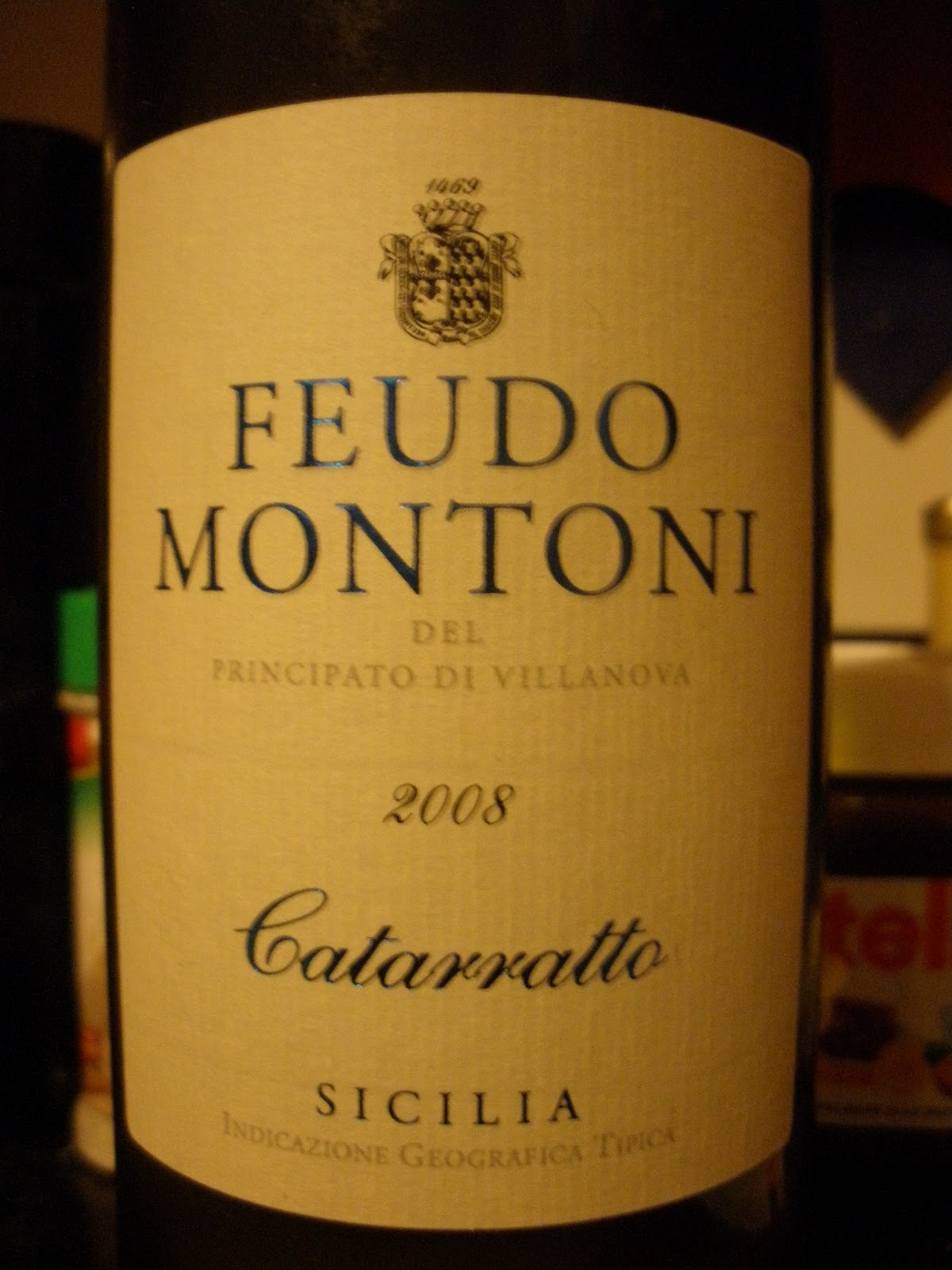
I don't know which one was in the bottle of Catarratto that I was able to find, but the odds suggest that it's probably Catarratto Bianco Comune.  I picked up a bottle of the 2008 Feudo Montoni Catarratto locally for about $20.  In the glass the wine was a fairly deep lemon-gold color.  The nose was nicely aromatic with green apple and apple pie filling aromas with some pineapple tropical fruit notes.  On the palate the wine was medium bodied with medium acidity.  There were flavors of baked apples and apple cider with a touch of lemony citrus.  The finish was bitter with a powdery, chalky kind of edge to it.  The cidery notes kept getting stronger as the wine stayed open, making it harder and harder to drink.  Overall, I didn't care for this at all.  Even taking into account that it is probably just a little past its prime, the flavors here were too one dimensional and the chalky texture was so unpleasant that it became a struggle to get through this bottle.  I'm always wary of writing a grape off due to one bad bottle, so I'll keep my eyes open for something a little fresher and will post a review if I come across anything.

Thursday, January 5, 2012

Uva di Troia (Nero di Troia) - Castel del Monte, Puglia, Italy

You might be inclined, upon seeing the name of today's grape, to assume that it has something to do with the ancient city of Troy.  "Troia" is right there in the name, you might say, so there must be some connection between the two.  While you wouldn't be alone in thinking that, you also wouldn't be correct.  It seems to happen a lot in the wine world (and beyond) that someone takes a quick look at a word and uses their intuition to come up with an explanation for it rather than doing any research.  In actuality, the name of the grape most likely comes from a town named Troia in Puglia which is west of the town of Foggia in the northern part of the region, which isn't nearly as exciting as a reference to the ancient city of Troy, but sometimes facts can be pretty boring.

It is thought that Uva di Troia came to Puglia via Greece several thousand years ago.  The name of the game in Puglia has traditionally been high volume bulk wine production so over the years growers would select certain vines that had larger grapes with more clusters to replant in their vineyards in order to increase the amount of juice that each vine could produce.  This kind of clonal selection in the field has result in a handful of distinctive clonal variants that differ primarily in the size of the grape and the compactness of the bunches.  As you might expect, those clones with very large berries tends to produce inferior wine.  The obvious reason is that the juice is less concentrated on these vines and the wine is dilute and lacking in flavor.  The less obvious reason is that Uva di Troia has a tendency for its bunches to ripen unevenly and the larger berries of certain clones cause the bunches to be more compact, making it difficult for some of the grapes closer to the center of the bunch to ripen completely since they are shielded from the sun.  These underripe grapes are tossed into the fermentation vat along with everything else where they contribute harsh tannins and acid to the finished wine.  Clonal variants with looser clusters and smaller berries are generally preferred for quality production, as the juice is more concentrated and the berries ripen more evenly and completely, making for a less harsh wine.

The grape is somewhat noteworthy for just how average it is across the board when you look at its viticultural characteristics.  It's fairly resistant to a wide variety of diseases, it yields fairly abundantly (depending on which clone is planted) and it isn't prone to dropping clusters or berries during the growing season.  It tolerates the heat of Puglia fairly well and while it's a fairly late ripener, that's not a big problem in the warm, dry Puglian climate.  Increasingly, however, plantings of Uva di Troia are on the decline.  It seems that Uva di Troia isn't quite as user friendly as the other Puglian stand-bys, Negroamaro and Primitivo, either in the vineyard, the winery or the marketplace.  Further, the DOC regulations for the most important region for Uva di Troia, Castel del Monte, are set up in such a way that use of the grape in the DOC wine isn't necessary.  The regulations stipulate that the wine must contain Uva di Troia and/or Aglianico and/or Montepulciano with up to 35% of non-aromatic red grapes added.  What that means is that a red wine from Castel del Monte can be 100% Uva di Troia, 100% Aglianico, 100% Montepulciano or any blend of the three grapes with over 1/3 of the blend allowed to come from virtually any other red grape.  There are a handful of other DOC regions that have Uva di Troia as the primary grape, but Castel del Monte is by far the most important economically and since there is no incentive for growers or winemakers to use the grape, many are moving away from it to the more recognizable Aglianico and Montepulciano grapes.

Fortunately, there are still some wines made from the Uva di Troia grape.  The Rivera winery is one of them and I was able to pick up a bottle of their 2003 "Il Falcone" bottling for about $33.  The wine is 70% Uva di Troia (called Nero di Troia by them, and supposedly made up of three different clones) and 30% Montepulciano.  The wine is from the Castel del Monte DOC, which is named for an octagonal castle in the area that was built by Frederick II in the 12th Century.  Frederick was apparently a big fan of hunting with Falcons, which is how "Il Falcone" got its name. In the glass the wine was a very deep purple-ruby color that was  opaque nearly all the way out to the rim.  The nose on the wine was very reserved with purple fruit that had a blackcurrant character to it with a hint of smoke.  On the palate the wine was on the fuller side of medium with medium acidity and medium tannins.  There were flavors of ripe black cherry and blackberry fruits with smoke, leather, tobacco, cocoa and cassis.  This is a dark and brooding wine with ripe fruit flavors that are held in check by the rich, earthy flavors.  This is very well balanced, very deep and very interesting.  It's hard to call a $30 bottle of wine a value, but if I had paid $50 for this wine, I still would have felt like I got my money's worth out of it.  It's a really fascinating, deep, complex wine that would be an ideal companion for game or grilled meats.  It's probably as good as Uva di Troia gets so if you happen to run across it, definitely give it a shot.

Wednesday, January 4, 2012

Grillo - Sicily, Italy

When researching grapes for this blog, I occasionally stumble over interesting stuff completely by accident.  In the case of today's grape, Grillo, I was simply looking online for a picture of some grapes that I could use to decorate the post with.  It's usually sufficient to enter the name of the grape into a Google image search to get what I'm looking for, but occasionally there are some surprises.  When I entered Grillo into the search today, I got back pages and pages of pictures of all kinds of crickets because, apparently, grillo is the Italian word for cricket.  So, for those of you like me who do not speak any Italian, there's your word for the day.  As for why the grape is known as Grillo, I have no idea.  Nobody who writes about the grape seems all that interested in the fact that the grape's name also means cricket, so my guess is that it's probably just a coincidence.  Nothing about the grapes or the vines look like a cricket to me and, as far as I know, crickets don't eat grapes, so I'm out of ideas as to the source of the name.

It turns out that exactly where the grape comes from is a bit of a mystery as well.  The most popular explanation online is that the grape came to Sicily via Puglia.  Nicolas Belfrage, in his Brunello to Zibibbo is doubtful about this since there doesn't appear to be anything like Grillo at all in Puglia.  Further, those who champion this explanation believe that the grape came to Sicily only after phylloxera struck the Italian vineyards, which would mean that it has only been grown on Sicily for about 150 years at the most.  I'm skeptical about this since another factoid given out about Grillo is that it was the basis for the famous Roman wine called Mamertino, which was a favorite of Julius Caesar.  One assumes that the ancient Mamertino wine was made around the area of Mamertino, which is itself on the island of Sicily, so if it is true that Grillo is the base of the Mamertino wine of old, then we have to posit that Grillo has been on the island of Sicily for several thousand years.  It is, of course, unbelievably difficult to match modern grapes to historical wines, so that's not exactly a smoking gun, but Belfrage's observation about the lack of similar grapes in Puglia seems pretty damning to me.  His theory is that the grape came to Sicily with the Phoenicians thousands of years ago, but given that Grillo's parents are listed on the VIVC as Muscat of Alexandria and Catarratto, which is thought to be native to Sicily, it seems more likely to me that Grillo was born on Sicily at some point in the distant past.

Grillo is particularly well suited to the Sicilian climate as it is very tolerant of high temperatures and dry conditions, which Sicily has in abundance.  Further, the grape is capable of reaching fairly high sugar levels when ripe, which was a major boon when it was the primary grape used in the production of Marsala.  Marsala, as some of you may know, is a fortified wine produced on the island of Sicily that is made in a way that is similar to Sherry.  The Sicilian name for what the Spanish call the solera system is in perpetuum.  In the late 18th and early 19th Centuries, Marsala was a big deal on the international wine scene, but demand for it has fallen even more precipitously than for the fortified wines of other areas such as Madeira, Port and Sherry.  For the most part, the Marsala of today is industrially produced and is good for little more than use as a cooking wine.  There are some artisan producers still making quality Marsala, but it is very difficult to find.

Grillo was once fairly widely planted, but as you might expect, once demand for the principal wine produced from it began to fall, acreage devoted to the vine began to decline as well.  It's also not exactly a prolific yielder, so as the process for Marsala production began to shift over to a bulk, industrial process, Grillo was uprooted in favor of the Catarratto grape, which yields more productively and reliably.  The low point for Grillo came in the early 1990's when acreage devoted to the grape fell below 5,000 acres.  Plantings have rebounded lately as the popularity of dry white table wines has increased over the past twenty years or so, and growers and consumers have found that Grillo can make interesting, characterful table wines.

I was able to find two wines made from the Grillo grape.  The first was the 2008 Corvo "Terrae Dei" which I was able to find for about $12.  In the glass, the wine had a medium lemon-gold color. The nose was shy with a little bit of lemon and pear, but not much. It picks up a little funky leesy, cheesy kind of aroma as it approaches room temperature, but it never really gets that strong.  On the palate the wine was on the fuller side of medium with medium acidity.  The sensation was of light, delicate fruits like lemon, lime, green apple and creamy pear.  The leesy kind of flavor persisted a bit onto the palate as well, providing an interesting, slightly cheesy and funky kind of flavor that picks up as the wine approaches room temperature, but never gets out of control.  I was a little concerned when I bought this bottle that it might be in the midst of its decline, and I think I was probably right.  It's drinking OK right now, but the fruit flavors are definitely in full retreat here.

Luckily I was able to find a bottle of the 2009 Ca' di Ponti Grillo from my friends at the Gypsy Kitchen for about $10.  In the glass, the wine was a fairly pale silvery lemon color.  The nose was very aromatic with melon, green apple, pineapple and grapefruit aromas.  It was like a fruit cocktail leaping out of the glass.  On the palate the wine was on the fuller side of medium with medium acidity.  There were flavors of creamy pear and melon with some banana and lemony citrus.  The fruits were much more muted on the palate than on the nose, which surprised me a little bit.  I have in my notes that the overall flavor profile was "broad," which, to me, means that the acid is fairly muted and the wine has almost a kind of creamy mouthfeel.  A broad wine has more acidity than a "flabby" wine, but it's still on the lower side of balanced.  I'm a sucker for a high-acid white wine, so this didn't really do it for me, though it is a very nicely made wine and at only $10 a bottle represents a very good value.  Those looking for a substitute for Chardonnay will find a lot to like here, but I just need more zip in my whites than this wine can provide.

Bonus factoid for those of you who read all the way to the end: Grillo is unusual in that it only has one known synonym.  The grape is also known as Riddu in some places, though the Palomino Fino grape has Grillo as one of its accepted synonyms.  Most grapes pick up dozens of synonyms as they move through different regions (see Chasselas and its 200+ different names), but Grillo only has the one.

Wednesday, December 21, 2011

Pugnitello - Tuscany, Italy

When I'm out shopping for unusual wines for this website, there are a few sections of most wine shops that I linger in, and a few sections that I blow right through.  I usually blow through the South American section, for example, because for the most part, I know exactly what I'm going to find there.   The South American sections of nearly every wine shop on earth are laid out the same way with the same kinds of wines in them and I know that the likelihood of me finding something unusual is pretty slim.  I tend to linger a little longer in the Italian sections of most shops and really pay attention to what they have because the chances of my finding something unusual in the Italian section are much higher than they are for pretty much any other section in the store.

Some of the larger shops have their Italian sections broken up into smaller, region-specific sections as well, and there are some parts of Italy that I really linger over and some parts that I blow right by.  I really dive in to the sections devoted to the wines of Piedmont (or anywhere in northern Italy, really) and Sicily in particular, but the region that I find that I skip over the most is Tuscany.  It's certainly not because I don't love wines from this region, it's just that for the most part, Tuscany's wines are very mainstream and the grapes that they use for nearly all of the wines are very well known.  I've been dying to try a wine made mostly from some of the supporting players in Chianti like Colorino or Canaiolo, but so far haven't had any luck in finding one.  The DOC reds are almost all made from Sangiovese of one form or another while the IGT wines are nearly all some blend of Sangiovese, Cabernet Sauvignon and Merlot.  I am a big fan of these wines at my dinner table, but for the purposes of this website, Tuscany doesn't provide me with a lot of material.  To date, I've only written about one wine from Tuscany, a Teroldego/Syrah blend that was very nice, but which has proven to be an extreme outlier in the world of Tuscan wine.

Which is too bad, because it turns out that there are a lot of grapes that are native to Tuscany that may be of some interest to the wine world.  In the 1980's, a group of researchers got together with the aim of identifying and preserving what was left of the native grape population throughout Tuscany in an attempt to stave off the selective extinction of a large number of heirloom grape varieties.  They visited 500 estates throughout Tuscany and identified 229 different grapes that were growing throughout the region.  They took samples and planted 18 vines of each of them in an experimental vineyard property owned by the San Felice winery called "Vitiarium."  A large number of the vines produced grapes that were of no commercial or viticultural interest, but a few of them showed some potential.  In 1990 the researchers selected 13 of the most interesting vines and made small lots of wine from the grapes produced at Vitiarium.  Of those 13, a grape called Pugnitello quickly established itself as the star of the show, and the San Felice winery planted 1000 cuttings of the vine for more large-scale experimentation.  The first commercial bottlings were made in 2003 and have been made each year except for 2005.  In many cases, the governmental authorities are slow to recognize new discoveries like Pugnitello, but in 2002, the Italian Ministry of Agriculture put Pugnitello in the National Registry of Vine Varieties, and in 2003 the Tuscan  Regional Commission approved Pugnitello for use throughout the region.  As of today, only a few wineries other than San Felice are making a varietal Pugnitello, but it is happening.

The original Pugnitello vine had been found in a vineyard near the town of Cinigiano, which is just southwest of Montalcino in Tuscany.  The owner of the vineyard site had no information about the grape itself and there doesn't appear to be any record of the grape in any previous ampelographical work.  The name Pugnitello was given to the grape because the clusters resemble little balled up fists (pugno, in Italian).  The researchers conducted DNA testing on the grape and have thus far found no genetic links to any other existing grape varieties.  It's easy to imagine how the grape could have been overlooked in the past.  From a grower's perspective, it doesn't have much to recommend it.  The clusters are very small and the berries themselves are on the smallish side with thick skins.  The vine is also a naturally low-yielder, so pretty much any way you look at it, it doesn't look like a very profitable vine to grow.

Except for the fact that it makes really interesting wine.  On the consumer end of things, we often think that this should really be the only consideration given when one decides to plant and tend to the vine, but in reality, good wine is not always profitable for the grower, and it's all too easy to see how over time growers would abandon low-yielding, unreliable vines that make excellent wine for higher yielding varieties that make an inferior product, but make more of it and make it more reliably.  Those of us interested in characterful, interesting, different kinds of wines owe a great debt to growers and researchers who are committed to discovering and maintaining the great diversity of vines, whether their efforts pay off with a discovery like Pugnitello or not.  The world could very easily shift over to the major ten or so major grape varieties tomorrow without too much gnashing of teeth from the wine drinkers of the world, but part of what I really love about wine is its variety and the seemingly inexhaustible supply of grapes as source material.  I am grateful when I hear about discoveries like Pugnitello because I'm certain that the discovery won't lead to any kind of major financial windfall for its discoverers, but the fact that they were curious enough to go out and find something like Pugnitello and make wine from it just so that they could see what might happen really excites me.

I mentioned yesterday that my friend Joe Godas over at Curtis Liquors in Weymouth invited me to his back room to sample a Mavrotragano from Santorini, Greece, he had been given.  As he mentions in the comments to that post, his disappointment was as great as mine was at how the Mavrotragano turned out, but little did I know that he had a backup plan.  Joe hadn't told me about the Pugnitello before I showed up, but given the Mavrotragano's poor showing, he was gracious enough to open a bottle of the 2006 San Felice Pugnitello da San Felice that he had also been given as a sample bottle.  I'm not sure about the SRP, but online prices for this wine seem to be somewhere between $36 and $60. In the glass, the wine was a deep purple ruby color with a medium purple-crimson rim.  The nose was somewhat reserved with savory leathery funk over a bit of red cherry fruit.  As the wine opened up a bit, some darker, blacker fruits started to show up as well.  On the palate, the wine was medium bodied with fairly high acidity and medium tannins.  There were ripe cherry fruit flavors with a bit of blackberry, leather, cocoa and espresso.  The wine walked the line between dark, ripe fruits and savory, earthy flavors extraordinarily well.  It was a bit closer to Brunello than Chianti in style, but really walked the line between the two nicely.  This is a very very good wine and it was universally preferred amongst the local distributor's and customer's in Joe's back room to the flashier, oakier Mavrotragano that had preceded it.  Yes, this wine sees some new oak, but it's much more integrated here and it gives the grape a chance to express itself in the glass.  If you run across this rarity, I'd definitely recommend it to you not only for the great story, but also for the great wine you'll find in your glass.

Tuesday, December 20, 2011

Mavrotragano - Santorini, Greece

It doesn't happen all that often, but it does occasionally happen that I will get an invitation from someone familiar with this site to sample an interesting bottle of wine that I wouldn't ordinarily have access to.  In today's case, what happened was that Joe Godas, the head wine guy over at Curtis Liquors in Weymouth, received a sample bottle of a wine made from the Mavrotragano grape that he invited me to his shop to try out.

Mavrotragano has been on my radar since I picked up a few bottles of wine made from the Mandilaria grape on the island of Santorini in Greece.  In doing the research for those wines, I came across the following passage in Konstantinos Lazarakis' excellent book, The Wines of Greece: "...in terms of quality, it [Mandilaria] is totally eclipsed by the much rarer Mavrotragano...[which] can be Greece's answer to Mourvedre."  I rather enjoyed the Mandilaria that I was able to try, so I was very intrigued by the notion that the little blending partner in the wines I had may be the real star.  I tried to track down a bottle made mostly from Mavrotragano grapes, but it turns out that very few bottles are actually made and not very much of it finds its way to US shores.  The producer for the bottle that I was able to try only makes about 500 cases per year, just to give you an idea.

And, frankly, it's something of a miracle that even that much is made today.  Nearly a century ago, Mavrotragano was relatively common throughout the island of Santorini, but what was grown was typically used to make a sweet red wine for the growers themselves that generally wasn't bottled or sold to the public.  Through the years, a handful of circumstances began to line up that nearly sounded the death knell for the grape.  First of all, Santorini is an absolutely gorgeous place and as the island began to develop something of a reputation amongst tourists, new places for the tourists to stay needed to be built.  Many vineyards were torn up to make way for the hotel building blitz undertaken to keep pace with Santorini's rise in stature as a tourist destination.

This was a problem, but there were still plenty of vineyards around Santorini where Mavrotragano could have been planted.  The trouble was compounded, though, by the belief that Santorini was not an appropriate place to try and make red wine due to its somewhat erratic climate and the incredibly powerful winds that tear across the island's surface.  Historically, the island has been best known for its white wines made from the Assyrtiko grape, and its reputation in the wider wine world has been rising rapidly over the past few decades on the strength of the wines made from that grape (it doesn't hurt anything that it's  usually pretty hot on Santorini and the white wines made from Assyrtiko are very refreshing, much more so than a red wine would be, and a major market for the wines made here are the tourists looking more to unwind than to explore the island's vinous range).  Further, Assyrtiko is easier to grow in the difficult conditions on Santorini than Mavrotragano, and many growers uprooted their Mavrotragano plantings for new Assyrtiko plantings in greater and greater numbers through the years until Mavrotragano occupied less than 2% of the vineyard land by the year 2000. 

As happens in so many places, though, there were a certain number of growers whose curiosity and experimental spirit wouldn't allow them to be content with the one-dimensional view of Santorini wine that had begun to take hold.  A few of them looked to the native red grapes that they had on the island and saw that Mavrotragano might have some potential.  There were some experimental trials run in the late 1990's that began to show promise, and a few estates began to plant over small vineyard sites to the Mavrotragano grape.  Production is still small, but there is a buzz growing about these wines in the international community that seems to indicate that Santorini may have found a red star to complement its already famous Assyrtiko.

As mentioned above, the wine that I was able to try was a sample bottle.  I tasted the wine with Joe and a few other locals in a back room at Curtis Liquors following a public tasting of some Italian wines that the shop had put on.  The wine was from the 2008 vintage and was from the Domaine Sigalas, who apparently has about 8 hectares of land devoted to the Mavrotragano grape. I'm not entirely sure what the SRP is for this bottle, though Decanter has it listed at £12 in the UK market. In the glass, the wine was a deep crimson ruby color that was opaque in the center to a narrow crimson rim. The nose was nicely aromatic with spicy blueberry, blackberry, black cherry and boysenberry fruits with a touch of smoke to them. The nose was very deep with a lot of interesting fruit aromas. On the palate, the wine was on the fuller side of medium with medium acid and medium tannins. The flavors were very ripe with rich black and blue fruit flavors throughout. There were flavors of blueberry pie, black cherry and blackberry with some baking spice and chocolate and a touch of black pepper. The oak influence was incredibly pronounced here, and the back label confirmed what a lot of us in the room were picking up on. The wine spends 18 months in new oak, and it wears it very loudly. The wine wasn't necessarily bad, but I know that I was somewhat disappointed that so much oak was applied to the wine, as it really masked what might exist for varietal character or any real sense of place. Instead, the wine came across as most similar to a California Zinfandel or an Aussie Shiraz, an overripe fruit bomb (14% abv for those interested) slathered in new oak that can be enjoyable in its own way, but which is interchangeable with any number of other bottles.  Oak tastes like oak no matter what and it's disturbing to see something so rare hidden behind all that make-up.