A blog devoted to exploring wines made from unusual grape varieties and/or grown in unfamiliar regions all over the world. All wines are purchased by me from shops in the Boston metro area or directly from wineries that I have visited. If a reviewed bottle is a free sample, that fact is acknowledged prior to the bottle's review. I do not receive any compensation from any of the wineries, wine shops or companies that I mention on the blog.

Monday, April 2, 2012

Grechetto - Umbria, Italy

I mentioned in my last post that I occasionally am able to learn some interesting things just by entering the name of the the grape I'm trying to research into a Google image search.  Today, for example, I learned that there was a 17th Century Italian painter named Giovanni Benedetto Castiglione who was known as Il Grechetto, according to Wikipedia, because of the "classic air of his pastoral depictions," whatever that means.  Those of you up on your Art History may also know that there was a Spanish painter known as El Greco, who, it turns out, died when Castiglione was about five years old.  El Greco's real name was Doménikos Theotokópoulos, which, as you can tell, is definitely not a Spanish name, so no prizes for guessing where his nickname came from.  He signed many of his paintings Δομήνικος Θεοτοκόπουλος, which is his name in Greek script.


None of which really has anything to with wine grapes.  The only similarity that the grapes have with the painters is that, like El Greco and Il Grechetto, the Greco and Grechetto grapes are not related to one another at all. Many people believe that the Grechetto and Greco grapes must be related to one another given the similarity of their names, but it doesn't look like that's the case (or if it is, no one has stepped forward with any proof).  The similarity of their names is due to the fact that both grapes are thought to have originated in Greece and been brought over to Italy at some point in the fairly distant past, though I've not yet seen any evidence to support this claim.  I've looked for studies linking either of these grapes to grapes currently grown in Greece and haven't been able to come up with anything.  Today Greco is mostly found in southern Italy around Campania while Grechetto makes its home a little farther north in Umbria with some plantings in Lazio and Tuscany.

There seems to be two distinct subvarieties of Grechetto: Grechetto di Todi and Grechetto Spoletino.  Grechetto di Todi seems to be the more widely grown of the two and has its own DOC within the Colli Martani region of Umbria, just southwest of Montefalco.  Grechetto has traditionally been known as a blending grape and is perhaps best known for its occasional appearance in the wines of Orvieto in western Umbria.  Grechetto can account for up to only 45% of the blend for Orvieto while Trebbiano (here called Procanico) must account for 40-60% and a grape called Verdello (which may or may not be the same as the Portuguese Verdelho) must account for 15-25%.  There is no minimum requirement for Grechetto, and some producers don't use any in their wines.  As the grape's penchant for making quality wine becomes more recognized, though, more producers are using as much Grechetto as they can.  There are a few other DOC areas that allow for a high percentage of Grechetto, but most of the varietal Grechetto's that I've seen end up being bottled under the Umbria IGT designation since most of the DOC wines only allow for a maximum of 85% Grechetto.  Producers interested in making a 100% Grechetto have no option other than the Umbria IGT designation.  The grape is also widely used in late harvest dessert wines and Vin Santo production because it has especially thick skins that are better able to survive the extra time on the vine without succumbing to fungal infections.  

I was able to find two different wines made from the Grechetto grape.  The first was the 2007 Argillae Grechetto from Umbria which I picked up from my friends at Curtis Liquors for about $18.  In the glass, this wine was a medium golden lemon color.  The nose was fairly intense with aromas of buttery nuts, ripe red apples and lemony citrus.  It smelled a little oaky and a little leesy, but both aromas were pretty well integrated.  On the palate the wine was medium bodied with medium acidity.  There were flavors of ripe apple and pear with a touch of lemon.  There was also a faint nuttiness and a distinct dairy-ish, cheesy kind of funk to it.  I would have guessed that this wine saw some oak at some point, but the winery's website makes no mention of it.  The wine has definitely undergone malolactic fermentation, which is why the acid seemed kind of blunted here and why there was a distinctive dairy note.  This wine was probably little past its prime and made in a style that I don't naturally gravitate towards, so it's hard for me to recommend it.  It's not exactly a bargain at nearly $20 a bottle, but fans of moderately oaked Chardonnay may find a lot to like here.

The second wine that I tried was the 2010 San Clemente "Verdeaura" Grechetto from Umbria.  This wine came to me from Paul Turina, an importer located in Portland, Maine, who stopped by my house last week to drop a few samples off.  I'll be profiling Paul and some of his selection in greater detail a bit later this week.  As always, what follows is my honest impression of the wine I tasted.  I have not been compensated in any way other than with the sample bottle and do not have any commercial association with Turina Italian Wines or any of its partners.  In the glass this wine was a very pale silver which was as close to water white as I've ever seen in a wine.  The nose was fairly intense with peach, pineapple, lemon and green apple fruits.  It was really a delightful wine to smell.  On the palate the wine was medium bodied with fairly high acidity.  There were juicy, ripe peach and pineapple flavors with pink grapefruit and lime citrus with a hint of stony minerality on the finish.  Paul tells me he gets something a little buttery out of this wine and enjoys it with lobster.  I'd drink this with just about anything as I thought it was an exceptional wine that was intensely flavored but very well balanced.  It was honestly one of the better white wines I've had in some time, which came as a real surprise to me since I've never been a big fan of Orvieto and didn't care much for the Argillae above.  If any distributors are reading this, Paul is looking for representation outside of the state of Maine so please contact him through his website so that more people can experience this wine and some of the others in his portfolio.  I'll be reviewing a Sagrantino from this same producer later this week so be sure to stay tuned for that.

Friday, March 30, 2012

Verdelet - Finger Lakes, New York, USA

Entering words blindly into Google image search isn't always a wise idea.  There isn't usually a lot of overlap between grape names and tawdry photos, but I do occasionally get some racy results.  Other times, I find out that there's a weird kind of synonymy between the grape I happen to be researching and some random thing in the world.  Today, for example, I found out that there is apparently a character named Verdelet in a video game called Drakengard who "is a pious man who is always careful of his words and of doing the right thing, but places himself first should the situation becomes dire."  Sure, I could eliminate these kinds of results by always including the word "grape" in my searches, but sometimes those wrong results can shed some interesting light on how a grape may have gotten its name, like with the Trousseau grape.  Most of the time, though, those wrong turns just end up at dead ends like the pious, self-interested Verdelet of Drakengard who, I think we can safely assume, has nothing to do with today's grape.

Today's grape is Verdelet and it is a hybrid grape that was created by the great French hybridist (hybridizer? hybridder?) Albert Seibel, who we've mentioned in passing in a few posts around here but who we've never really taken a good, detailed look at.  Seibel lived from 1844 - 1936 and was a physician by trade.  Those of you who are up on your vinous history will note that Seibel was a young man through the heart of the Phylloxera epidemic, which really started to become a noticeable problem in France around the 1860's.  Once it became known that native American vines were the source of the louse and, further, that the native American vines seemed to be immune to it, one of the proposed solutions to the scourge was to create hybrid grapes by crossing native European vines and native American vines.  This solution was successful, but was not ultimately the answer to the problem since the resulting hybrid vines were unable to produce wines that were qualitatively similar to the native European vines.  But just because it wasn't the ultimate solution doesn't mean that it wasn't a viable (and profitable) solution in the short term, and Seibel ended up creating a company that was focused on developing new hybrid grape varieties.

Seibel and his group ultimately created over 16,000 different hybrid grapes and had as many as 500 of those available for commercial cultivation at one point.  While nowhere near that many are still cultivated today, it is shocking how many are still planted and made into wine.  One might wonder why anybody would bother with these vines since the Phylloxera louse has been rendered virtually obsolete by the technique of grafting European vines onto native American rootstocks.  The answer is that many of the hybrids created are also tolerant of more extreme climactic conditions, especially cold conditions, such as those found in the northeastern or mid-western United States or in the UK.  Further, they tend to be quite disease resistant and also tend to yield generously.  For climactic regions that are too harsh for the cultivation of vinifera species, the French hybrids that Seibel and others like him created are a good second choice.  Even though the wines made from them aren't as interesting or complex as wines made from vinifera grapes, they are much better than the foxy, ultra-sweet wines made from native American grapes.

When I visited the Finger Lakes region of New York recently, I came across a wide variety of hybrid grapes, many of which were created by Seibel.  Verdelet, also known as Seibel 9110, is certainly one of them, but Chancellor, Chelois, De Chaunac and Vignoles were also well represented.  Grapes like Aurore, Rougeon, and Rosette are also relatively well represented in other parts of the US, Canada and the UK, while the Plantet grape still covers quite a bit of ground in the Loire Valley in France.  Verdelet is one of the less common Seibel grapes, and as a result, specific information about it is limited.  As you can see from the picture above, the grapes are nearly clear when ripe with little green pigmentation their skins.  Most nurseries that offer the vine for sale indicate that it is mostly used as a table grape, and a very productive one at that.  In a book on wines from British Columbia in Canada, the author gives an anecdote about a producer who obtained 120 tons of fruit from only 6 acres of land planted to Verdelet.  Acreage devoted to the grape is declining pretty much everywhere, though it is apparently still fairly popular in Texas.

While in the Finger Lakes, I only came across a single wine made from the Verdelet grape.  It was made by Bully Hill Vineyards, who we've had some dealings with before around here, and it was a NV wine that I picked up for about $8 in their tasting room.  In the glass, this wine was a medium lemon gold color.  The nose was moderately intense with aromas of pear, ripe apple, grapefruit and a bit of peachy stone-fruit.  On the palate the wine was on the lighter side of medium with high acidity.  The label says the wine is dry but I found it to be just off-dry.  There were flavors of lime citrus, peach and grapefruit that were tart and zippy.  It wasn't a particularly complex wine, but the flavors were bright with a nice intensity.  It reminded me a little bit of Riesling, though without the depth and concentration that good Rieslings can have.  Overall, I was very pleased with this wine, especially at only $8, and would be eager to try it again the next time I find myself in the area.  It was definitely the best thing that I tried from Bully Hill, though that isn't exactly saying a lot.  Bully Hill makes a ton of different wines (I mean a ton) and I tried only a few while I was there (for the reasons why, see this post on the St. Croix grape).   For the most part, the quality of wines made here isn't that great, but this wine and the Chardonel I wrote about last week were were pleasantly surprising.  The Verdelet isn't listed on their webpage, for some reason, so I don't know what kind of availability they usually have, but if you happen across it, it's definitely worth a try.

Thursday, March 29, 2012

Pignoletto - Emilia-Romagna, Italy

My first exposure to the Pignoletto grape was in the dimly lit tasting cellar at the Wine Bottega in the North End of Boston.  The Bottega had invited Alberto Tedeschi, a winemaker from Emilia-Romagna, to come over and present his wines, all of which are made from the Pignoletto grape.  It's not often that I am able to meet the person who makes the unusual wines that I buy, so this was a real treat.  I found the wines and the man very interesting and picked up a couple of bottles that we'll get to in a bit.  First, though, I'd like to take a closer look at Alberto's grape of choice, Pignoletto.

The Pignoletto grape is considered the "king of the Colli Bolognese wine zone," but few have heard of it outside of this region.  The grape is grown on over 17,000 acres of land in Italy, but it can be very difficult to find wines made from it here in the US, and in fact I've not been able to find another wine made from Pignoletto other than these Tedeschi bottles.  For some reason, wines from the Emilia-Romagna region within Italy, other than Lambrusco, can be difficult to find in general.  Today's post marks only the second time I've written about a wine from Emilia-Romagna (the first was Mostosa/Pagadebit), and I only have two or three more in my cellar that I hope to write about in future posts.  There are a lot of really cool grapes grown in Emilia-Romagna, but for some reason, few of them make it to us over here.

Unfortunately, information about the grapes from Emilia-Romagna is about as scarce as the wines themselves. Wikipedia has no entry for the grape and the Oxford Companion to Wine's entry reads in full "lively, crisp white grape grown around Bologna in northern Italy on an area totalling almost 7,000 ha/17,300 acres according to the 2000 vineyard census." What information I've found is scattered on various sites online.  Some of those sources indicate that Pignoletto is the same as the Grechetto grape grown primarily in Umbria, but I don't believe that's the case.  The VIVC does list Pignoletto as an accepted synonym for Grechetto, but it also has a separate listing for Pignoletto itself, so I believe that the Pignoletto grown in Emilia-Romagna is distinct from Grechetto.  The name Pignoletto probably comes from the word pigna, which means "pine cone" in Italian, which is the same root as the red Pignolo grape grown in Friulia, though the two grapes are not related.  In both cases, the name comes from the fact that the bunches of grapes produced by the vines resemble pine cones.  Some believe that the Pino Lieto referenced by the Roman writer Pliny is the same as the modern Pignoletto, but as we've found before, linking Roman grape names to modern grapes is a virtually impossible task.  The grape is unusual in that it has very thick skins which are very high in tannins so most white wines made from the grape are pressed very lightly and moved away from the skins as soon as possible in order to avoid too much tannic extraction into the wine.

Alberto Tedeschi leases several small vineyard sites, a one hectare site called Spungola and another small site called Bellaria, that are devoted entirely to the Pignoletto grape.   He farms organically and does all of the vineyard work and cellar work himself.  He uses natural yeasts for his fermentations and doesn't fine or filter his wines.  The first wine of his that I tried was the 2007 "Spungola Bellaria," which is his still wine that is named for his two vineyard sites.  I picked this up from the Wine Bottega for about $20.  For this wine, Alberto presses the grapes very gently and leaves the juice outside overnight.  He then transfers the juice to stainless steel containers and allows the natural fermentation to occur over a 3-4 day span.  He then racks the fermented wine into neutral oak containers where the wine ages for at least 12 months on the lees.  In the glass, this wine was a deep bronze tinted gold color.  The nose was reserved with apple cider, pastry dough and toasted nut aromas.  On the palate the wine was on the fuller side of medium with  fairly high acidity and a surprising little bit of a tannic grip.  There were flavors of toasted nuts and golden apples with a cidery kind of character to it.  It wasn't oaky, but did taste kind of woody, like sawdust or like cracked pecan shells or something like that.  It was definitely a bit oxidized, though that's almost certainly by design.  It was a very unique wine that is definitely not for those looking for squeaky clean, fresh white wines.  Fans of the oxidized white wines of the Jura will find a lot to like here.

The second wine that I tried was the 2008 Pignoletto Sur Lie, which is a frizzante wine made from Pignoletto grapes, which I picked up from the Wine Bottega for about $25.  For this wine, Alberto ages the wine on its lees for at least a year in stainless steel containers.  He bottles this wine with a bit of unfermented must which he had kept refrigerated, and the sugar in the unfermented must causes a secondary fermentation in the bottle giving the wine its fizzy character.  In the glass, this wine was a deep golden bronze color with light fizz and some cloudy sediment floating around.  The nose was fairly aromatic with ripe cidery apples, apple peel, nuts and sweet yeast rolls.  On the palate the wine was medium bodied with medium acidity and light fizz.  There were flavors of toasted nuts, ripe apples and apple cider with a bit of a yeasty character to it.  It too is a bit oxidized, though not to the same degree as the still wine.  The wine needs to be carefully served as the cloudy sediment is bitter and the less of it that ends up your glass, the better.  It is a very unique wine that is difficult to compare to anything else I've had.  Tedeschi only farms about 2.5 hectares of land in total so the quantities for these wines are limited, but they're distinctive and interesting enough that I'd definitely recommend more adventurous wine drinkers seek them out.  Even if you've had wines made from the Pignoletto grape before, you've probably not had one quite like either of these two.

**UPDATE** I recently was able to try a more traditional wine from the Pignoletto grape and my tasting note can be found in this post.

Tuesday, March 27, 2012

Pecorino - Offida, Marche, Italy

Confusion is usually the first thing that people experience when confronted with the Pecorino grape for the first time.  "Isn't Pecorino the name of a cheese?" many ask, and, of course, they're right.  Pecorino Romano is the name of a famous sheep's milk cheese made in the Latium and Sardinia regions of Italy, while the Pecorino we're concerned with here is a grape grown on the other side of the Italian peninsula in the Marche and Abruzzo regions.  One might be inclined to wonder if the grape and the cheese had something in common given their identical names and the answer is, kind of.  Both are derived from the same word, pecora, which means "sheep" in Italian.  Pecorino Romano (and Pecorino Toscana and Pecorino Sardo) is so named because it is a sheep's milk cheese.  The Pecorino grape is so named not because of any kind of direct link to sheep, but because it is said that sheep particularly enjoyed eating the grapes while they were being driven through vineyards from pasture to pasture.

Whether the story of the grape's name is true or not isn't really all that important, but it does give us some idea of how long the Pecorino grape has been around.  Sheep herding is something that is still done, but the kind of pastoral imagery that a story like that conjures up definitely makes me think of a much more distant past.  And while it is true that the grape itself is thought to be very old, wines made from the Pecorino grape date only to about the 1990's.  The story is shockingly similar to the story of the Pugnitello grape from Tuscany, with a slight twist.  While Pugnitello was found just growing in a field somewhere, Pecorino had a bibliographic history that dated back to at least 1871 and so it was known to researchers, but it was feared to be extinct.  Like so many grapes that have teetered on the precipice of extinction, Pecorino is a somewhat stingy yielder and over time many growers abandoned it in favor of more prolific vines like Trebbiano.  Growers make money on volume and Pecorino just wasn't able to sufficiently deliver.

In the early 1980's, a man named Guido Cocci Grifoni was doing research on native grape varieties on the eastern coast of Italy within the Marche region.  Like the researchers in Tuscany who discovered Pugnitello, part of his research was devoted to trying to save heirloom varieties from extinction, but he was also looking for more characterful grapes to make wine from than the local Trebbiano and Malvasia clones.  Rather than starting out by combing the fields, Grifoni and his team started going through the written records for the region and in the course of their research, they discovered the presence of a tiny vineyard on the right bank of the river Tronto which was located 1000 meters above sea level and was owned by an 80 year old man named Mr. Cafani.  Mr. Cafani's vineyard was purported to have a few struggling vines of the old Pecorino variety and when they visited the site in 1982, they took some of these cuttings home with them.

Grifoni grafted the vines onto modern rootstocks and began trying to grow the Pecorino grape in earnest.  The vines didn't give any substantial harvests until the early 1990's, and when they finally started producing usable grapes, Grifoni began experimenting with making wine from those grapes.  Encouraged by his early results, he planted more and more land to Pecorino.  Eventually he was making enough wine to sell, which he began doing in the early 1990's.  Since Pecorino was not an approved grape variety at that time, the first commercial wines featuring the Pecorino grape were sold as vino de tavola, which does not allow any vintage information, grape information or regional information on the front or back labels.  Grifoni campaigned for official recognition and received it in 2001 as Pecorino was finally allowed into the Offida DOC zone, where wines carrying the Offida Pecorino DOC designation must contain at least 85% Pecorino grapes.

Pecorino has roared back from the brink of extinction and is now grown not only in the Marche and Abruzzo, but also in Umbria and Lazio to the west.  It is a fairly thin-skinned grape that performs best at a slight altitude.  The grapes can be naturally quite high in sugar, which may help explain their attractiveness for the wandering sheep, and the wines produced from them are frequently in excess of 13% abv.  Luckily, the grapes are also blessed with naturally high acidity which helps to keep the alcohol in balance.  For those who are curious to learn more (and who can read Italian), somebody wrote a book about Pecorino called La Riscoperta del Pecorino: storia di un vitigno e di un Pecorino, which you can order here.

I was fortunate enough to find and try two different wines made from the Pecorino grape, both of them from the Offida DOC in the Marche.  The first wine I tried was the 2009 Saladini Pilastri Pecorino which I picked up from my friends at Bin Ends for about $13.  In the glass, the wine was a fairly light lemon gold color.  I tried this wine at the shop before I bought it and one of the salespeople there said to me "it tastes just like bananas!" which then promptly got into my head and wouldn't leave.  I gave myself a few months before I opened it at home, but that memory persisted and all I could smell or taste on this wine was bananas.  The nose smelled like bananas.  On the palate, the wine was on the fuller side of medium with fairly high acidity and tasted like bananas.  There was also some lemon, green apple and pineapple with a hard, steely kind of minerality to it, but the dominant flavor was still bananas.  Not even like fully ripe bananas either but like Laffy Taffy banana flavored candy, which I really don't enjoy.  I tried leaving my glass on the counter for a few hours but when I came back to it, it still smelled and tasted like bananas.  I read up on the grape to see if this was a common characteristic, and it certainly didn't seem to be, so I set about to track down another bottle for comparison's sake.

The second bottle that I was able to find was the 2009 Tenuta Cocci Grifoni "Colle Vecchio" Pecorino which I also picked up from my friends at Bin Ends for about $14.  This is the winery owned by Guido Cocci Grifoni who was responsible for discovering the Pecorino grape in the first place.  This wine is made from some of the original grafted vines and probably contains the oldest vine Pecorino juice available today.  If any winery could be said to make the benchmark Pecorino, surely this would be it.  The first bottle I bought was disappointingly corked, but Bin Ends replaced the bottle and the second was much better.  In the glass the wine was a pale silvery lemon color.  The nose was fairly reserved with some white pear and green apple.  On the palate the wine was medium bodied with fairly high acidity.  There were flavors of bright green apple, lemon peel and a lot of ripe, juicy pear.  The wine finished with a kind of chalky minerality.  It's not an assertively flavored wine, but it is well balanced and refreshing.  Fans of high acid whites should find a lot to like about Pecorino.

Friday, March 23, 2012

Chardonel - Finger Lakes, New York

Researching hybrid grapes can be brutally and mind-numbingly boring sometimes.  There are the occasional interesting cases of older grapes like Delaware, but the closer you get to the present day, the less interesting the back-stories for these grapes tend to be.  Generally speaking, these hybrids have been created in a laboratory setting in order to meet a specific need, such as cold-hardiness or disease resistance, and their status as engineered products puts off a lot of people who are seduced by the romance of nature in grapes and wine.  Most of the information that is published about these grapes reflects this utilitarian functionality and is aimed more for growers and for researchers than for consumers.  It tends to be loaded with descriptions about the vine's temperature preferences, disease resistance and susceptibilities, yields, and more physical description of each part of the plant than you would ever want to know.  There are few places to try and get a good narrative foothold since there's rarely any kind of mysterious back story or human angle in the grape's creation.  Sure, the grapes are ultimately made by people (scientists are people after all), but the creation stories for these grapes almost never focus on them, opting for information about their pedigree and behavior in the field instead, which ultimately ends up coming across as sterile and dull.  They're basically plant catalogs whose function is to convey a certain kind of information as simply and efficiently as possible.

This certainly isn't the case for all hybrids and crossings.  Some of the older hybrids and crossings are interesting because there is a distinct human element present in their story.  Grapes like St. Croix, for instance, which was created by an amateur in Wisconsin in his own back yard.  Or grapes that were created by people like Harold Olmo or Albert Seibel who were prolific in their efforts and were extraordinarily successful in creating a large number of grapes that are still somewhat widely cultivated today.  I like to think of these guys as mad scientists in flickering rooms cluttered with arcane equipment who are hell bent on unleashing their huge armies of Frankengrapes upon the world.  People like that are out of date now, though, as most grapes are created by teams of scientists at breeding institutions who are fortunate if any of their creations are ever made available for public use.  In the case of the Chardonel grape, the published paper announcing the grape's release has eleven authors on it, which should give you some sense of the collaborative effort required for its creation.  One man who creates a dozen grapes is interesting but a dozen people who create one grape is a different story altogether.

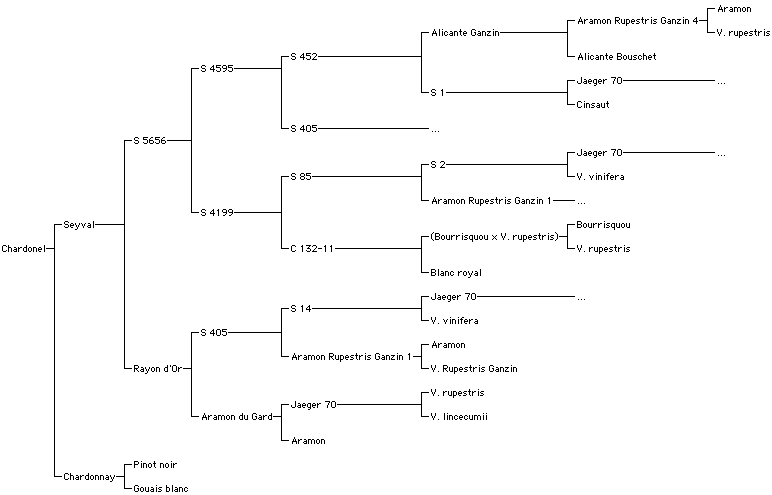
But Chardonel was created and it is available for commercial propagation.  Since I was able to track down a bottle of it, I'm going to tell you the most interesting things that I've been able to find out about it.  Chardonel was created at Cornell's New York State Agricultural Experiment Station in Geneva, NY, in 1953 from a crossing of Seyval Blanc and Chardonnay.  Seyval Blanc is itself a hybrid which is grown mainly in cooler climate regions like the Finger Lakes in New York and, surprisingly, in England.  The full pedigree for Chardonel can be seen here and it's an interesting view of just how grueling it can be to create a viable hybrid.    If you just stopped the family tree at Chardonel's parents, it would look like a fairly simple project, but as you go deeper and look at the family tree for Seyval Blanc, it gets dizzying in a hurry.  All of those fields that are simply letters and numbers are other hybrid grapes created by other hybridizers which were never deemed good enough for commercial release and thus never named.  The letters represent the hybridizers last names (S = Seibel, for example) and the numbers correspond to whatever numbering convention each hybridizer used to catalog his own creations.

Though the Seyval x Chardonnay crossing responsible for Chardonel happened in 1953, the fruit was not observed until 1958 and the vine wasn't chosen for experimental propagation until 1960.  The grape wasn't released to the public until 1990, though, for reasons we'll get to momentarily.  I mentioned above that the paper announcing Chardonel's release had 11 authors and implied that they were all involved in the grape's creation, but the fact of the matter is that the very long time between the grape's creation and its release makes it difficult to say for sure who was involved and in what capacity.  The VIVC and this page at Iowa State University lists the grape's creators as Reisch, Pool and Einset.  Reisch and Pool are the lead authors of the announcement paper, but Einset is only mentioned in the acknowledgements.  I'm not sure who the other 9 people given an author credit in the paper are or what their role actually was.

Like most grapes created at the New York State Agricultural Experiment Station, Chardonel was bred specifically to be able to handle cold conditions.  Seyval Blanc is noted for its winter hardiness and the hybridizers were hoping that they could create something as hardy as Seyval with the flavor characteristics of Chardonnay.  And to some extent, they were successful.  Chardonel has much better winter hardiness than Chardonnay and is rated as hardier than Seyval in Michigan but as slightly less hardy in most other places.  It does ripen late, though, which is a problem for cooler areas with short growing seasons like New York.  Wines made from the Chardonel grape are generally regarded as preferable to those made from Seyval, and wines made from grapes grown in warmer areas like Missouri and Arkansas are considered superior to those of New York.  The reason that the grape wasn't released for 30 years is that the fields tests being done in New York weren't promising enough to warrant release.  Some vines were planted experimentally in Michigan and Arkansas, though, and the results from those vines were so encouraging that the grape was finally named (it had been known as New York 45010 at first and then as GW9 prior to 1990) and released.

I was able to find a bottle of Chardonel at Bully Hill Vineyards on my trip to the Finger Lakes region of New York a few months back.  I've previously written about my experience at the winery and interested readers can find that information here.  Bully Hill is weird about their vintages and this wine isn't labeled with one.  It cost me about $8 in their tasting room.  In the glass the wine was a medium lemon gold color.  The nose was very reserved with a whiff of pear if I used my imagination, but overall it was a total blank.  On the palate the wine was medium bodied with fairly high acidity.  It is one of the few dry offerings that Bully Hill has.  There were zippy lemon and lime citrus flavors with some green apple and citrus peel with a touch of green melon on the finish.  The wine was bright, lively and interesting, which was much more than I was really expecting.  The label on this wine honestly put me off of it for a long time and I kept looking at it in my cellar and dreading the thought of opening and drinking it, but I found it very nice.  I would gladly pay $8 for this again and am now very curious about these superior wines being made from Chardonel elsewhere in the US.