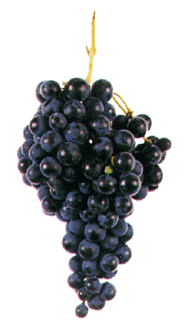
About a year ago, I was surprised to find a wine made from the Espadeiro grape in the Vinho Verde region of Portugal while I was visiting my in-laws for Thanksgiving in Pittsiburgh. It was a spritzy little surprise that I thought really over-delivered for the meager price of $10. A few months later, I started seeing wines in Boston-area shops made from a grape called Padeiro that were also from the Vinho Verde region of Portugal. Given how similar their names were, I figured there was probably some kind of link between them, but while there doesn't seem to be any evidence that these two grapes are related to one another, just what other grapes they may actually be related to is a complicated story indeed.
The confusion really started for me in Richard Mayson's The Wines and Vineyards of Portugal. In that book, when you go to look up Padeiro in the index, it redirects you to the entry for the Tinto Cão grape, which is grown mostly in the Douro region of Portugal and is used in Port production. Tinto Cão was pushed to the brink of extinction in the 1970's because while it is a very high quality vine, it is a very poor yielder and many growers pulled it up in favor of more productive vines. Mayson notes at the end of his entry that "Tinto Cão is also known as Padeiro in the Basto sub-region of Vinho Verde and Tinta Mata." None of which is particularly problematic, but when I looked up Padeiro on the Vinho Verde website, they do indicate that the grape is also known as Tinto Cão or Tinto Matias in some regions, but the following description also comes up: "Highly productive, it produces ruby to garnet-red colour wines with a distinctive aroma and taste, harmonious and flavourous (sic)." Highly productive? The singularly defining characteristic of the Tinto Cão vine seems to be its extraordinarily low productivity, so it seems pretty unlikely that we're talking about the same grape here.
I decided to take another look at the Espadeiro grape to see what Mayson had to say about it. The index of Mayson's book directs you to two different entries when you try to look up Espadeiro. The first is to the Sousão grape while the second is to a grape called Trincadeira Preta. In the section on Sousão, Mayson mentions that this grape is also known as Vinhão in some parts of Portugal, but in the Basto region of Vinho Verde, it is known as Espadeiro de Basto. Espadeiro Basto is, in fact, an accepted synonym for Vinhão/Sousão, but it isn't clear whether Mayson is saying that Espadeiro Basto is the same as Espadeiro. This paper, which is in Portuguese, analyzed several different Portuguese grapes, including Vinhão, Sousão and Espadeiro, and they found that while Vinhão and Sousão were synonymous, Espadeiro was a separate cultivar. So, by extension, Espadeiro and Espadeiro Basto are two different grape varieties, though this isn't exactly clear in Mayson's book. As for the Trincadeira Preta connection, this paper shows that a grape known as Trincadeira das Pratas, which is the same as Trincadeira Preta, is definitely different from Espadeiro as well (it also shows that neither grape is related to Vinhão/Sousão).
What does all that mean? Essentially it means that Mayson's book is unreliable when it comes to grape synonymies, and thus we have ample reason to doubt his claim that Padeiro is the same grape as Tinto Cão. Reason to doubt is not the same as proof, though, so our next problem becomes trying to find information that will let us know definitively whether Padeiro is the same as Tinto Cão or any other grape for that matter. The VIVC does have separate entries for both Padeiro and Tinto Cão, which is a good sign, but Tinto Cão is listed as an accepted synonym for Padeiro as well. Further, there seems to be a lot of overlap in synonyms between Padeiro and Espadeiro, and at least one paper I read (citation 1 below) seemed to indicate that Padeiro was simply another name for Espadeiro in many places.
I searched for a really long time to try and find a DNA profile for Padeiro, and had virtually given up until I came across this paper, which was essentially announcing the creation of a database of microsatellite DNA for Portuguese grape varieties. In that paper, the authors give the microsatellite profiles for hundreds of Portuguese grapes, including Padeiro, Tinto Cão and Espadeiro. I took a look at the data, and sure enough, it was clear that all three grapes were different from one another. That data was confirmed by another paper (citation 2 below) that gave the same results.
So what does all that mean? It means that Padeiro is not the same grape as Tinto Cão or Espadeiro. Further, Espadeiro is not the same grape as Sousão/Vinhão or Trincadeira Preta (aka Tinta Amarela). Once again, one must be very careful when consulting reference works that do not cite any recent DNA studies, as there has been an avalanche of research just over the past decade or so that has revolutionized the way that we are able to think about and categorize different grape varieties. Mayson's book is very informative and gives a masterful overview of the history of wine in Portugal and the characteristics of the different wine producing regions, but the section on the grapes is definitely out of date. The book is out of print and outrageously expensive second hand, so be forewarned if you're looking for definitive information on Portuguese grapes, look elsewhere, but if you're looking for information on Portuguese wine in general, it is an unparalleled English-language resource.
I was able to pick up a bottle of the 2011 Quinta da Raza "Dom Diogo" Padeiro from my friends at the Wine Bottega for around $13. In the glass this wine was a vibrant pink color with light fizz. The nose was nicely aromatic with cut watermelon, fresh strawberry and rainier cherry fruit. On the palate the wine was on the lighter side of medium with fairly high acidity and just a light prickle of CO2. There were flavors of fresh red cherries, strawberries and raspberries backed with just a bit of bitterness from the CO2. Overall the wine was bright, fresh and very refreshing. The fruits were lively and prominent, but the zippy acid and the bitter twist at the end gave it nice balance and kept it from being just a liquid fruit cocktail. I enjoyed this wine with tacos, which is a difficult food to match wine with in my experience, and it performed admirably. The day I opened it it also happened to be nearly 100 degrees outside and this wine was just perfect in those conditions. It's a little pricier than some other Vinho Verde wines that I've had, but I still believe that it's a great value at only $13.
CITATIONS
1) Martin, JP, Arranz, C, Castro, ID, Yuste, J, Rubio, JA, Pinto-Carnide, O, & Ortiz, JM. 2011. Synonymy in grape (Vitis vinifera L.) cultivars of northern Portugal and northwestern Spain. Acta Horticulturae, 918, pp. 791-798.
2) Castro, I, Martin, JP, Ortiz, JM, & Pinto-Carnide, O. 2011. Varietal discrimination and genetic relationships of Vitis vinifera L. cultivars from two major Controlled Appellation (DOC) regions in Portugal. Scienta Horticulturae, 127(4), pp 507-514.
A blog devoted to exploring wines made from unusual grape varieties and/or grown in unfamiliar regions all over the world. All wines are purchased by me from shops in the Boston metro area or directly from wineries that I have visited. If a reviewed bottle is a free sample, that fact is acknowledged prior to the bottle's review. I do not receive any compensation from any of the wineries, wine shops or companies that I mention on the blog.
Showing posts with label Espadeiro. Show all posts
Tuesday, October 2, 2012
Saturday, November 26, 2011
Espadeiro - Vinho Verde, Portugal
I'm currently on vacation for the Thanksgiving holiday, but while visiting my in-laws in Pittsburgh, I came across this wine that I just had to pick up and write about. I have a few other wines from the Vinho Verde region back home that I'll be writing about in the near future, but this wine was made completely from Espadeiro grapes, which was completely new to me, and I decided to do something I've never done before: I'll be writing today's post while I'm drinking the wine in question. I usually record my notes in a little book I have and have written about some wines up to several months after I actually drank them, but since these Vinho Verde wines are best enjoyed fresh, I thought it would be interesting to write about it while it was fresh in my mind as well.
Espadeiro is not just one grape, but rather a small family of grapes that are all, as far as I know, related to one another. The two main varieties are Espadeira Tinto and Espadeira Mole, which I'm guessing are distinguished based on the color of the grape skins, though I'm not completely sure. There are some sources that will have you believe that Espadeiro is the same as the Port grape Tinta Amarela, but this is only true for what is called Espadeiro in the area around Lisbon. In the Vinho Verde region, Espadeiro is a distinct variety that is unrelated to Tinta Amarela. There are a handful of synonyms for the grape, but most of them seem to be very geographically specific and don't really concern us here. The grape is considered a high quality variety on the Vinho Verde website, though the Oxford Companion to wine is slightly less enthusiastic about and really only references the grapes ability to yield profusely and ripen to low sugar levels.
This wine is from the Vinho Verde region of Portugal which is located in the extreme northern part of the country, just under the overhanging Spanish region of Galicia (Espadeira is also grown in Galicia, and surprisingly goes by the same name in both countries). It's easy to forget that Vinho Verde is the name of a wine region and not just the name of a style of wine, as most of the wines here are white and made from slightly underripe grapes with a hint of residual CO2, which can give them the "green" character alluded to in the name of the region and wine. There is a proportion of still red wine and rosé wine produced in the region, though they are definitely a little tougher to track down than their white counterparts. Vinho Verde is subdivided into nine different sub-regions, and Espadeiro is recommended for cultivation in eight of them, with Monção being the only exception.
I picked up a bottle of the 2010 Quinta de Gomariz Espadeira Colheita Seleccionada from one of the state stores here around Pittsburgh, PA, for about $10. As mentioned above, in an unusual move for the site, I've been writing about the wine as I've been drinking it. For those interested in the micro-terroirs of the Vinho Verde region, this wine is from the Ave region and the grapes are grown on primarily granitic soils. In the glass, the wine has a medium salmon pink color with a little bit of orange to it and some very tiny bubbles flying around. The nose is very aromatic with strawberry and watermelon fruits and a leesy, cheesy kind of funk to it. Right out the bottle, there were orange citrus aromas and flavors, but as the wine sat and developed into glass number two, these orange citrus notes moved over towards pink grapefruit and have stayed pretty firmly put. On the palate, the wine is medium bodied with acidity just slightly on the higher side of medium and is just off-dry (there is nearly 8 g/l of residual sugar, but the wine tastes much more dry than sweet). There is a prickle of residual CO2 as well. There are flavors of strawberry and grapefruit citrus with a sort of tropical fruit component to it that tastes a bit like pineapple to me. There's a bitter grapefruit pith flavor that persists through the finish. Overall, I like this quite a bit. It's developing in interesting ways right in front of me and has enough going on to keep me interested. It's also delicious and is the kind of thing I wish I had found when I was down here in June rather than now in November. The price here is phenomenal and this wine way over-delivers at the $10 price point. It also would have been a good starter wine for our Thanksgiving meal a few days ago, but I don't like to force others to go on these vinous expeditions with me, so I held this bottle back for myself.
UPDATE - I recently wrote about another Vinho Verde wine made from a grape called Padeiro, and in that post, I take another look at the Espadeiro grape and clear up some confusions. That post can be read here.
Subscribe to:
Posts (Atom)
